Beach Tramping New Zealand

Beach Ginny

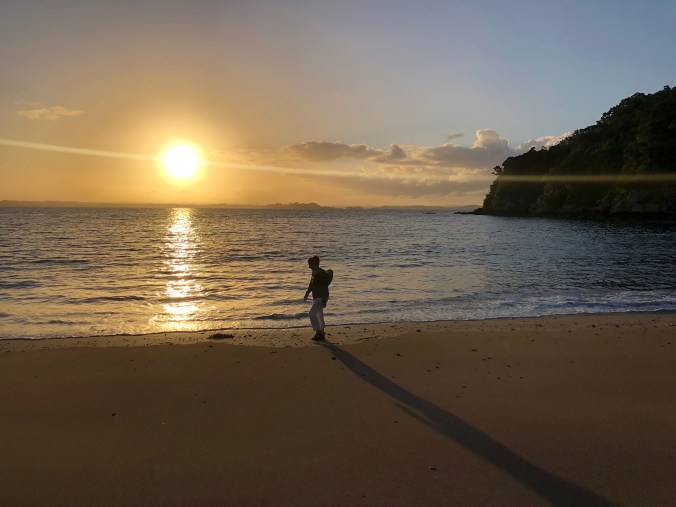
Ginny Stones wanders along an isolated beach track on Moturua Island. Photograph © Jeffrey Cardenas

New Zealand has more than 15,000 kilometers of coastline bordered by the Southern Ocean, the Tasman Sea, and the Pacific Ocean. James Cook mapped the entire coastline. My explorations have been more modest.

Flying Fish arrived in the Bay of Islands five months ago. Much of the time here was devoted to refitting and repairs. The tradesmen and services for ocean-going voyagers are excellent in Opua. Once the work was done, I took off my shoes and began wandering the many beachside tracks of the Bay of Islands.

These are not the sugar sand beaches of Polynesia shaded by coconut palms. New Zealand is recently born geologically. Evidence of volcanic activity, earthquakes, and geothermal areas can be seen throughout the landscape, especially along the shoreline. The beaches vary dramatically from cold fiords in the South Island to towering hot sand dunes in the north. For the most ambitious walkers the Te Araroa Trail is a 3,000 kilometer route of spectacular New Zealand landscapes featuring beaches and volcanoes, forests and cities. The walking track stretches from Cape Reinga on the North Island to Bluff on the South Island.

A person could spend a lifetime walking in New Zealand, but aboard Flying Fish I am beginning to feel the pull of time and tide. Winter is fast approaching. In the coming month as the cyclone season ends in the South Pacific, I will watch for a weather window that will provide safe passage for Flying Fish over the next horizon.

Click on individual images for high-resolution display

Below, a meditative ebb and flow along New Zealand’s Bay of Islands. Add a little volume and enjoy the sound of the shoreline.

Please subscribe at the bottom of this page so that you don’t miss a new post, and please share this post with others who might enjoy following the voyage of Flying Fish

To see where Flying Fish has sailed in the past year click here: https://cruisersat.net/track/Flying%20Fish

For current weather along the route click here: https://forecast.predictwind.com/tracking/display/Flyingfish

Text and Photography © Jeffrey Cardenas 2019

All rights reserved

After Christchurch

Comfort in Nature

New Zealand is in mourning.

This is a country that has become insulated to the incidents of mass murder that are commonplace in so many other parts of the world. For reasons of isolation, or politics, or simply its tolerance of other human beings, New Zealand is a sanctuary from hate.

And then hate appeared in the doorway of a house of worship with a semi-automatic weapon.

How does one reckon with such unexpected tragedy?

Prime Minister Jacinta Arden has been praised for her leadership in the aftermath of the shooting. She said that although many of the victims of the shooting are migrants, “New Zealand is their home. They are us.”

She said New Zealanders were not chosen for this act of terror because they condone racism but rather that they represent diversity, kindness, compassion, and a refuge for those who need it. “And those values, I can assure you, will not and cannot be shaken by this attack,” she said.

For those of us who are visitors in this country, especially those of us who come from a nation where mass shootings have become frequent, there is a feeling of profound sadness. In those  15 minutes of sustained gunfire in Christchurch it was as if the innocence of an entire nation had been lost.

New Zealanders, however, will respond with typical strength. Christchurch was magnificently rebuilt following the devastating 2011 earthquake. It will recover from this tragedy, too. All of New Zealand will heal again.

But on this day, the sky is dark in Aotearoa, the Land of the Long White Cloud.

Text and Photography © Jeffrey Cardenas 2019

All rights reserved

New Zealand Harvest

Harvest Sarah.sm

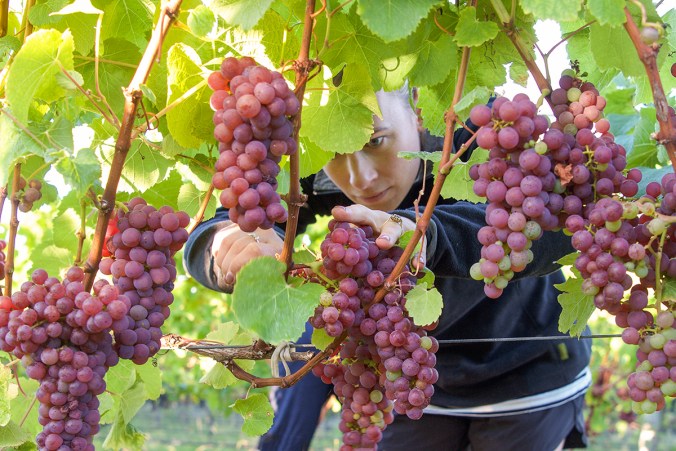
Omata Estate Vineyard Manager Sarah Cashmore harvests the 2019 Pinot Gris grapes in Russell, New Zealand. Photograph: © Jeffrey Cardenas 2019

In the cool autumn air of New Zealand’s Northland wine country the Omata Estate Pinot Gris grapes have reached a perfect sugar content of 23° Brix. It is time to harvest. Sailors from the Russell community, and international vagabonds such as the crew of Flying Fish, have been invited to help with the harvest. Considering the amount of wine that sailors consume, this is not hardship duty.

At 7:30 AM, Vineyard Manager Sarah Cashmore summons the group of about 18 pickers and dispenses essential tools of the trade–razor sharp cutting shears and a large box of “plasters”, known in America as Band-Aids. “We’ll take a break in a couple of hours for tea and cakes,” she says, “and then a vineyard meal will be served after the harvest.” Our cadre of grape pickers include backpackers and grandparents. We are now all officially Woofers (Willing Workers On Organic Farms), or laborers who are happy to work for their supper.

Omata Estate is a small family vineyard producing about 8,000 bottles annually from harvests of Chardonnay, Pinot Gris, and Syrah. The vines are nurtured by the sea breezes off the Bay of Islands and long hours of New Zealand sunshine. Each of the varieties has been planted in carefully selected sites within the vineyard to maximize the individual microclimates. All of the vines are carefully tended by hand and the resulting wines are full-bodied and stunning. The grapes we pick today will be blended to make Omata Estate’s delicious Rosé and Sparkling wines. 

After the last clusters of Pinot Gris grapes are clipped and put into the harvesting baskets we Woofers amble up to Omata’s outdoor kitchen with its spectacular views overlooking vineyard and bay. Gourmet food including local produce platters, artisanal cheeses, and wood-fired pizza overflow the tables of the outdoor kitchen. Sarah announces that our Pinot Gris harvest is 4.5 metric tonnes, a record for Omata Estate. She then stacks the tables with bottles of the vineyard’s finest vintages. We are happy Woofers and with our nipped fingers taped in bright blue plasters we toast a job well done.

This slideshow requires JavaScript.

Please subscribe at the bottom of this page so that you don’t miss a new post, and please share this post with others who might enjoy following the voyage of Flying Fish

To see where Flying Fish has sailed in the past year click here: https://forecast.predictwind.com/tracking/display/Flyingfish

Text and Photography © Jeffrey Cardenas 2019

All rights reserved


Anglican Ash Wednesday

Anglican Ash Wednesday.sm

The graveyard surrounding New Zealand’s oldest church in Russell tells the story of life and death upon the sea. Photograph: © Jeffrey Cardenas

With Flying Fish secure at anchor in Te Wahapu Bay near the New Zealand township of Russell, I am feeling especially blessed as a priest in the Anglican Christ Church prints a mark of ashes across my forehead.

In this lovely old church, history comes alive from the earliest years of Māori and European contact in the Bay of Islands. Musket holes from the 1845 war between them still mark the exterior of the church. Russell, then called by its original Māori name of Kororāreka, was a rough seaport known as “The Hellhole of the Pacific.” Brothels and grog shops lined the waterfront. Gunshots could be heard across the bay.

Missionaries felt that Kororāreka needed a little bit of religion. They purchased land in 1834 from Māori chiefs and agreed that Māori and Europeans should have equal rights of burial. The fundraising subscription list for the church still survives with names of missionaries, settlers, traders, and explorers including Captain Robert Fitzroy and Charles Darwin of H.M.S. Beagle.

Legend has it that Kororāreka is named after a soup made from the little blue penguin (Eudyptula minor) which was given to a Māori chief wounded in battle. Feeling better, he was believed to have said, “Ka reka te korora – How sweet is the penguin,” leading to the town’s name. Today, little blue penguins still come ashore after dark on the beach at Russell to nest under the floorboards of waterfront buildings.

Among the graves in the churchyard are those of Tamati Waka Nene (a Ngapuhi chief largely responsible for the Māori’s acceptance of the Treaty of Waitangi and peace with the Europeans), Hannah King Letheridge (the second European girl to be born in New Zealand, despite her grave marker stating she was “The First White Woman Born In New Zealand”), and men from H.M.S. Hazard who fell in the battle in 1845.

But on this day as the Anglican priest dips his finger into a glass bowl of ashes–the charred remains of local New Zealand palms–and presses a cross over my bowed forehead he says, “From dust you came, and from dust you will return.”

I understand these earthly sentiments of the Anglican Ash Wednesday but my feelings of mortality fall more in line with a verse written on the original oak headstone of the perished seamen from H.M.S. Hazard. Situated on the grounds of Christ Church in Russell, it marks the final resting place of six men who died defending the town formerly known as Kororāreka.

On that headstone are the words of 19th century poet Felicia Hermans: “Go, stranger! Track the deep. Free, free the white sail spread! Wave may not foam, nor wild wind sweep…”

Undine

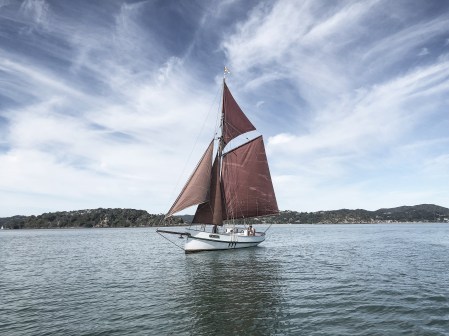
The 123-year-old gaff-rigged cutter Undine ghosts across the Bay of Islands near Russell. Photograph: © Jeffrey Cardenas

Please subscribe at the bottom of this page so that you don’t miss a new post, and please share this post with others who might enjoy following the voyage of Flying Fish

To see where Flying Fish has sailed in the past year click here: https://forecast.predictwind.com/tracking/display/Flyingfish

Text and Photography © Jeffrey Cardenas 2019

All rights reserved

Wind in my Sails

DCIM100GOPROGOPR0432.JPG

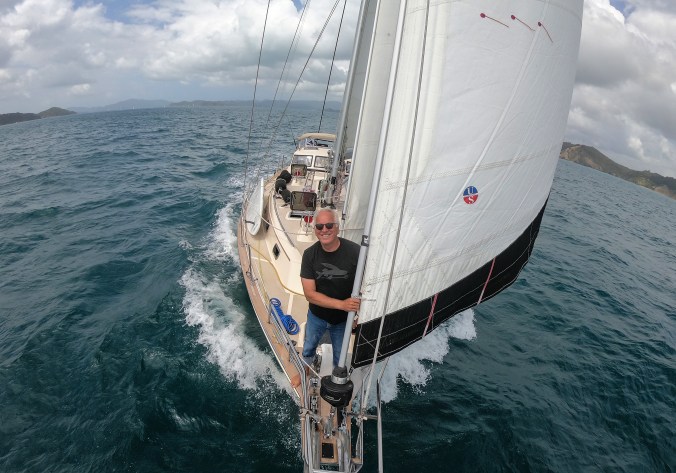
Flying Fish, just out of the boatyard and sailing again in New Zealand’s Bay of Islands. Photograph: © Jeffrey Cardenas

According to the ship’s log it is exactly 112 days and 10 hours since the sails of Flying Fish were last filled with wind.

Flying Fish has undergone a series of maintenance and repair projects that have kept her lashed to the dock and in the boatyard since her landfall in Opua, New Zealand last October. She needed a little lovin’ after the 10,000-mile passage from Key West. It has been too much time away from the water. Today Flying Fish once again spreads her wings.

The tropical cyclone season continues in the South Pacific so for another several months my passages will remain close to the safe harbor of Opua. This week I’ll sail among New Zealand’s Bay of Islands. In 100 square miles there are nearly 150 islands, some with fascinating historical antecedents.

Researchers believe large Māori migration canoes journeyed to the Bay of Islands a millennium ago from Hawaiki, the mythical home for the Polynesians dispersing across the Pacific. Captain James Cook landed here in 1769 and while he hunkered down waiting out a series of gales he charted and named the Bay of Islands. It was the first area in New Zealand to be settled by Europeans. The Māori provided the early settlers with and abundance of fresh produce and fish. The Europeans reciprocated with guns, alcohol, and venereal disease. Whalers arrived towards the end of the 18th century, and the first missionaries settled in 1814.

The missionaries and whalers did not cohabitate well. By the 1830s the settlement of Kororareka in the Bay of Islands was known as the “Hell Hole of the Pacific.” Dozens of whaleships anchored in the Bay of Islands, many of which had been at sea for over a year. Canoes filled with Māori women, “many naked and covered with fish oil” swarmed the boats to barter their favors for gunpowder and tobacco. Ashore, vagabonds, runaway sailors, and convicts bloodied each other in the crowded grog shops and brothels that lined the waterfront.

In 1835 Charles Darwin visited the Bay of Islands in HMS Beagle and left with the opinion that the European residents who had settled here were “the very refuse of society.” He described it as “the land of cannibalism, murder, and all atrocious crimes.” However, according to historian Richard Wolfe, before he departed the Bay of Islands Darwin donated £15 to fund the building of a new church. It was an ironic gesture coming from a man who would go on to publish The Origin of the Species, a treatise that would shake the foundations of Christianity.

Eventually, missionaries established a settlement a few kilometers across the bay in Paihia. Church hymns could be heard on the missionary side of the bay while gunshots echoed across the water from the Hell Hole of the Pacific.

I drop the anchor of Flying Fish in the lee of Urupukapuka Island. The water is turquoise and crystal clear. New Zealand’s Park Service maintains walking trails across the island that feature stunning panoramic views, beaches, and verdant forests abundant with native vegetation and rare birds. There are also archaeological ruins here, including the remains of author Zane Grey’s fishing camp in Otehei Bay. Grey arrived in 1926 and described the waters off the Bay of Islands as an “Angler’s Eldorado,” rich in billfish and tuna. His son Loren Grey once said that his father fished 300 days a year.

Born Pearl Gray (he later changed Pearl to Zane and Gray to Grey), Zane Grey published more than 90 books which sold in excess of 40 million copies. Over 100 films have been based upon his works. But on Urupukpuka Grey’s luxury lifestyle in the 1920s, as the worldwide economic depression loomed, chafed the local New Zealanders. He and his wealthy companions were considered the original glampers. It was said that when Grey caught a big fish he’d pull out a megaphone to announce his catch as he approached shore in his launch. Nonetheless, Grey is widely credited today with playing a major part in the foundation of New Zealand’s modern sport fishing industry. In Tales of the Angler’s Eldorado, Grey said, “The New Zealand coast is destined to become the most famous of all fishing waters. It will bring the best anglers from all over the world.”

I feel as if I am a time traveller as I sail among the the Bay of Islands. The Hell Hole of the Pacific, now named Russell, has been gentrified with chic shops, art galleries, and cafés. Offshore the New Zealand Millennium Cup is underway. Billed as the South Pacific’s premier superyacht regatta it features racing sailboats 160 feet long. The entry fee alone for this race is $5,400. On the ruins of Zane Grey’s fishing camp a group of Japanese tourists with mosquito net hats and bird binoculars chitter about while pop music plays and a server brings them burgers and beer.

It’s a little too much commotion for this solitary sailor. I tack offshore, trimming the sails to look for a quieter anchorage. I prefer to migrate toward a more simple existence where nature dictates the rules. Or as Zane Grey once said (presumably without a megaphone) “I need this wild life, this freedom.” 

OLYMPUS DIGITAL CAMERA

A panoramic view of Okahu Passage in New Zealand’s Bay of Islands. Photograph: © Jeffrey Cardenas

Please subscribe at the bottom of this page so that you don’t miss a new post, and please share this post with others who might enjoy following the voyage of Flying Fish

To see where Flying Fish has sailed in the past year click here: https://forecast.predictwind.com/tracking/display/Flyingfish

Text and Photography © Jeffrey Cardenas 2019

All rights reserved.