2018: A Year in Pictures

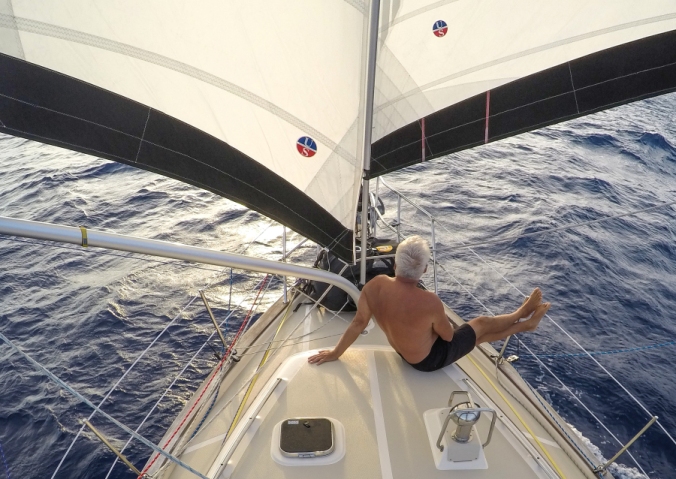
DCIM100GOPROGOPR0981.

Sailing wing-and-wing across the Pacific Ocean

One year ago today, I departed Key West in my cutter Flying Fish on the first leg of a global circumnavigation. It has been a voyage of self-discovery in a wonderland of raw nature. When I look back at these images of 2018, I see that my camera bias emphasizes the idyllic — downwind sailing, tropical sunsets, vibrant color reefs. These halcyon days are what I record but there have also been moments during this 10,000-mile passage of sheer terror, illness, injury, and loneliness. I prefer to remember the positive. Enjoy these images, and thank you for being here with me.

Passage South

Departure from Key West, December 2, 2017–with 34,000 miles to go. The crew onboard for this leg is my brother Bob and father Robert, both are accomplished ocean sailors. Rounding the west end of Cuba, the bluebird weather quickly turns into the notorious Caribbean “Christmas Winds” with rain squalls approaching gale force in intensity. Still, there is magic in the air. After dark, the sea is alive with phosphorescence. Following one night of squalls Dad finds a flying fish that crash-landed on the deck of Flying Fish. This first passage is a trial by fire–literally. The generator starter motor shorts out and smoke billows from the bilge. The primary navigational electronics fail from the wet weather. Landfall at Panama’s Bocas del Toro is dark and stormy and achieved as if by braille. With a local forecast showing wind increasing to 40 knots, we slip into the Bocas del Toro channel at 2AM with zero visibility in a torrential rainstorm.


(Click on thumbnail images for captions, camera information, and a full-frame image)

Through the Canal

Flying Fish enters the Panama Canal’s Miraflores Locks with heavy metal close astern. Mast and rigging are a study in geometry under the famed Centennial Bridge as a new ocean opens to the horizon. Las Islas Perlas on Panama’s west coast are a biological and geological treasure. Many sailors eager to cross the ocean will bypass Islas Perlas but Flying Fish lingers for months. I am enchanted by the islands’ flora and fauna, and miles of pristine beaches.


Across the Pacific

Daughter Lilly, a USCG 100-Ton Master Captain, provides the heavy lifting for the 3,500-mile passage from Panama to the Marquesas Islands. These are blissful days of fishing and reading, and on rare occasion, trimming the sails. Tradewinds blow consistently downwind and Flying Fish averages 175 miles per day. Lilly creates healthy and delicious meals with the bountiful fruit and vegetables provisioned from Panama. More challenging for her is trying to establish a routine of yoga, exercise, and French lessons for her stubborn father. Crossing the Equator is a notable event marked by sailors on all ocean passages. Becalmed, Lilly and I celebrate by swimming where the water from the Northern Hemisphere mixes into the Southern Hemisphere. After nearly a month a sea, we find ourselves gazing west, looking for a Polynesian landfall.


French Polynesia

The sights and sounds and fragrance of French Polynesia are pure exotica. We make landfall at Fatu Hiva in the famed Bay of Virgins. Spectacular monolithic landscapes rise from the sea. Further west, the water clarity is astonishing. Within it are gardens of live coral and a full spectrum of brilliantly colored tropical fish. French Polynesians are generous, beautiful, and they honor their heritage. A young Polynesian girl quietly sings indigenous ballads while she plays a handmade guitar. In the Tuamotos Islands a pearl diver ascends to the surface with her treasure.


Oceania

Continuing the passage west, Flying Fish makes landfall on the islands of Maupihaa, Aitutaki, and Nuie. Humpback whales migrate through the islands on an annual journey north from the Antarctic to find mates and give birth. The land and weather is more rugged here, sculpted by great waves born in the Southern Ocean. This area of the Pacific is known as the Dangerous Middle. Weather is unpredictable and venomous sea snakes emerge when least expected.


Tonga

In the Kingdom of Tonga, Flying Fish anchors in the Port of Refuge. From this base in the Va’vau group of islands there is a sense of sailing in the wake of our predecessors. Capt. James Cook narrowly escaped assassination here. A few years later Fletcher Christian set William Bligh adrift in these waters. Today, Tongans welcome ocean sailors. Markets overflow with fresh produce and Tongan feasts are prepared on the beach. Rocky shorelines provide habitat for octopus and shellfish. The ocean is alive with whales, sharks, and fish. The Kingdom of Tonga is a land of plenty.


Minerva Reef

At high tide nothing visible exists of South Minerva Reef. It lies unseen beneath the surface of the water until the tide begins to recede. Then, rocks emerge from mid ocean forming two perfect natural atolls. The debris of shipwrecks litter the outside edges of the atoll and the sandy bottom inside of the lagoon. The water is crystalline and fish–big fish–abound in this remote patch of ocean. It is the final outpost of Polynesia in the South Pacific.


Destination – New Zealand

As the year at sea ends, and with the South Pacific Cyclone Season well underway, Flying Fish sails south to the storm-sanctuary port of Opua, New Zealand. The passage in these southern latitudes is formidable. Gales coming out of the Tasman Sea make it difficult to find an open weather window for the sail from Minerva Reef to Opua. A miscalculation (compounded by impatience) results in a punishing five-days at sea. In a lull between squalls, 200 miles from land, a storm-weary European Goldfinch lands on Flying Fish to rest. Despite the Māori name for New Zealand–Aotearoa, land of the long white cloud–landfall here is amid sawtoothed islands under a dark sky. The passage from Key West has been 10,000 miles and nearly a year underway. Both the body and boat are battered. A Māori welcoming ceremony–a pōwhiri–is performed onshore. Kia ora!

My mantra for the next five months will be: rest, repair, and rejuvenate.


Flying Fish will remain in New Zealand until the South Pacific Cyclone Season ends in May 2019. Then, when the southerly winds are right, I will set sail for Fiji, Vanuatu, New Caledonia, Indonesia, and Malaysia. Please subscribe to FlyingFishSail.com for updates, new images, and essays.

To see where Flying Fish has sailed in the past year click here: https://forecast.predictwind.com/tracking/display/Flyingfish

A Stormy Passage South

OLYMPUS DIGITAL CAMERA

Storms generated in the Tasman Sea brought 30 to 40 knots of headwind to parts of the passage from Tonga to New Zealand.  Photography: ©Jeffrey Cardenas

The stormy passage from Tonga to New Zealand was a little over 1,000 miles but the southern latitudes tested both Flying Fish and her captain. Flying Fish handled it well. Her captain took a beating.

The landfall at the Bay of Islands in New Zealand is welcoming but my first thought this morning is where are all the palm trees and why is it foggy and 50 degrees (10 degrees celsius; I’d better get used to it.)  I confess to a wistful nostalgia for Polynesia…

The decision to sail to New Zealand was in many ways a practical one. The South Pacific Cyclone Season begins in about 10 days. Already, there has been one named storm. Tonga, Fiji, Samoa, and other Polynesian island groups are frequently in the cyclone impact zone. My last port of Nuku’alofa, Tonga was ravaged just nine months ago by Tropical Cyclone Gita, a storm that brought 230km winds over the island. It is still difficult to buy a banana or papaya in Nuku’alofa because most of their fruit trees were leveled by wind.

New Zealand is out of the South Pacific Cyclone Zone.

Flying Fish will spend the cyclone season here. There are some refitting projects necessary on the boat (and her captain) and I am assured by the locals that the weather does get better. It’s springtime here. And by the grace of God, so am I.


To see where Flying Fish has sailed in the past year click here: https://forecast.predictwind.com/tracking/display/Flyingfish
I will continue to post, including details from this passage and a stop en route at the mid-ocean underwater atoll of Minerva Reef. Please subscribe here so that you don’t miss a new post, and please share this post with others who might enjoy following the voyage of Flying Fish


Whale Songs

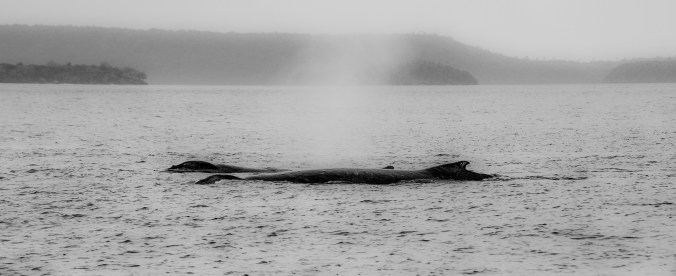
whale pair.high.sm

After a long serenade, a male humpback whale has found its mate near the island of Eukafa, Tonga. Now, the nearly 4,000-mile migration south to the Antarctic begins. Photograph: © Jeffrey Cardenas

For an interactive series images from my close encounter with a humpback whale, click here: Humpback whale surfaces under Flying Fish

The first time I heard the song of a humpback whale I was at anchor on a moonless night in the shelter of Eukafa Island in Tonga. I had been sleeping and the sound seemed to emanate from a dream. Then, with open eyes, I realized that the long, sonorous aria was coming from the ocean and resonating through the fiberglass hull of Flying Fish. The sound was longing and lonely and seductive. The life force in this whale song called out: I am here, where are you?

Both male and female humpback whales vocalize, but only males produce the complex song of wails, moans, and shrieks that is so identifiable of this species. Humpback songs are repeated in cycles lasting up to 30 minutes and individual whales may sing continuously for more than 24 hours. Each population of humpbacks collectively sings a unique song, one they have learned from other whales.

“The traditional explanation for why whales do this is that male whales are singing to seduce female whales, and that females get really turned on by songs that are currently in style,” said cognitive neuroscientist Eduardo Mercado III in a recent edition of LiveScience.

To the casual human listener, the love song of a humpback whale sounds magnificently free-flowing and improvised. But fresh mathematical analysis by some bioacousticians has found that there are complex grammatical rules used in whale songs. Using syntax, the whales combine sounds into phrases, which they further weave into hours-long melodies packed with information. Whales have even been found to sing in dialect, according to a study in the Journal of the Acoustical Society of America. Although researchers say that while these songs don’t meet the linguistic rigor necessary for a true language, there is evidence that whales use a hierarchical structure of communication similar to human beings.

Most animals use sight and smell to communicate, but these senses are limited in the ocean. Whales rely on sound, which travels four times faster in water than in air. Whale songs are thought to have an important role in mate selection as males sing for attention and to establish dominance.

Courtship rituals take place in the warm waters of Tonga and competition for a mate can be fierce. Males sometimes gather into competitive groups around a female and fight for the right to mate with her. Male humpbacks can be seen breaching, tail slapping, and charging during courtship. Ultimately, however, the female calls the shots. Polyandry has been observed in humpback whales, with females known to have multiple male partners throughout their lifespan.

Once hunted to the brink of extinction, the humpback whale population fell by an estimated 90% before a 1966 moratorium on killing them went into effect. The population has since rebounded to about 80,000 worldwide. Cultural attention to whale vocalization intensified after a 1970s paper published in Science magazine by biologists Roger Payne and Scott McVay describing “surprisingly beautiful sounds” made by humpback whales. Analyzing underwater recordings they found that these whale sounds were intricately repetitive. “We call the fixed patterns of humpback sounds ‘songs,’” they wrote. Soon thereafter, the hit album Songs of the Humpback Whale was released and the recording went multi-platinum.

After hearing my first whale song through the hull of Flying Fish, it was impossible to return to sleep. I went on deck squinting into the darkness hoping to see the whale. I saw nothing move in the calm water. Strangely, I could no longer hear the song, either. It was only when I went below that the song echoed again through the cabin. The area of the hull below the surface of the water functioned as a hydrophone. Somewhere out there a whale was looking for love.


Track the passage of Flying Fish here: https://forecast.predictwind.com/tracking/display/Flyingfish

Please subscribe here so that you don’t miss a new post, and please share this post with others who might enjoy following the voyage of Flying Fish

Gone Troppo

guitar and kava bowl.sm

Gone troppo in the Tongan bush, around the kava bowl.    Photography: ©Jeffrey Cardenas

A pretty English girl is sipping a fruit drink at a beach resort when I wade up out of the ocean like the lizard man in the Creature from the Black Lagoon.

“Hi!” I say, as I pull up a barstool next to her, certain that she will be delighted to spend some time with a fascinating person like me.

She jumps off her barstool, tipping it over in alarm, and says, “Have you gone troppo?”

This is the first time I have heard the expression–gone troppo–which means, according the Outback Dictionary, that the person it refers to has “succumbed to a state of tropical madness; to have lost the veneer of civilization after spending too much time in the tropics.”

How could the English girl have thought this about me? After more than a week of sitting out a low pressure system at anchor aboard Flying Fish, I was eager to get off the boat and interact with other living human beings. That I hadn’t washed, shaved, brushed my teeth, or changed my clothes in longer than I could remember didn’t seem to me like it should have been a problem. Had I really “lost the veneer of civilization?” I never even knew I had it.

Bad weather on a boat is a perfect petri dish for ennui. It’s not that the weather was dangerous, although there was continuous rain and the wind was blowing a steady 30 knots with gusts to 35. I had two good anchors down on the leeward side of Lifuka in the Ha’apai Islands of Tonga. Hatches and portholes were leaking from the rain. It felt like water torture as drops of rain dripped onto my forehead. I could almost see the mold growing on the inside of the cabin. I love my boat but the walls were closing in.

Sensing my unwelcome at the resort bar, I set off on foot through the bush across the island of Lifuka. Rain or no, it feels good to move my legs. I imagine myself as the character Pig-Pen in the comic strip Peanuts by Charles Schulz, leaving a trail of dirt in my wake. Walking is liberating.

The Kingdom of Tonga is known as The Friendly Islands, given the name by explorer Capt. James Cook in 1773, who was apparently unaware of a well-developed plot by a Tongan chief named Finau intended to kill Cook and seize his ships. Upon his arrival, the Tongans had welcomed Cook with gifts of fruit, pigs, turtles, and extravagant hospitality.

I think about this as the road I walk turns into a track and then ultimately into a footpath. Despite my appearance, the Tongans I encounter on my walkabout receive me with enthusiasm, and in english.

“Where are you going?” asks a man feeding his pigs, without the preamble of a greeting.

I am walking to see your island, I answer, and to get some exercise.

“Why?” is his reply.

An elderly woman tending an open fire rendering coconut oil in a charred iron caldron asks, “Where is your wife?”

The question catches me off guard. She is where she wants to be, I say.

This does not translate so I answer more directly. She is working, I say. And this response further complicates the conversation.

“Why is she working and you are walking in the bush on Lifuka?”

What might seem like random banter with the coconut oil woman is insightful to me on many levels. I have always appreciated direct communication and in Tonga directness is a conversational precept. Tongans see into a person and discard their evasiveness. The woman pulls three bananas off a stalk and hands me a green drinking coconut. She says, “You are hungry and thirsty.”

Further along the footpath, two boys emerge from a trash heap of junk food wrappers and empty beer cans that litter a grove of banana trees and taro plants.

Hello, I say. Mālō e lelei.

“Give me money,” the larger of the two boys says in english. He is maybe 10 years old. He is menacing and holds a homemade slingshot.

Why? I ask. Why should I give you money? I can see that the boy understands my question but he cannot not answer it.

“I want money,” he repeats. And then his younger companion chimes in, “‘Io, gimme money, too.”

I turn away and continue walking. Then I see the boy’s hand raise with the slingshot. He has a piece of coral rock wedged between the rubber bands. I whirl around and take a step toward him. The boys flee down the trail. As they disappear into the trees I hear one call out, “Pālangi!” 

The encounter with the boys is disturbing but the word Pālangi is not necessarily an invective. Cook speculated that the word translated to “cloth men” or foreigners who arrived in boats with sails. Earlier etymologies link Pālangi to the expression, “People from the Sky.” But, the boys wanting money delivered this word with venom. In their usage, Pālangi described a foreigner as a “white pig.”

As a stranger in a strange land, I must constantly remind myself to walk softly in these beautiful and unfamiliar places. I straddle a world where on one side of an island there is a beach resort and on the other side of the island hard-scrabble families struggle for their daily bread. This, too, is part of my voyage of self discovery.

It is time for me to return to Flying Fish for a shower, a shave, and a clean change of clothing–and to remember who I am.


There he, sitting in the moonlight
Not found, livin no city
He smile, mucho in a sunshine
High life, counting de fruit bat

Troppo, gone troppo, troppo
It’s time you know I gone troppo

Troppo by George Harrison 1982


Track the passage of Flying Fish here: https://forecast.predictwind.com/tracking/display/Flyingfish
Please subscribe here so that you don’t miss a new post, and please share this post with others who might enjoy following the voyage of Flying Fish

Sick at Sea

OLYMPUS DIGITAL CAMERA

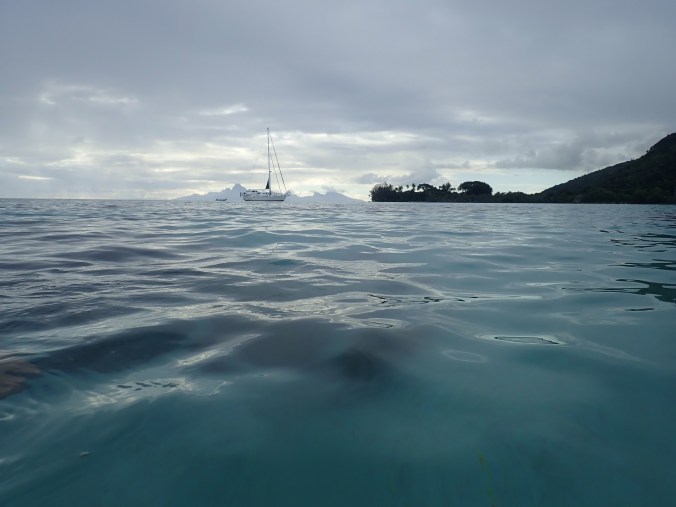
Flying Fish in the South Pacific. Alone in an isolated anchorage can be beautiful beyond words… until you become sick. Then, all a solo sailor wants is a kind word and someone to bring him a cup of tea.    Photography: ©Jeffrey Cardenas

It is not seasickness that ails me. I love the rhythm of this sailboat. And, I am not sick of the sea. I cannot imagine a more beautiful place to be than on the ocean aboard Flying Fish.

If I were onshore it would be just a routine illness, the kind that we all get from time to time, maybe more severe than usual–bronchitis, high fever, vomiting, diarrhea, and a blinding headache for hours on end. (If this is “too much information” it won’t hurt my feelings if you click off now, however, this bout of the flu or whatever it was, is relevant to the narrative of the voyage of Flying Fish.)

Onshore there are doctors and medications immediately at hand. You call in sick at work for a few days. No drama. On a sailboat, in a remote part of the world, it becomes an entirely different issue.

This 72 hours of delirium hit me like an unforecasted cyclone. I had been preparing for a departure from Neiafu, Tonga the following day. Fortunately, I was still at anchor when the illness immobilized me. I was awaken at midnight by a volcanic eruption of nasuea and night sweats. I could not even sit upright in my berth. If I had been underway navigating the reefs of Vava’u or the Ha’api islands, as I had intended, there might have been serious consequences.

Flying Fish is a thoroughbred of a sailboat. At nearly 49 feet and 16 tons this boat takes my undivided attention to keep the keel moving straight and level. She is a handful to sail alone but I am up to the task. I am not a young man any more but when I am sailing this boat I feel half my age. In nearly 10,000 miles under sail aboard Flying Fish, in all weather conditions, I have felt completely confident in my abilities to sail her singlehandedly. But, until now, I had not been sick like this onboard. This was a game-changer.

By morning, my lungs were seriously congested. It was difficult to breath. The vomiting had forced me to place a Home Depot bucket at the side of my berth. I was sweating and then freezing between convulsive waves of nausea. I stared at the ceiling of my cabin and thanked God that I was not under sail.

This is the first moment in the voyage of Flying Fish when doubt of my ability to sail long distances alone has entered my mind. Before I left the dock in Key West eight months ago, I had carefully prepared for potential accidents at sea. It was part of my risk mitigation. A neurosurgeon friend even gave me a surgical staple gun as a bon voyage gift, and a hands-on a demonstration of how to use it, if necessary. But I never considered the more mundane possibilities of just being physically sick at a time when I needed to be at my peak mental and physical capabilities.

After two days on my back, with the cabin of Flying Fish a horror show of sweat-soaked sheets, spilled bottles of over-the-counter medications, and an overflowing bucket, I finally addressed my options. There is a clinic on the island of Vava’u but at least three sailors I have spoken with who were recently attended there have contracted serious staph infections. That was not a good option to me. I almost made an “assistance needed” VHF radio called to other yachts in the area that might be listening. That would have been the prudent thing to do but I let my pride get in the way of feeling better. Being solo on Flying Fish–a big, conspicuous boat–puts out the message, “Hey, I’m tough enough to sail across oceans alone. I don’t need anyone’s help.” How wimpy would it look now to get on the radio to say, “I don’t feel very good. Can someone please bring me some chicken soup?” The irony is that nearly every boat in radio range would have responded. Cruising sailors look out for each other. It doesn’t have to be just life and death situations.

On the morning of the third day the illness was over. As I cleaned my body and boat I began to feel somewhat chagrined. Had I overdramatized a bad case of the flu? I don’t know; I’m a sailor not a doctor. At what point do severely congested lungs become pneumonic? Or a coral cut becomes a staph infection? In 1888, Robert Louis Stevenson sailed to the South Pacific on the yacht Casco, “to be far from any hand of help.” He had struggled with tuberculosis for years and had hoped the tropical sea air might heal his lungs. Four years later he was dead in Samoa at age 44.

Thus far along my journey, I have focused the risk mitigation on avoiding reefs and storms, but this little health event reminded me that I need to pay attention to the health and well-being of the pilot of Flying Fish, too. When I set sail from Key West with such ambitious plans I wanted a challenge without a lifeline. I didn’t want it all to be easy and comfortable. Now, I realize I need to learn about the physiological part of sailing alone, too. Being sick at anchor is far less serious than being sick under sail but in an odd way it has given some perspective and balance to my passage aboard Flying Fish.

I could have taken a lesson from one of my maritime heroes, Joshua Slocum, who as most sailors know was, in 1898, the first person to sail alone around the world. On his Atlantic crossing he had just left the island of Faial in the Azores and he made a supper of cheese and plums he had been given as gifts. Within hours he was on his back on the cabin floor writhing with cramps and delirious with fever. At one point he looked out of the companionway doors to see an ethereal figure at the helm steering the Spray. The figure looked at Slocum and said, “I am one of Columbus’s crew. I am the pilot of the Pinta come to aid you. Lie quiet, señor captain, and I will guide your ship tonight.”

Guardian angels manifest themselves in many ways. May all of those who sail alone have an angel looking out for them, especially when we are sick at sea.

Track the passage of Flying Fish here: https://forecast.predictwind.com/tracking/display/Flyingfish

Please share this post with others who might enjoy following the voyage of Flying Fish