New Caledonia’s Living Reef

OLYMPUS DIGITAL CAMERA

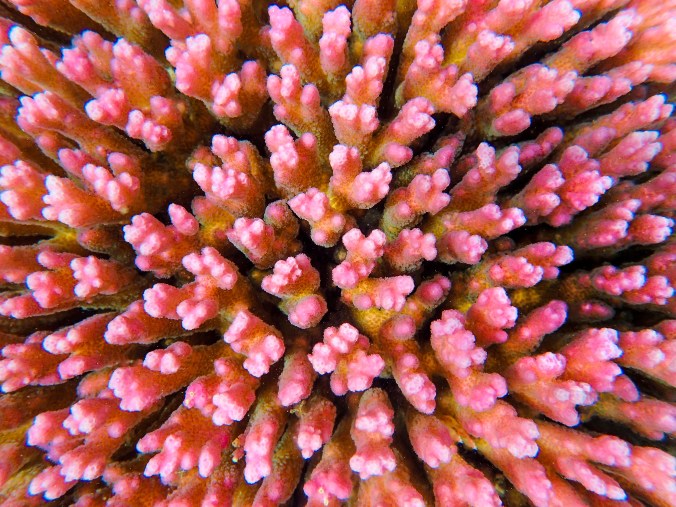
Like a galaxy of muti-hued stars, these coral polyps thrive on the reef in New Caledonia’s Natural Park of the Coral Sea. © Jeffrey Cardenas

I welcome visitors when I am sailing alone, even when those visitors are a curious pair of white tip reef sharks. They seem fascinated with the flash of my underwater camera. Sharks, being the alpha predators, always seem fearless — until they threatened by man, particularly those in this hemisphere who want to cut off their fins to make a bowl of soup. These white tips are a kinder, gentler predator. They seem to know that in this lagoon food is plentiful and they can swim without threat.

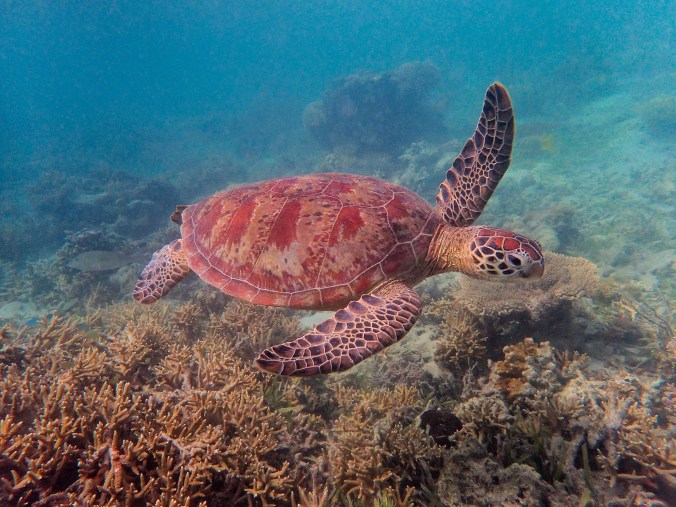
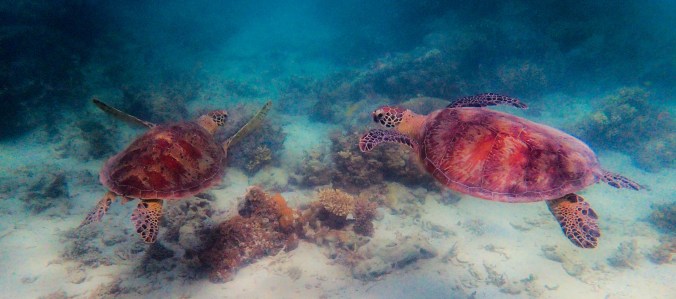
New Caledonia is internationally renowned for its exceptional natural beauty, rich biodiversity, and remarkable coral reefs. The Natural Park of the Coral Sea protects 502,000 square miles of the southwest Pacific islands. It is sanctuary for sharks, whales and turtles. New Caledonia is also home to one of the world’s largest populations of dugong, the last remaining marine mammal on earth that eats strictly plants. These creatures live in a lagoon circled by an epic 618-mile long coral reef. To summarize the superlatives, this tiny, French semiautonomous territory of New Caledonia boasts one of the largest nature reserve on earth.
OLYMPUS DIGITAL CAMERA

All images are of the Natural Park of the Coral Sea. © Jeffrey Cardenas

Paradoxically, New Caledonia’s maritime sanctuary is measured against the country’s unremarkable environmental record on land. As I swim with the sharks and turtles and tropical fish over the shallow coral reef inside the lagoon at Ilot Maître, it is possible to look back at the mainland and see the scars of strip mining. New Caledonia has one of the largest economies in the South Pacific. It is home to a quarter of the world’s known nickel reserves. The foreign dollars earned from nickel mining and smelting account for more than 90% of all exports. It explains the affluence of New Caledonia when compared to its neighbors in the South Pacific. But the wealth has come at a price. Strip mining in the 1970s turned once lush valleys rust red in color and sliced off entire mountaintops. Mining techniques and regulations have improved since then but in the past decade there have still been several serious leaks of acidic effluent flowing directly into this UNESCO World Heritage site.

There are other challenges to this pristine maritime environment. Despite there being literally thousands of boats moored in several modern marinas in New Caledonia, there are few if any functioning sanitary pump out stations in the entire country. Most sewage goes directly into the water. Enforcing the sanctuary’s well-intentioned marine regulations in an area twice the size of Texas is hardly possible with the limited resources here to police it.

Tourism is underdeveloped in New Caledonia with a little more than 100,000 visitors a year, compared to neighboring Fiji where tourism numbers are approaching 900,000 annually. This seems surprising considering the attraction of New Caledonia’s unique natural habitat of 3,700 species of plants, 114 species of birds and 143 species of reptiles. Over 80% of these species are found nowhere else on earth. Its lagoon is a thriving nursery for 25 kinds of marine mammals (including dugongs and humpback whales), 48 species of shark and five different marine turtles.

New Caledonia is proud of its 2019 tourism advertising campaign titled, “Feel The Pulse Of New Cal.” That pulse is clearly in the natural habitat of this island with its spectacular lagoon. Nature is the carotid artery, the life blood of New Caledonia. At some point in the future, as the nickel and other minerals in the land are depleted, the marine environment will be what sustains this beautiful island.

Follow the initiative of groups like Conversation International and the Pew Trust that focus on New Caledonia’s marine environment.

OLYMPUS DIGITAL CAMERA

A white tip reef shark passes by to welcome Flying Fish to the Natural Park of the Coral Sea. © Jeffrey Cardenas

Please subscribe at the bottom of this page so that you don’t miss a new post, and please share this post with others who might enjoy following the voyage of Flying Fish

To see where Flying Fish has sailed in the past year click here: https://cruisersat.net/track/Flying%20Fish

For current weather along the route click here: https://forecast.predictwind.com/tracking/display/Flyingfish

Text and Photography © Jeffrey Cardenas 2019

All rights reserved


A New Neighbor in Nouméa

Endeavor bow.sm

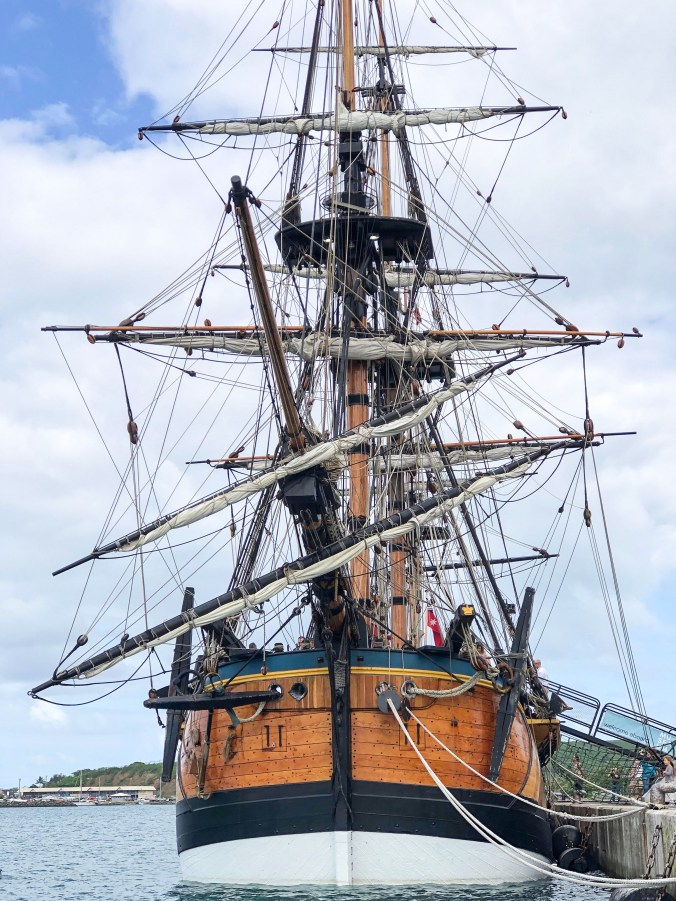
HMB Endeavour, an exact replica of the first ship Capt. James Cook commanded when he charted the Pacific, arrived in Nouméa, New Caledonia this week after having twice circumnavigated the globe. Photograph: © Jeffrey Cardenas

Walking along the wide planked decks of the Endeavour replica, one has the sense of treading two worlds.

There is this vessel, a working reproduction that recently arrived in Nouméa, a tall ship that has twice navigated the globe. And then there is the ship she represents, the HMS Endeavour, launched more than 250 years ago that carried Capt. James Cook and a crew of 94 on an epic voyage of discovery around the world. 

Cook departed England in 1768, ordered to the South Seas to observe the Transit of Venus and to secretly search for the fabled Great Southern Continent (Terra Australis Incognita). The HMS Endeavour rounded Cape Horn east to west against the Roaring Forties and then sailed into the Pacific bound for Tahiti. Cook returned to England by way of South Africa after two years and 11 months, having travelled some 30,000 miles and charted over 5,000 miles of coastline.

“Cook not only redrew the map of the world, creating a picture of the globe much like the one we know today” writes historian Tony Horwitz, “he also transformed the West’s image of nature and man.”

The replica of Cook’s ship is no tourist boat. Construction of the Endeavour replica began in Australia in 1988 and the ship was launched 5 years later. Since her commissioning she has sailed over 170,000 nautical miles–more than five times the distance sailed by James Cook on the original HMS Endeavour.

The Endeavour replica was built using surveys and plans archived by the National Maritime Museum in Greenwich, England. The timbers are of jarrah, a West Australian hardwood with spars from old-growth Douglas fir. The ship’s traditional iron fittings, including lanterns and the large iron firehearth, were handmade in a specially installed blacksmith shop. Traditional manila was used for the standing rigging, handmade on a 140-year-old ropewalk to the exact specifications of the original rope. The necessary concessions to the 21st century–engines, generators, an electric galley, showers, and safety equipment–are all hidden away in the cargo hold where Cook stored his ship’s provisions.

This slideshow requires JavaScript.

In over 200 voyages aboard the Endeavour replica some 8,000 men and women have been able to experience 18th-century seamanship and see how Cook and his men lived. Hundreds of others have joined day sails in harbors and rivers around the world, and many more have worked as guides and volunteers.

With Flying Fish currently undergoing repairs in Nouméa, I was invited by Shipping Agent Chloé Morin to help a group of fourth graders from Nouméa’s Paul Duboisé elementary school tour the Endeavour replica. The children were wide-eyed at the 100-foot, 400-ton ship. The Endeavour was built for endurance, not speed or comfort. It  bluff-bowed and wide beamed with an average sailing speed of 2.5 knots. The ship has been described (unkindly) by one historian as “A cross between a clog and a coffin.”

Endeavour’s Master John Dikkenberg, showed off his ship with enthusiasm to the children. The two areas that most fascinated the kids, Capt. Dikkenberg said, were the sitting boards hanging outboard with holes in them used during the Cook era as toilets (from which one unfortunate seaman plummeted into the ocean while underway), and the flogging rack. “Were sailors really whipped?” one young girl asked Capt. Dikkenberg. “With a cat o’ nine tails,” he replied, and he invited a boy to spread eagle on the rack, much to the delight of his fellow students.

Capt. James Cook’s mission was a voyage of science and discovery, and his legacy continues in the voyages of the Endeavour replica. Who knows in which student this spark of adventure may eventually alight. I know as the passage of Flying Fish crosses the wake of both Endeavours that my adventure is greater for having known their stories.

Endeavor from stern.sm

The rig of the HMB Endeavour carries over 10,000 square feet of canvas with 17 sails. © Jeffrey Cardenas

Please subscribe at the bottom of this page so that you don’t miss a new post, and please share this post with others who might enjoy following the voyage of Flying Fish

To see where Flying Fish has sailed in the past year click here: https://cruisersat.net/track/Flying%20Fish

For current weather along the route click here: https://forecast.predictwind.com/tracking/display/Flyingfish

Text and Photography © Jeffrey Cardenas 2019

All rights reserved


And Then This Happened

DCIM100GOPROG0220798.JPG

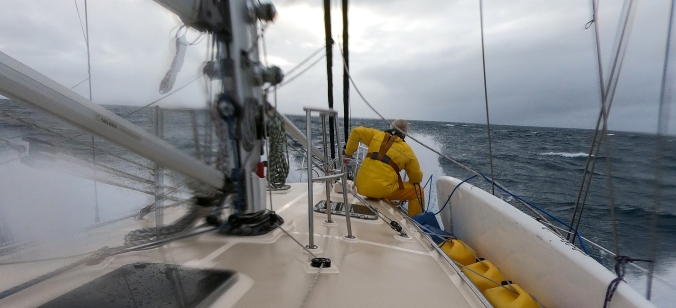
Setting up preventer lines on the rough downwind run to the Coral Sea. © Jeffrey Cardenas

Sleep is a rare pleasure on singlehanded passages and I was deep into a blissful state of REM on the comfortable salon berth of Flying Fish when the cabin around me seemingly exploded from within.

The crash was of such intensity it was as if I had been struck hard by a heavy truck. Still in a dream, I thought how is this possible? I should be floating on water, in an ocean 10,000 feet deep. Instead I awoke to a sound unlike anything I have ever heard on the ocean. First there was first a roar followed immediately by impact and detonation. Then, onto my sleepy head, came an awful shower of broken glass, canned food, cookware, and a drawer full of cutlery.

Flying Fish had been knocked down–mast to the surface of the water–rolled broadside by a wave that must have transcended by multiples any wave I had seen since my departure from New Zealand three days earlier.

An abnormal wave is rare. For years “rogue waves” were thought to be mythical, almost embarrassing to talk about, movie stuff. But, abnormal waves have been scientifically recorded. They are real, unpredictable, and they impact anything in their path with a tremendous and unstoppable force.

When I had gone below to rest some 30 minutes earlier, the wind was a moderate 20 knots and the boat sailing smoothly on a broad reach. The mainsail was double reefed, the jib was furled, and a staysail was rigged on the inner forestay. The sea was rough but manageable with a 6 to 8-foot swell from the east. The autopilot was working effortlessly with minimal weather helm. Radar, AIS, and a visual check showed no shipping traffic. Alarms were set.  The satellite forecast GRIB weather files indicated no change for the next 24 hours. It was the perfect time for a short snooze.

After the wave broke, Flying Fish rolled upright and I dug out of the debris field inside the cabin. My first instinct was to move toward light and air and get topside before another wave broke over the boat. But there was no other wave. The sea and wind conditions were the same as they had been 30 minutes earlier–except that Flying Fish was now wallowing in the foaming wash of the wave. The cockpit was full of water, hundreds of gallons. The canvas weather enclosure (custom built in New Zealand only a month ago) was in tatters. Cockpit cushions gone. Engine gauges underwater. And on the deck a 5-gallon jug of diesel had opened spreading a sheen of fuel oil and noxious fumes across the boat.

Flying Fish is a sturdy vessel. It is a 46′ Island Packet, a traditional cutter with a full keel, 32,000 pounds of displacement, and lots of fiberglass. What Flying Fish may lack in speed and sex appeal compared to modern racing sailboats, it more than makes up for in safety and security. I bought the boat specifically for its high rating of something called the “righting moment.” Simplified, the righting moment is the ability of sailboat to recover from a roll. Some boats will recover and some will not. Flying Fish recovered, which is why I am able to write these words.

While this knockdown was not an emergency situation, it was an event that captured my undivided attention. The initial reaction (after I rubbed the sleep out of my eyes and realized this was not a nightmare) was one of: What First?

Priority One was to get nearly a ton of the water out of the cockpit and regain buoyancy. An errant t-shirt had clogged one of the cockpit drains. Next I checked the bilge. It was dry, although 10 gallons of seawater was sloshing around the engine compartment (how did it get in there?) I knew I would have to get the engine started soon. The ports and hatches were all dogged and secured. The broken glass in the cabin, I am chagrined to say, was from improperly stowed glasses and plates (I just can’t drink fine wine out of plastic glasses). And there was more good news: The rig was intact. Torque from a mast and boom going into the water can be severe enough to rip the rig out of the deck. Amazingly, I was still sailing. The autopilot, God bless her inanimate soul, was holding course.

Then came the clean up. Because it had been such a passive passage to date, and because the forecast was for it to remain so, I was lackadaisical with my stowage. Imagine taking a full kitchen drawer and dumping it on the floor. Then imagine taking all of the kitchen drawers–and the contents of the cabinets–and throwing them into the mix. This is what the cabin of Flying Fish looked like. It might have been humorous until I saw a deep gouge in an interior bulkhead caused by impact from my cast iron griddle. The griddle had been stored under the stove where it had lived for more than 10,000 miles. But on this knockdown it somehow flew out and up with great velocity, across the entire cabin, passing inches over my head where I lay sleeping in the salon.

If the initial reaction to an event like this is What First, what follows logically is What Next?

I had been en route from Opua, New Zealand to Port Denauru, Fiji. Wind and seas were on the beam. I tried to understand the cause of this abnormal wave, and what the chance was of it happening again. In nearly a half a century of sailing and working on fishing boats I had never before encountered anything like this. Bob McDavitt’, one of New Zealand’s passage weather gurus likes to say, “Weather is a mix of pattern and chaos.” With careful planning ocean passages can be reasonably predictable, but I wanted to avoid more unpredictable chaos. So I turned downwind and down sea, diverting from a landfall in Fiji to one further west in New Caledonia. If Flying Fish was going to take another wave, she was going to take it on the backside where it wouldn’t hurt as much.

Lessons learned? Plenty.

I know that I cannot run before the wind and waves for the entire next 24,000 miles of my return passage to Key West. The ocean will often be rough and the seas will frequently be striking Flying Fish amidships. If I am going to sleep in these conditions I will need to heave to into the wind before I leave the helm. Also, I cannot be lazy about the proper stowage of PFOs (Potential Flying Objects) down below. When I sail again, I will look at my cabin with an eye to what will break free if the boat rolls 90 degrees, or worse. Finally, the cockpit needs to be an uncluttered environment. How humiliating it would have been for Flying Fish to founder because the cockpit drain was clogged with a dirty t-shirt I had tossed in the corner.

Ultimately, I need to better understand the inherent risk of this adventure. If a person walks in the rain they face the chance of being struck by lightning. If a person sails offshore they face the risk of encountering something as unpredictable as an abnormal wave. The alternative is to sit at home and watch reality TV. That’s not going work for me.

#

Please subscribe at the bottom of this page so that you don’t miss a new post, and please share this post with others who might enjoy following the voyage of Flying Fish

To see where Flying Fish has sailed in the past year click here: https://cruisersat.net/track/Flying%20Fish

For current weather along the route click here: https://forecast.predictwind.com/tracking/display/Flyingfish

Text and Photography © Jeffrey Cardenas 2019

All rights reserved
 

Two Seas and Ancient Spirits

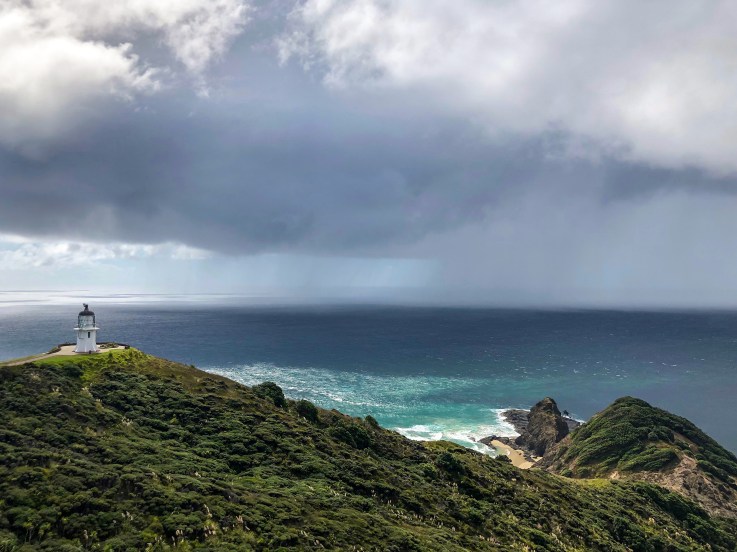
Cape Reinga

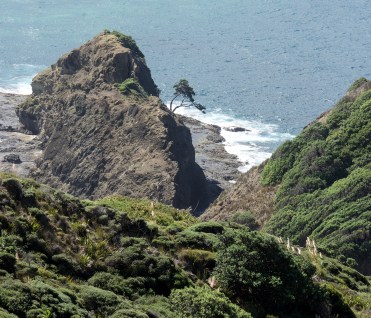
At Cape Rēinga on the northern end of New Zealand, where water from the Tasman Sea mixes with the Pacific Ocean, Māori spirits depart to the underworld. Photography: © Jeffrey Cardenas

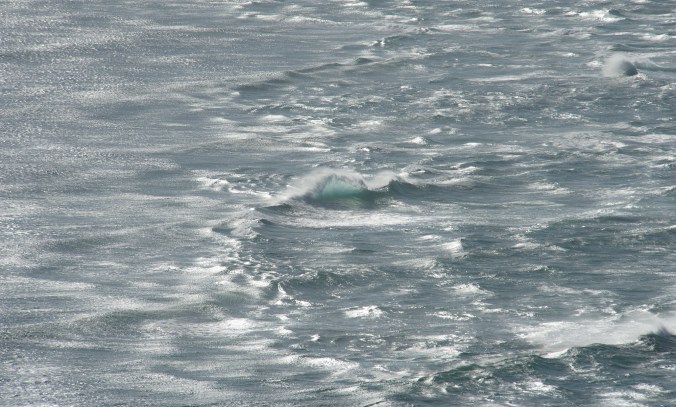
Cape Rēinga at the top of New Zealand is one of the great headlands of Oceania. It was used as a waypoint by the earliest Polynesian sailors, ancestors to Māori, on their voyages of exploration. It is off this point of land that the Tasman Sea to the west and the Pacific Ocean to the east meet in a tumultuous mixing of counter currents and confused seas.

And it is this landmass that will be my final view of New Zealand as Flying Fish sails north tomorrow en route to Fiji.

Like so much of New Zealand, Cape Rēinga is rich in Māori tradition. According to legend, these turbulent waters are where the male engendered sea, Te Moana Tāpokopoko a Tāwhaki, meets a female body of water called Te Taio Whitirela. Their love affair arouses a dance of whirlpools and currents that initiate the Māori creation of life.

But just as there is love and life in the meeting of these seas, there is also a specter of death. For Maori, Cape Rēinga means the leaping-off place of spirits. It is Māori belief that the cape is the point where the spirit of the dead enter the underworld.

Cape pōhutukawa.sm

In mythology, these spirits travel to Cape Rēinga on a final journey to the afterlife, then leap off the headland from the roots of an 800-year-old pōhutukawa tree. That tree exists today. Its roots tenaciously cling to bare rock just above the breaking seas. According to New Zealand’s Department of Conservation, pōhutukawa are known for their brilliant red flowers, but this particular tree–growing out of the rock where the spirit of the dead enter the underworld–has never flowered.

Visitors who journey to the cape are asked not to eat, drink, or smoke out of respect for this sacred place. And, it is not only humans who journey to Cape Rēinga. Just below the mystical pōhutukawa tree is Scratching Rock where whales sometimes enter the bay to rub their flanks against dark red rocks formed by undersea volcanic eruptions.

Maōri had occupied this land hundreds of years before explorer Abel Janszoon Tasman dropped anchor looking to replenish his ship’s fresh water supply. On the eve of Epiphany in 1643, Tasman named a group of rocky islets he encountered as the Three Kings Islands. But these rocks already had a name. Historian Percy Smith wrote that a Maōri chief named Rauru, once swam across the treacherous 50-mile passage from Cape Rēinga to one of the islands. In the state of exhaustion upon his arrival Rauru named the island Manama Tāwhi, Maōri meaning “panting breath.”

Cape Rēinga is said to be the most sacred place in New Zealand. It is a landscape of death and rebirth, a tableau of creation and destruction. As a foreigner I will never understand the full spiritual significance of this place but I will always have a personal connection here. In New Zealand that connection is known as Hawaiki. It is both a mythical location and a template for everything that is good, powerful, and benevolent in the world. Hawaiki is where fullness of life is envisioned and experienced. This helps me to understand a little more clearly why I wander the world in search of places like Cape Rēinga.

Cape Seas Meeting.sm

This is the exact moment when the Tasman Sea meets the Pacific Ocean. In Maōri tradition this is the encounter, seduction, and conception of two spiritual entities. Photography: ©Jeffrey Cardenas


Please subscribe at the bottom of this page so that you don’t miss a new post, and please share this post with others who might enjoy following the voyage of Flying Fish

To see where Flying Fish has sailed in the past year click here: https://cruisersat.net/track/Flying%20Fish

For current weather along the route click here: https://forecast.predictwind.com/tracking/display/Flyingfish

Text and Photography © Jeffrey Cardenas 2019

All rights reserved
 

The New Zealand Fern

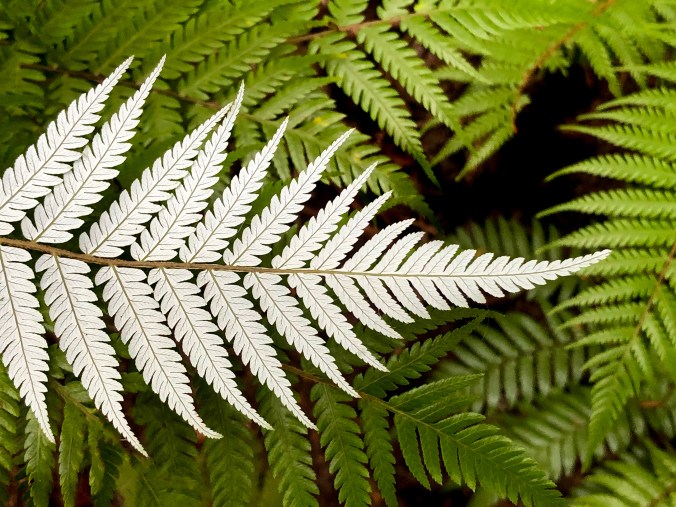
Silver ferns, with their leaves turned upward to reflect moonlight, helped Māori hunters and warriors to find their path homeward. Photograph: © Jeffrey Cardenas

As I begin this long goodbye to New Zealand I am focused on the ocean passage ahead. Yet, in these final weeks ashore, I am also inexorably drawn back to the terra firma of this lovely country.

Click on the individual photos for high resolution images

New Zealand’s ferns are an iconic symbol of this country. To Pākehā (New Zealanders of non-Māori descent), the fern symbolizes a sense of attachment to their homeland. It represents the national identity of this country. The symbol was first used in the 19th Century by New Zealand troops fighting in South Africa and it continued to be used to identify New Zealand units during both world wars and subsequent conflicts. All Commonwealth war graves of fallen New Zealand soldiers have the silver fern engraved on their tombstones.

To Māori, the elegant shape of the fronds stands for strength, stubborn resistance, and enduring power. There are hundreds of varieties of ferns in New Zealand. Ferns were used by Māori for their medicinal properties. The mouki and parako were used for skin rash, kiwakiwa was chewed to alleviate a sore mouth or tongue, the root of rahurahu was used to prevent seasickness. The silver frond of the ponga has long been used for marking tracks in the bush, springy leaves of waewaekoukou form a good bush mattress, and stems were used by Māori as a binding twine for making eel traps.

The magnificent silver fern is a variety of tree fern found only in New Zealand. It grows to over 10 meters high in the verdant forests on both islands. Māori hunters and warriors used the silver underside of the fern leaves to find their way home. When bent over, the fronds would catch the moonlight and illuminate a path through the forest.

According to Māori legend, the silver fern once lived in the sea until the plant with its sacred power entered the forest to help guide the Māori people on their travels.

At the navigation station aboard Flying Fish, I have placed a silver fern leaf next to the compass. It is a talisman that I hope will also help guide me on the long journey home.

Fiddlehead.sm

Fiddlehead, the new growth of a New Zealand fern.

Please subscribe at the bottom of this page so that you don’t miss a new post, and please share this post with others who might enjoy following the voyage of Flying Fish

To see where Flying Fish has sailed in the past year click here: https://cruisersat.net/track/Flying%20Fish

For current weather along the route click here: https://forecast.predictwind.com/tracking/display/Flyingfish

Text and Photography © Jeffrey Cardenas 2019

All rights reserved