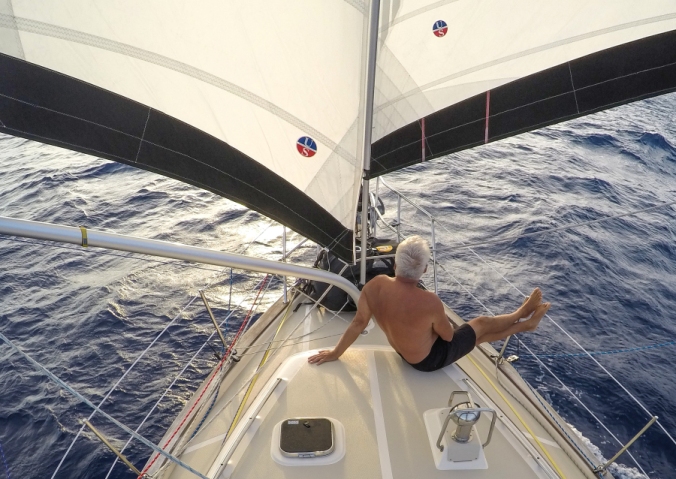
Sailing wing-and-wing across the Pacific Ocean
One year ago today, I departed Key West in my cutter Flying Fish on the first leg of a global circumnavigation. It has been a voyage of self-discovery in a wonderland of raw nature. When I look back at these images of 2018, I see that my camera bias emphasizes the idyllic — downwind sailing, tropical sunsets, vibrant color reefs. These halcyon days are what I record but there have also been moments during this 10,000-mile passage of sheer terror, illness, injury, and loneliness. I prefer to remember the positive. Enjoy these images, and thank you for being here with me.
Passage South
Departure from Key West, December 2, 2017–with 34,000 miles to go. The crew onboard for this leg is my brother Bob and father Robert, both are accomplished ocean sailors. Rounding the west end of Cuba, the bluebird weather quickly turns into the notorious Caribbean “Christmas Winds” with rain squalls approaching gale force in intensity. Still, there is magic in the air. After dark, the sea is alive with phosphorescence. Following one night of squalls Dad finds a flying fish that crash-landed on the deck of Flying Fish. This first passage is a trial by fire–literally. The generator starter motor shorts out and smoke billows from the bilge. The primary navigational electronics fail from the wet weather. Landfall at Panama’s Bocas del Toro is dark and stormy and achieved as if by braille. With a local forecast showing wind increasing to 40 knots, we slip into the Bocas del Toro channel at 2AM with zero visibility in a torrential rainstorm.

Departure from Key West December 2, 2017. Photo: Carol Tedesco

Caribbean squalls bring frequent periods of zero visibility

A grimace or a smile…? Wild weather always brings both

Dad checks out a flying fish that miscalculated its altitude and landed aboard Flying Fish

A dark and stormy landfall on Panama’s Caribbean shoreline
(Click on thumbnail images for captions, camera information, and a full-frame image)
Through the Canal
Flying Fish enters the Panama Canal’s Miraflores Locks with heavy metal close astern. Mast and rigging are a study in geometry under the famed Centennial Bridge as a new ocean opens to the horizon. Las Islas Perlas on Panama’s west coast are a biological and geological treasure. Many sailors eager to cross the ocean will bypass Islas Perlas but Flying Fish lingers for months. I am enchanted by the islands’ flora and fauna, and miles of pristine beaches.

A massive container ship squeezes (by inches) into the Mirafllores Locks of the Panama Canal

Passage through the Panama Canal at the Gatun Locks aboard Flying Fish

Flying Fish passes under the famed Centennial Bridge as a new ocean opens to the horizon

Stunningly beautiful Isla Bartolome in the Gulf of Panama is my first Pacific Island landfall

A nesting turtle leaves her footprints–and her eggs–on this Islas Perlas beach

A hermit crab peers out of its house

A hawksbill turtle takes flight in the calm, clear waters of Islas Perlas

Soft coral branches wave in the tidal current

A school of damsel fish flutter in the late afternoon sunlight

The white shaving brush flower falls from the trees like snowflakes in the tropics

Waves and tide have eroded the shoreline to bare rock but foliage still finds enough nutrition to grow

In peculiar behavior, hundreds of birds alight on one stretch of sand while other beaches remain vacant

Natural erosion has provided a picture of resiliency as this tree holds on to the shoreline

In more remote areas some reefs remain uncharted and visual navigation is essential

High cirrus clouds show a change in Pacific Ocean weather
Across the Pacific
Daughter Lilly, a USCG 100-Ton Master Captain, provides the heavy lifting for the 3,500-mile passage from Panama to the Marquesas Islands. These are blissful days of fishing and reading, and on rare occasion, trimming the sails. Tradewinds blow consistently downwind and Flying Fish averages 175 miles per day. Lilly creates healthy and delicious meals with the bountiful fruit and vegetables provisioned from Panama. More challenging for her is trying to establish a routine of yoga, exercise, and French lessons for her stubborn father. Crossing the Equator is a notable event marked by sailors on all ocean passages. Becalmed, Lilly and I celebrate by swimming where the water from the Northern Hemisphere mixes into the Southern Hemisphere. After nearly a month a sea, we find ourselves gazing west, looking for a Polynesian landfall.

The spinnaker is a perfect sail for the downwind run to Papeete

The hull of Flying Fish slices through the Pacific at at rate of 175 miles per day

Sailing with jib and staysail before the wind is the most restful point of sail

Like bananas, oranges ripen all at once. I use the generator to power a juicer and squeeze a bushel of Central American oranges

Lilly has an internal gimbal in the galley and prepares delicious vegetarian feasts regardless of the weather

We never catch more fish than we can eat, but we always catch enough to have fresh fish on our table

Reading is one of the luxuries of a long sailing passage and Lilly reads a new book each day

This glorious sailfish, while edible, is more than we need and it is released

When the bananas ripen, they ripen all at once

The geometry of sailing is one of its greatest allures

The spinnaker is both powerful and beautiful at once, and it has a life of its own

Another late afternoon on the long passage across the Pacific, looking for land

A seabird signals land near the Galapagos Islands

Lilly is at much at home at sea as she is on land

Lilly swims in mid ocean on a calm morning after Flying Fish crosses the Equator into the Southern Hemisphere
French Polynesia
The sights and sounds and fragrance of French Polynesia are pure exotica. We make landfall at Fatu Hiva in the famed Bay of Virgins. Spectacular monolithic landscapes rise from the sea. Further west, the water clarity is astonishing. Within it are gardens of live coral and a full spectrum of brilliantly colored tropical fish. French Polynesians are generous, beautiful, and they honor their heritage. A young Polynesian girl quietly sings indigenous ballads while she plays a handmade guitar. In the Tuamotos Islands a pearl diver ascends to the surface with her treasure.

A schoolgirl performs a traditional Polynesian Haka dance during a presentation on the island of Fatu Hiva

The tropical Polynesian island of Tahaa in the foreground with the majestic peaks of Bora Bora as a backdrop

This Marquesan fisherman proudly shows off his catch, of which every piece this grouper will be consumed

Evolution: One Pufferfish is colored black with white spots while another swimming right next to it is white with black spots

In this valley author Herman Melville once hid out for three weeks and was inspired to write his classic novel Typee

A pearl diver ascends to the surface with baskets of treasure in Ahe, Tuamoto Islands, French Polynesia

With the surface of the water reflecting like a mirror, coral and palms radiate in a tropical paradise

Immune to the stinging tentacles of an anemone, a Clownfish defends its territory

Double-Saddle Butterfly Fish reflect on the surface in the Coral Gardens of French Polynesia

Flying Fish is anchored in Fatu Hiva’s famed Bay of Virgins after nearly a month at sea crossing from Central America to French Polynesia

Flying Fish is at anchor (foreground) in Vaianae Bay, Mo’orea. Photo: Skydive Tahiti

The Catholic Église de la Sainte-Famille in Ha’apiti, Mo’orea is set against a saintly backdrop

A vision from a painting by Paul Gauguin, this young girl plays her hand-carved guitar in front of a cemetery on the island Tahuata

The brightly colored Epaulette Soldierfish is a delicacy of French Polynesia
Oceania
Continuing the passage west, Flying Fish makes landfall on the islands of Maupihaa, Aitutaki, and Nuie. Humpback whales migrate through the islands on an annual journey north from the Antarctic to find mates and give birth. The land and weather is more rugged here, sculpted by great waves born in the Southern Ocean. This area of the Pacific is known as the Dangerous Middle. Weather is unpredictable and venomous sea snakes emerge when least expected.

A Humpback Whale, close to shore, breaches in the Ha’apai Islands

A severe squall rips through the island of Maupihaa

Tropical Cyclone Gita was the most intense tropical cyclone to impact Tonga since reliable records began

The highly venomous black banded sea kraits are not aggressive but a Polynesian fisherman was killed by one this year when it became entangled in his nets and bit him

A surreal area of rock formations on Kenutu Island in Tonga forms an immoveable barrier reef

A quiet waterfall in a chasm of rocks is the reward after a long hike on the island of Nuka Hiva

The Talava Arches of Niue are accessible only by hiking inland through the center of a cave

Tour guide Narumi Saito at a shoreline cave on the island of Niue

The windward coast of Niue bears the force of waves traveling thousands of miles across the Pacific Ocean

The breathtaking beauty of a live Cowrie, gently released back to its place on the reef after the photograph

Shallow water reefs still thrive in many parts of the Pacific where water quality is untainted by runoff and effluent

A Humpback Whale goes vertical in a dive
Tonga
In the Kingdom of Tonga, Flying Fish anchors in the Port of Refuge. From this base in the Va’vau group of islands there is a sense of sailing in the wake of our predecessors. Capt. James Cook narrowly escaped assassination here. A few years later Fletcher Christian set William Bligh adrift in these waters. Today, Tongans welcome ocean sailors. Markets overflow with fresh produce and Tongan feasts are prepared on the beach. Rocky shorelines provide habitat for octopus and shellfish. The ocean is alive with whales, sharks, and fish. The Kingdom of Tonga is a land of plenty.

Laveni Tatafa from Nuapapu Island in a happy pose with her coconut husking knife

The Neiafu Market in Va’Vau offers a cornucopia of fresh fruits and vegetables

This rare Leopard Shark makes an appearance at twilight over an outer reef in the Ha’apai Island Group

A dense school of anchovies swims backlit against the entrance of an underwater cave

Neiafu Harbor in the Va’Vau Group of Islands in Tonga is known as the Port of Refuge

Tongans comfortably numb around the kava bowl

Veisinia Falevia prepares pandanus leaves for weaving at her home in the Ha’apai Islands

Young Alesha Muhuinga sips the juice of a fresh green coconut at the Saturday Market in the Port of Refuge, Tonga

A simple cross and a powerful sky over the island of Pangaimotu are reminders of a higher power

Remote Kelefesia Island, one of the southernmost Polynesian Islands, is bountiful with coconuts, wild papaya, and fresh seafood

A Humpback Whale reveals hydrodynamically perfect tail flukes as it dives for the bottom
Minerva Reef
At high tide nothing visible exists of South Minerva Reef. It lies unseen beneath the surface of the water until the tide begins to recede. Then, rocks emerge from mid ocean forming two perfect natural atolls. The debris of shipwrecks litter the outside edges of the atoll and the sandy bottom inside of the lagoon. The water is crystalline and fish–big fish–abound in this remote patch of ocean. It is the final outpost of Polynesia in the South Pacific.

A school of curious Blue-Line Snappers congregate in the clear water of South Minerva Reef

Giant Pacific Clams and yellow coral highlight the reef line at South Minerva

South Minerva Reef’s coral blossoms in a pristine environment

South Minerva Reef atoll at low tide. Once the tide rises, no dry land is visible above the surface. Photo: Jim Patek

This Spotted Moray Eel is barely submerged in a Minerva tidepool

A colony of coral polyps morphs into an unusual pattern

A young Brown Booby has something to say about Flying Fish

In aquarium-like visibility, a school of Blue-Green Chromis swarm amid a healthy clump of Antler Coral

A Hawksbill Turtle sleeping under a coral ledge says, “Hey, a little privacy please!”

A close-up image of the mantle of a Giant Pacific Clam looks like a fluorescent blue lava flow

The friendly eye of the Pufferfish belies the fact that some species carry a toxin 1,200 times more deadly than cyanide

A Black Tip Reef Shark is an alpha predator in the waters of the South Pacific
Destination – New Zealand
As the year at sea ends, and with the South Pacific Cyclone Season well underway, Flying Fish sails south to the storm-sanctuary port of Opua, New Zealand. The passage in these southern latitudes is formidable. Gales coming out of the Tasman Sea make it difficult to find an open weather window for the sail from Minerva Reef to Opua. A miscalculation (compounded by impatience) results in a punishing five-days at sea. In a lull between squalls, 200 miles from land, a storm-weary European Goldfinch lands on Flying Fish to rest. Despite the Māori name for New Zealand–Aotearoa, land of the long white cloud–landfall here is amid sawtoothed islands under a dark sky. The passage from Key West has been 10,000 miles and nearly a year underway. Both the body and boat are battered. A Māori welcoming ceremony–a pōwhiri–is performed onshore. Kia ora!
My mantra for the next five months will be: rest, repair, and rejuvenate.

A series of gales originating in the Tasman Sea makes for challenging conditions on the final leg to New Zealand

The water and sky become eerily calm before a South Pacific gale descends out of the Tasman Sea

This storm-battered European Goldfinch takes refuge aboard Flying Fish after a gale from the Tasman Sea

The sea and sky change after gale-force winds exceeding 40 knots swept across the boat the day before

This sawtoothed landfall marks the arrival of Flying Fish in New Zealand

Dancing on the edge of the beautiful Rainbow Falls near Kerikeri, New Zealand

An eclectic bicycle basket planted with succulents graces the front porch of a Russell, New Zealand home

A Māori dancer performs a welcoming Kapa Haka for arriving ocean sailors. An extended tongue is said to be an expression of the wairua, or spirit, temporarily emerging from the body during the dance

A portrait of an ancient Māori king and a hand-carved shell fish hook
Flying Fish will remain in New Zealand until the South Pacific Cyclone Season ends in May 2019. Then, when the southerly winds are right, I will set sail for Fiji, Vanuatu, New Caledonia, Indonesia, and Malaysia. Please subscribe to FlyingFishSail.com for updates, new images, and essays.
To see where Flying Fish has sailed in the past year click here: https://forecast.predictwind.com/tracking/display/Flyingfish



 Stella Maris Sail