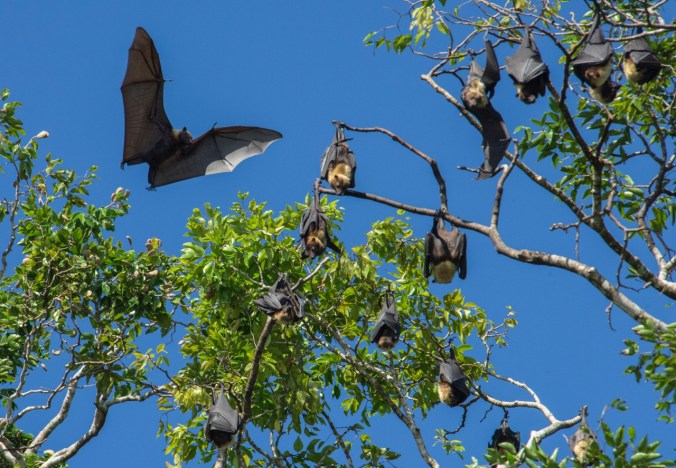
A colony of male Flying Fox fruit bats hang upside-down on scent-marked branches as a female makes her final approach to choose a mate. Photography: ©Jeffrey Cardenas
The Unique Fauna of Tonga
Each landfall in Flying Fish presents new fascination and wonder. Every island offers distinctive culture, unique geology, and an idiosyncratic diversity of nature. The Kingdom of Tonga is no exception.
Flying Fish is anchored close to a shoreline in the island group of Vava’u. Growing at the high water mark is a Tropical almond tree that provides a roost for a colony of bats. These are big bats. Think of a small dog with black leathery wings. And yes, they do have teeth, fangs actually. And no, they are not vampire bats, there are no puncture wounds on my neck (yet). Still, I would not be happy to wake up in the middle of dark night to find a bat the size of a poodle fluttering around inside the cabin of Flying Fish.
These bats are known as flying foxes (Pteropus tonganus). They are the only mammals that can fly. The bats are thriving in Tonga but their numbers have declined on other Pacific islands. Some species of fruit bats in Samoa and Fiji have become extinct because of overhunting. Flying foxes are considered a culinary delicacy in the South Pacific. In the Kingdom of Tonga, however, they are considered sacred. Nobody is allowed to hunt them except, of course, the King of Tonga. There is an expression here–Fakatonga–translated it means, it’s the Tongan way of doing things.
In my anchorage there are several dozen bats hanging upside-down in the almond tree. They are a generally passive group with continual chittering and readjustment of their claws upon the branches of their roosts. Occasionally, one will drop from a branch, take flight, and disappear into the crown of a nearby mango tree. When the fruit is ripe, the bats masticate the pulp and spit out an “ejecta pellet” (a wad) of fiber. Contented, the males then scent-mark sections of a tree branch to attract females to land within their territory.
I look up to a sudden commotion on one branch. Two bats bare their teeth and wrap their wings around each other, squealing, as they begin a ferocious struggle. Amid the screeching and tumult there is a whirling ball of wings and fur, yet somehow the bats manage to stay attached to the branch. The melee causes other bats in the vicinity to wrap their cloaks tightly around their heads, as if they cannot bear to look at what happens next. It seems as if the combatants are in a battle to the death.
But then… Oh!
It turns out that they are not actually fighting at all. It’s bat sex. Procreation. The two bats re-emerge from their amorous scrum and then immediately look in opposite directions and ignore each other. It is the way things are done here. Fakatonga!
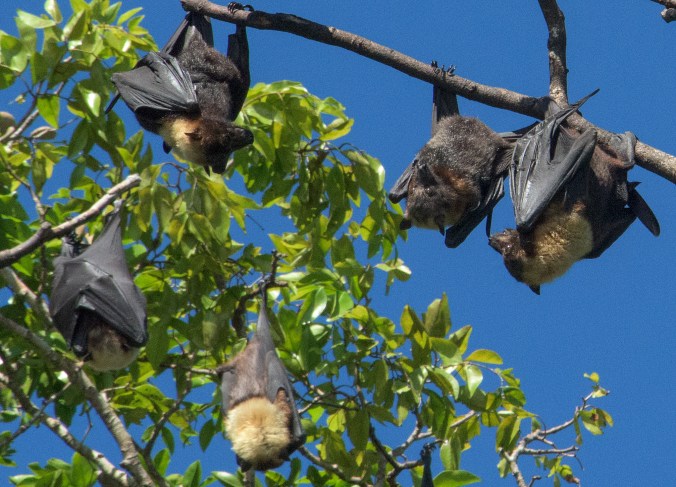
A female bat (middle, with the black neck) chooses between two males. Other bats nearby cover their faces with their cloaks because all hell is getting ready to break out as the males fight for the right to mate. Photography: ©Jeffrey Cardenas
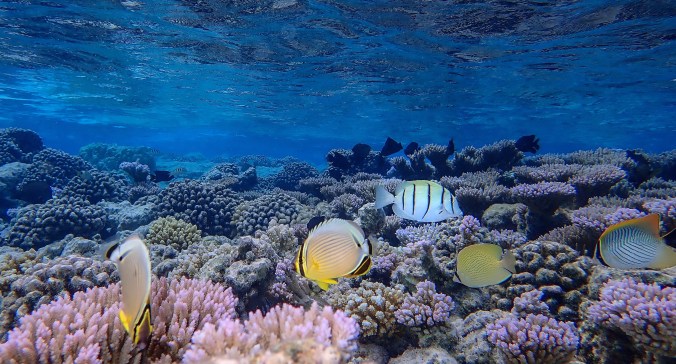
Underwater, the life in Tonga is equally fascinating. The reef and coral is vibrant and alive, despite evidence of an invasive predator that is multiplying here as in many other tropical South Pacific habitats.
This beautiful creature is called the Crown of Thorns starfish, and it has an insatiable appetite for coral. A Crown of Thorns starfish is capable of eating six square meters of live coral in a single year. The size of this starfish can be massive with a diameter that measures up to three feet projecting 23 individual coral-eating arms. It’s spines will not only puncture a wet suit but they are also laced with a toxin that can cause vomiting, nausea, and severe pain.
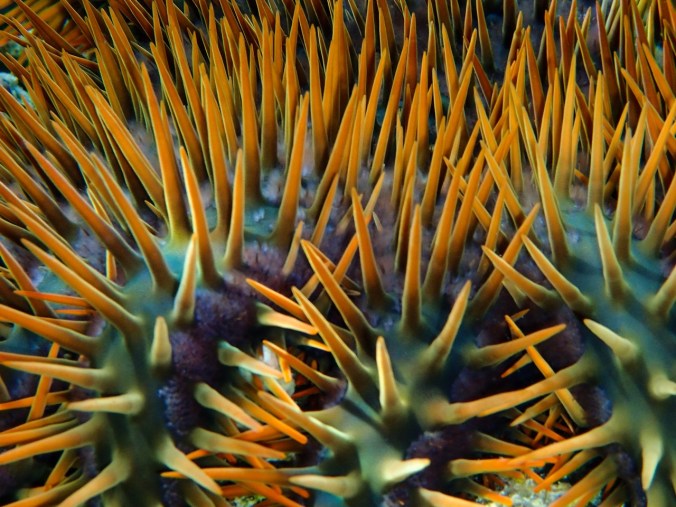
The Crown of Thorns starfish has 23 individual coral-eating arms with venomous spikes that repel predators and can cause vomiting, nausea, and severe pain in human beings. Photography: ©Jeffrey Cardenas
I first began seeing Crown of Thorns starfish on the pristine reefs of French Polynesia. In the nearshore waters off the Cook Islands, where much of the reef is dying or already dead, these starfish were feeding on the last of the live coral polyps. In Australia, The Great Barrier Reef Marine Park Authority has joined in the culling efforts of Crown of Thorns there. The problem is so severe that in February volunteer divers removed nearly 47,000 of these starfish from the southern Great Barrier Reef in just seven days.
Research has shown that the outbreaks of Crown of Thorns are related to many of the same issues occurring in all oceans worldwide: increasing water temperatures, spikes in nutrients caused by costal and agricultural runoff, overfishing of natural predators. While the problem is not nearly as severe in Tonga as it is in other areas of the Pacific, the threat to these reefs is real. Crown of Thorns starfish have the ability to move at a speed of 20 meters an hour and one female can produce up to 65 million eggs during a single season.
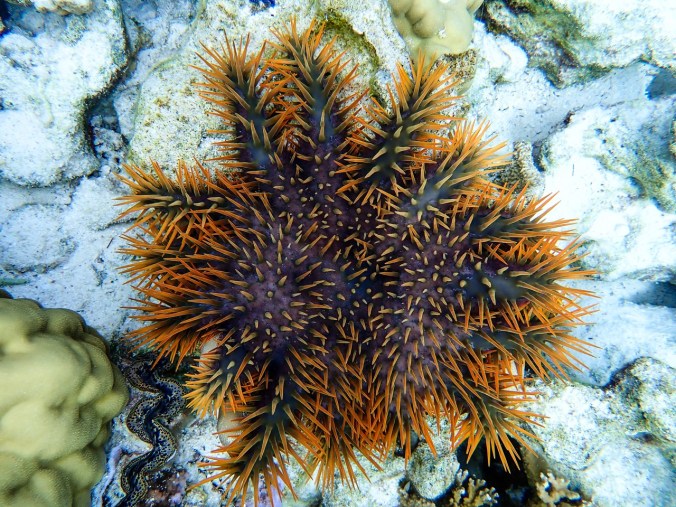
A beautiful but destructive creature, a single Crown of Thorns starfish is capable of eating six square meters of live coral in a single year. Photography: ©Jeffrey Cardenas
And so what do big bats and bad starfish in Tonga have to do with each other?
Nothing. And Everything.
Creatures like these in places like this remind me why I am here, alone on a sailboat, a long way from home. The voyage of Flying Fish is taking me to places where every sight, and scent, and touch seems fresh and new. Some things are beautiful. Others are destructive and even frightening. It is all life as I have never seen it before. I am experiencing the wonder of a natural world more complex than I could ever imagine.
Track the passage of Flying Fish here: https://forecast.predictwind.com/tracking/display/Flyingfish
Please share this post with others who might enjoy following the voyage of Flying Fish





 Stella Maris Sail