Sailing with Lilly

Lilly JV Schooner.sm

Lilly and Dad, 31 years ago, watching the schooners sail back into Key West at sunset

Flying Fish takes flight this week on the 2nd Leg of a three-year circumnavigation. For this passage I will have serious backup. Our daughter Lilly will join me across the Pacific to Tahiti .

This is no ordinary Key West kid on a sailboat. The family legend is that in Mom’s last month of pregnancy her labor was induced by a rough boat ride in a fishing skiff. Lilly soon followed us into the world. She tried a conventional lifestyle by earning a degree in Journalism at the University of Florida. The ocean’s siren was more persuasive. Lilly continued her education at sea and relocated to Maui where she now sails as a captain with USCG 100-Ton Master credentials.

I asked Lilly to note a few of the highlights from her work abroad in just the past 12 months. In her words:

Big Island, HI–Seeing lava dumping into ocean
Havana–Driving around in classic cars with my girlfriends
Bahamas–Swimming with sharks
Virgin islands–Seeing Tortola before the hurricane devastation a few months later
Sardinia and Corsica–Mooring within a fortress at the harbor of Bonifacio
Croatia–Picking and nibbling on raw figs and wild fennel sprouts on the island Komiza
Istanbul–Cruising between two continents
Greece–Sipping rosé at sunset on the sea walls of Hydra
Sicily–Sailing alongside the smoking volcano of Stromboli
Thailand–Swimming alone on a pristine reef near crowded Koh Phi Phi and exploring  the hongs of Phang Nga National Park
Maui–Coming home and hiking a steep mountain trail during the lunar eclipse while listening to whales breathing below

After all that, why Lilly would want to sail with her old man remains a mystery.

Maybe it has something to do with love.

Stay tuned… It’s gonna be a great ride to the South Seas!

Lilly palm.JPG

Master & Commander Lilly Cardenas        Photo: © Joanna Rentz

Track the passage of Flying Fish here: https://forecast.predictwind.com/tracking/display/Flyingfish


CAVU

OLYMPUS DIGITAL CAMERA

Soft corals sway in the current at Islas San Jose, Gulf of Panama.   Photo: © Jeffrey Cardenas

The aviation acronym CAVU–Ceiling And Visibility Unrestricted has always been an expression that evokes endless possibility. Go as high as Icarus, just don’t let the sun melt the wax in your wings.

I don’t know if there is a maritime equivalent to CAVU for water clarity but when I am underwater here, drifting with the current, I feel in the slipstream of life just as surely as if I were flying. I float past green lobsters, yellow porcupine fish, and pearl oysters as large as the palm of my hand. When I remember the waters of Las Islas Perlas I will always think of them as CAVU.

The Secret Lives of Rocks

hole in the wall rock.md

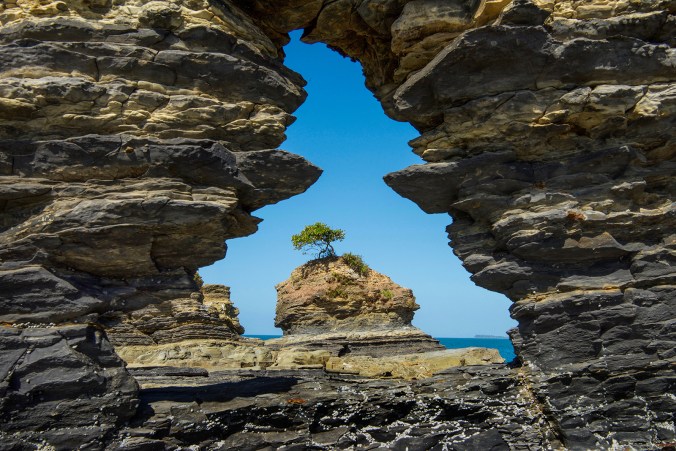
The Super Moon brings extraordinarily low tides to the anchorage at Isla de Fuenche, Gulf of Panama.  Photos: © Jeffrey Cardenas

I have never been much of a rock guy. Rocks don’t give me that warm, fuzzy feeling I receive from softer elements like water when I am on a boat, or clouds when I am in the air. Unexpected rocks cause anxiety for both mariners and pilots. I have always felt that rocks are cold, inanimate, lifeless–they’re rocks.

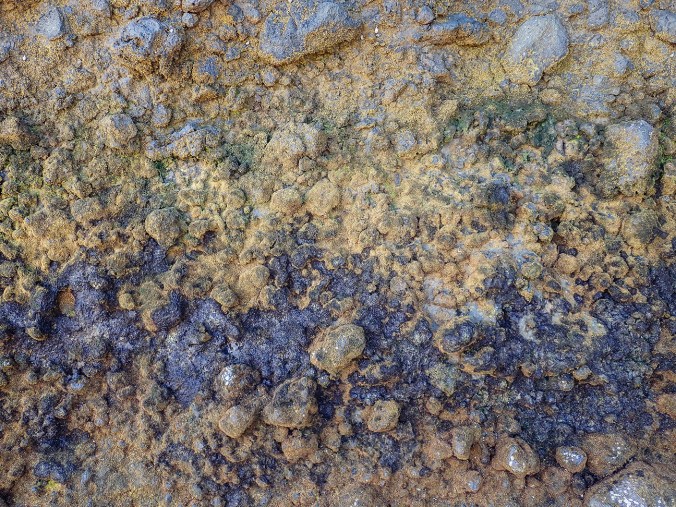
Then I sailed to these islands in the Gulf of Panama where there are 15-foot tides. Twice each day the receding water exposes an undersea province of stone that speaks an archaic language revealing the origin of these islands millions of years ago.  OLYMPUS DIGITAL CAMERAorange rock.meOLYMPUS DIGITAL CAMERALast night was the Super Moon and it brought extraordinarily low tides to my anchorage at Isla de Fuenche. Many of the exposed rocks are ancient coral reefs that have been pushed to the surface of the ocean by tectonic forces. Geologists call it “marine sedimentary limestone,” but what I see in these rocks is fossilized proof of life. I see an imprint in a boulder where brain coral was once attached. Individual coral polyps are etched into the surface. What is now static was once alive. Millions of life forms lived right here. There were communities. Some colonies thrived while others struggled and then simply died out. The life and death recorded in these ancient coral reefs parallels the life cycle of the human beings who settled on these islands.flying fish platanal.smPanama is a young landmass, relatively speaking. The rise of the isthmus three million years ago was the “last big episode of global change,” according to former Smithsonian Geologist Tony Coates, who has also written that the changing shape of Panama played a significant role in ocean circulation coinciding with the last Ice Age. Three million years ago was the Pleistocene Epoch when glaciers covered huge parts of the earth. One could argue now that the melting of the glaciers are an indication of the next “big episode of global change.”

There are no active volcanoes in Las Islas Perlas as there are in other parts of Central America, but as I look out beyond my anchorage I see volcanic history. The hilltops on some of the islands rise in sharp conical shapes. But, because of these rocks, erosion has not yet worn down the islands. The geological youth of these islands creates a spectacle at low tide. Mounds of basaltic lava have melted into layers of black obsidian separated by volcanic ash creating an unpredictable–and beautiful–patchwork of strata and uplifted angles.


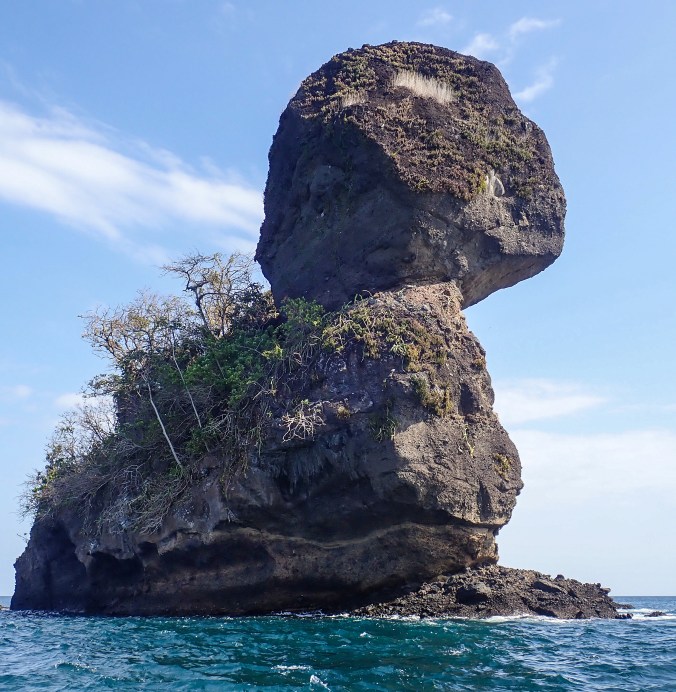
On Isla San Jose, I talked with a local fisherman about a distinctive rock offshore called The Monkey. It is a round boulder weighing tons and it balances improbably atop a rocky base that rises over 100 feet out of the ocean. I struggle with my Spanish when I ask the fisherman for an explanation. I start to say, “How is it possible…” He cuts me off with a wave of his hand. “Como…? Digame.” — “How…,” he says? “You tell me.”

OLYMPUS DIGITAL CAMERA

It would be good to be a student of rocks, but even a curious person can’t know everything. The acclaimed American writer Rick Bass (from whom I swiped part of the title to this essay) is a trained geologist who can look at a layer of strata and clearly describe its geological origin. My eyes just see pattern, shape, and color in rock formations that seem beyond possibility.

The secrets of rocks are withheld in antiquity. Three million years ago on this little island as the continents shifted the sky rained fire and molten rock and ash. I cannot imagine the mayhem here as the earth changed. But the rocks remember. And in their own way of communicating they are trying to explain it to us.

Track the passage of Flying Fish here: https://forecast.predictwind.com/tracking/display/Flyingfish

Moving Slowly

Version 2

A blossom from the White Shaving Brush tree.  Photos: © Jeffrey Cardenas

I am moving slowly, focused today on the extraordinary detail and variance of nature that make up the land and sea—and people—of Las Perlas.

In every exhibition of natural beauty there is an incongruity that seems to accompany it. Example: The Panamic Cushion starfish is a carnivore with an arsenal of hydraulic tube feet, but its five arms are vulnerable. If one arm is attacked or damaged this sea star has remarkable regenerative powers to re-grow a new one. The White Shaving Brush tree has razor-sharp, inch-long thorns on its trunk and branches but it blossoms into a flower of fragrant and delicate white stamens. The flower bursts open with a popping sound at night but by noon the next day the flower is finished and it drops gently to the sand. Three million years ago colliding tectonic plates pushed up these islands and an ancient reef rose to the surface creating a land bridge between the Americas. The rocks of Las Perlas exhibit both an historic record of this cataclysmic event and a lasting vision of natural art.

This is a reality check of new sights, scents, and sounds. It reminds me that everything is changing and nothing is as simple as it seems.

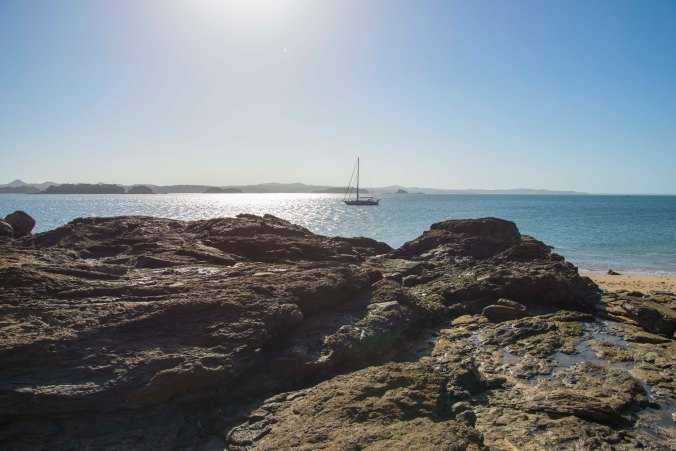
Flying Fish is anchored near the remote Isla Espiritu Santo. This is a beautiful but foreboding coastline. A 15-foot tide hides jagged rock outcroppings that rise without warning out of great depths to the surface of the Pacific. Many of these rocks are uncharted. And, in areas near the big island of Isla Del Rey where streams drain into the ocean, the water is turbid. Visual navigation is essential here. I move slowly.

Also unsettling along this coastline are the geographic names given to the islands. Entire civilizations of indigenous people were wiped out here by Spanish conquistadors. The charts read Punta Matadero (Slaughterhouse Point), Punta Mala, and Isla Entierra Muerto (Island of the Buried Dead).

Author and cartographer Eric Bauhaus made a brief entry in a guidebook noting the remains of a whaling station lost in the jungle near Isla Espiritu Santo. The station was set up long after the Indians were gone and now it, too, has disappeared under the dense forest and wild tangled mass of vegetation on Isla Del Rey.

I take the dinghy ashore. Fragments of pre-Columbian pottery have been found on this beach. Steam rises from the wall of vegetation that borders the sandy beach. The jungle is impenetrable without a machete. There are plenty of tools aboard Flying Fish but who would have thought to bring a machete? A local mariner, that’s who. Every fisherman aboard the passing cayucos (dugout canoes) carries a machete.

By a small fresh water stream I see a familiar leaf in the wall of vegetation. There is an ancient mango tree growing here. I push my way forward through the tangle and when I reach the tree I see that all undergrowth below the mango tree has been cleared. Excitedly, I see a brick, and then a hand-hewn piece of wood. When I look closer, however, the brick is only a rock, and the wood is not timber–it is simply driftwood etched by the sea and pushed up into the jungle by a storm. I find no remains of a whaling station, or the indigenous people who once lived here. Just as well. I don’t need to see any bones on Isla Entierra Muerto.

Nearby, in the isolated fishing village of Cañas on Isla Del Rey all eyes stare at Flying Fish as I sail into the bay. Men lying in hammocks under the palms trees watch me silently and without welcome as I wade ashore. They offer no response to my greeting in Spanish. I can only imagine their thoughts. “What now? What does this odd looking stranger want with us?”

Then, around the corner of a house a little girl breaks the tension and hands me a stalk of bananas. Another little girl shyly offers me a basket of sour oranges. I realize the most beautiful detail in nature can be the simplicity of a child’s innocent smile.

Track the passage of Flying Fish here: https://forecast.predictwind.com/tracking/display/Flyingfish

Las Perlas

OLYMPUS DIGITAL CAMERA

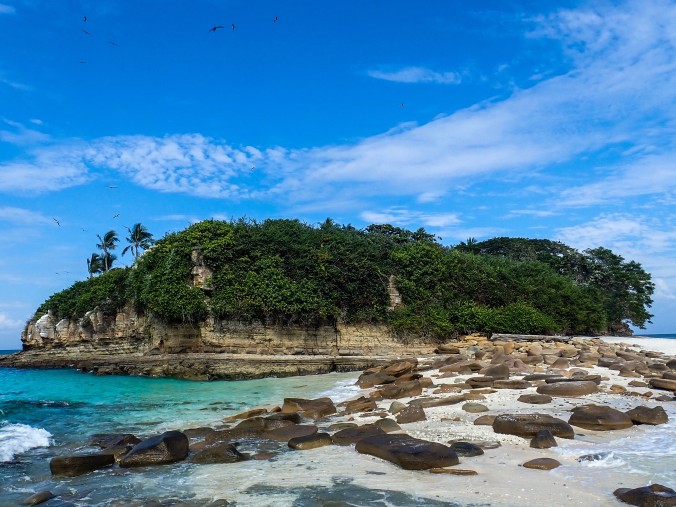
Isla Bartolome in the Las Perlas Archipelago on the Pacific Coast of Panama is truly a rare gem.  Photo: © Jeffrey Cardenas

Today I entered the Pacific Ocean, and for Flying Fish it is exciting new water.

Just 30 miles from the coastline everything has changed. The sea is clear and full of life. There are whales and tuna. More than 200 islands make up the 90 square miles of Las Perlas. The islands are built upon a living reef that is rich with tropical fish. I snorkeled today amid a school of several hundred snapper that were completely unconcerned by my presence. Along the shoreline, hardwood jungles come down to sugar sand beaches. Thousands of orchids cover the trees in this maritime habitat. There is a stunning tree in bloom now called guayacan that is a solid mass of electric pink flowers. Shells cover the beaches. The islands are named for a history of pearls that were once found here in abundance.

Of course, in this part of the world there is always a dark history that seems to cast a shadow on paradise. Spanish conquistadors Gaspar de Morales and Francisco Pizarro invaded these islands which were ruled then by King Toe (yes, King Toe). The pearl beds were looted and the indigenous people were extinct by 1518. One notable pearl survived, La Peregrina, the largest pearl ever discovered. An African slave found this perfectly symmetrical 56-carat teardrop pearl on the island of Santa Margarita and La Peregrina made its way through the various treasuries of European Royalty before ultimately ending up in the jewelry box of Elizabeth Taylor, a gift from her husband Richard Burton. (Historical note: Elizabeth Taylor once lost La Peregrina. After some anguished searching she looked down at her puppy who was happily chewing on the world most famous pearl.)

The modern history of Las Perlas is as bizarre as its past.

In 1979, The Shah of Iran went into exile on the island of Contradora in Las Perlas. Panamanian Dictator General Omar Torrijos had taken in Shah Mohammad Reza under heavy American pressure because the U.S. didn’t want him in New York. Panamanians rioted. Torrijos made no secret of his dislike of the Shah, calling him a chupon, a Spanish term meaning an orange that has had all the juice squeezed out of it. Torrijos taunted the Shah of Iran by telling him “It must be hard to fall off the Peacock Throne and into Contadora.”

Later, the Las Perlas slipped onto obscurity until the islands were discovered as a reality TV destination. More than a dozen shows were produced here including the American television show Survivor which filmed three episodes in Las Perlas. Most notable, however, was a Dutch reality TV show called Adam Seeks Eve. It was promoted as a “unique love experiment.” In the production of Adam Seeks Eve everybody is naked, of course, but the twist comes midway in each episode when a “second candidate” (also naked) is introduced to compete for the affection of main character. Deserted island drama ensues.

Flying Fish is anchored in the lee of Contradora today. The Shah of Iran gone, he died in 1980. There are a few naked people on the beach in front of me, just regular French nudists, fortunately no TV cameras. I may just stay right here until I get voted off the island.

Track the passage of Flying Fish here: https://forecast.predictwind.com/tracking/display/Flyingfish