Las Perlas

OLYMPUS DIGITAL CAMERA

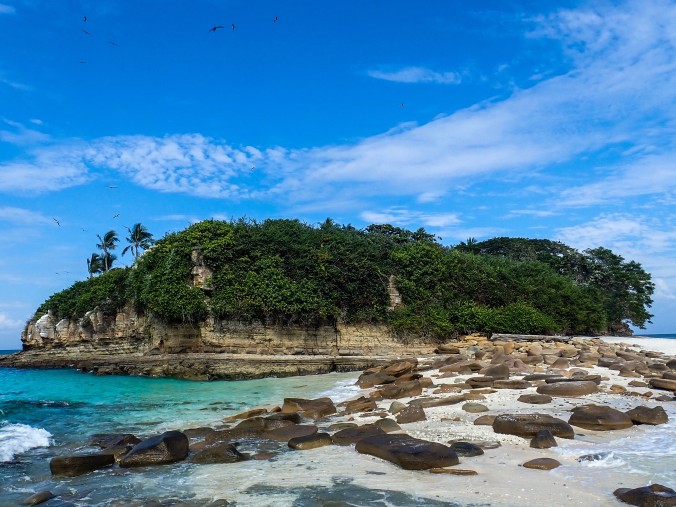
Isla Bartolome in the Las Perlas Archipelago on the Pacific Coast of Panama is truly a rare gem.  Photo: © Jeffrey Cardenas

Today I entered the Pacific Ocean, and for Flying Fish it is exciting new water.

Just 30 miles from the coastline everything has changed. The sea is clear and full of life. There are whales and tuna. More than 200 islands make up the 90 square miles of Las Perlas. The islands are built upon a living reef that is rich with tropical fish. I snorkeled today amid a school of several hundred snapper that were completely unconcerned by my presence. Along the shoreline, hardwood jungles come down to sugar sand beaches. Thousands of orchids cover the trees in this maritime habitat. There is a stunning tree in bloom now called guayacan that is a solid mass of electric pink flowers. Shells cover the beaches. The islands are named for a history of pearls that were once found here in abundance.

Of course, in this part of the world there is always a dark history that seems to cast a shadow on paradise. Spanish conquistadors Gaspar de Morales and Francisco Pizarro invaded these islands which were ruled then by King Toe (yes, King Toe). The pearl beds were looted and the indigenous people were extinct by 1518. One notable pearl survived, La Peregrina, the largest pearl ever discovered. An African slave found this perfectly symmetrical 56-carat teardrop pearl on the island of Santa Margarita and La Peregrina made its way through the various treasuries of European Royalty before ultimately ending up in the jewelry box of Elizabeth Taylor, a gift from her husband Richard Burton. (Historical note: Elizabeth Taylor once lost La Peregrina. After some anguished searching she looked down at her puppy who was happily chewing on the world most famous pearl.)

The modern history of Las Perlas is as bizarre as its past.

In 1979, The Shah of Iran went into exile on the island of Contradora in Las Perlas. Panamanian Dictator General Omar Torrijos had taken in Shah Mohammad Reza under heavy American pressure because the U.S. didn’t want him in New York. Panamanians rioted. Torrijos made no secret of his dislike of the Shah, calling him a chupon, a Spanish term meaning an orange that has had all the juice squeezed out of it. Torrijos taunted the Shah of Iran by telling him “It must be hard to fall off the Peacock Throne and into Contadora.”

Later, the Las Perlas slipped onto obscurity until the islands were discovered as a reality TV destination. More than a dozen shows were produced here including the American television show Survivor which filmed three episodes in Las Perlas. Most notable, however, was a Dutch reality TV show called Adam Seeks Eve. It was promoted as a “unique love experiment.” In the production of Adam Seeks Eve everybody is naked, of course, but the twist comes midway in each episode when a “second candidate” (also naked) is introduced to compete for the affection of main character. Deserted island drama ensues.

Flying Fish is anchored in the lee of Contradora today. The Shah of Iran gone, he died in 1980. There are a few naked people on the beach in front of me, just regular French nudists, fortunately no TV cameras. I may just stay right here until I get voted off the island.

Track the passage of Flying Fish here: https://forecast.predictwind.com/tracking/display/Flyingfish
 

The Panama Canal

Panama Canal Transit.sm

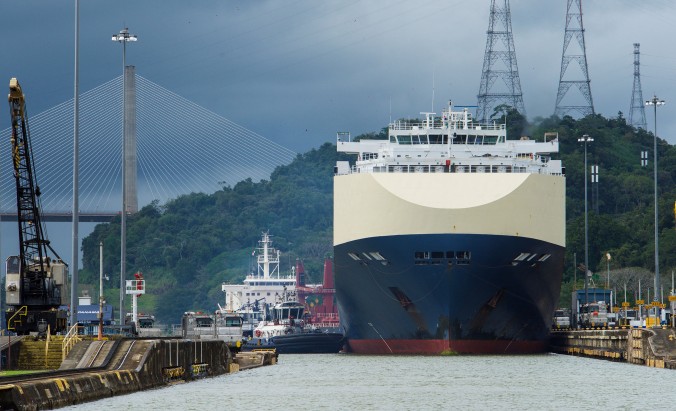
A Panamax cargo ship containing 5,000 automobiles is maneuvered to within several feet of Flying Fish in the Miraflores Locks of the Panama Canal. Photo: © Jeffrey Cardenas

So much has been written about the Panama Canal and yet nothing can prepare a sailor for what he sees and he feels when making a first transit in his own vessel.

The Canal is an engineering endeavor that has been compared to the construction of the pyramids. It has been named one of the Seven Wonders of the Modern World. Author David McCullough called it, “one of the supreme human achievements of all time.”

It has also been called the “greatest liberty ever taken with nature.” The loss of biomass when this 48-mile swath was cut between two oceans is incalculable. Mountains were moved, the land bridge between the north and south American continents was severed, and more than 150 square miles of pristine jungle was submerged under a new man-made lake.

Finally, there is the loss of human life. Some 27,000 men and women died to make this canal. They died of malaria, and yellow fever, and the bubonic plague. Workers died in dynamite blasts, crushed under tons of rock by landslides, and poisoned by the venomous bites from the spiders and snakes that they were displacing.

I don’t pass lightly as I transit the Panama Canal in Flying Fish.

To put some of this in perspective here is an abbreviated historic timeline: The earliest mention of a canal across the Isthmus of Panama dates back to 1534, when Charles V, Holy Roman Emperor and King of Spain, ordered a survey for a route through the Americas that would ease the voyage for ships traveling between Spain and Peru.

In 1788, U.S. interest was first expressed when Thomas Jefferson encouraged a canal as a less treacherous route than going around the southern tip of South America.

Beginning in 1826, U.S. officials began negotiations with New Grenada (present-day Colombia), hoping to gain a concession for the building of a canal. Fearing (correctly) that his country would be dominated by an American presence, president Simon Bolivar declined American offers.

In 1877, Lucien Napoléon Bonaparte Wyse surveyed the route for France and negotiations were completed with Colombia to build the Canal. The French, however, were unprepared for the rainy season during which the Chagres River became a raging torrent rising up to 35 feet over its banks. Black clouds of mosquitos emerged from the standing water and thousands of Canal workers died of yellow fever and malaria. The French effort went bankrupt in 1889, after spending $287 million, losing an estimated 22,000 lives to disease and accidents, and wiping out the savings of 800,000 investors.

Seeing an opportunity, the United States stepped into the void in 1903, and encouraged a coup d’état on the isthmus. U.S. warships blocked sea lanes preventing Colombian troops sent to put down the rebellion. The new country of Panama declared independence on November 3, 1903. President Theodore Roosevelt famously stated, “I took the Isthmus.” The New York Times called it an “act of sordid conquest.” The New York Evening Post said it was a “vulgar and mercenary venture.” It is often cited as the classic example of U.S. gunboat diplomacy in Latin America.

The construction of the Canal was completed in 1914, some 401 years after Panama was first crossed by Vasco Núñez de Balboa. The United States spent almost $375 million to finish the project. It was by far the largest American engineering project to date. The Panama Canal joined the Atlantic and Pacific oceans, changing international trade forever. The 48 mile-long pathway through the Isthmus of Panama created a significant shortcut enabling ships to avoid the lengthy and hazardous Cape Horn route around the southernmost tip of South America via the Straits of Magellan.

After World War II, U.S. control of the canal and the Canal Zone surrounding it became contentious. Relations between Panama and the United States were increasingly tense. Many Panamanians felt that the Canal Zone belonged to Panama.

In 1974, negotiations toward a settlement began. On September 7, 1977, the treaty was signed by United States President Jimmy Carter and Panama’s de facto leader Omar Torrijos. After a period of joint American–Panamanian control the Canal was taken over in 1999 by the Panamanian government and is now managed and operated by the Panama Canal Authority.

Since the Torrijos-Carter treaty in 1977, the Canal has been officially and permanently neutral, providing service to ships of all nations. This means that if any nation were to attempt to seize the Canal, every other nation in the world would, presumably, defend it. Panama has no military, nor do they need one, to protect the Canal.

It was estimated in 1934 that the maximum capacity of the Canal would be around 80 million tons of shipping per year. Canal traffic in 2015 reached 340.8 million tons. An expanded Canal began commercial operation on June 26, 2016. New locks now allow transit of larger, Post-Panamax ships, capable of handling more cargo. The expansion has cost nearly $6 billion. All vessels crossing the Canal must pay a toll based on their weight and length. The largest ships now pay well over $1 million to transit. In 1928, American adventurer Richard Halliburton swam the length of the Panama Canal. His rate to transit was 36 cents.

This is the paradox of the Panama Canal. Modern engineering wonder. Environmental holocaust. Graveyard for tens of thousands of people. And yet, superlatives alone cannot accurately describe the feeling of transiting the Canal. To be upon these waters in Flying Fish was simply humbling.


Track the passage of Flying Fish here: https://forecast.predictwind.com/tracking/display/Flyingfish
Río Chagres, Panama

OLYMPUS DIGITAL CAMERA

The Río Chagres is the only river on earth that flows into two oceans–the Atlantic and the Pacific

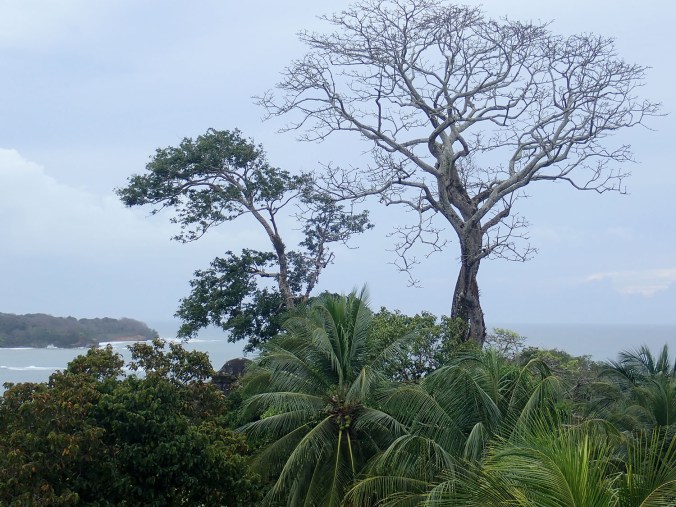
At the mouth of the Río Chagres on the Atlantic side of the Isthmus of Panama all that remains of what was once a thriving indigenous community and critical point of defense are the crumbling walls of the fortress of San Lorenzo. Rainforest has overgrown the coral rock fortifications. The edges of the jungle echo with riotous flocks of green parrots and the unearthly guttural roar of howler monkeys.

Flying Fish is staged at the entrance to the Panama Canal, waiting for transit. We are not alone. Dozens of ships are queued offshore including massive Post-Panamax container ships, some of which are longer than 1,200 feet. The Canal operates 24/7, every day of the year. The Canal pilots and advisors, however, do not. Many have cancelled their transit assignments over the holidays. One Canal agent today said that it has caused “chaos” at the Canal Authority.

Chaos is not a good way to start a new year. Which is why I chose to spend my downtime in the Río Chagres rainforest.

The Río Chagres is one of the most important rivers in the world and yet it remains relatively unknown despite its history and current global significance. Some 80% of the water that is needed to operate the Panama Canal originates from the Río Chagres watershed. Each boat that crosses the locks needs about 52 million nonrecoverable gallons of fresh water and the Chagres provides it.

Despite its industrial use to the Canal, this watershed is rich in biodiversity. The Río Chagres National Park includes 320,000 acres. In a 1996 Audubon Society annual census there were 525 species of birds recorded here on just one day. There are said to be more species of plants here than in all of Europe. Jaguars, anteaters, coati, and troops of monkeys inhabit this dense, dark, and wet environment.

The river and its habitat have borne witness to an extraordinary history of human greed, agony, and ingenuity. The Río Chagres valley contained rich veins of gold until it was removed by Vasco Núñez de Balboa in 1513. When the Chagres gold was gone the Spaniards turned their attention to Peru and shipped that treasure back to the Old World along a trade route that included the Chagres. More gold fever came centuries later when a nugget was discovered in California and thousands of miners transited the Chagres as they crossed the isthmus to the Pacific.

Today water from the Río Chagres carries the bulk of the world’s trade goods–another form of gold–across the 50 miles between two great oceans.

Tomorrow the Río Chagres may carry Flying Fish from the Atlantic to the Pacific.

For this moment I am content to sit in the solitude of this jungle and listen to the song of a toucan.

Weird Stuff About the Ocean

Weird Stuff About the Ocean will be a random post, on the rare occasion that I have a wifi signal and there is nothing to repair aboard Flying Fish.

Today’s post even has a connection to the Holidays. From Nell Greenfieldboyce at NPR comes the story of a giant blue whale eyeball being gifted to the Animal Eyeball Lab at the University of Wisconsin Madison.

The eye, floating in a jar of preservative for 30 years, was part of a private collection that needed a new home. The Animal Eyeball Lab had some 50,000 specimens in their collection but nothing like this.

A beleaguered Postal Service carrier this week delivered a soggy white box wrapped in duct tape to the University. When the staff opened the package at the lab and beheld the dripping gray mass one scientist said, “It’s the best Christmas ever!”

NPR’s report is embedded here: https://www.npr.org/player/embed/572299263/573046527

Piracy: Then and Now

portobelo boats2sm

The public wharf at Portobelo, Panamá with two local boats, Benedicion por Dios (Blessed by God) and Pirates

In an outdoor bar on the historic waterfront of Portobelo, Panamá I watch as a sailor shuffles out of his dinghy and slumps into a seat at a table next to mine. A waiter is quick to bring him a steaming mug of coffee. As the sailor shovels his seventh spoonful of sugar into the cup I ask, “Tough passage?”

“You could say that,” he says, in a thick eastern European accent.

“A few weeks ago I was boarded by 20 guys in three go-fast boats 35 miles offshore between the Nicaraguan coast and the island of Providencia. They ransacked my sailboat, in the middle of the day, taking everything of value—money, computers, electronics. They wanted drugs, which of course I didn’t have. I’m just a guy from Poland sailing my boat in the Caribbean.”

He is Jarek Glistak, a singlehanded sailor aboard the 44-foot sloop Draga (Darling).

After a terrifying hour looting the boat the pirates gave him back a laptop and portable GPS so that he could navigate to land. He reported the incident to Colombian officials upon his arrival in Providencia.

Sailors’ stories are sometimes just that—tall tales. But there is an organization called The Caribbean Safety and Security Net (CSSN) that monitors incidents such as these and their reports confirmed the details of this event happening in the disputed waters off the Honduras/Nicaragua border about six weeks ago. In fact, CSSN reports that there were four other incidents of piracy this year alone in this remote area of the Caribbean.

Jarek has finally made his way to Portobelo as he tries to reorganize his life. He said he is “scarred” from the attack but thankful that he was left with his Darling, and his life.

Portobelo has a rich history of piracy that dates back to the 1500s when this port was the transshipment center for the gold, silver, and precious jewels looted by the Spaniards from the New World.

Sir Francis Drake was considered one of the most ruthless privateers to prey upon the treasure galleons in Portobelo’s harbor. He was slave trader who went on to be a famed circumnavigator and knighted by Queen Elizabeth I. To the Spaniards he was simply a cold-blooded pirate known as “The Dragon.”

He was 55 when he died. The official cause of death was dysentery. Drake was interred in a lead casket that was dumped into the bay at Portobelo. There is speculation that he may have still been breathing when the coffin went overboard.

No trace of the lead coffin has ever been found but it is likely somewhere in the vicinity of where Flying Fish lays at anchor tonight in Bahia de Portobelo.