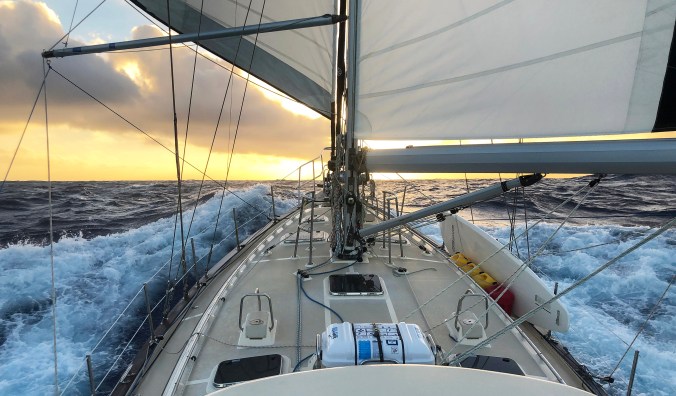
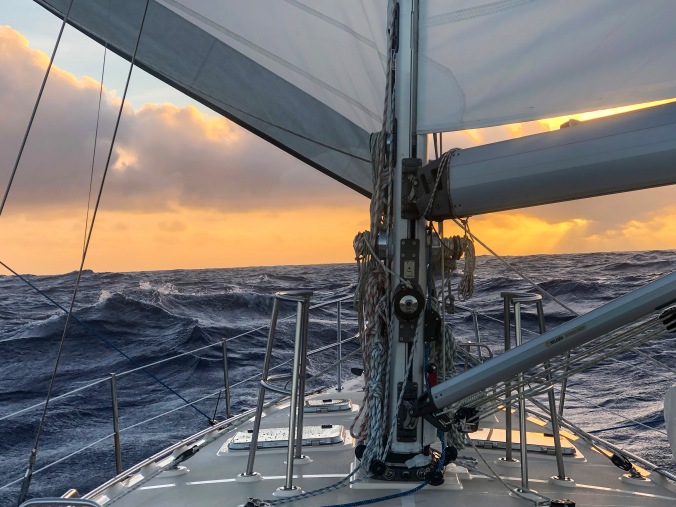
Flying Fish running hard before the wind on passage from Vanuatu to Australia. © Jeffrey Cardenas
There is a peculiar rhythm to a sailing passage. It often takes a few days for a sailor to become completely in synch with the boat. The ocean is a foreign environment for human beings, but that is exactly why some of us go to sea. We want unpredictability, to break out of routine, to be surprised. Be careful what you wish for.
Log Entry / 22 June 2019–Underway!
Flying Fish is departing Mele Bay, Vanuatu for Cairns, Australia 1,326 nautical miles west. I am making a rare sunset departure on this passage but weather conditions are perfect–a clear sky and 15 knots of tradewinds from the east. I am rested and eager to sail. As the light fades there is a bright but waning moon over the island of Efate. Low tide and an offshore breeze fill the air with the fecund aroma of Vanuatu’s rich volcanic earth.
Log Entry / 23 June–A quick nap on the first night offshore and erratic dreams crowd my subconscious. Why can’t they be erotic dreams instead? I wake with a shutter convinced that there is an oversized wharf rat scuttling across the cabin floor of Flying Fish. Of course there is no rat, but the dream was so vivid. Why a rat dream? Where is that coming from? This passage feels different. There is a sense of foreboding. Careful, careful, careful…
Despite the bizarre dreams, there is a sublime reality to the beginning of this passage. I love the feeling of all three sails on this cutter pulling tightly together on a broad reach over an easy sea. Flying Fish moves through the water like music; there is the pitch of the wind, the tempo of the boat’s motion among the waves. When all the sails are trimmed correctly Flying Fish sings along in the key of the sea.
Log Entry / 24 June––There is a change in the weather. It is expected but not welcomed. Wind gusts push over 30 knots and are combined with increasing sea conditions. The course to Australia is due west but a strong swell is developing from the south. Waves are hitting the boat broadside.
The concern is not the strength of the wind, or the size of the seas. At issue is swell direction. The tops of some waves are breaking. I cannot push out of my mind the freak wave that knocked down Flying Fish–mast horizontal to the water–on her passage north from New Zealand in April. I understand now that wave was an aberration. But it is like being bitten by a friendly dog–you know it’s (probably) never going to happen again but the memory of it leaves you wary.
Log Entry / 25 June––Proximity alarms integrated into my electronics alert me to a 1,000-foot merchant vessel on an intercepting course with Flying Fish. The massive ship with the decidedly unromantic name of FPML B 104, en route to Taiwan, diverts to pass several hundred meters astern of Flying Fish . I make radio contact with FPML B 104 but our communication is lost in translation.
I am fully into the rhythm of the passage now. The boat is pitching and rolling but my body is moving with the sea instead of against it. It is a bizarre dance, a dance that always leaves one hand free for the boat. Despite the rough sea conditions I manage to take a much needed shower. Inspired to achieve even greater things, I bake three loaves of banana bread in the wildly swinging gimbaled stove. It is a triumph, considering I don’t know how to cook. I feel like a Renaissance Man.

Log Entry / 26 June 2019––I awaken from a short nap to the screeching sounds of birds. Birds? Seven hundred miles from land? Clearing my eyes I look into the ocean and it is teeming with life. Gannets are diving on whorls of sardines that are being driven to the surface by hundreds of ravenous yellowfin tuna. As far as my eyes can see there is a predatory maelstrom. It seems at first as if this must be another dream… but no, a blast of spume from a beaching humpback whale reinforces reality in the ocean surrounding me.
Let there be life! Acres of tuna boil on the surface devouring sardines in a spectacle worthy of the Roman Coliseum. My automatic reflex is to drop back the fishing lines. I hesitate. These fish have somehow avoided the commercial factory boats scouring this part of the Pacific Ocean. I let the tuna enjoy their meal of sardines unmolested. I already have enough food onboard.
Log Entry / 27 June 2019–I am euphoric. I am 63 years old, in the prime of my life, alone in the Coral Sea, driving a magnificent sailboat toward Terra Australis. I am abashed to admit that the phrase King of the World enters my consciousness. It is a privilege and a blessing to be here now.
And then I am bleeding badly.
I am in the galley of Flying Fish at midnight celebrating my good progress and making a cup of hot chocolate when the sudden roll and lurch of the boat causes a heavy hatch board to become dislodged from the companionway and it flies with great velocity, edge first, onto my bare right foot, nearly severing a toe.
I switch on a light and I am astounded by the amount of blood pooling under my foot. I don’t like the sight of my blood. In 30 knots of wind and 12-foot seas the boat is twisting and turning and jumping like a bad carnival ride. The pain in my foot is mind-numbing. I’ve got to stop the blood flow. I grab a wad of paper towels and press them between my toes. Ouch! Then I am on my back on the floor of the cabin looking at the ceiling and seeing stars. I reach for my satellite phone. In Key West my wife Ginny is drinking coffee and reading the newspaper. “How much blood does a person have in their body?” I ask, as I explain the injury. Compassionately, and without hesitation from 12,000 miles away, she says, “Get your foot up. Now. Over your head.”
My friend and surgeon, Dr. Byron Bailey, helped me outfit a medical emergency kit for Flying Fish. He provided a surgical staple gun for times like this. We practiced with it on a skinless chicken breast in his kitchen. I know I need to close this wound but the thought of powering staples into my toe right now is nauseating. I change out the wad of paper towels instead and stare at the spinning ceiling of the cabin while the boat races forward on autopilot, through the night.
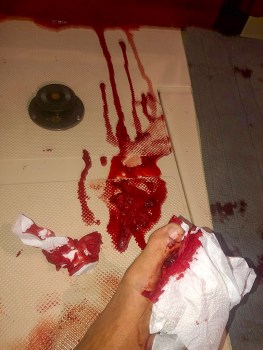
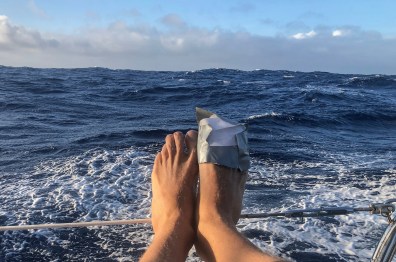
Log Entry / 28 June––Fuck my foot hurts!
Morning. I am still on my back on the floor of the cabin with my bloody foot resting on the companionway steps above my head when my eyes open to first light. The cabin sole looks like the floor of a slaughterhouse. I hobble upright. The boat is still on course but I am in the shipping lanes and there is traffic–the AIS signature of three merchant ships light up the chart plotter. The wind is still 30 knots. And Flying Fish is tearing across the open ocean like an ambulance on its way to the hospital. I am still more than 500 miles from shore.
Log Entry / 29 June–I must focus now. Oxycodone is calling me from my surgical kit but I cannot succumb. The shipping traffic is skirting an area of reefs to the west that I must sail through in the next 24 hours. Got to keep it together, got to stay sharp…
The Coral Sea is a patchwork of reefs. There is a dangerous spot called Atoll de la Surprise. The chart also marks numerous areas along my route as “Unsurveyed.” Another shallow patch is titled “Presumed Position of Sandy Island.” I do not want the presumed position of Sandy Island, I need to know the exact position of Sandy Island. The moon is waning now. The nights are darker.
Log Entry / 30 June–All night I hear breaking waves. My mind tells me to believe the instruments–I am in deep water–but my senses tell me that waves are breaking, just ahead, on jagged patches of coral.
Daylight reveals that the seas have increased to 15 feet and the wind remains gusting at 30 knots behind me. I am flying a triple reefed mainsail and the tiny shred of jib set wing-and-wing. Each swell lifts Flying Fish to the top of its crest and then sends her heavy hull with a traditional keel surfing down the face of the wave. The ensuing roar of 22 tons of sailboat exceeding hull speed sounds exactly like waves breaking on a reef.
Then at mid-day do I see waves breaking over coral. I cannot see any land but I know that these waves are breaking over one of the Seven Natural Wonders of Earth. I have arrived at Australia’s Great Barrier Reef.
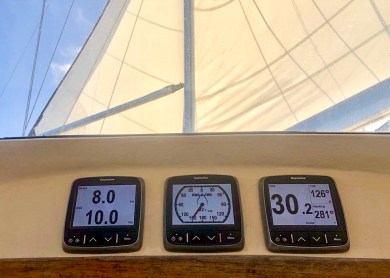
Whole Numbers–10 knots of boat speed surfing downwind in 30 knots made for a fast passage to Oz. © Jeffrey Cardenas
###
Please subscribe at the bottom of this page so that you don’t miss a new post, and consider sharing this post with others who might enjoy following the voyage of Flying Fish
To see where Flying Fish has sailed in the past year click here: https://cruisersat.net/track/Flying%20Fish
For current weather along the route click here: https://forecast.predictwind.com/tracking/display/Flyingfish
Text and Photography © Jeffrey Cardenas 2019




 Stella Maris Sail