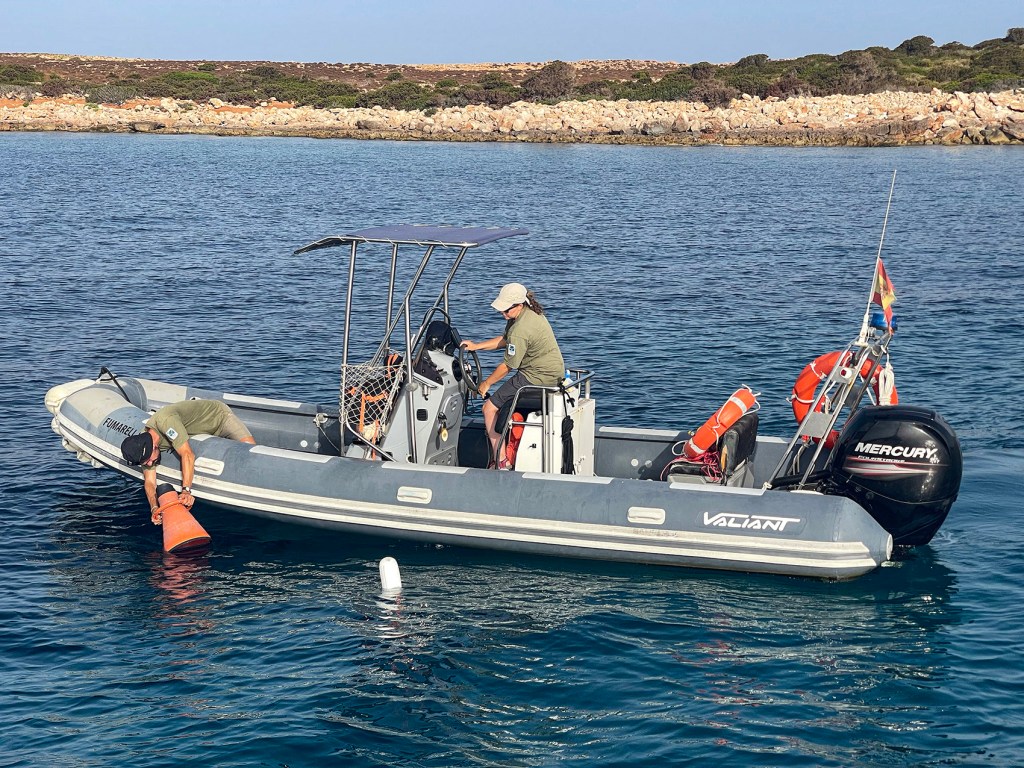
The Spanish Posidonia Police came calling on Flying Fish today. I was happy to see them.
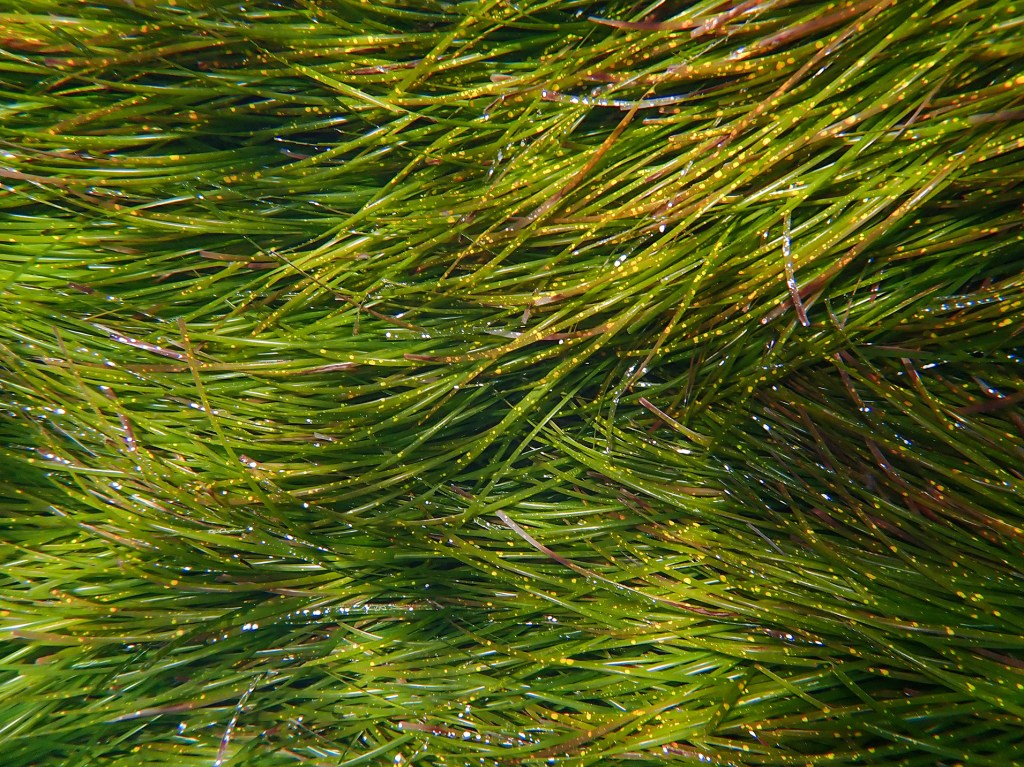
Posidonia is a seagrass species that is endemic to the Mediterranean Sea. Like the turtlegrass of the subtropic Americas and the Caribbean, Posidonia forms large underwater meadows vital to the ecosystem. The aquatic grass has a high carbon absorption capacity. It is said to soak up 15 times more carbon dioxide every year than a similar-sized piece of the Amazon rainforest.1 In 2006, a vast colony of Posidonia was discovered south of Ibiza and is estimated at around 100,000 years old. It may be one of the largest and oldest clonal colonies on Earth.2
Posidonia grows best in clean waters, and its presence is a marker for lack of pollution. It is found only in the Mediterranean Sea, where it is in decline. The UNESCO world heritage site around the Balearic Islands includes about 140,000 acres of Posidonia, which has global significance because of the amount of carbon dioxide it absorbs. The meadows are being threatened by rising temperatures, slowing its growth, as well as damage from anchors.3 The Posidonia meadows of Ibiza are fiercely protected. Drop an anchor on Posidonia, and you are breaking the law.
This is why it astonished me when I watched the superyacht Chuck Taylor drop its anchor in a bed of Posidonia at an anchorage on Mallorca that we were sharing. (I don’t know that it was the shoe guy Chuck Taylor; who would name a boat after themselves?) Nonetheless, I wish the Posidonia Police had been in the bay that day. When Chuck Taylor departed, an entire square yard of the living colony was impaled on the tines of its anchor.
Granted, anchoring in the Balearic Islands in July and August–especially during this post-lockdown year–is a challenge. Nowhere in the world have I seen so many boats, and so many inconsiderate boat operators, as I have here during the past two months. Because anchorage space is limited, boats battle for every square foot of sea bottom available without Posidonia. Many boats anchor regardless of the protected areas. Bays are so tightly packed that adequate anchor scope for holding is frequently compromised. Two nights ago, at 03:00, katabatic winds ripped through my anchorage at Benirràs, Ibiza, and tore the fleet apart. One sailboat dragging an anchor collided with two other sailboats, pulling their anchors from the bottom and sending them adrift. A boat ended up against a ragged rock wall. Two large powerboats also dragged and collided in the wind. In the darkness, shouts and curses in foreign languages echoed across the anchorage. Flying Fish somehow escaped the carnage, but the Posidonia meadow at Benirràs was most certainly plowed into oblivion by the dragging anchors.

The Posidonia meadows are carefully identified on every chart. This morning over coffee, in the lovely anchorage of the Illa Sa Conillera marine park, I was startled by a heated argument coming from two boats. The Posidonia Police had arrived and warned a visiting sailboat owner (for the second time) that he anchored on the protected grass. His anchor was crushing the habitat of plants, fish, and juvenile crustaceans. The sailboat captain maintained it was his “right” to anchor where he wanted. The park ranger explained otherwise. The argument increased in volume and acrimony, and continued for 30 minutes. Then the guilty sailor pointed at me. I was anchored nearby.
The Posidonia Police motored up to Flying Fish with an underwater viewing scope. I passed the inspection; my anchor was embedded in a pocket of sand, where I had carefully placed it when I arrived.
“May I take your photograph,” I asked?
“¿Por qué?” was the reply.
“Because,” I said, “I think what you are doing is important.”
###
References:
- Ibiza’s Monster Marine Plant, Ibiza Spotlight, 28 May 2006
- Oldest living thing on earth’ discovered, Jonathan Pearlman, The Telegraph. 7 February 2012
- Posidonia oceanica, Wikipedia
Sailing is not just about the wind and the sea; equally important are the places to which this boat takes me.
Please click Follow at the bottom of this page so that you don’t miss a new update, and please consider sharing this post with others who might enjoy following the voyage of Flying Fish. I welcome your comments. I will always respond to your comment when I have an Internet connection. And I will never share your personal information.
You can follow the daily progress of Flying Fish, boat speed (or lack thereof), and current weather as I sail into the Mediterranean by clicking this satellite uplink: https://forecast.predictwind.com/tracking/display/Flyingfish. Click the “Legends and Blogs” box on the right side of the tracking page for en route Passage Notes.
To see where Flying Fish has sailed since leaving Key West in 2017, click here: https://cruisersat.net/track/Flying%20Fish.
Instagram: FlyingFishSail
Facebook: Jeffrey Cardenas
Text and Photography © Jeffrey Cardenas 2021
Let this be a time of grace and peace in our lives –Fr. John Baker


 Stella Maris Sail