Kingdom of Fire

“Fire coral will be the last remaining living coral on earth.”

I remember writing those words once, in a bluster of prophetic arrogance. That’s not exactly the most positive Earth Day message to consider as I dive this week on a shallow reef in the French West Indies at Île Fourchue, Saint Barthélemy.

First of all, fire coral is not even a true coral. Instead, it is more closely related to hydra, a very small predatory animal similar to jellyfish and other stinging anemones. But, for the sake of consistency, I will still refer to it as fire coral.

Fire coral can be either blade-like or encrusting. It is colored a mustard-yellow to dark orange, often with white edges. It has strong stinging cells that on contact cause intense pain lasting from two days to two weeks. Relapses of inflammation, itching, and welts are common. Fire coral releases venom through tiny hairs called cilia. It is their only defense mechanism against predators, including thoughtless human beings. Do not touch it, or any coral.
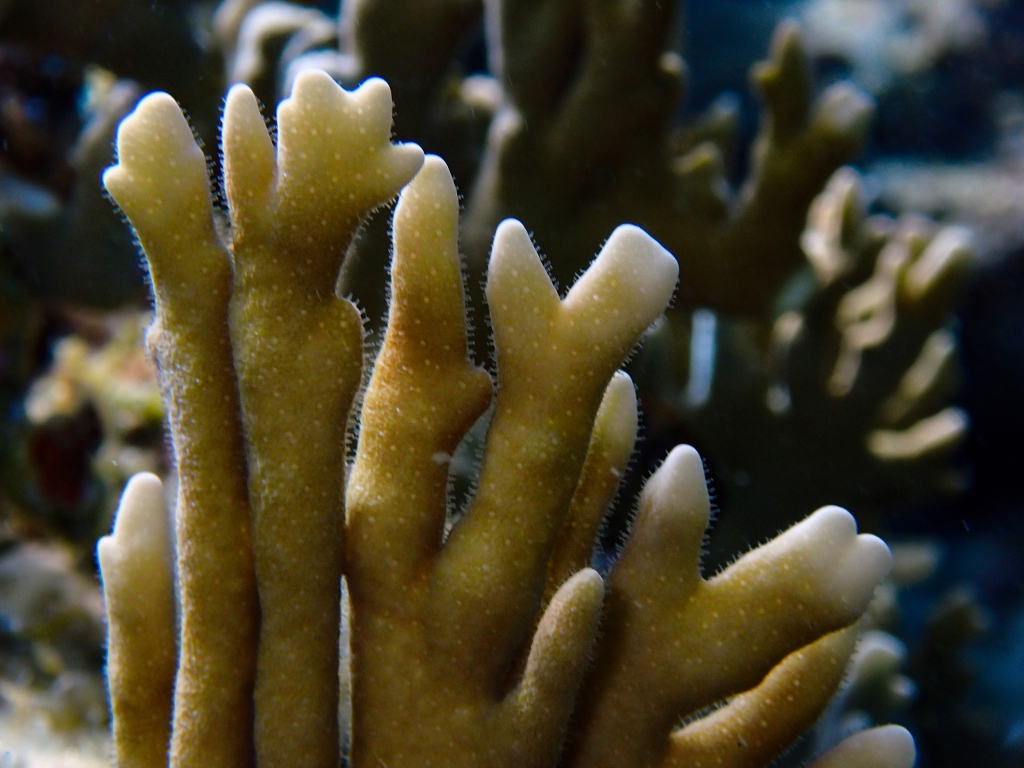
Microscopic venomous hair–cilium–inflicts intense pain that can last from two days to two weeks. Photograph: © Jeffrey Cardenas

Because fire coral has the unusual ability to grow in two different forms, some marine biologists believe it has a survival edge over other Caribbean corals. It can grow like a bush with a stem and branches sprouting upward, or in sheets that appear as a flat coating across rocks and other surfaces.

“Fire corals have been around for millions of years and what they are doing is pretty darn successful,” says California State University marine biologist Peter Edmunds. For the past 30 years, he has been traveling to the Caribbean to document the life history of fire coral on inshore reefs.

“They are now poised to be… the inheritors of the reef, while other corals, particularly stony corals, die back,” he said. ”When it’s not stormy, they can produce branches and exploit the light and plankton in the water. When it’s storming and everybody gets beaten up, it loses its branches but it still has its sheets, which it can use to spread out and claim more territory.”
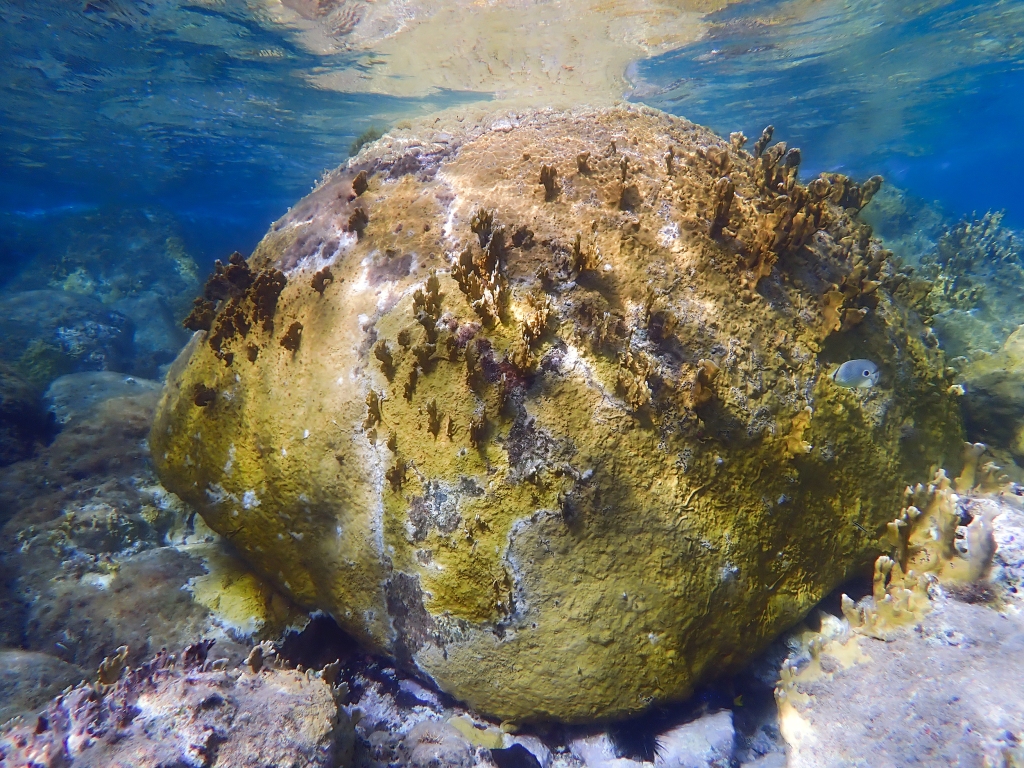
A sunken granite boulder near shore is slowly becoming encased in a sheathing of fire coral while fire coral branches take root and sprout from the surface of the dead rock. Photograph: © Jeffrey Cardenas

Researchers believe this adaptation may help save Caribbean reefs, which have been plagued by hurricanes, global warming, disease, and an overabundance of algae. Because fire corals are thriving as other corals die off, they are creating structures for fish and other organisms. Fire corals “are going to be very important habitat providers because they are able to survive under these stresses,” says Colleen Bove, a marine ecologist at Boston University.

But fire coral is not bulletproof. Some species have brittle skeletons that can easily be broken during storms, by anchors, or by careless divers and collectors who are taking fish for the aquarium trade. I watched blueheaded wrasse spawn over fire coral. Rock beauties, butterfly fish, yellow tangs, and the aggressive beau gregory retreat into branches of fire coral when threatened. In Brazil, fire coral colonies are extensively damaged by divers harvesting yellowtail damselfish. The fire coral is deliberately smashed and the fish hiding among the branches are captured in plastic bags.

Bluehead wrasse spawn at midday on a full moon over a pinnacle of fire coral at Île Fourchue, Saint Barthélemy in the French West Indies Video © Jeffrey Cardenas

Reproduction in fire corals is more complex than in other reef-building corals. The polyps reproduce asexually, producing the jellyfish-like medusae. These contain the reproductive organs that release eggs and sperm into the water. Fertilized eggs develop into free-swimming larvae that will eventually settle on the substrate and form new colonies. 

Most divers wouldn’t mind seeing less fire coral on the reef, but I like to think of fire coral as a tactile warning to tread more carefully underwater. When the alternative may be a reef of dead rock, the sting of fire coral is a potent reminder that there is still life on that reef. And, it is one of the few ways the habitat has of fighting back.
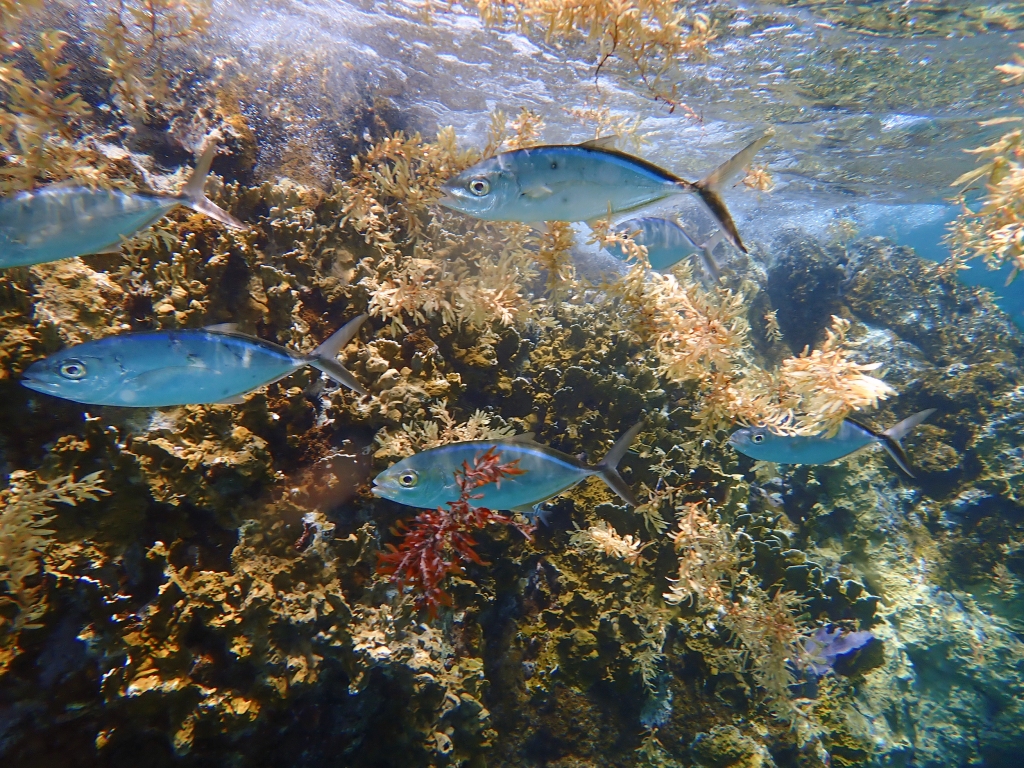
Blue runners feed amid clusters of sargasso being swept over a West Indian reef of fire coral. Photograph © Jeffrey Cardenas

As always, sailing is not just about the wind and the sea; the places, the flora, fauna, and people encountered along the way are equally important.

Please click “Follow” so that you don’t miss a new update,- and please consider sharing this post with others who might enjoy following the voyage. I welcome your comments and will always respond when I have an Internet connection. I will never share your personal information.

Instagram: StellaMarisSailing / Facebook: Jeffrey Cardenas

Text, Photography, and Videos © Jeffrey Cardenas 2024

Let this be a time of grace and peace in our lives – Rev. John C. Baker

Breathe In, Breathe Out…

I am anchored tonight next to an island blowhole.

As ocean swells from a distant storm meet the iron rock shoreline, water travels under great force through a labyrinth of ancient passages in the limestone until it emerges as a fountainhead roaring with a blast of sea air.

Breathe in, breathe out… I will sleep in peace listening to this tonight.


A secluded anchorage with a hydrodynamic soundtrack. Turn up the volume…

Thanks for sailing along with Stella Maris.

As always, sailing is not just about the wind and the sea; equally important are the places, the flora, fauna, and people encountered along the way.

Please click “Follow” so that you don’t miss a new update,- and please consider sharing this post with others who might enjoy following the voyage. I welcome your commentsand I will always respond when I have an Internet connection. I will never share your personal information.

Instagram: StellaMarisSailing
Facebook: Jeffrey Cardenas

Text, Photography and Videos © Jeffrey Cardenas 2023

Let this be a time of grace and peace in our lives”   – Fr. John Baker

Posidonia

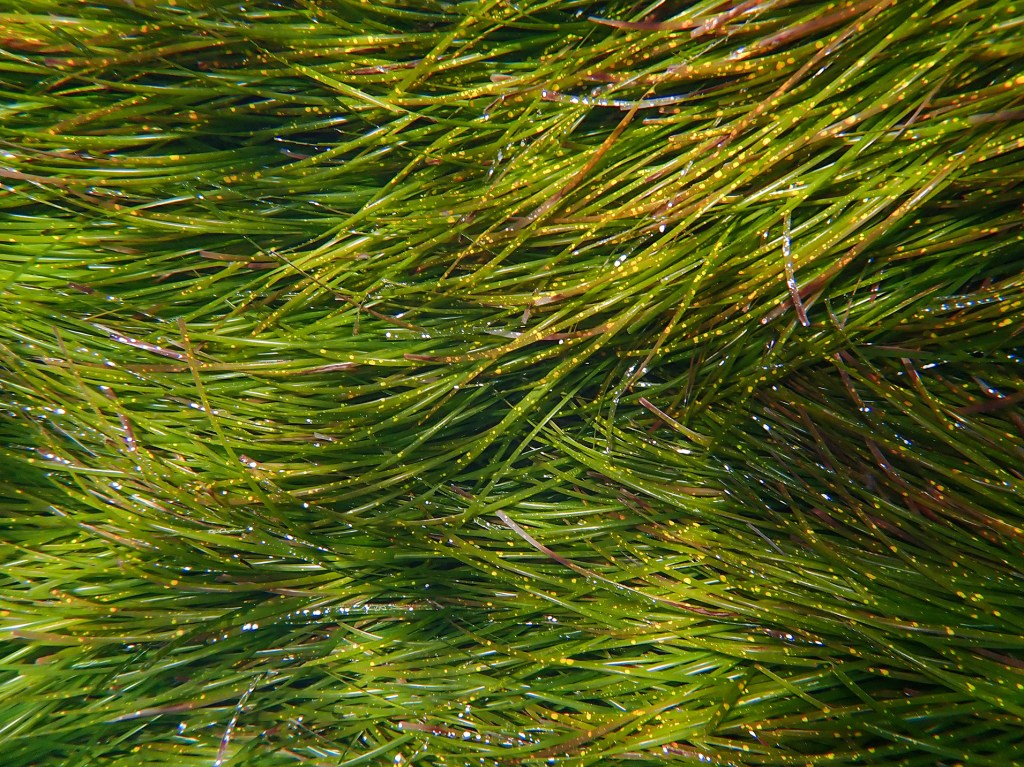
The lush carpet of a Posidonia prairie in Spain’s Balearic Islands. Photograph: Jeffrey Cardenas

The Spanish Posidonia Police came calling on Flying Fish today. I was happy to see them.

Posidonia is a seagrass species that is endemic to the Mediterranean Sea. Like the turtlegrass of the subtropic Americas and the Caribbean, Posidonia forms large underwater meadows vital to the ecosystem. The aquatic grass has a high carbon absorption capacity. It is said to soak up 15 times more carbon dioxide every year than a similar-sized piece of the Amazon rainforest.1 In 2006, a vast colony of Posidonia was discovered south of Ibiza and is estimated at around 100,000 years old. It may be one of the largest and oldest clonal colonies on Earth.2

Posidonia grows best in clean waters, and its presence is a marker for lack of pollution. It is found only in the Mediterranean Sea, where it is in decline. The UNESCO world heritage site around the Balearic Islands includes about 140,000 acres of Posidonia, which has global significance because of the amount of carbon dioxide it absorbs. The meadows are being threatened by rising temperatures, slowing its growth, as well as damage from anchors.3 The Posidonia meadows of Ibiza are fiercely protected. Drop an anchor on Posidonia, and you are breaking the law.

This is why it astonished me when I watched the superyacht Chuck Taylor drop its anchor in a bed of Posidonia at an anchorage on Mallorca that we were sharing. (I don’t know that it was the shoe guy Chuck Taylor; who would name a boat after themselves?) Nonetheless, I wish the Posidonia Police had been in the bay that day. When Chuck Taylor departed, an entire square yard of the living colony was impaled on the tines of its anchor. 

Granted, anchoring in the Balearic Islands in July and August–especially during this post-lockdown year–is a challenge. Nowhere in the world have I seen so many boats, and so many inconsiderate boat operators, as I have here during the past two months. Because anchorage space is limited, boats battle for every square foot of sea bottom available without Posidonia. Many boats anchor regardless of the protected areas. Bays are so tightly packed that adequate anchor scope for holding is frequently compromised. Two nights ago, at 03:00, katabatic winds ripped through my anchorage at Benirràs, Ibiza, and tore the fleet apart. One sailboat dragging an anchor collided with two other sailboats, pulling their anchors from the bottom and sending them adrift. A boat ended up against a ragged rock wall. Two large powerboats also dragged and collided in the wind. In the darkness, shouts and curses in foreign languages echoed across the anchorage. Flying Fish somehow escaped the carnage, but the Posidonia meadow at Benirràs was most certainly plowed into oblivion by the dragging anchors.

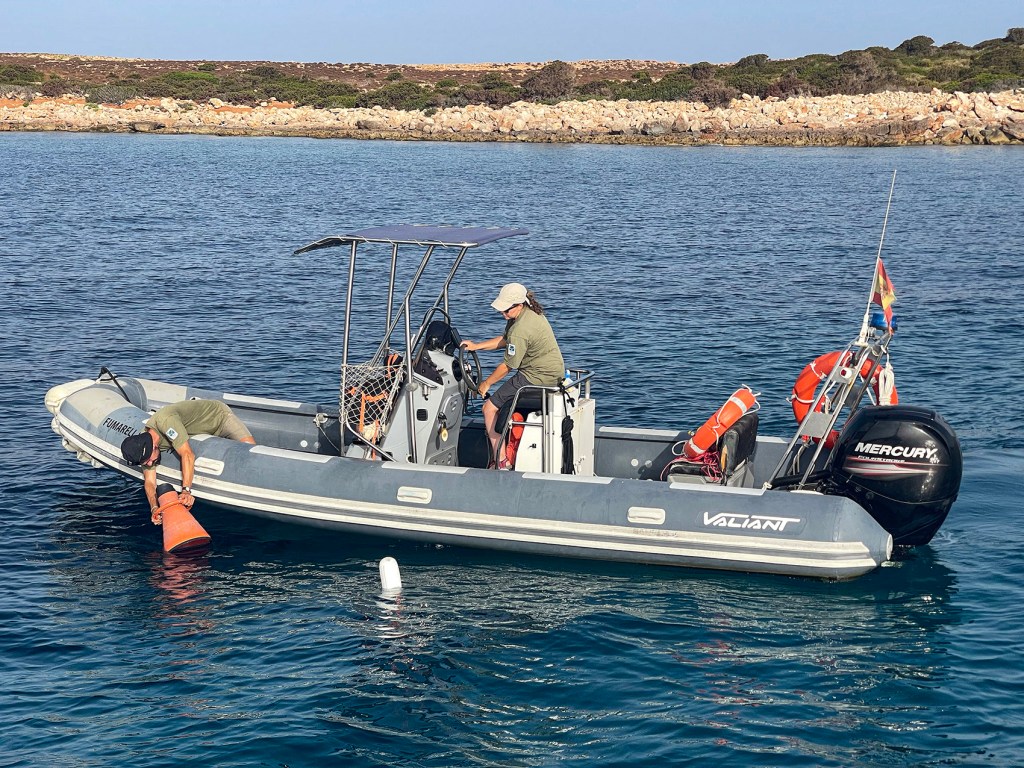
The Posidonia Police encounter a repeat offender in the Illa Sa Conillera marine park who insisted that it was his “right” to drop an anchor anywhere he wanted. Photograph: © Jeffrey Cardenas

The Posidonia meadows are carefully identified on every chart. This morning over coffee, in the lovely anchorage of the Illa Sa Conillera marine park, I was startled by a heated argument coming from two boats. The Posidonia Police had arrived and warned a visiting sailboat owner (for the second time) that he anchored on the protected grass. His anchor was crushing the habitat of plants, fish, and juvenile crustaceans. The sailboat captain maintained it was his “right” to anchor where he wanted. The park ranger explained otherwise. The argument increased in volume and acrimony, and continued for 30 minutes. Then the guilty sailor pointed at me. I was anchored nearby.

The Posidonia Police motored up to Flying Fish with an underwater viewing scope. I passed the inspection; my anchor was embedded in a pocket of sand, where I had carefully placed it when I arrived.

“May I take your photograph,” I asked?

“¿Por qué?” was the reply.

“Because,” I said, “I think what you are doing is important.”

###

Park rangers inspect the placement of the anchor of Flying Fish at Illa Sa Conillera, Ibiza. Photograph: © Jeffrey Cardenas

References:

  1. Ibiza’s Monster Marine Plant, Ibiza Spotlight, 28 May 2006
  2. Oldest living thing on earth’ discovered, Jonathan Pearlman, The Telegraph. 7 February 2012
  3. Posidonia oceanica, Wikipedia

Sailing is not just about the wind and the sea; equally important are the places to which this boat takes me.

Please click Follow at the bottom of this page so that you don’t miss a new update, and please consider sharing this post with others who might enjoy following the voyage of Flying Fish. I welcome your comments. I will always respond to your comment when I have an Internet connection. And I will never share your personal information.

You can follow the daily progress of Flying Fish, boat speed (or lack thereof), and current weather as I sail into the Mediterranean by clicking this satellite uplink: https://forecast.predictwind.com/tracking/display/FlyingfishClick the “Legends and Blogs” box on the right side of the tracking page for en route Passage Notes. 

To see where Flying Fish has sailed since leaving Key West in 2017, click here: https://cruisersat.net/track/Flying%20Fish.

Instagram: FlyingFishSail
Facebook: Jeffrey Cardenas

Text and Photography © Jeffrey Cardenas 2021

Let this be a time of grace and peace in our lives   –Fr. John Baker