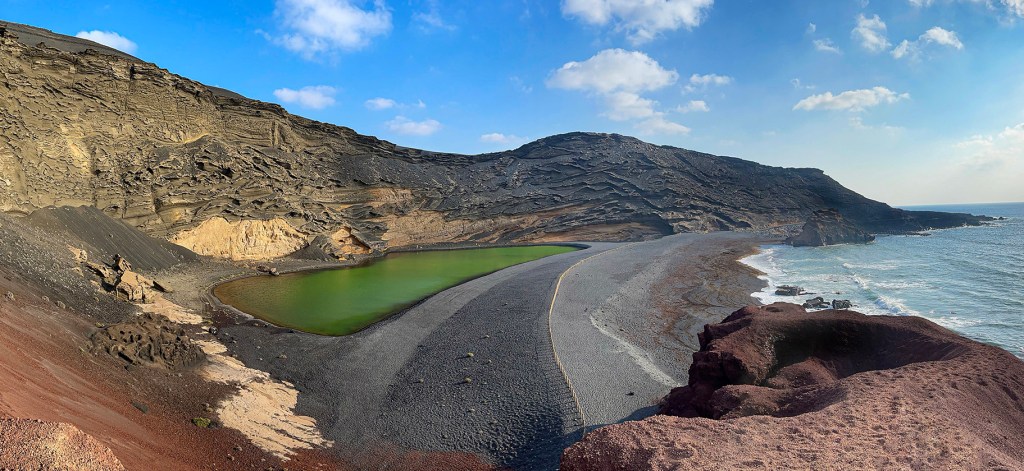
Charco de los Clicos, Lanzarote — If only I had been here 57 years ago… I might have seen Raquel Welch emerging from this green lagoon, her breasts spilling out of a fur bikini, only to be snatched from the beach by a carnivorous Pteranodon and flown to its nearby nest where the distraught “Loana the Fair One” was to be fed to the pterosaur’s offspring.
Ah, well, timing is everything.
Much of the 1966 cinematic fantasy, One Million Years B.C., was filmed in Lanzarote, including the epic green lagoon scene. The location director deserved an Oscar for choosing this island. If I blinked today and saw a 200-pound flying reptile swoop down out of the volcanic rocks to carry away a tourist climbing out of a tour bus, it would all seem perfectly normal. A million years and this place is still prehistoric.
The island of Lanzarote bubbled up from a hot spot in the ocean 15 million years ago as plate tectonics transformed the earth. It has been nearly three centuries since the last major volcanic eruption and much of the island is unchanged. A dry climate and lack of erosion–and the protection of the spectacular Timanfaya National Park–have left the landscape pristine (translation: burnt to a crisp). NASA used this otherworldly topography to train the Apollo 17 crew.
Despite the current and severe volcanic activity on the Canary Island of La Palma 200 miles to the west, Lanzarote is known as the “Island of Volcanoes.” There are over 100 volcanic craters on this island that measures only 37 miles north to south. During the eruptions here in the 1730s, which lasted six years, the island grew by several square miles. Flames were visible 130 miles away and smoke hung in the air while lava and ash covered large areas of the island. Lives were lost, homes destroyed, and residents were plunged into years of darkness.[1]
The Green Lagoon is one of the volcanic craters that formed during these powerful eruptions. The Atlantic Ocean eroded the western side of the cone flooding the crater with seawater. A berm of black volcanic rock and coarse sand now separates the lagoon from the ocean. Ancient lava tubes and underground fissures circulate the water. Charco de los Clicos was once home to a thriving colony of shellfish known locally as clicos (thus the name) until someone put a pair of turtles into the lagoon, and they devoured every last clico. Now the lagoon is inhabited by phytoplankton, microscopic marine algae, which gives the water its distinctive emerald green hue.
The Charco de los Clicos is a Natural Reserve bordering Timanfaya National Park. Regulations forbid swimming… unless, of course, you are Loana the Fair One and you come attired in a fur bikini.
Sailing is not just about the wind and the sea; equally important are the places where Flying Fish carries me.
Please click “Follow” at the bottom of this page so that you don’t miss a new update, and please consider sharing this post with others who might enjoy following the voyage of Flying Fish. I welcome your comments, andI will always respond when I have an Internet connection. I will never share your personal information.
You can follow the daily progress of Flying Fish, boat speed (or lack thereof), and current weather as I sail into the Atlantic by clicking this satellite uplink: https://forecast.predictwind.com/tracking/display/Flyingfish. A Bonus: Click the “Legends and Blogs” box on the right side of the tracking pagefor passage notes while I am sailing offshore.
Aboard Flying Fish, I sense the Rock before I even see it. Gibraltar remains hidden by dense fog until Flying Fish is just a few hundred meters offshore. Then, the Rock appears like a specter off the starboard bow. Huge and close. I have frequently felt the presence of places I have visited on this voyage, but few affect me as powerfully as seeing this monolith emerging from the foggy Mediterranean Sea. A Gibraltar landfall is a rite of passage for many ocean sailors.
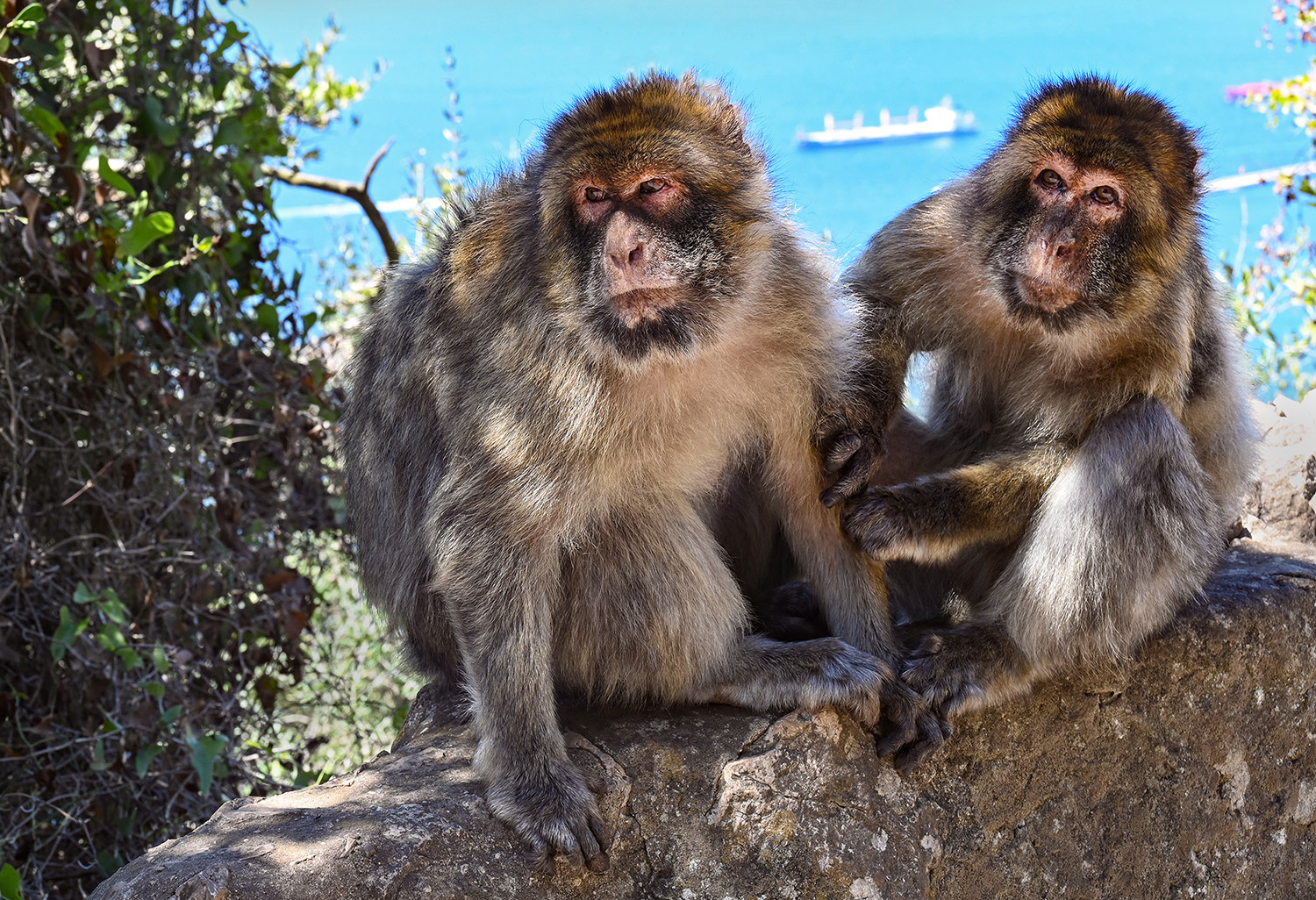
Neanderthals walked here, as did the Cro-Magnons. Arriving later were the Phoenicians, Goths, Moors, Romans, and centuries of European powers. Overlapping many of those civilizations, one group of survivors remained established on the Rock–Gibraltar’s Barbary Ape.
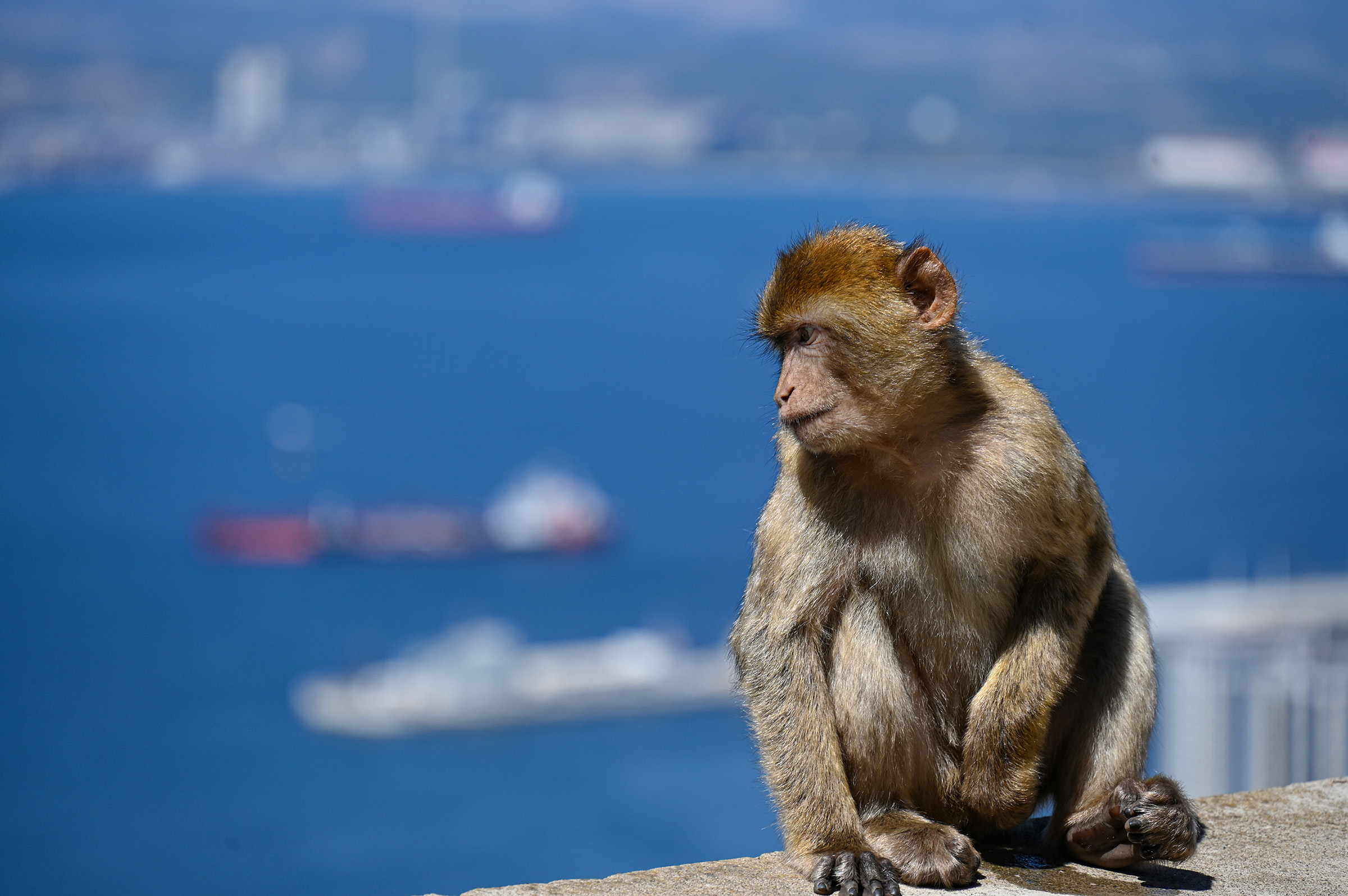
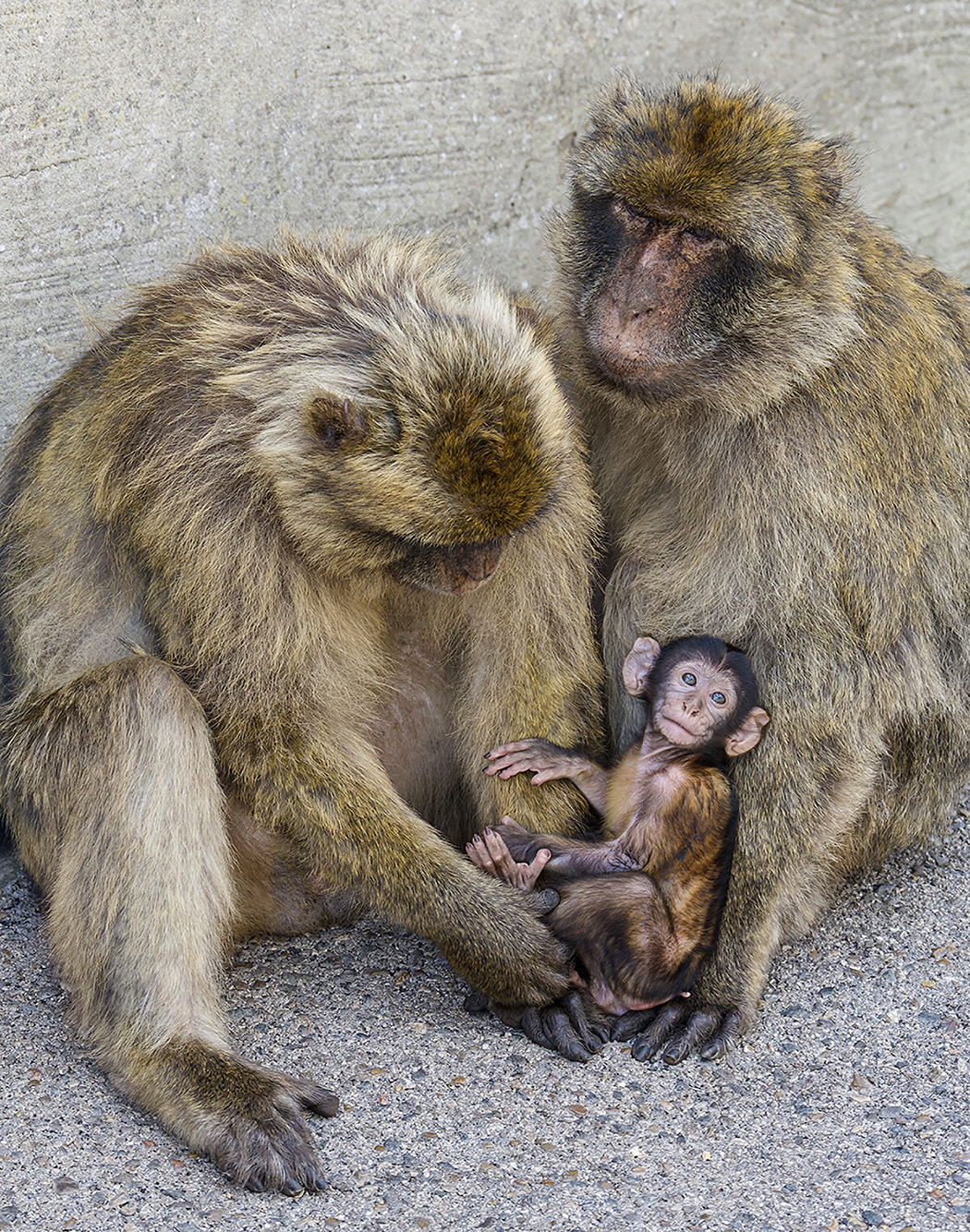
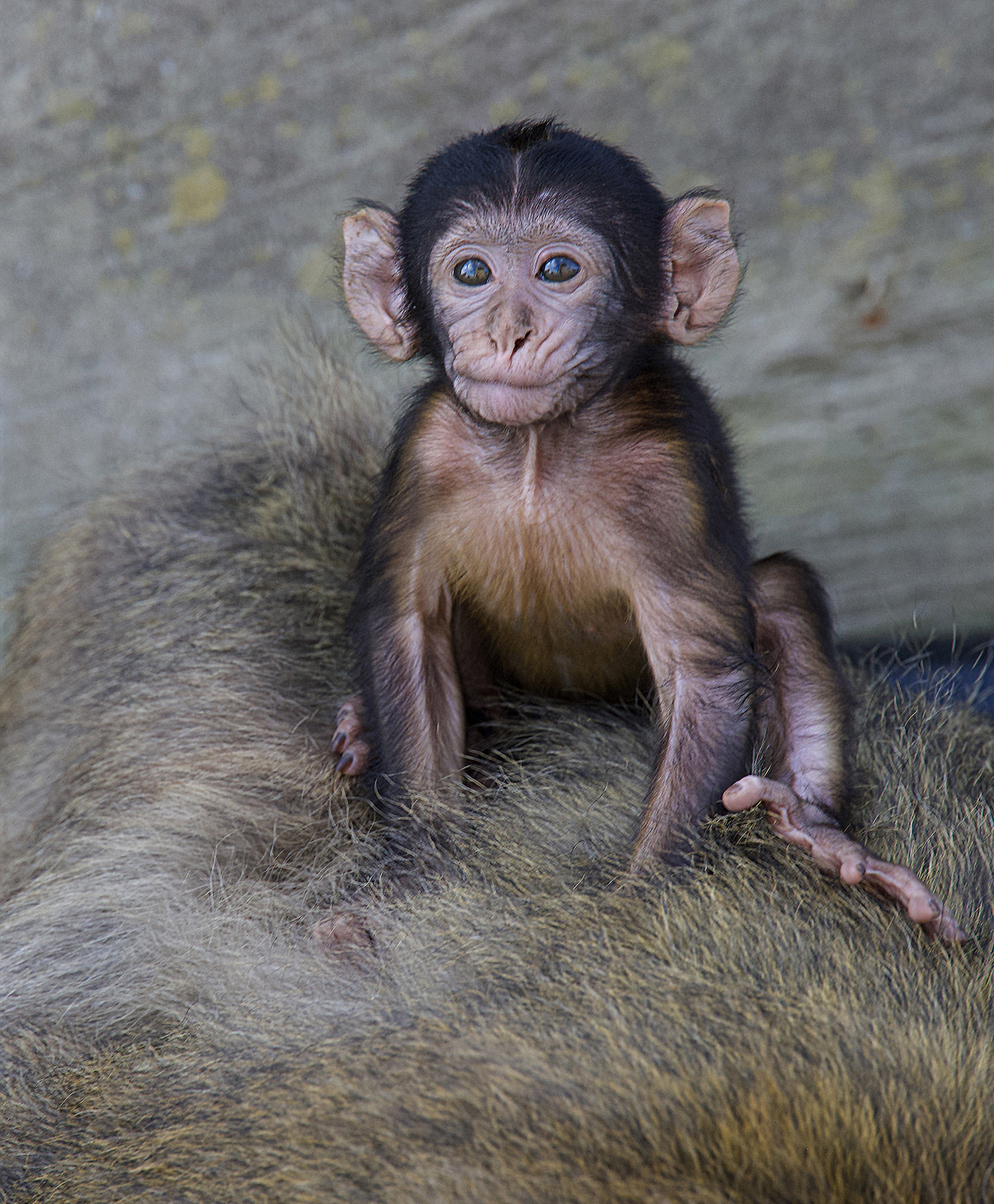
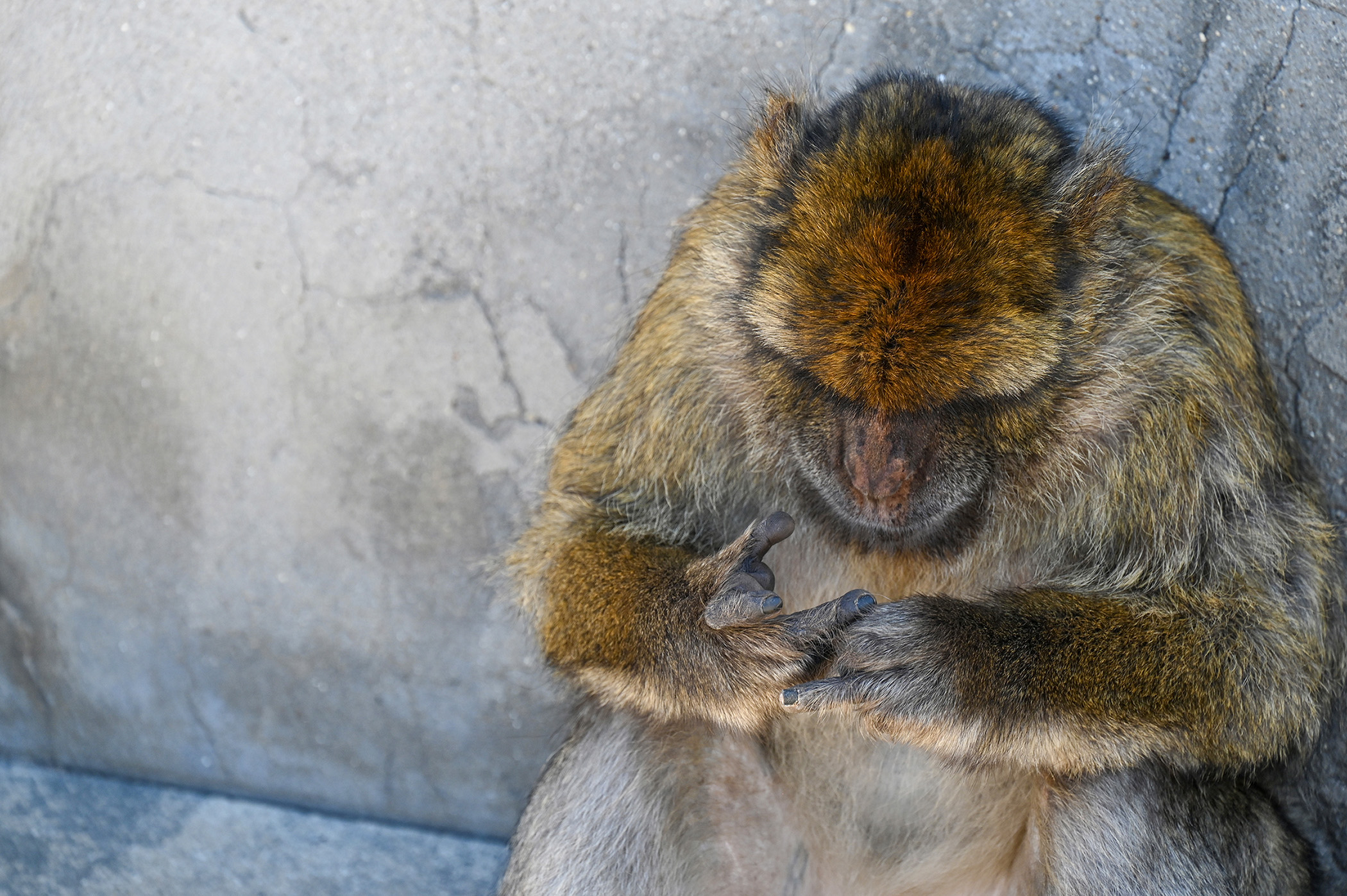
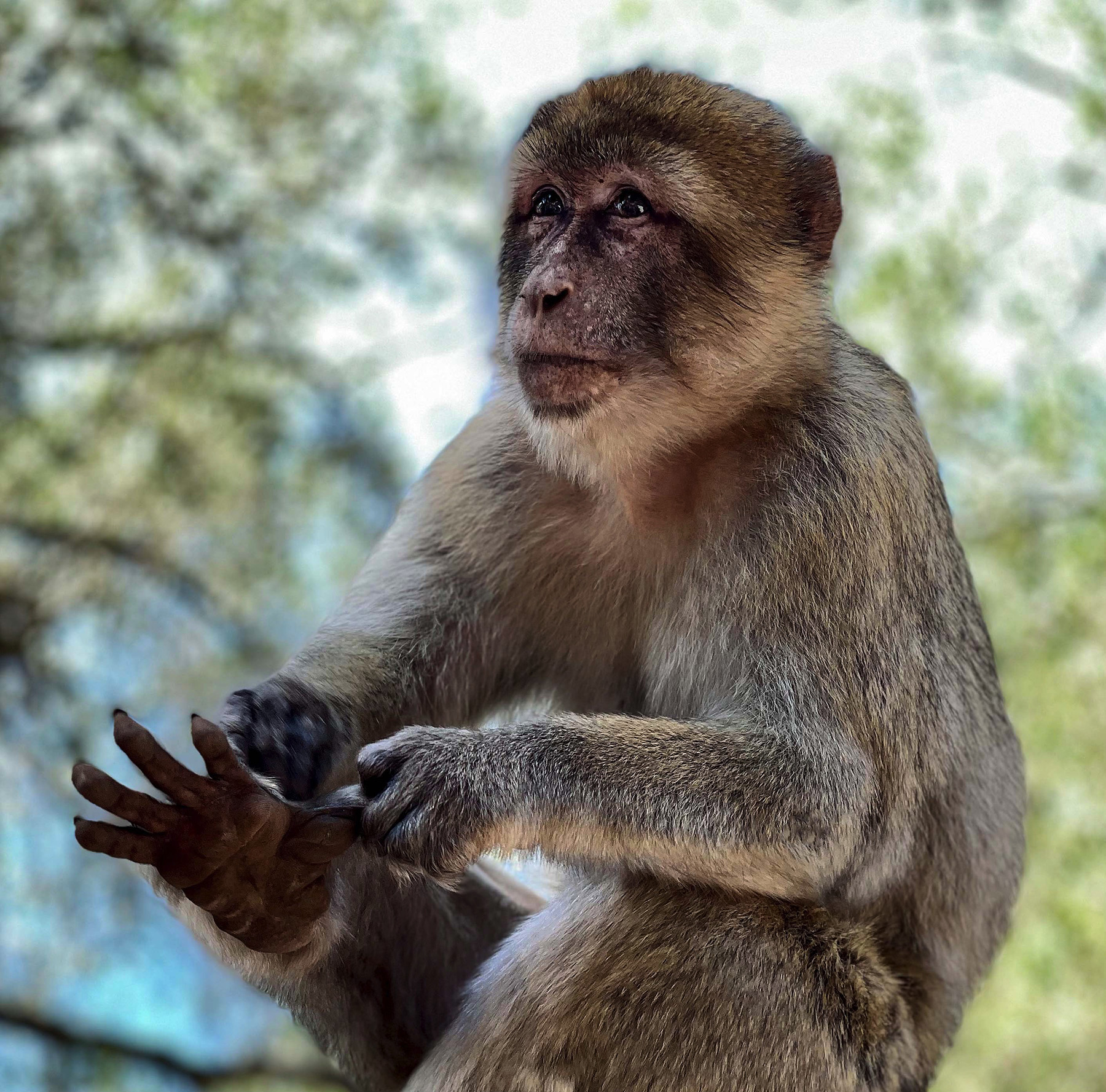
The “Ape” is an Old World monkey species, a Barbary macaque, originating in the Atlas and Rif Mountains of Morocco and Algeria, 20 kilometers across the Strait of Gibraltar. Some scientists speculate that the monkeys may also be related to macaques that migrated 5 million years ago across southern Europe. Regardless of their lineage, Gibraltar’s Barbary macaques are iconic to the Rock. Wrote historian Alonso Hernanández del Portillo of Gibraltar in the early 1600s: “There are monkeys, who may be called the true owners, with possession from time immemorial.”[1]
I cannot sail past the Rock of Gibraltar without reacquainting myself with this wild band of free-roaming monkeys I first met some 45 years ago. Much has changed, but the Barbary macaques are still the main attraction in Gibraltar.
A popular belief holds that as long as the macaques exist on Gibraltar, the territory will remain under British rule.[2] In 1942, after the macaque population dwindled to just seven monkeys, Winston Churchill ordered their numbers be replenished from North Africa (in the midst of World War II and Rommel’s Afrika Korps). The monkeys became so important to Gibraltar’s interests that until 1991 their care was entrusted to the British Army, and later, the Gibraltar Regiment. A “Keeper of the Apes” maintained up-to-date records for each macaque, listing births and names and supervising their diet. The War Office in 1944 gave the macaques a food budget of £4 a month for fruit, vegetables, and nuts. Each macaque was issued a serial number with its name. The Gibraltar Chronicle would announce births: “Rock Apes. Births: To Phyllis, wife of Tony, at the Upper Rock, on 30th June 1942— a child. Both doing well.” The names would often be associated with someone of stature in British society, like Elizabeth, named for the Queen, or Winston, for Churchill. If Elizabeth or Winston, or any ill or injured monkey needed surgery or medical attention they were taken to Royal Naval Hospital in Gibraltar, where they received the same treatment as an enlisted serviceman.[3] Queen Elizabeth II and the Duke of Edinburgh, along with Prince Charles and Princess Anne, met the Barbary Apes while visiting Gibraltar in 1954. A photograph shows the Queen and royal family happily feeding the macaques.
About 250 macaques remain on the Rock. Although the human population of Gibraltar numbers only 34,000 people, this tiny territory of 6.8 square kilometers recorded 11 million visitors in 2019 (pre-COVID). It is one of the highest tourist-to-resident ratios in the world, and many of those visitors come to co-mingle with the free-roaming Barbary Apes. These days if the Queen fed a macaque in Gibraltar, she (or anyone else) could be fined £4,000. That penalty, however, doesn’t stop tourists from acting badly.
Early one morning, I pack a bag of cameras and climb to the top of the Rock at Prince Philips Arch, where I hope to see a troop of Barbary macaques. When I arrive, there is already a gridlock of taxi vans disgorging a mob of tourists insistent on capturing selfies with a monkey. Prince Philips Arch is in the Gibraltar Upper Rock Nature Reserve, an official feeding station for the macaques, and it is stocked today with carrots, corn, and watermelon. The monkeys, however, are more focused on the bags of snack food, candy bars, and surreptitious peanuts in the possession of the tourists. There are squeals of delight every time a macaque jumps on somebody’s head or unzips a backpack. Two young men speaking Russian tease the macaques with a peanut butter sandwich. The men are shirtless and sunburned, and possibly drunk because one man slaps the open face of his sandwich onto the bare back of his buddy, and they howl with laughter as the macaques go berserk and chase them.
Tourism reached its peak in Gibraltar in 1985, when, after years of hostilities with Spain, the border finally reopened. A flood of visitors poured onto the Rock. Some 45,000 people entered Gibraltar within the first week, increasing to over 10,000 per day. Within six months, a million people had visited. By 1986, five million visitors a year were arriving in Gibraltar. Nearly everyone who came wanted to see the Barbary Apes. To make room for visitors’ cars on Gibraltar’s crowded roads, 1,000 old vehicles were rounded up in Gibraltar and pushed off the cliffs into the sea at Europa Point on the southern tip of the territory.[4] The number of macaques rapidly increased as a result of illegal feeding by tourists. It also led to an increase in aggressive behavior as the monkeys associated humans with junk food. The problem culminated in 2008 with the Government of Gibraltar ordering the culling of a rogue troop of monkeys that was breaking into hotel rooms and scavenging garbage cans. Researchers and animal rights activists protested the cull, but the Government justified it because overly aggressive monkeys would frighten tourists and damage the economy.[5]
More recently, the Government of Gibraltar says it is making efforts to crack down on human interactions with the macaques, including daily patrols and microchips in the monkeys. In addition to fines for feeding the macaques, a new law was passed last year, making it an offense to touch or interfere in any way with the monkeys. In the 20 hours over several days that I recently spent among the monkeys in Gibraltar’s Upper Rock Nature Reserve, I saw many tourists feeding, touching, and interfering with the macaques. Not once did I see any official presence or enforcement of the tourist misbehavior.
Later, I hike to an isolated promontory above Europa Point, between what the Athenian philosopher Plato called the “Two Pillars of Hercules”–the Atlas Mountains of Africa to the south and the Rock of Gibraltar to the north. I think of the prehistoric description of this piece of land by Gibraltar Museum evolutionary biologist Clive Finlayson: “While the rest of Europe was cooling, the area around Gibraltar back then resembled a European Serengeti. Leopards, hyenas, lynxes, wolves and bears lived among wild cattle, horses, deer, ibexes, oryxes and rhinos – all surrounded by olive trees and stone pines, with partridges and ducks overhead, tortoises in the underbrush and mussels, limpets and other shellfish in the waters.”
Gibraltar’s Barbary Apes are survivors in a rapidly changing world. Among the dense pines above Europa Point, I watch a troop of macaques interact, away from the melee of tourists. They forage naturally and groom each other, a sign of reduced stress. I watch a female macaque nurse an infant while a male moves close to gently participate in the parenting. This idyllic scene has me questioning whether my presence among the macaques also makes me part of the problem. I may not torment the monkeys with peanut butter, but I am, along with millions of other visitors, encroaching upon the space of a wild thing that was here first. I wonder: How can humans learn to interact with less impact and more equitably share this natural world?
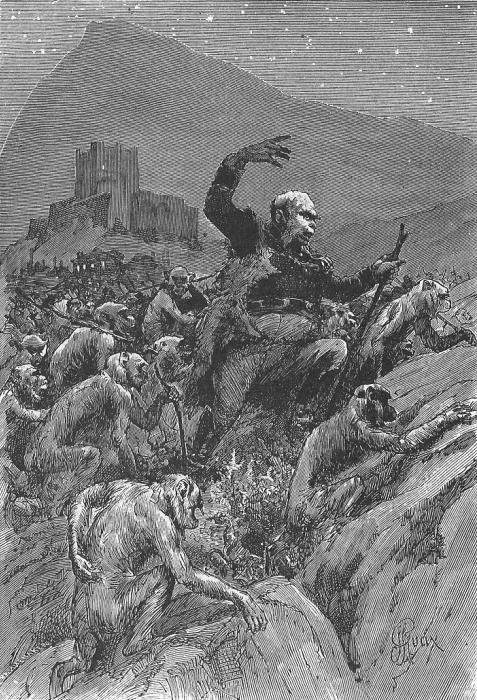
In an 1887 satire by Jules Verne, the Spaniard Gil Braltar invades the Rock with a macaque troop after disguising himself as one of them. Drawn by George Roux. Credit: Public Domain
References:
[1] “Historia de la Muy Noble y Más Leal Ciudad de Gibraltar,” Alonso Hernanández del Portillo(1605-1610)
[2] “The Curious Caseof the Last ‘Wild’ Monkeys in Europe,” Atlas Obscura, Dan Nosowitz, 2019
[3] “Gib Monkeys,” Internet Archive, 2011, Wikipedia
[4] “Gibraltar: British or Spanish?” Peter Gold 2012, Wikipedia
[5] “Tourism Management: An Introduction,” Clare Inkson, Lynn Minnaert, 2012, Wikipedia
Sailing is not just about the wind and the sea; equally important are the places where Flying Fish carries me.
Please click Follow at the bottom of this page so that you don’t miss a new update, and please consider sharing this post with others who might enjoy following the voyage of Flying Fish. I welcome your comments. I will always respond when I have an Internet connection. And I will never share your personal information.
You can follow the daily progress of Flying Fish, boat speed (or lack thereof), and current weather as I sail into the Mediterranean by clicking this satellite uplink: https://forecast.predictwind.com/tracking/display/Flyingfish. Click the “Legends and Blogs” box on the right side of the tracking pagefor en route Passage Notes.
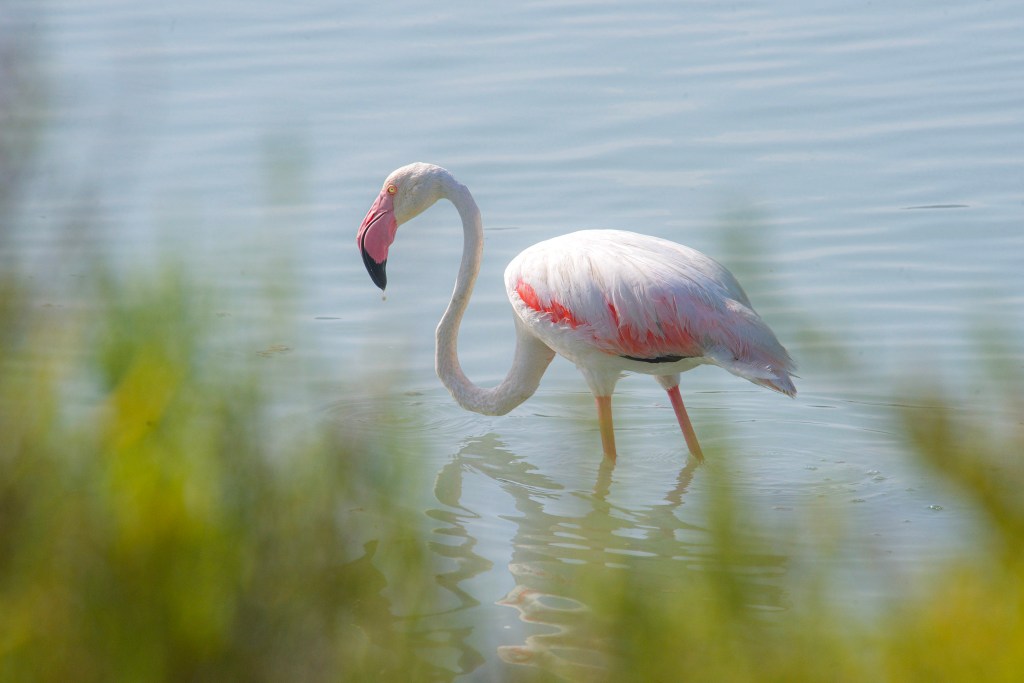
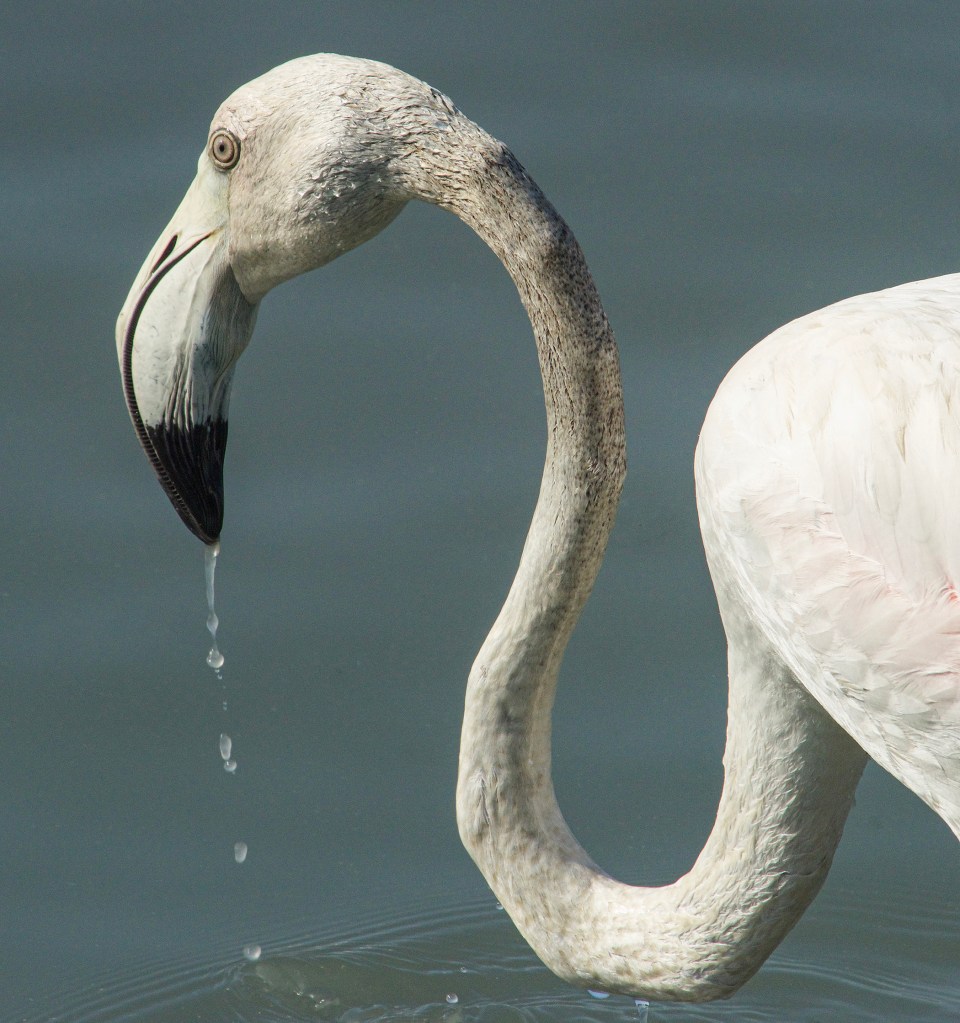
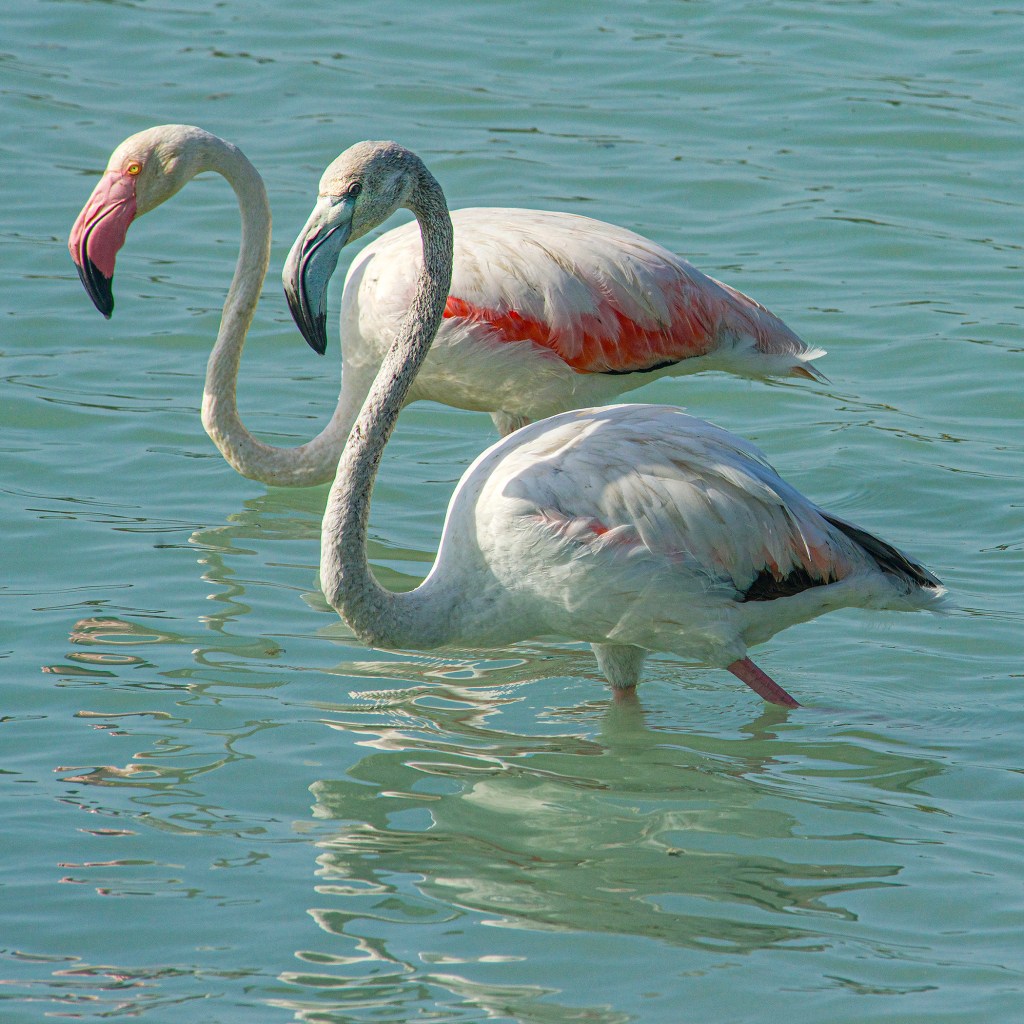
The earth’s Prime Meridian transits the salt flats of Calpe, where Flying Fish lays at rest after a passage from Ibiza. In a sense, this line of longitude is where time begins and ends each day. Time modifies and reorders the natural world: adaptation or extinction. These random thoughts occupy my mind as I share space on the salt flats with one of the world’s most iconic bird species. The greater flamingo has adapted and survived thousands of years of extraordinary change along Spain’s Costa Blanca.
The salt flats of Las Salinas were first utilized during the great Roman era of the 2nd century AD. Now, a busy marina and a European holiday center surround the edges of these ancient alluvial deposits. The greater flamingo continues to thrive here despite the high-rise apartments, Jet Skis, and música electrónica that have changed the shadow and sound of its environment. These flamingos are wild birds. Their wings are not clipped. They are not fenced in or fed. That they choose to return to Las Salinas, in the middle of this urban setting, is a testament to how nature adapts.
The salt flats and the city of Calpe are at the base of the massive rock Peñón de Ifach, a 1,000-foot massif of limestone rising from the Mediterranean Sea. Ifach is an important homing beacon for birds. Some 173 species, both nesting and migrating, have been recorded here, including black-winged stilts, avocets, the black wheatear, and the white wagtail. There is some ornithological tourism in Calpe, but most tourists come instead for a different variety of wagtail, and to get sunburned and drink sangria.
Tourists sharing Calpe with the birds date back at least two millennia. Across the sandbar delineating the salt flats and the edge of the sea, archeologists excavated the “Baños de la Reina.” Ancient Roman engineers designed a thermal complex including pools of different temperatures, a sophisticated heating system, and a piscinae for sunken gardens and the farming of live fish. But for whom this ultimate vacation villa was constructed is still unknown. Archeologists know that hidden tunnels allowed private access to the Baths of the Queen, but they do not know who the queen was. Whoever merited this elaborate architecture of marble and mosaics was most certainly “a person with a high purchasing power.”[1] Marcus Aurelius is famously quoted saying, “Accept the things to which fate binds you, and love the people with whom fate brings you together, but do so with all your heart.” Perhaps Marcus Aurelius kept a mistress at the salt flats of Calpe.
The history that has shaped the landscape of Las Salinas has also helped maintain its natural habit and biodiversity. Salt was a necessity for fish preservation, which Calpe used to market its catch. Eventually, salt from these lagoons supplied fishing industries in over 40 Spanish municipalities. At the end of the 18th century, Salt production declined when Las Salinas was thought to harbor yellow fever. In 1993, Spain declared Las Salinas a protected maritime-terrestrial zone.
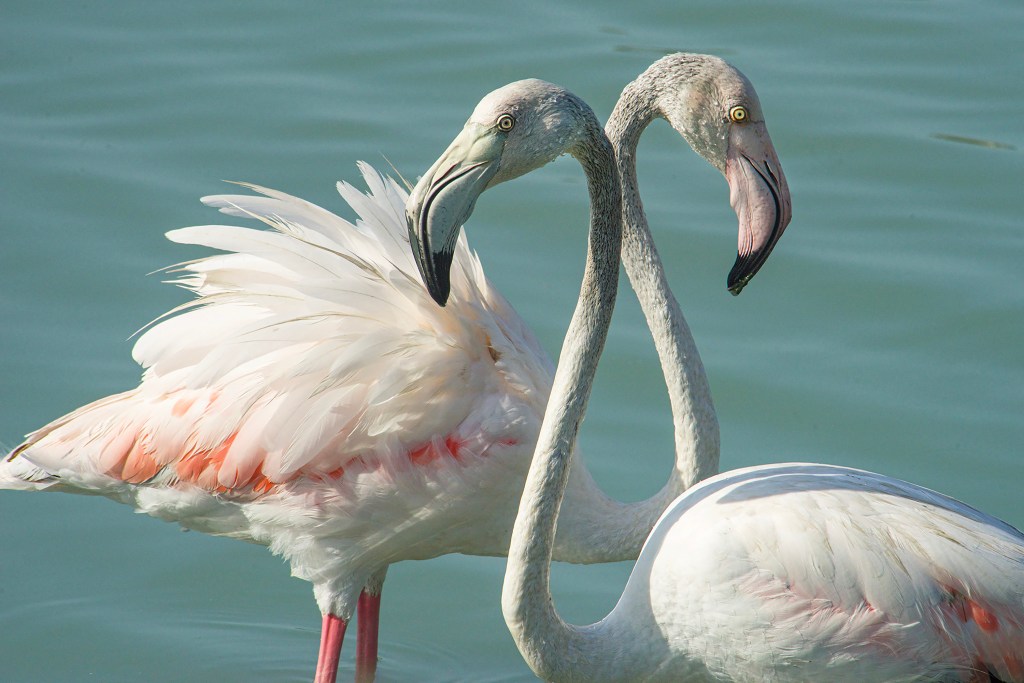
While many species make up the Las Salinas habitat, the population of flamingos generates the most attention. The coloration of all flamingos comes from the carotenoid pigments in the organisms that live in their feeding grounds. The greater flamingo, one of four distinct species, is less flashy than some of its genetic relatives like the hot-pink American flamingo. That doesn’t prevent them from wanting to look good. Secretions of their uropygial “preening” gland contain carotenoids–red pigments. During the breeding season, greater flamingos preen to spread these uropygial secretions over their feathers, enhancing their color. Ornithologists have described this cosmetic use of uropygial secretions by greater flamingos as “applying make-up.”[2]
The greater flamingo is an enthusiastic eater. It feeds with its head down; its upper jaw is movable and not rigidly fixed to its skull.[3] Using its feet, the bird stirs up mud, then sucks the slurry through its bill to filter small shrimp, seeds, blue-green algae, microscopic organisms, and mollusks. It is a healthy diet. Wild greater flamingos have an average lifespan of 30 – 40 years. The oldest known greater flamingo, named Greater, (duh) lived in an Adelaide, Australia zoo for between 85-93 years.[4] The bird’s exact age is unknown; he was already a mature adult when he arrived in Adelaide in 1933. Greater was euthanized in January 2014 due to “complications of old age.”
It is zero hundred hours, at zero degrees longitude. A full moon has risen in direct alignment with Jupiter and Saturn. Flying Fish is secure nearby at her mooring. Somewhere in the ruins of a partially submerged palace, the legacy of an unknown queen waits to be discovered. And on the salt flats of Las Salinas, flamingos secrete pigment over their feathers. Some days I, too, feel the complications of aging, but I’m not ready to be euthanized yet. There is still so much to see and so much to know.
###
References:
[1] “The Baths of the Queen, a Roman Palace,” The World (2012)
2] “Greater flamingos Phoenicopterus roseus use uropygial secretions as make-up,” . Behavioral Ecology and Sociobiology, J.A., Rendón, J Garrido-Fernández, A Garrido, M, Rendón-Martos, and A Pérez-Gálvez. (2011).
[3] Flamingo, Wikipedia
[4] “Flamingos at Adelaide Zoo,” Vaughan Wilson; at Conservation Ark / Zoos South Australia 2008
Sailing is not just about the wind and the sea; equally important are the places to which Flying Fish carries me.
Please click Follow at the bottom of this page so that you don’t miss a new update, and please consider sharing this post with others who might enjoy following the voyage of Flying Fish. I welcome your comments.I will always respond to your comment when I have an Internet connection. And I will never share your personal information.
You can follow the daily progress of Flying Fish, boat speed (or lack thereof), and current weather as I sail into the Mediterranean by clicking this satellite uplink: https://forecast.predictwind.com/tracking/display/Flyingfish. Click the “Legends and Blogs” box on the right side of the tracking pagefor en route Passage Notes.
In the spirit of, “I may never pass this way again,” I could not leave Sardinia without first having eaten casu marzu–the rare and illegal delicacy of maggot-infested cheese. What could go wrong?
Translation first: Casu marzu in Italian literally means, “putrid, rotten cheese.” The beauty of the Italian language is that it is direct; Italians say exactly what they mean. Casu marzu is not a “fragrant” cheese or a “bold” cheese. Casu marzuis a decomposing cheese. It is crawling with worms. And Italians will risk breaking the law just to get a taste of it.
The creation of a fine casu marzu begins normally enough as a classic sheep’s milk pecorino. Then the process gets a little weird. The cheese is left outside in the heat of summer with part of the rind removed. This attracts the cheese fly, Piophilidae, which can lay more than 500 eggs at one time. The larvae hatch and emerge as translucent white worms eating through the cheese. The process then goes from fermentation to a stage of decomposition, brought about by the acid from the maggots’ digestive system breaking down the cheese fats. The cheese texture becomes soft and creates a weeping liquid called làgrimas–teardrops. By the time it is ready for consumption, a typical casu marzu will contain thousands of maggots.
When I first asked about casu marzu, the local formaggiaio in Carloforte wagged his finger at me and then turned away. A street vendor was more forthcoming. “There is an open market on Wednesday,” he said. “Follow your nose.” At the open market, there were several cheese vendors. One said, in English, “Casu marzu? Of course. We have.” When he showed me the cheese, I asked where the worms were. “Ah,” he said, “the worms were here, but now they have gone away.” Casu marzu is considered by many Sardinians to be unsafe to eat when the maggots in the cheese have died.
Another cheese vendor, working out of the back of a truck, was cautiously watching our exchange. That’s the guy, I thought.
When I asked him for casu marzu he looked to his right, then looked to his left, and said, “Sei la polizia?” I laughed, “Do I look like the police?” He laughed and pulled out a white plastic construction bucket he had hidden under a table near his truck. When he took the towel off the top of the bucket it was filled with wheels of foul-smelling cheese crawling with worms. “I’ll buy a half-kilo,” I said, “but please hold the cheese in your hands so that I can make a photograph.” His face went serious. He shook his head no and then held out his arms with his wrists crossed like he was in handcuffs. “No photo,” he said. “Formaggio, si. Io, no.”
Casu marzu presents an interesting paradox for Italian cheese aficionados. It has been considered illegal by the Italian government since 1962, due to laws that prohibit the consumption of food infected by parasites. Those who sell casu marzu can face fines up to €50,000. European regulators in 2002 reinforced the law making the cheese illegal not only in Italy but also in all the common EU markets. Casu marzu is also illegal in the United States.
The cheese remains a revered delicacy. Despite official health concerns, Sardinians consider casu marzu safe. (Sardinia has the highest percentage of people living to 100 years or beyond. The proportion of centenarians in the population is twice the rate considered normal for the rest of the world.) Also, as a traditional product of Sardinia, it is locally protected, although it still remains available only on the black market. There is, however, a formal proposal pending before the EU to give casu marzu DOP (Protected Designation of Origin) status like other cheeses and fine wines.
So what is it like to eat cheese infested with worms? You had better enjoy eating strong cheese, and cover your eyes. Casu marzu has the taste and texture of aged gorgonzola, but it moves. Writer Kara Goldfarb describes it best:
“When eating the cheese, one is meant to close their eyes. It’s not to avoid looking at the maggots as you eat them but to protect your eyes from them. When bothered, the maggots will jump up, sometimes going as high as six inches. Next tip, it is imperative for one to properly chew and kill the maggots before swallowing. Otherwise, they can live in the body and rip holes through the intestines… The next step is less of a safety precaution and more of a way to just enhance the culinary experience. It’s advised to enjoy the casu marzu with a moistened flatbread. It also pairs well with a glass of strong red wine. Potentially because the two go well together, possibly because of the added liquid courage.”
In the end, being able to taste casu marzu is a cultural experience that I consider a necessity of travel. I remember eating the fruit durian when I was sailing through Sumatra. It smelled like raw sewage but tasted like a rich custard. Years ago, in a no-name restaurant in the Chinese ghetto off Tiananmen Square, I asked for the house specialty and was served a bull’s penis. These are the things that make our journeys rewarding.
“Casu Marzu Cheese Is Dangerous, Illegal, And Filled With Maggots,” ATI, Kara Goldfarb
“Cazu Martzu,” Wikipedia
“Most Rotten Cheese,” The World’s Worst: A Guide to the Most Disgusting, Hideous, Inept, and Dangerous People, Places, and Things on Earth, Mark Frauenfelder
Sailing is not just about the wind and the sea; equally important are the places to which this boat takes me.
Please click Follow at the bottom of this page so that you don’t miss a new update, and please consider sharing this post with others who might enjoy following the voyage of Flying Fish. I welcome your comments.I will always respond to your comment when I have an Internet connection. And I will never share your personal information.
You can follow the daily progress of Flying Fish, boat speed (or lack thereof), and current weather as I sail into the Mediterranean by clicking this satellite uplink: https://forecast.predictwind.com/tracking/display/Flyingfish. Click the “Legends and Blogs” box on the right side of the tracking pagefor en route Passage Notes.
It has been 181 days, 12 hours, 17 minutes since Flying Fish was last underway. But who’s counting? What matters is that I am sailing today. I am departing Turkey where, despite the struggle of the pandemic, I was warmly welcomed. My destination today is Malta, 680 nautical miles due west.
I will transit the Greek Dodecanese islands. These ragged nuggets of rock piercing the sea are the tops of mountains that once stood upon the great plain of the Aegean. The Cyclades come next. I hope to sail inside the crater of the drowned volcano at Santorini. Sadly, I will only be able to see the storied whitewashed villages of Santorini at a distance from the deck of Flying Fish. Greece is still in COVID lockdown and entry is not permitted to those holding U.S. passports.
Peloponnesos will pass to starboard, its forbidding coastline hanging from the southern tip of Greece like the roots of a wisdom tooth. The people here are descended from Spartans, warriors who successfully defended this ancient trading route of silk, pearls, and opium from both the Ottomans and Romans. Weather in the Southern Ionian Sea can be equally fierce. Authors Rod and Lucinda Heikell write that the twin capes here, Tainaron and Maléas, “have acquired a reputation as minor Cape Horns.”
What follows is 425 miles of open water to the geographical center of the Mediterranean–Malta. Although the European Union is still closed to Americans, Malta (a member state of the EU) is currently admitting travelers holding U.S. passports, if they meet certain conditions. Flying Fish, because of an extended time spent in the “corridor country” of Turkey, meets Malta’s entry conditions.
Malta is located about 200 miles north of Libya and 200 miles east of Tunisia. It is one of the world’s smallest and most densely populated countries with a population of nearly 500,000 people living on 122 square miles. The ancient Greeks called the island Μελίτη (Melitē) meaning “honey-sweet”, probably for the endemic subspecies of black bees living on the island. There is a unique natural history in Malta. Pleistocene fossil deposits reveal the existence and extinction of dwarf hippos, giant swans, and pygmy elephants. With creatures like that maybe mythology was closer to real life than we imagine.
Mythology and region have always been conjoined in this part of the world, and Malta has a long-standing relationship with both folklore and the Catholic faith. Christianity came to Malta in the form of a shipwreck. In 60 AD, St. Paul the Apostle had been arrested for his religious teachings and was being transported to Rome by ship. A Mediterranean storm overwhelmed the vessel. New Testament Acts 27:41 describes the wreck: “But striking a reef, they ran the ship aground; the bow stuck and remained immovable, but the stern was being broken up by the force of the waves.” St. Paul survived by swimming ashore in Malta where he continued to preach the euaggelion, the “good news,” of the gospel.
“But striking a reef, they ran the ship aground; the bow stuck and remained immovable, but the stern was being broken up by the force of the waves.”
–New Testament Acts 27:41
Religion and art are also integrated into the culture of Malta. There are no fewer than 359 churches in Malta and many of them feature the works of Old Masters. The St. John’s Cathedral in Valletta is a Baroque crown jewel with “intricately carved stone walls and a floor that is an iridescent patchwork quilt of marble tomb slabs.” (A sign reads: “Stiletto Heels Not Permitted.”) Painted ceilings and side altars chronicle the life of the namesake of the cathedral. In the Oratory is displayed the Caravaggio masterpiece, The Beheading of Saint John the Baptist. I hope to celebrate Easter Sunday Mass here.
When I am asked why I leave the comfort of home on these extended journeys, I can only respond that I am moved by a sense of place. I want the see the headlands where Spartan warriors defended the Spice Routes. I want to touch the earth that supported dwarf hippos and giant swans. I want to immerse my body into the water where an Apostle of Jesus Christ swam ashore after a shipwreck. These are the things that motivate me to raise the sails today and press onward.
Please subscribe (for free!) at the bottom of this page so that you don’t miss a new update, and please consider sharing this post with others who might enjoy following the voyage of Flying Fish. I welcome your comments.I will always respond to your comment once I have an Internet connection.
You can follow the daily progress of Flying Fish, my speed (or lack thereof), and current weather as I sail into the Mediterranean by clicking this satellite uplink: https://forecast.predictwind.com/tracking/display/Flyingfish. Look for en route notes and log excerpts on the right side of the tracking page.









 Stella Maris Sail