A Beautiful Thing

As I sail north out of the Caribbean Sea, I have spent much of the last month diving over dead and dying coral reefs. I try not to focus on this. There is enough despair in the world these days without highlighting any more of it. I prefer instead to acknowledge isolated moments of beauty and hope. This morning, while snorkeling over another reef of broken coral rubble, I was heartened by the sight of a tiny coral farm attached to the bottom of the bay.

Bahía Tamarindo Grande is on the northwest coast of the island of Culebra in the Spanish Virgin Islands. It is an isolated stretch of land with no development and no roads. There are flowering frangipani, a symphony of birdsong echoing in the trees, and a deserted white sandy beach. In contrast, a sign warns visitors not to pick up unexploded ordnance. This area east of Puerto Rico was once a bombing and artillery range for the U.S. military. Nearby, a Sherman tank is rusting on the beach.

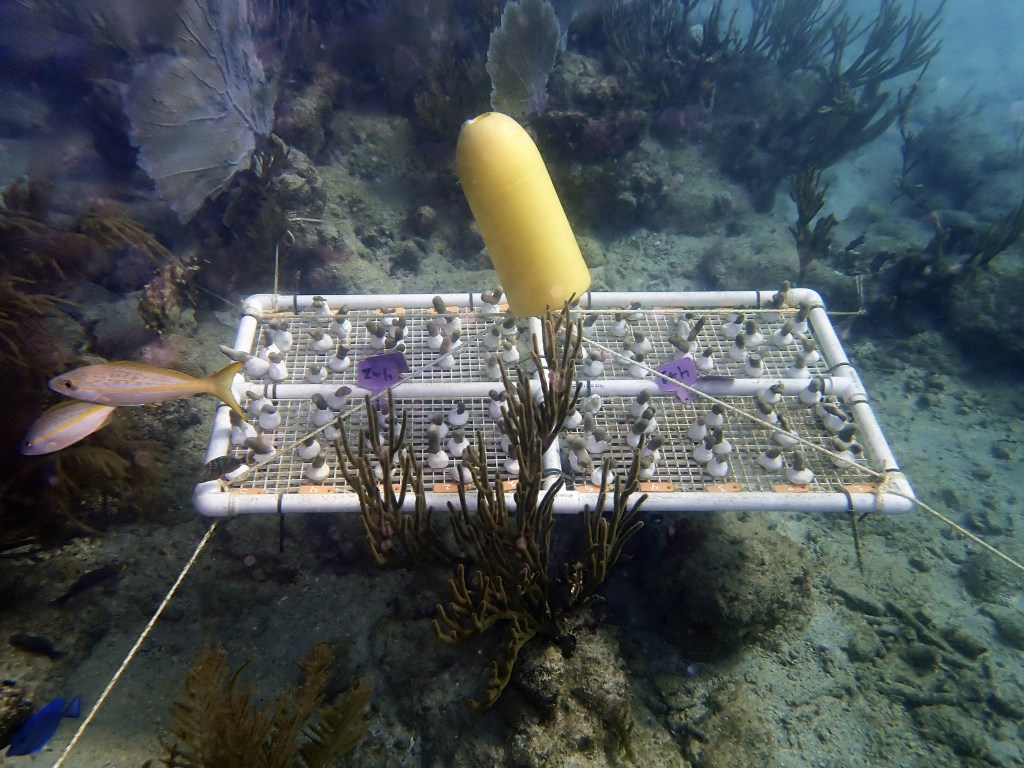
The coral farm, suspended 20 feet underwater, has no identification plate or surface buoy to mark its location. It’s not shown on any nautical charts. It is simply a submerged platform the size of a backyard vegetable plot. Instead of growing lettuce and carrots, some anonymous person has planted branched finger coral. About 80 coral nubs are mounted on a plastic grid, and they are thriving.

There is nothing new about the aquaculture of coral. One of the first successful coral propagation attempts occurred at New Caledonia’s Nouméa Aquarium in 1956. Commercial coral propagation began in the United States in the 1960s. Still, it wasn’t until worldwide coral populations began to crash in the 1980s that the industry focused on propagating coral for oceans instead of aquariums.

Then, in April 2006, the Margara, a 750-foot tanker carrying over 300,000 barrels of fuel oil, ran aground on a shallow coral reef in Puerto Rico’s Bahía de Tallaboa. No oil was spilled, but the grounding and efforts to remove the vessel destroyed 6,755 square meters of reef, including six species of coral protected under the Endangered Species Act. Emergency restoration by NOAA and the Puerto Rico Department of Natural and Environmental Resources saved approximately 10,500 coral colonies in the affected reef by using farmed corals from nurseries and transplanting them back onto the ocean floor.

As coral populations diminish due to human negligence and climate change, it may seem that coral is disappearing faster than it can be replaced. This does not deter the efforts of research and conservation groups such as the Mote Marine Laboratory, which has restored more than 216,000 corals to Florida’s reefs. Notably, some restored corals are now naturally reproducing to create new generations of coral.

The Coral Restoration Foundation in the Florida Keys is also succeeding in growing coral that reproduces both sexually through spawning and asexually through fragmentation (where a small piece of coral can reattach and develop into a new colony). Since 2012, the Coral Restoration Foundation has transplanted more than 220,000 corals onto Florida’s reef, restoring over 34,000 square meters of habitat.

Back in Culebra, local commercial fishermen proposed the establishment of the Luis Peña Channel Natural Reserve to replenish local fish stocks and protect the coral reefs. This reserve encompasses Bahía Tamarindo Grande, home to the coral farming garden plot. It is the first no-take marine protected area designated in Puerto Rico. The mission statement is simple: The health of coral reefs directly depends on strong reef fish populations. Fish and other animals, such as lobsters and shellfish, rely on the health of the coral reef. The livelihoods and culture of the people of Culebra depend on healthy coral reefs.

An image from the NASA Earth Observatory of Culebra Island, located about 17 miles east of Puerto Rico. 

As always, sailing is not just about the wind and the sea; the places, the flora, fauna, and people encountered along the way are equally important.

Please click “Follow” so you don’t miss a new update, and please consider sharing this post with others who might enjoy connecting with the voyage. I welcome your comments and will always respond when I have an Internet connection. I will never share your personal information.

An additional website, www.JeffreyCardenas.com, features hundreds of fine art images—underwater, maritime landscapes, boats, and mid-ocean sailing photography–from exotic locations worldwide.

Upcoming Exhibition: “On the Reef” will be exhibited in The Studios of Key West’s Zabar Project Gallery, on view from January 2–30, 2025. 

Instagram: StellaMarisSailing / Facebook: Jeffrey Cardenas

Text, Photography, and Videos © Jeffrey Cardenas 2024

Let this be a time of grace and peace in our lives – Rev. John C. Baker

Kingdom of Fire

“Fire coral will be the last remaining living coral on earth.”

I remember writing those words once, in a bluster of prophetic arrogance. That’s not exactly the most positive Earth Day message to consider as I dive this week on a shallow reef in the French West Indies at Île Fourchue, Saint Barthélemy.

First of all, fire coral is not even a true coral. Instead, it is more closely related to hydra, a very small predatory animal similar to jellyfish and other stinging anemones. But, for the sake of consistency, I will still refer to it as fire coral.

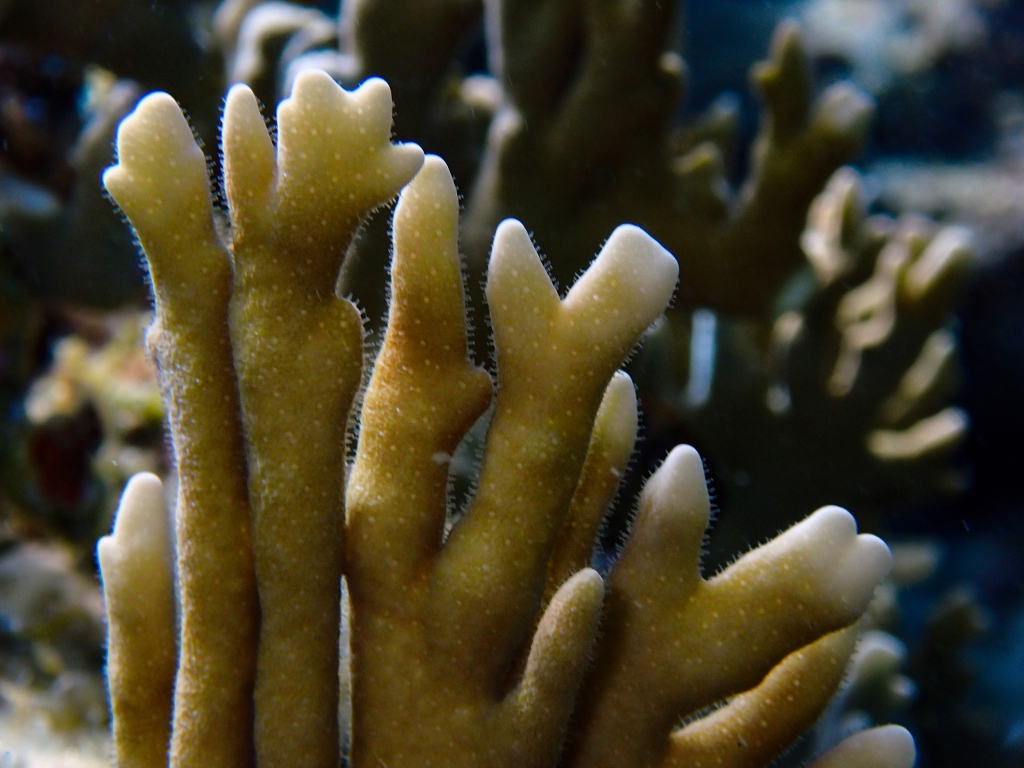
Fire coral can be either blade-like or encrusting. It is colored a mustard-yellow to dark orange, often with white edges. It has strong stinging cells that on contact cause intense pain lasting from two days to two weeks. Relapses of inflammation, itching, and welts are common. Fire coral releases venom through tiny hairs called cilia. It is their only defense mechanism against predators, including thoughtless human beings. Do not touch it, or any coral.

Microscopic venomous hair–cilium–inflicts intense pain that can last from two days to two weeks. Photograph: © Jeffrey Cardenas

Because fire coral has the unusual ability to grow in two different forms, some marine biologists believe it has a survival edge over other Caribbean corals. It can grow like a bush with a stem and branches sprouting upward, or in sheets that appear as a flat coating across rocks and other surfaces.

“Fire corals have been around for millions of years and what they are doing is pretty darn successful,” says California State University marine biologist Peter Edmunds. For the past 30 years, he has been traveling to the Caribbean to document the life history of fire coral on inshore reefs.

“They are now poised to be… the inheritors of the reef, while other corals, particularly stony corals, die back,” he said. ”When it’s not stormy, they can produce branches and exploit the light and plankton in the water. When it’s storming and everybody gets beaten up, it loses its branches but it still has its sheets, which it can use to spread out and claim more territory.”

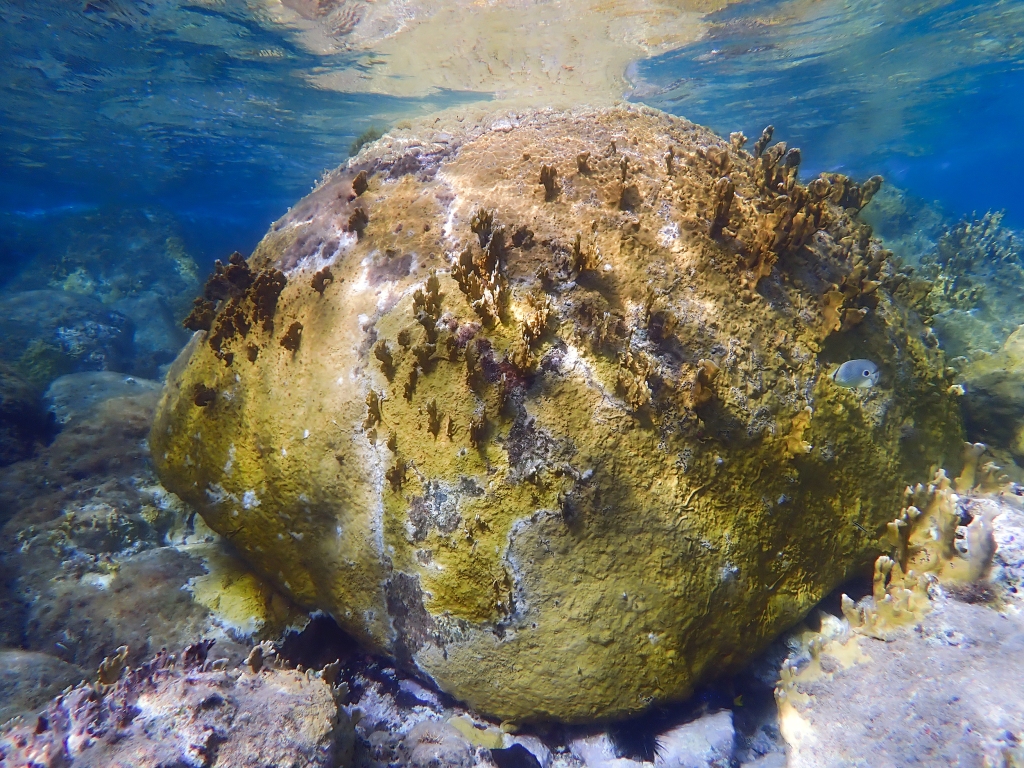
A sunken granite boulder near shore is slowly becoming encased in a sheathing of fire coral while fire coral branches take root and sprout from the surface of the dead rock. Photograph: © Jeffrey Cardenas

Researchers believe this adaptation may help save Caribbean reefs, which have been plagued by hurricanes, global warming, disease, and an overabundance of algae. Because fire corals are thriving as other corals die off, they are creating structures for fish and other organisms. Fire corals “are going to be very important habitat providers because they are able to survive under these stresses,” says Colleen Bove, a marine ecologist at Boston University.

But fire coral is not bulletproof. Some species have brittle skeletons that can easily be broken during storms, by anchors, or by careless divers and collectors who are taking fish for the aquarium trade. I watched blueheaded wrasse spawn over fire coral. Rock beauties, butterfly fish, yellow tangs, and the aggressive beau gregory retreat into branches of fire coral when threatened. In Brazil, fire coral colonies are extensively damaged by divers harvesting yellowtail damselfish. The fire coral is deliberately smashed and the fish hiding among the branches are captured in plastic bags.

Bluehead wrasse spawn at midday on a full moon over a pinnacle of fire coral at Île Fourchue, Saint Barthélemy in the French West Indies Video © Jeffrey Cardenas

Reproduction in fire corals is more complex than in other reef-building corals. The polyps reproduce asexually, producing the jellyfish-like medusae. These contain the reproductive organs that release eggs and sperm into the water. Fertilized eggs develop into free-swimming larvae that will eventually settle on the substrate and form new colonies. 

Most divers wouldn’t mind seeing less fire coral on the reef, but I like to think of fire coral as a tactile warning to tread more carefully underwater. When the alternative may be a reef of dead rock, the sting of fire coral is a potent reminder that there is still life on that reef. And, it is one of the few ways the habitat has of fighting back.

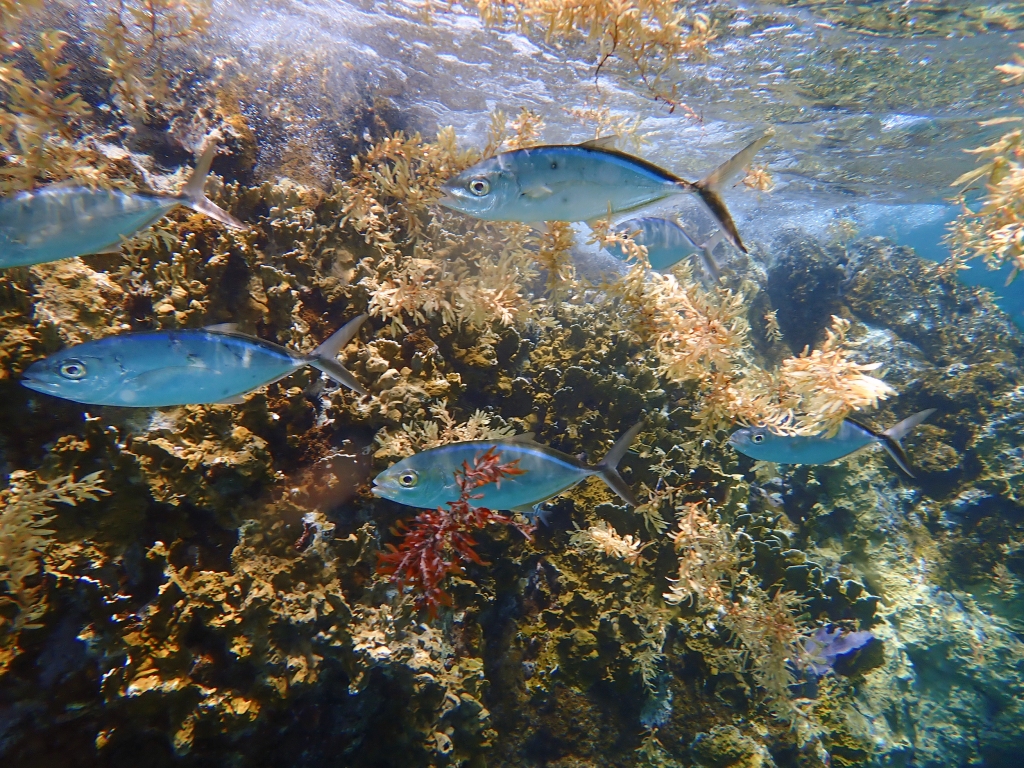
Blue runners feed amid clusters of sargasso being swept over a West Indian reef of fire coral. Photograph © Jeffrey Cardenas

As always, sailing is not just about the wind and the sea; the places, the flora, fauna, and people encountered along the way are equally important.

Please click “Follow” so that you don’t miss a new update,- and please consider sharing this post with others who might enjoy following the voyage. I welcome your comments and will always respond when I have an Internet connection. I will never share your personal information.

Instagram: StellaMarisSailing / Facebook: Jeffrey Cardenas

Text, Photography, and Videos © Jeffrey Cardenas 2024

Let this be a time of grace and peace in our lives – Rev. John C. Baker