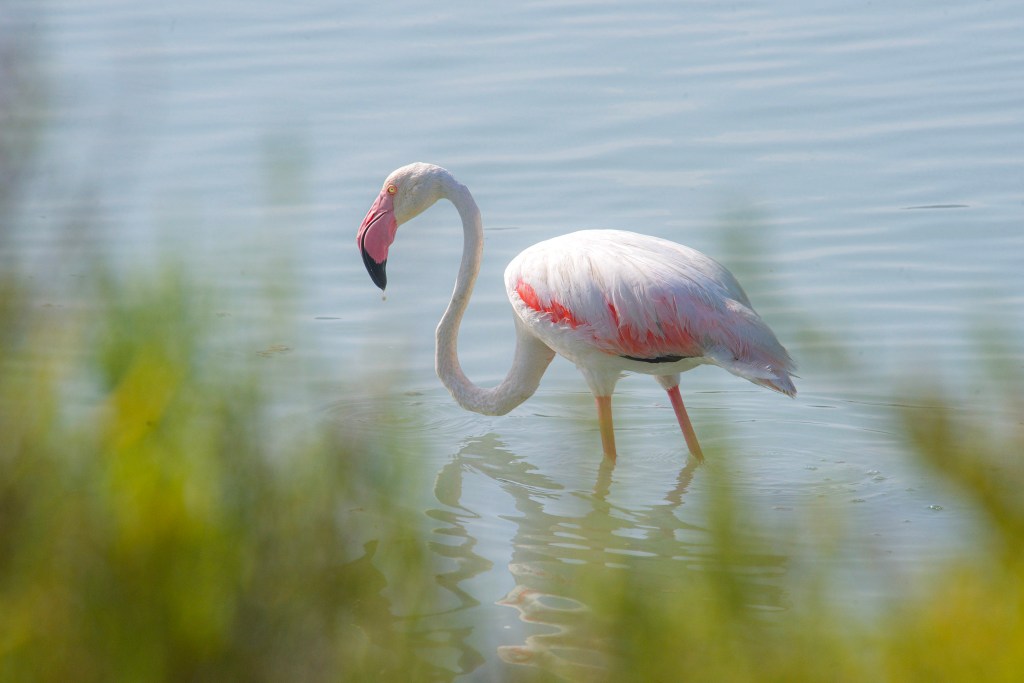
The earth’s Prime Meridian transits the salt flats of Calpe, where Flying Fish lays at rest after a passage from Ibiza. In a sense, this line of longitude is where time begins and ends each day. Time modifies and reorders the natural world: adaptation or extinction. These random thoughts occupy my mind as I share space on the salt flats with one of the world’s most iconic bird species. The greater flamingo has adapted and survived thousands of years of extraordinary change along Spain’s Costa Blanca.
The salt flats of Las Salinas were first utilized during the great Roman era of the 2nd century AD. Now, a busy marina and a European holiday center surround the edges of these ancient alluvial deposits. The greater flamingo continues to thrive here despite the high-rise apartments, Jet Skis, and música electrónica that have changed the shadow and sound of its environment. These flamingos are wild birds. Their wings are not clipped. They are not fenced in or fed. That they choose to return to Las Salinas, in the middle of this urban setting, is a testament to how nature adapts.
The salt flats and the city of Calpe are at the base of the massive rock Peñón de Ifach, a 1,000-foot massif of limestone rising from the Mediterranean Sea. Ifach is an important homing beacon for birds. Some 173 species, both nesting and migrating, have been recorded here, including black-winged stilts, avocets, the black wheatear, and the white wagtail. There is some ornithological tourism in Calpe, but most tourists come instead for a different variety of wagtail, and to get sunburned and drink sangria.
Tourists sharing Calpe with the birds date back at least two millennia. Across the sandbar delineating the salt flats and the edge of the sea, archeologists excavated the “Baños de la Reina.” Ancient Roman engineers designed a thermal complex including pools of different temperatures, a sophisticated heating system, and a piscinae for sunken gardens and the farming of live fish. But for whom this ultimate vacation villa was constructed is still unknown. Archeologists know that hidden tunnels allowed private access to the Baths of the Queen, but they do not know who the queen was. Whoever merited this elaborate architecture of marble and mosaics was most certainly “a person with a high purchasing power.”[1] Marcus Aurelius is famously quoted saying, “Accept the things to which fate binds you, and love the people with whom fate brings you together, but do so with all your heart.” Perhaps Marcus Aurelius kept a mistress at the salt flats of Calpe.
The history that has shaped the landscape of Las Salinas has also helped maintain its natural habit and biodiversity. Salt was a necessity for fish preservation, which Calpe used to market its catch. Eventually, salt from these lagoons supplied fishing industries in over 40 Spanish municipalities. At the end of the 18th century, Salt production declined when Las Salinas was thought to harbor yellow fever. In 1993, Spain declared Las Salinas a protected maritime-terrestrial zone.
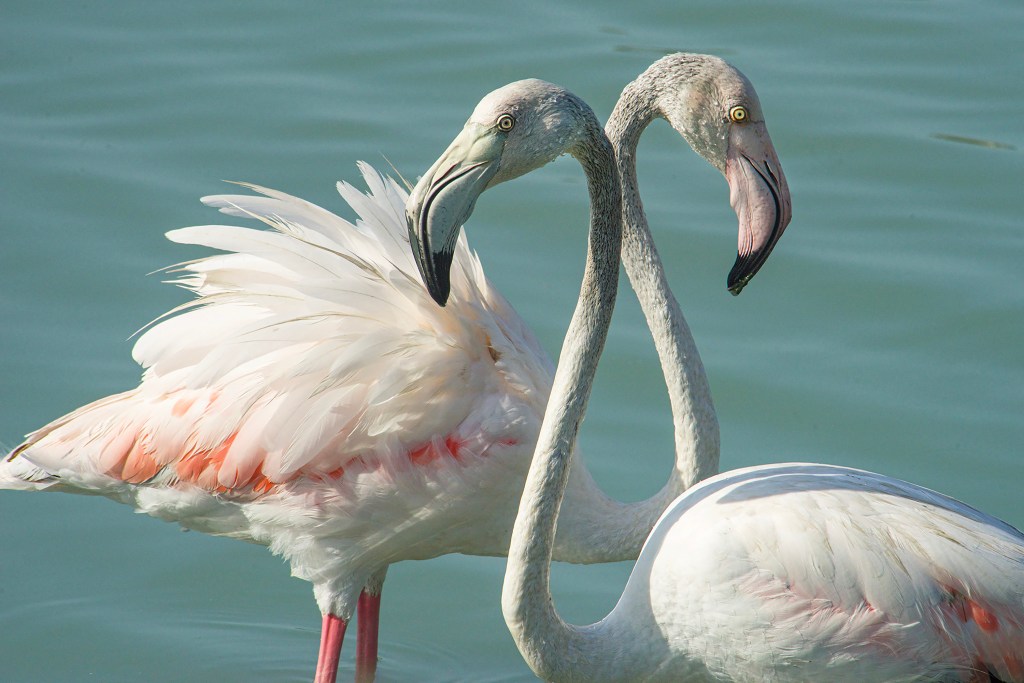
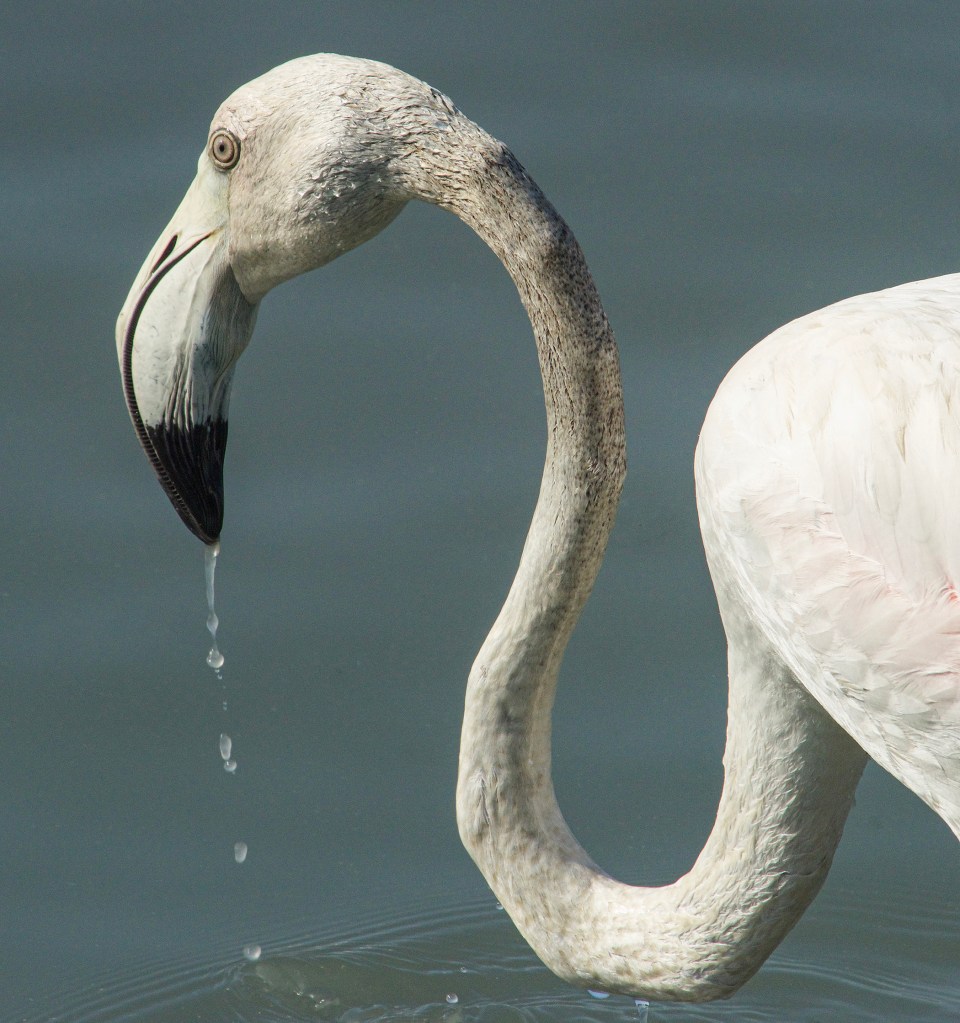
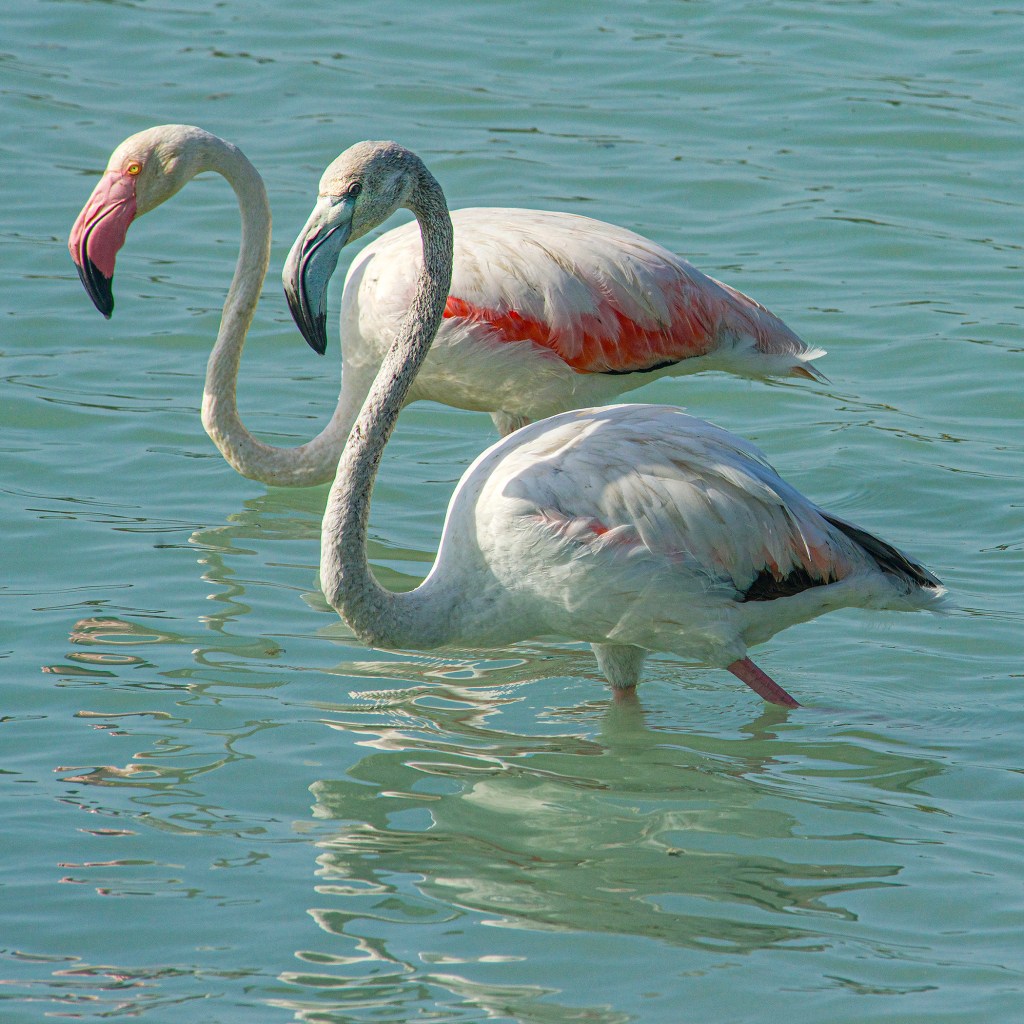
Two generations of greater flamingos. Flamingos suck water through their bills to filter feed. A mature and a subadult greater flamingo feed together. All images © Jeffrey Cardenas
While many species make up the Las Salinas habitat, the population of flamingos generates the most attention. The coloration of all flamingos comes from the carotenoid pigments in the organisms that live in their feeding grounds. The greater flamingo, one of four distinct species, is less flashy than some of its genetic relatives like the hot-pink American flamingo. That doesn’t prevent them from wanting to look good. Secretions of their uropygial “preening” gland contain carotenoids–red pigments. During the breeding season, greater flamingos preen to spread these uropygial secretions over their feathers, enhancing their color. Ornithologists have described this cosmetic use of uropygial secretions by greater flamingos as “applying make-up.”[2]
The greater flamingo is an enthusiastic eater. It feeds with its head down; its upper jaw is movable and not rigidly fixed to its skull.[3] Using its feet, the bird stirs up mud, then sucks the slurry through its bill to filter small shrimp, seeds, blue-green algae, microscopic organisms, and mollusks. It is a healthy diet. Wild greater flamingos have an average lifespan of 30 – 40 years. The oldest known greater flamingo, named Greater, (duh) lived in an Adelaide, Australia zoo for between 85-93 years.[4] The bird’s exact age is unknown; he was already a mature adult when he arrived in Adelaide in 1933. Greater was euthanized in January 2014 due to “complications of old age.”
It is zero hundred hours, at zero degrees longitude. A full moon has risen in direct alignment with Jupiter and Saturn. Flying Fish is secure nearby at her mooring. Somewhere in the ruins of a partially submerged palace, the legacy of an unknown queen waits to be discovered. And on the salt flats of Las Salinas, flamingos secrete pigment over their feathers. Some days I, too, feel the complications of aging, but I’m not ready to be euthanized yet. There is still so much to see and so much to know.
###
References:
[1] “The Baths of the Queen, a Roman Palace,” The World (2012)
2] “Greater flamingos Phoenicopterus roseus use uropygial secretions as make-up,” . Behavioral Ecology and Sociobiology, J.A., Rendón, J Garrido-Fernández, A Garrido, M, Rendón-Martos, and A Pérez-Gálvez. (2011).
[3] Flamingo, Wikipedia
[4] “Flamingos at Adelaide Zoo,” Vaughan Wilson; at Conservation Ark / Zoos South Australia 2008

Sailing is not just about the wind and the sea; equally important are the places to which Flying Fish carries me.
Please click Follow at the bottom of this page so that you don’t miss a new update, and please consider sharing this post with others who might enjoy following the voyage of Flying Fish. I welcome your comments. I will always respond to your comment when I have an Internet connection. And I will never share your personal information.
You can follow the daily progress of Flying Fish, boat speed (or lack thereof), and current weather as I sail into the Mediterranean by clicking this satellite uplink: https://forecast.predictwind.com/tracking/display/Flyingfish. Click the “Legends and Blogs” box on the right side of the tracking page for en route Passage Notes.
To see where Flying Fish has sailed since leaving Key West in 2017, click here: https://cruisersat.net/track/Flying%20Fish.
Instagram: FlyingFishSail
Facebook: Jeffrey Cardenas
Text and Photography © Jeffrey Cardenas 2021
Let this be a time of grace and peace in our lives –Fr. John Baker

 Stella Maris Sail