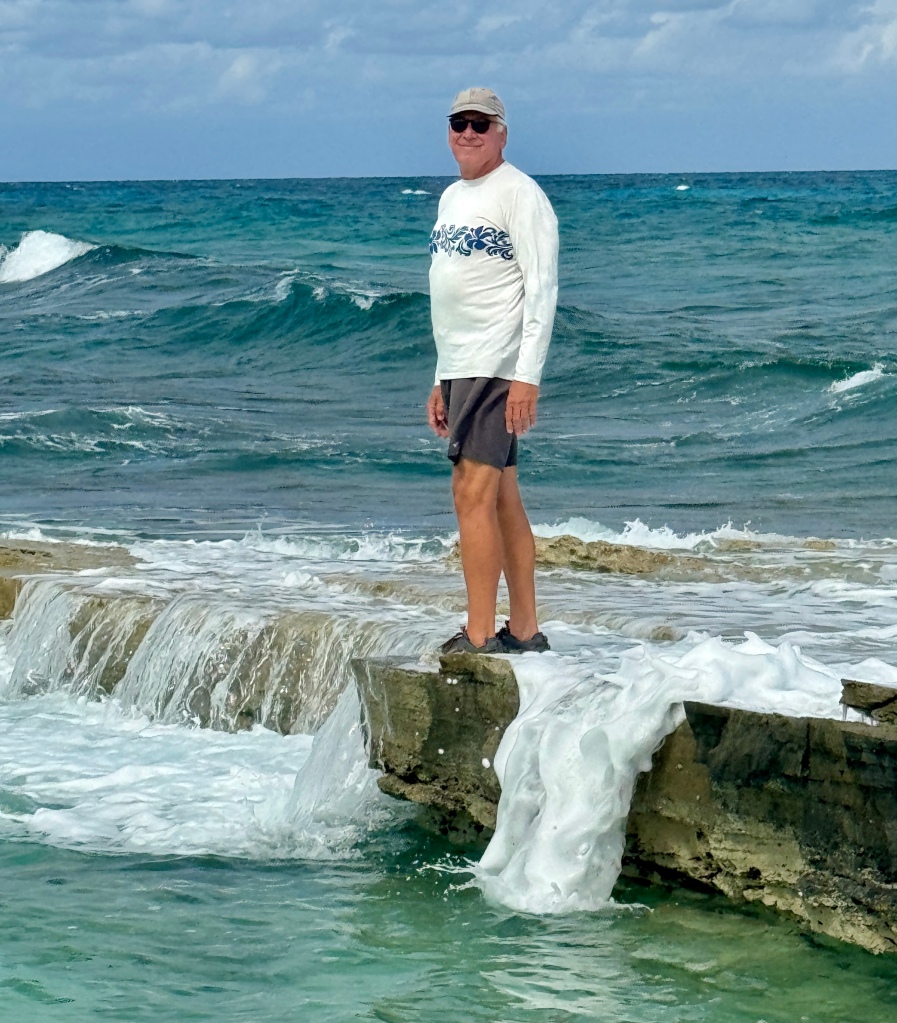
Sailing Stella Maris 2023

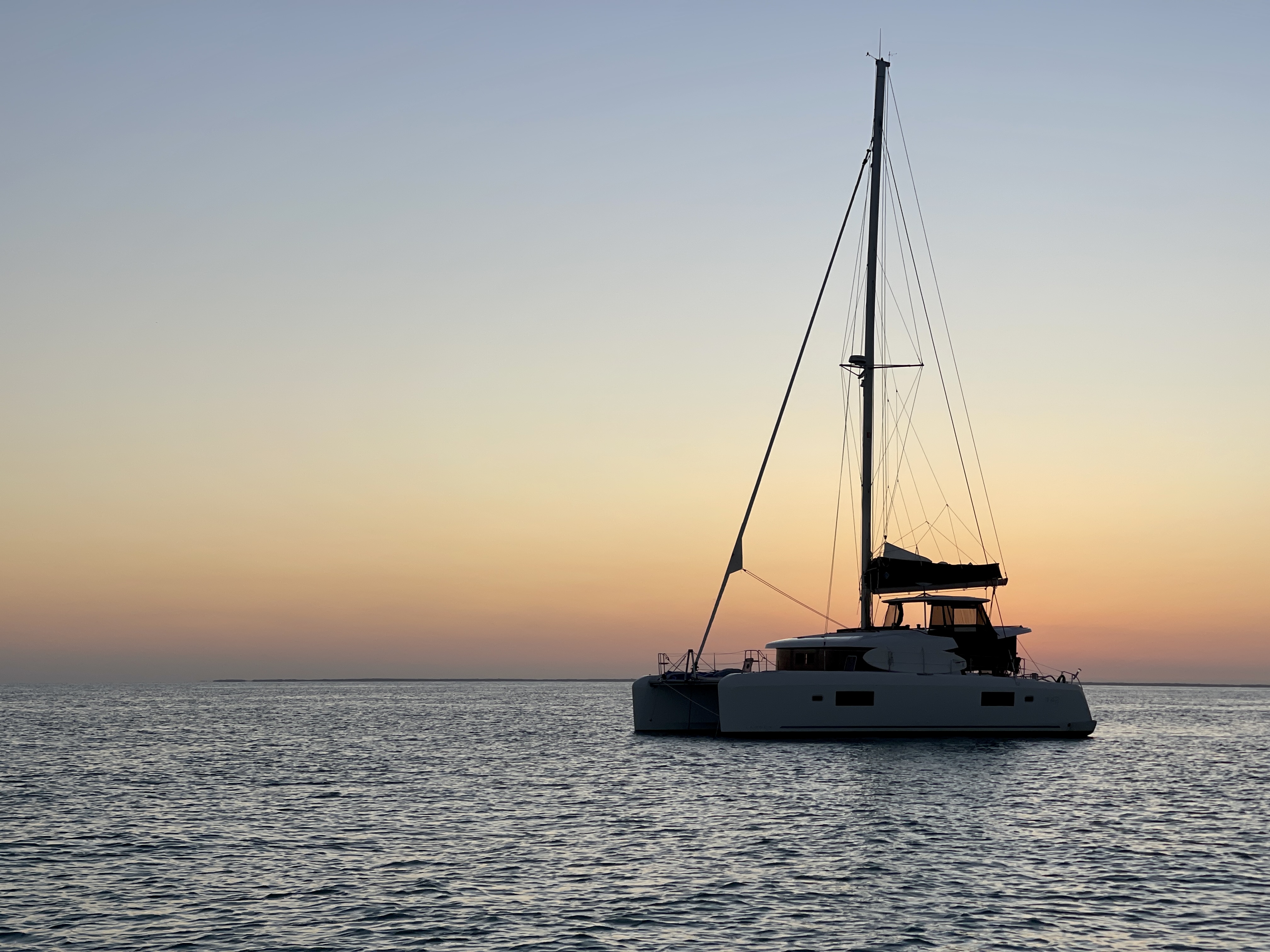
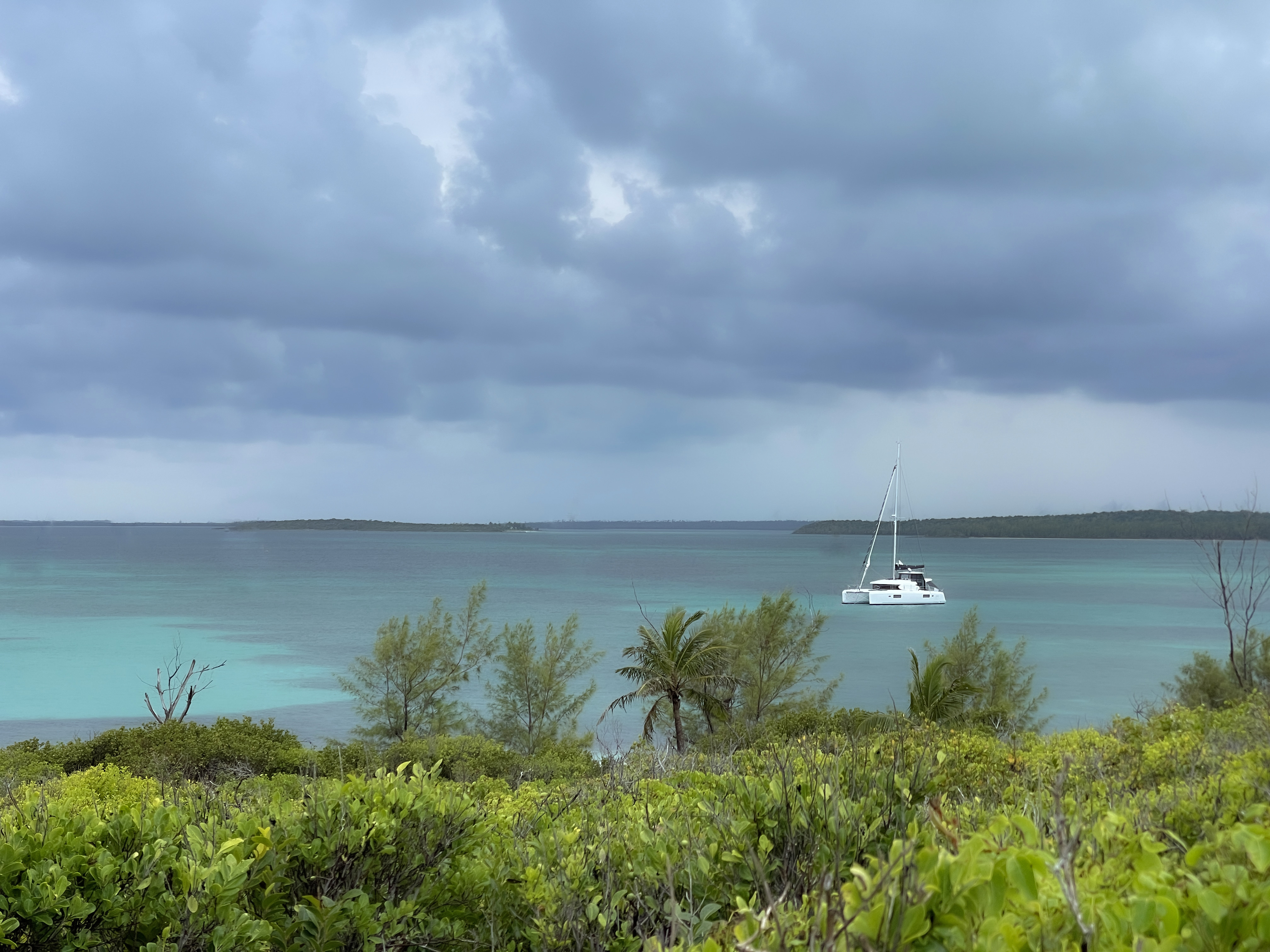
The joy of a sail filling with wind is inexpressible. Photograph: © Jeffrey Cardenas

Christening Stella Maris–Star of the Sea–February 2023

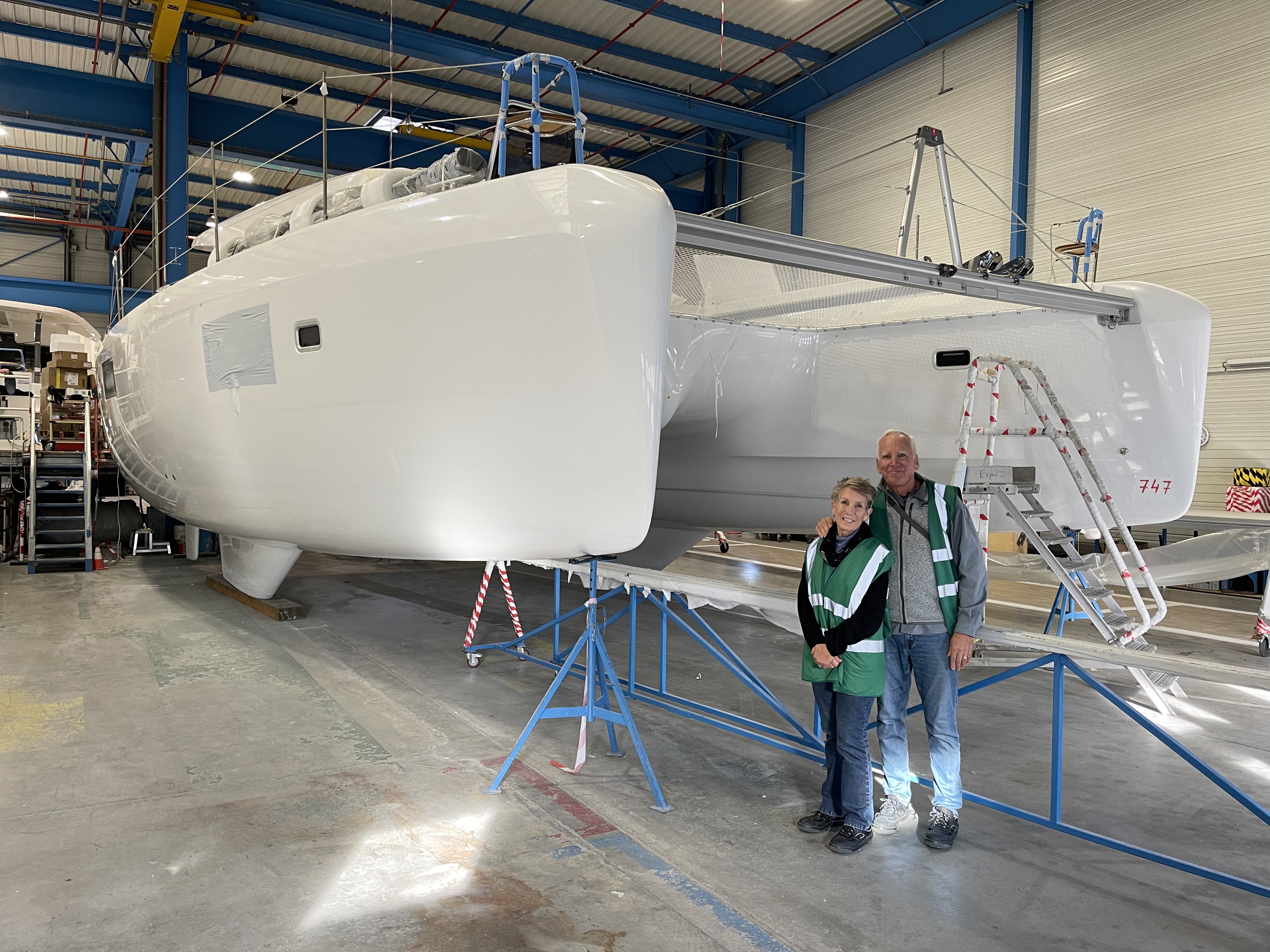
It is essential to know the genesis of a boat. Ginny and I went to the Lagoon Catamaran production facility in Belleville, France, to watch the final build of Stella Maris. She was then shipped from La Rochelle, France, to Florida. The only thing missing was a case of fine French wine that had been stashed onboard. No problem. A bottle of that wine ultimately appeared in a gift basket, and we christened Stella Maris with Mom and Dad onboard. We miss you, Pop, but we are happy that you were able to help christen the new boat.

Sea Trial West of Key West–March 2023

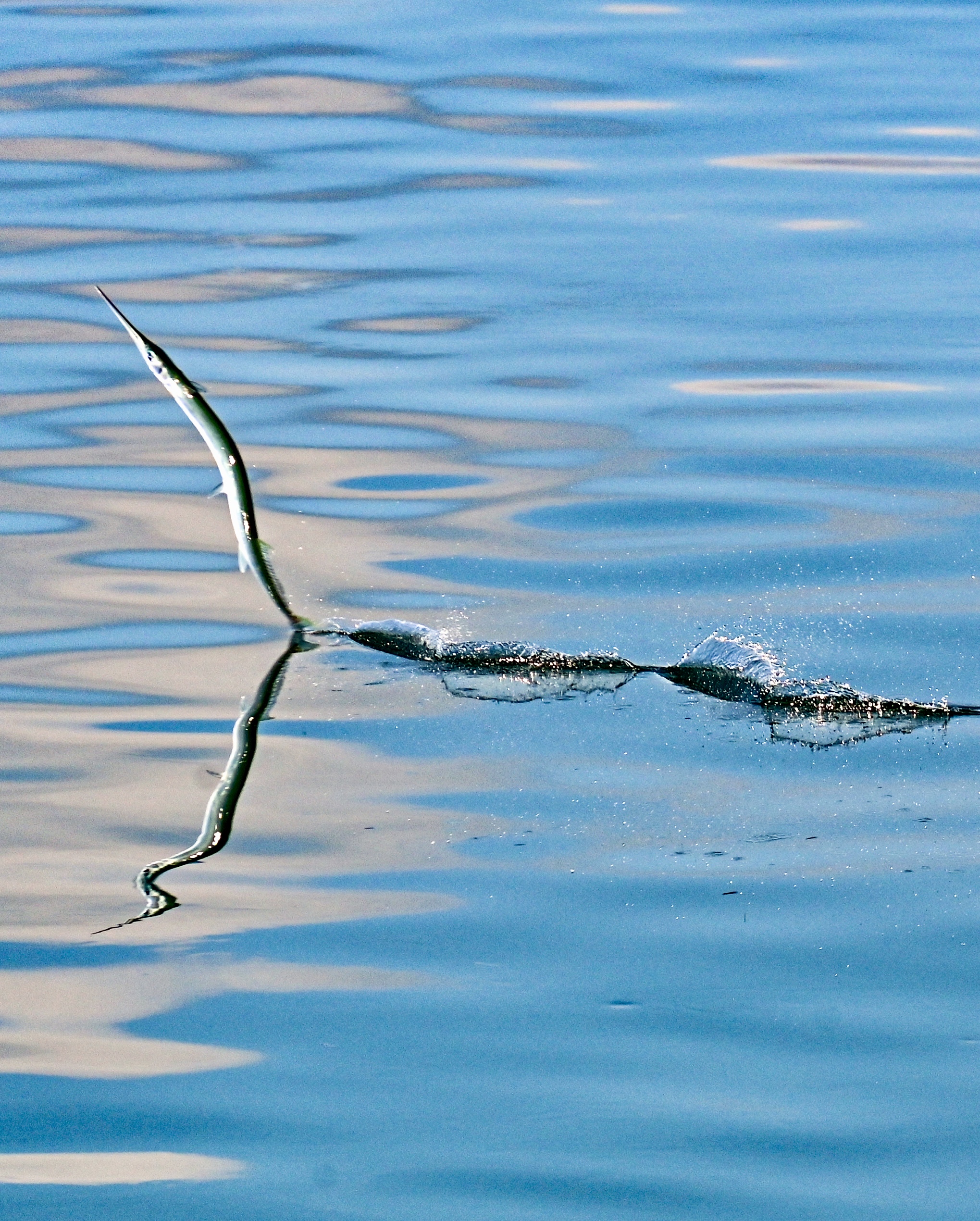
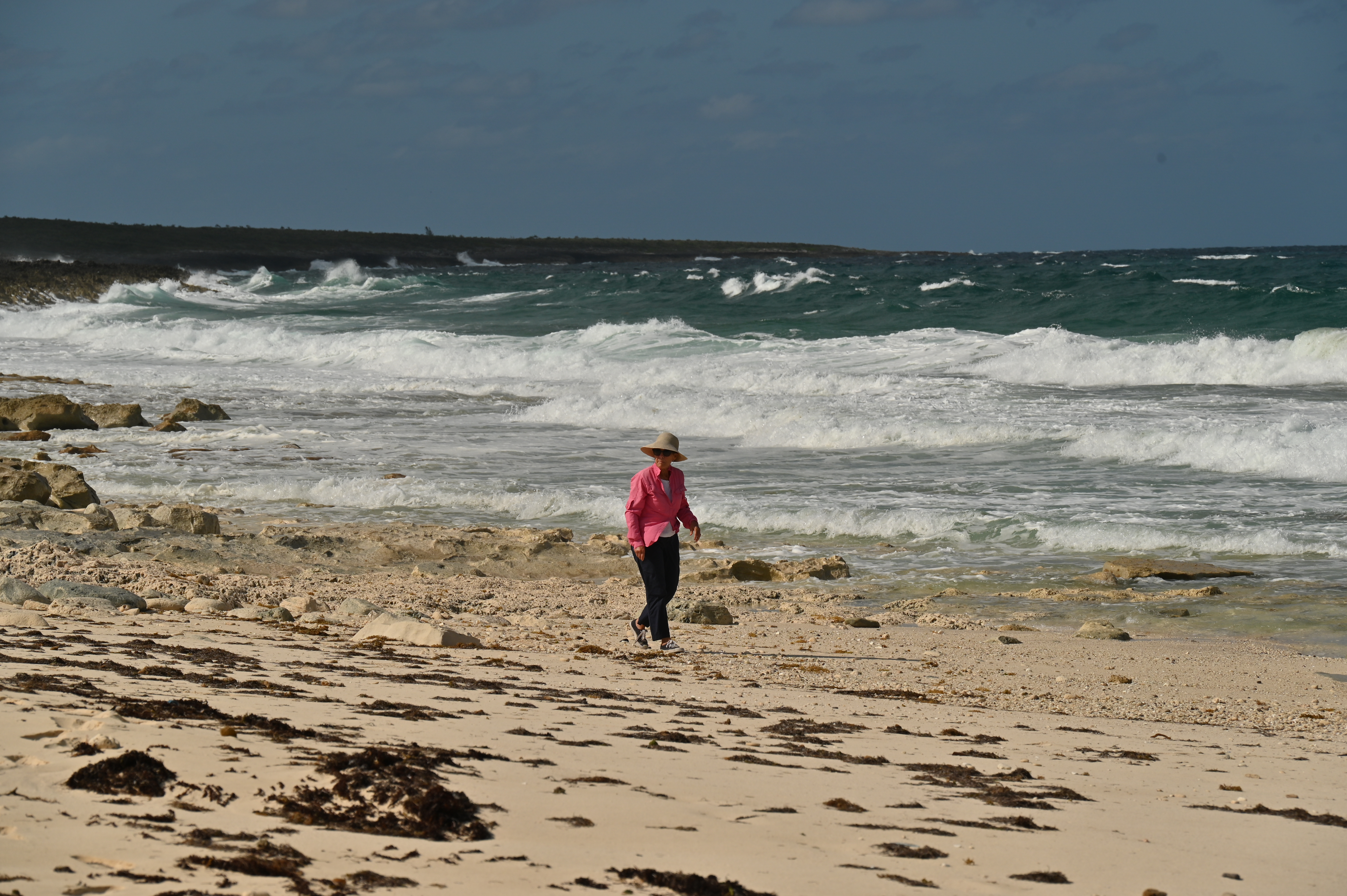
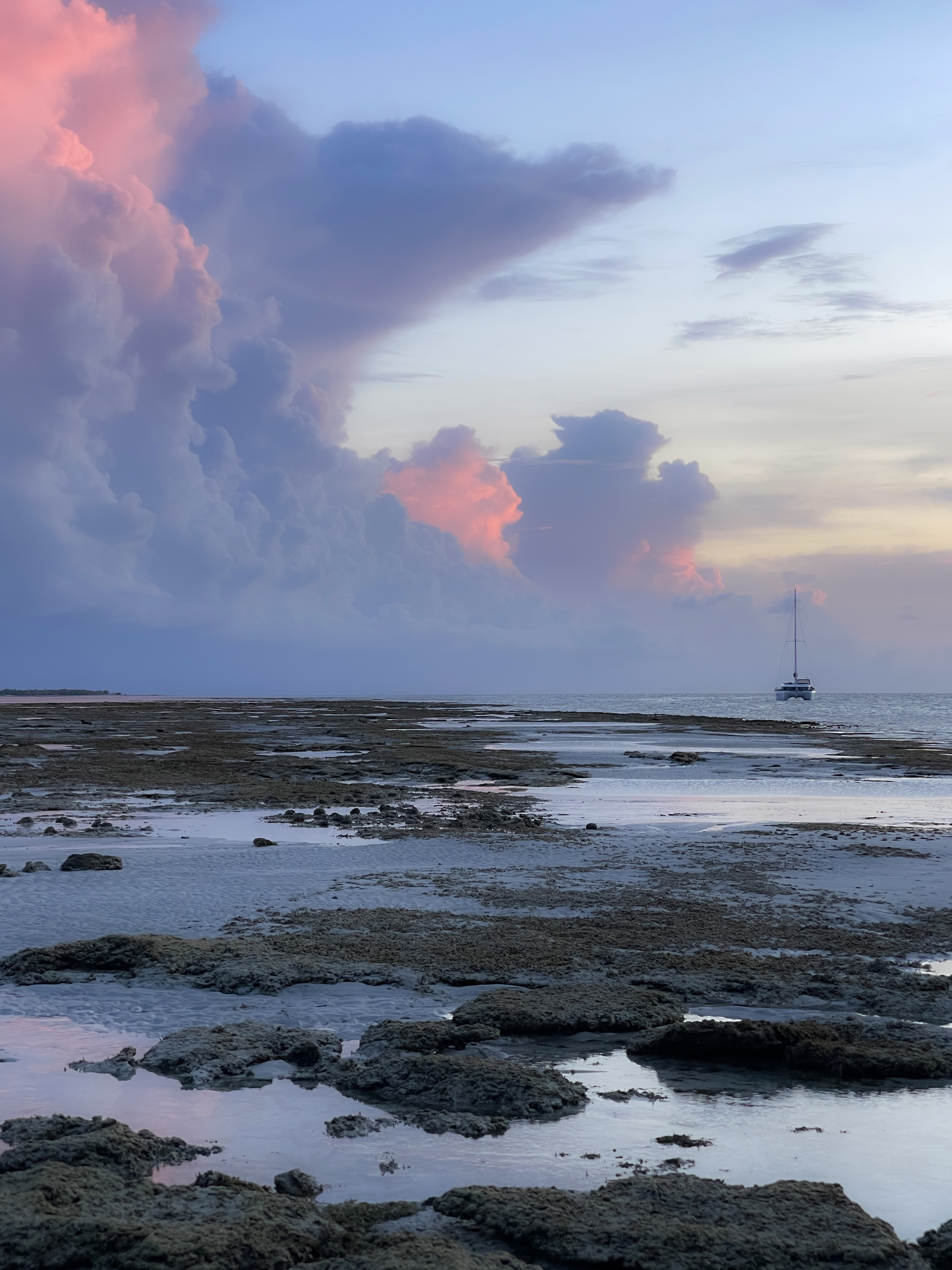
The catamaran, I quickly learned, is a different animal from the monohull that carried me around the world. Stella Maris is like a mobile beach cabin with a sail attached. It is a great platform to explore the islands west of Key West, where I spent so many years working as a charter fishing captain. The difference is that instead of pursuing the fish in these waters, the fish now–out of curiosity, and if I am quiet enough–come out to meet me. I can go to sleep and wake up in the islands, and a new day begins.

Click on individual gallery photos to see a high-resolution image


Shakedown Cruise to Bimini, the Berry Islands, and Abaco–May 2023

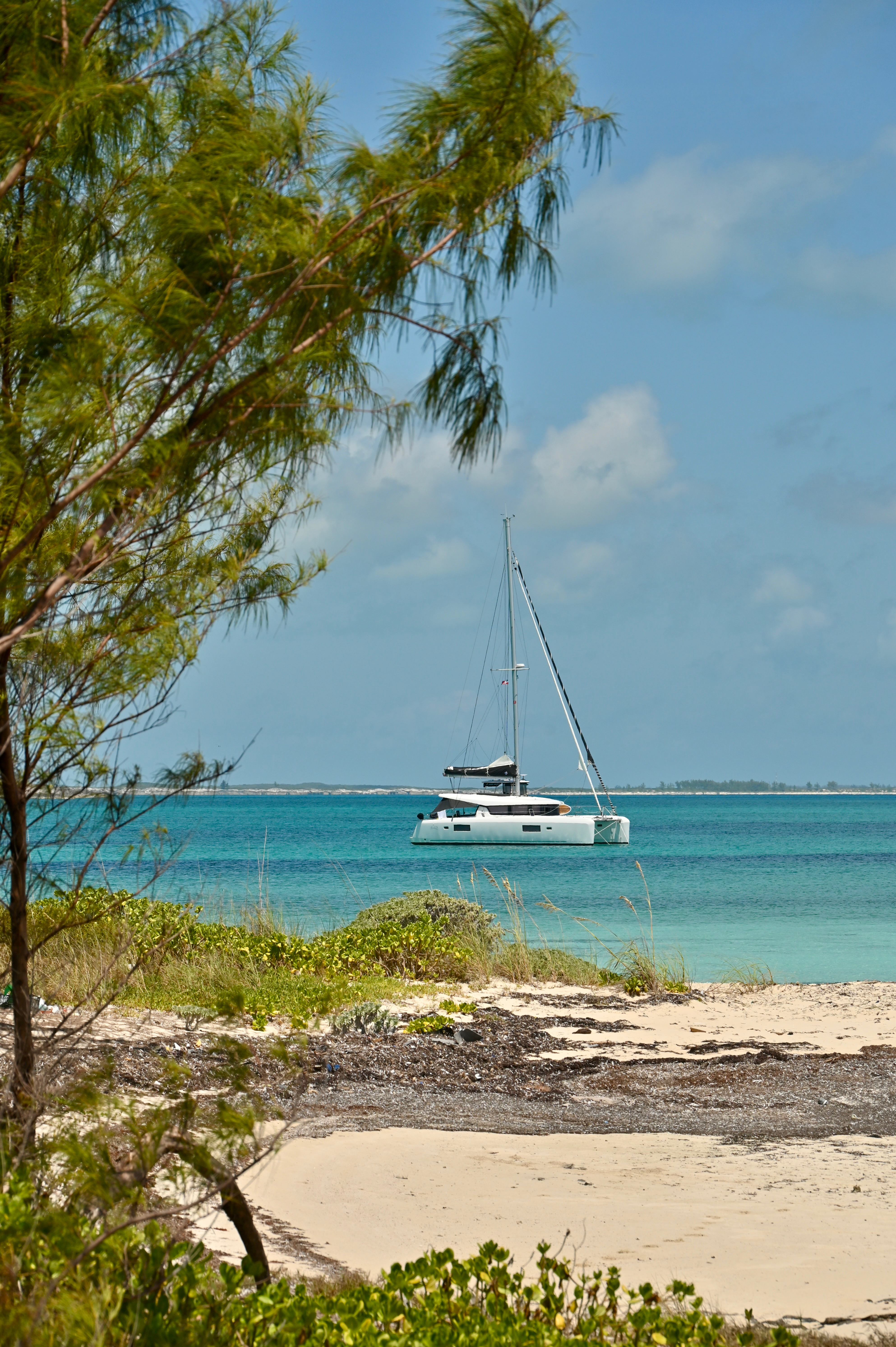
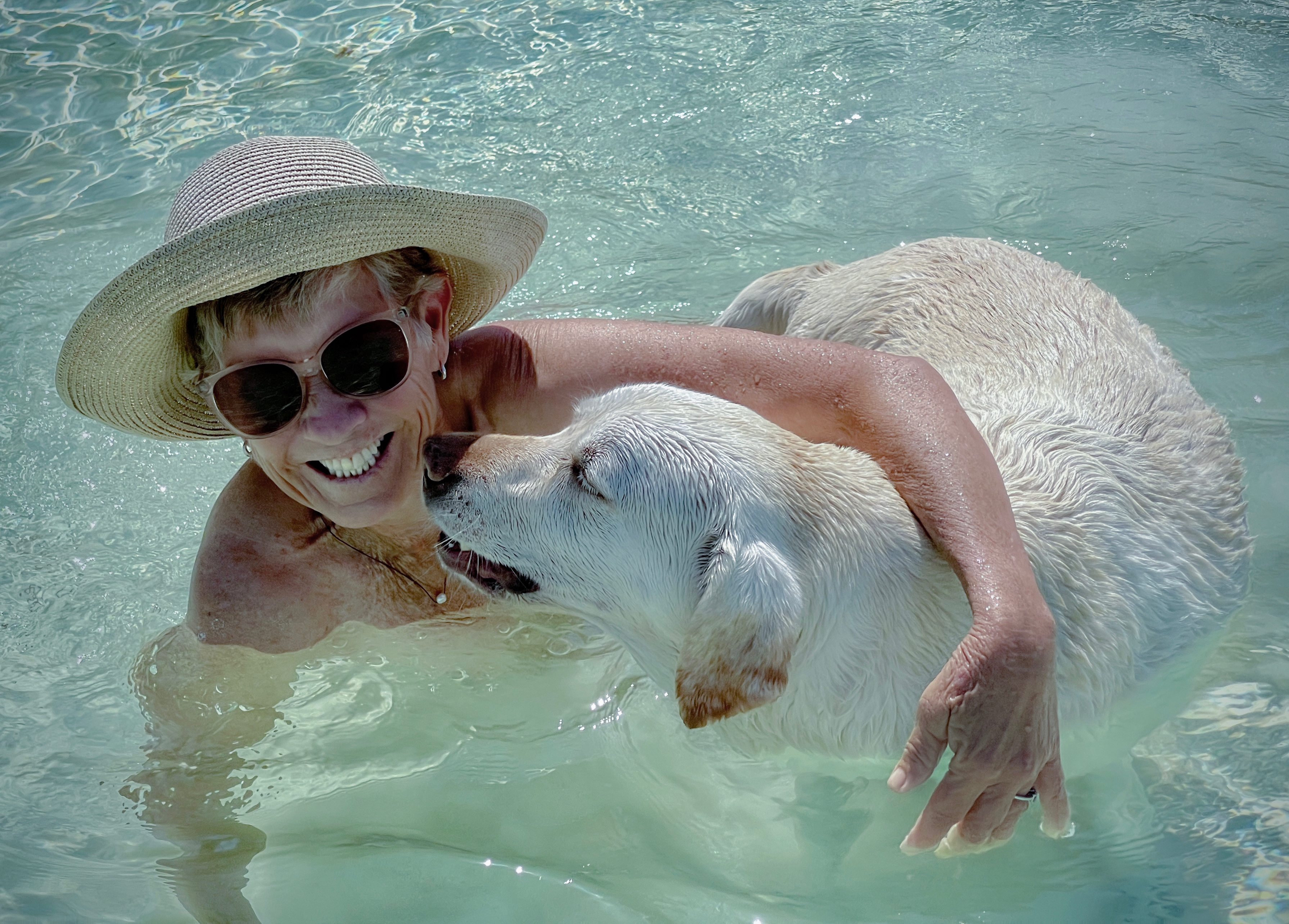
Ginny and Amiga were a welcomed crew on the first significant passage aboard Stella Maris from Key West to the Northern Bahamas. We revisited Bimini, where Ginny and I spent so many glorious days in our youth (she proposed to me there 44 years ago!) Gunkholing through the Berry Islands, we found secluded anchorages and nature trails. There is still some out-island tradition at Man-O-War and Green Turtle Cay in the Abacos. The highlight was a rendezvous with our daughter Lilly, who joined Stella Maris for several days, sharing her local knowledge of the Northern Bahamas.


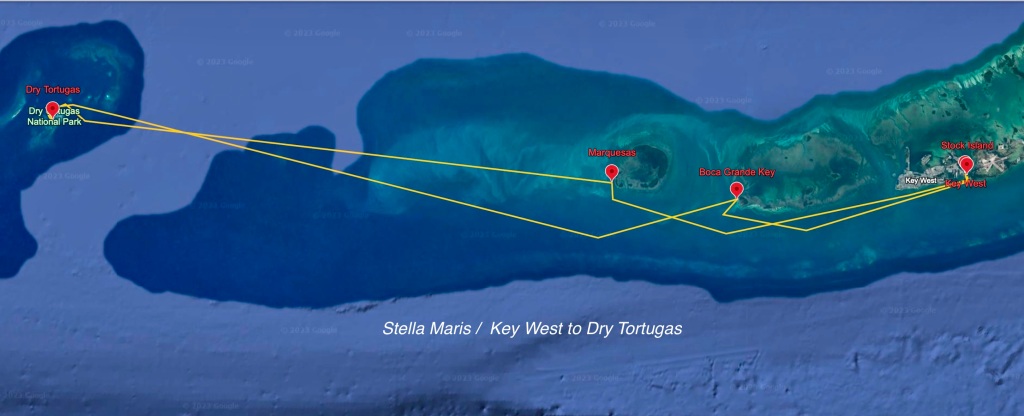
Dry Tortugas–August 2023

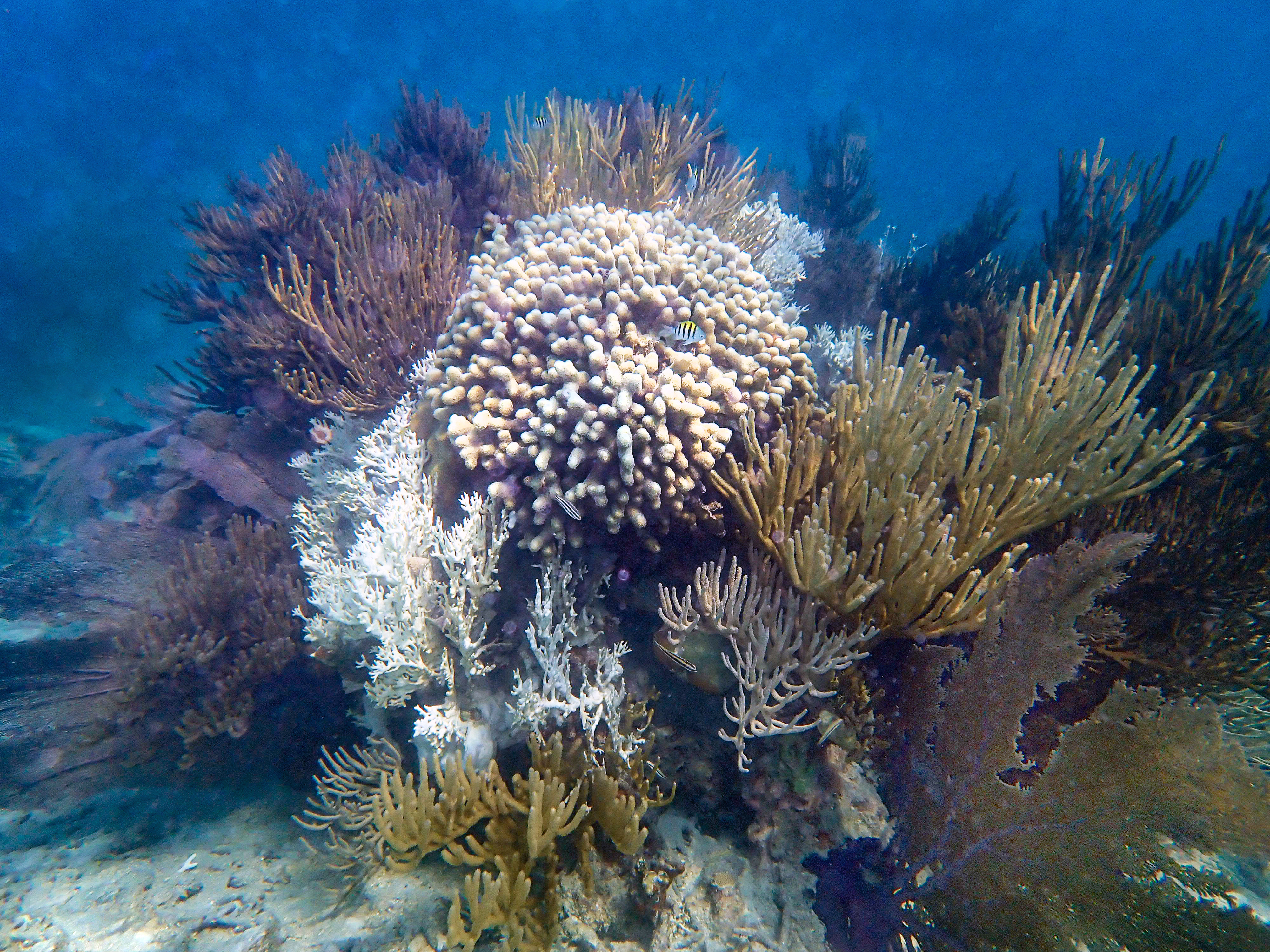
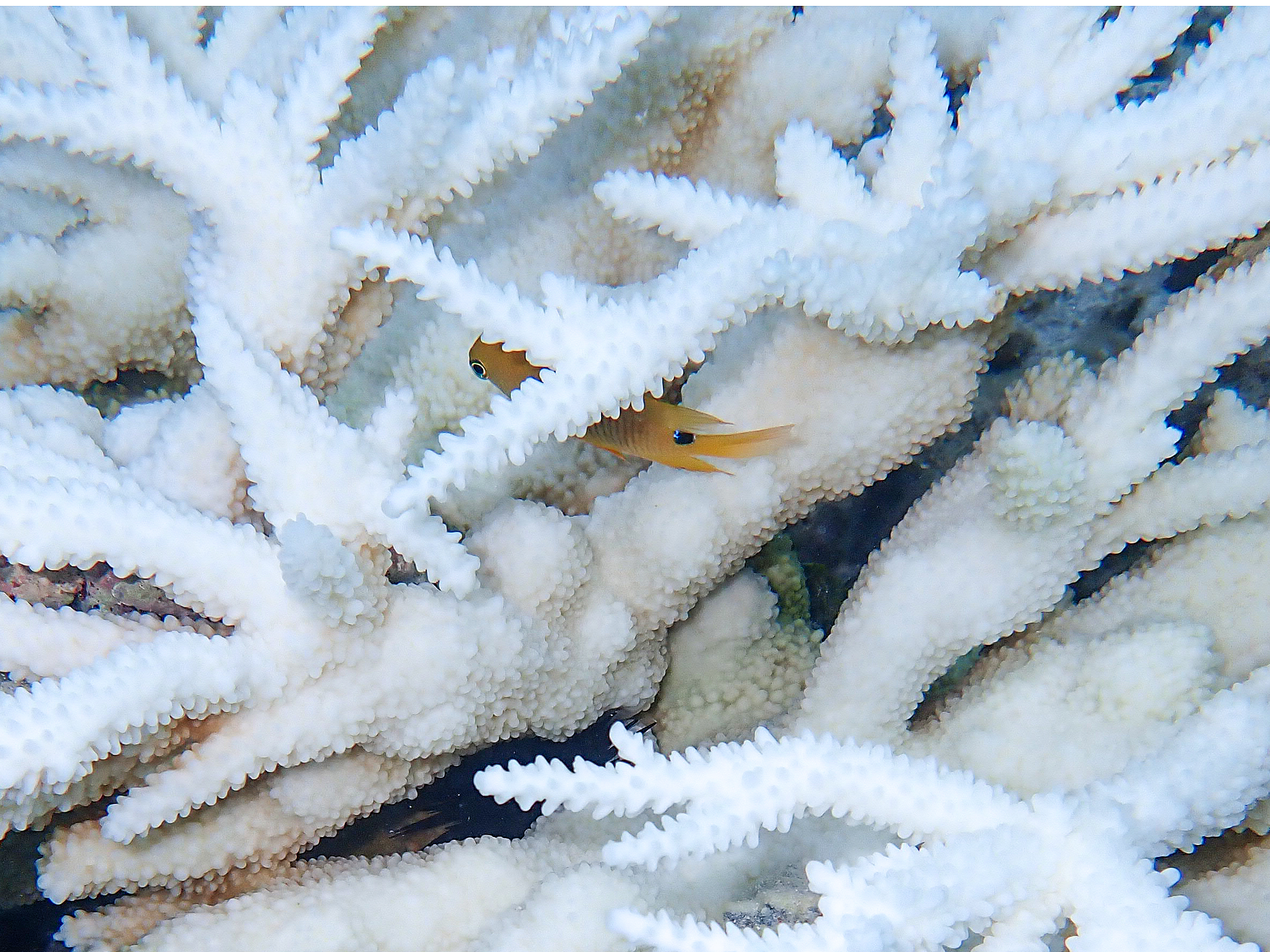
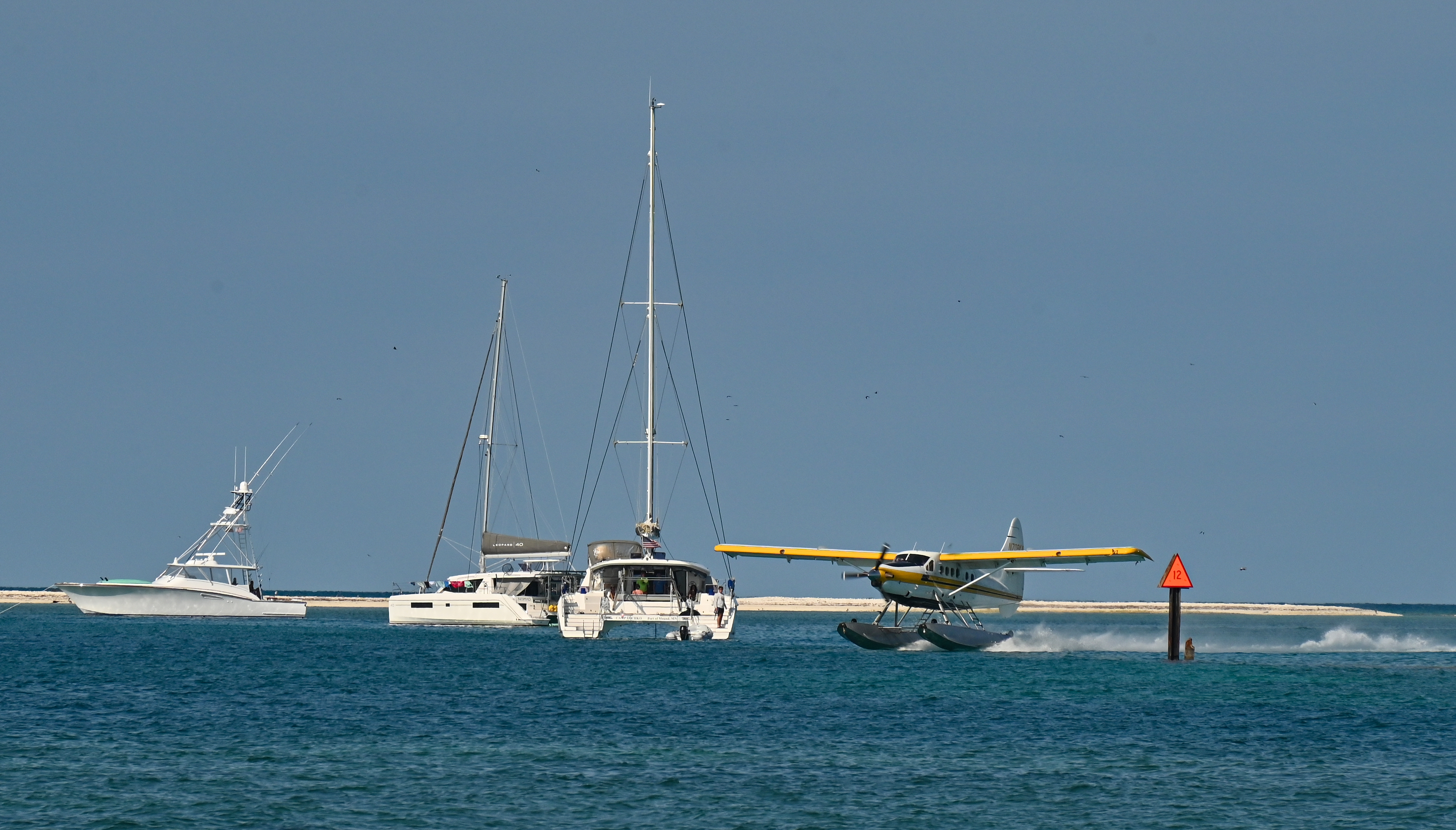
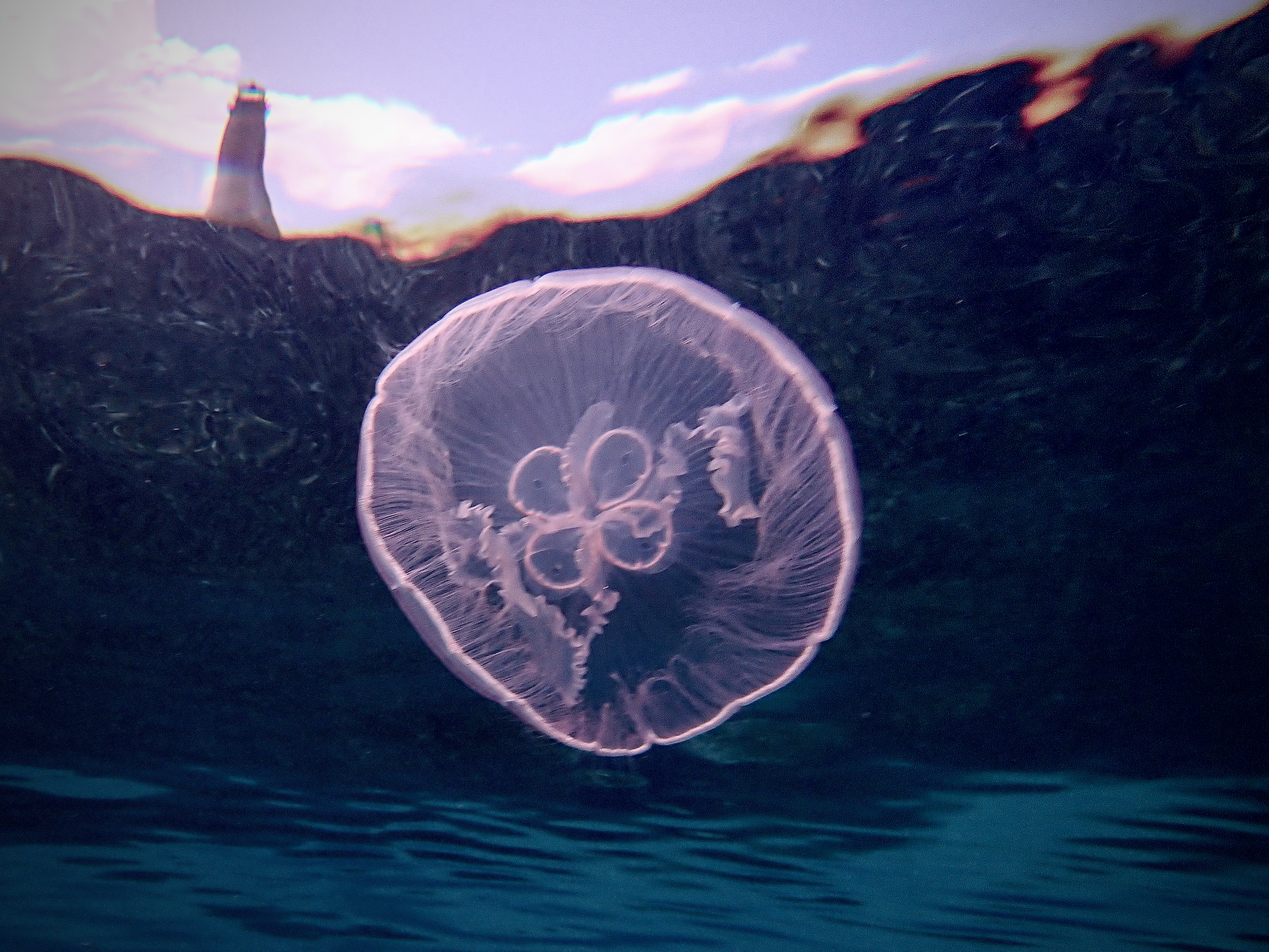
The summer heat of 2023 was frightening. I sailed to the historic Dry Tortugas National Park in light air and torrential rain squalls 70 miles west of Key West. I found some refuge from the heat under the water, but I was dismayed to see the damage done by global warming on the pristine reefs here. Immense brain coral heads and vast stands of staghorn coral, alive only a few months earlier, were now bleached white. The reefs at Dry Tortugas were severely stressed. Still, some indications of hope remained as moon jellyfish began to appear in cooler currents of water. The reef is resilient, but it cannot tolerate many more seasons of abnormally hot water temperatures.

Florida Keys Backcountry–September 2023

I have always loved the Florida Keys backcountry for its pristine habitat and dramatic flow of tides. Wading birds, lobster, and shallow-water gamefish thrive here. Conservationists recognized the importance of protecting this habitat decades ago. They established the Great White Heron and Key West National Wildlife Refuges. We sailed Stella Maris on the full moon into the rich heart of Jewfish Basin, along the extensive sand flats of Snipe Point and Marvin Key, and into Cudjoe Basin and Sawyer Key, where nature has been allowed to reclaim an island that was once developed. 


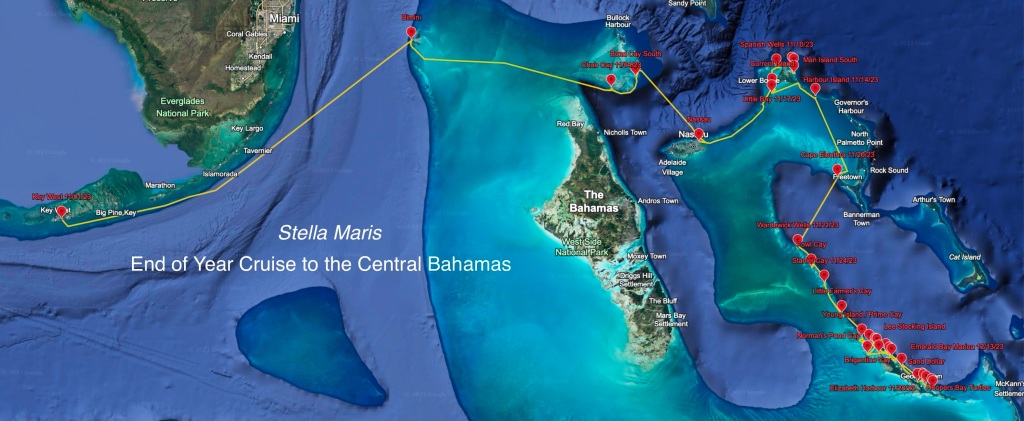
End-of-Year Cruise to the Central Bahama Islands–November / December 2023

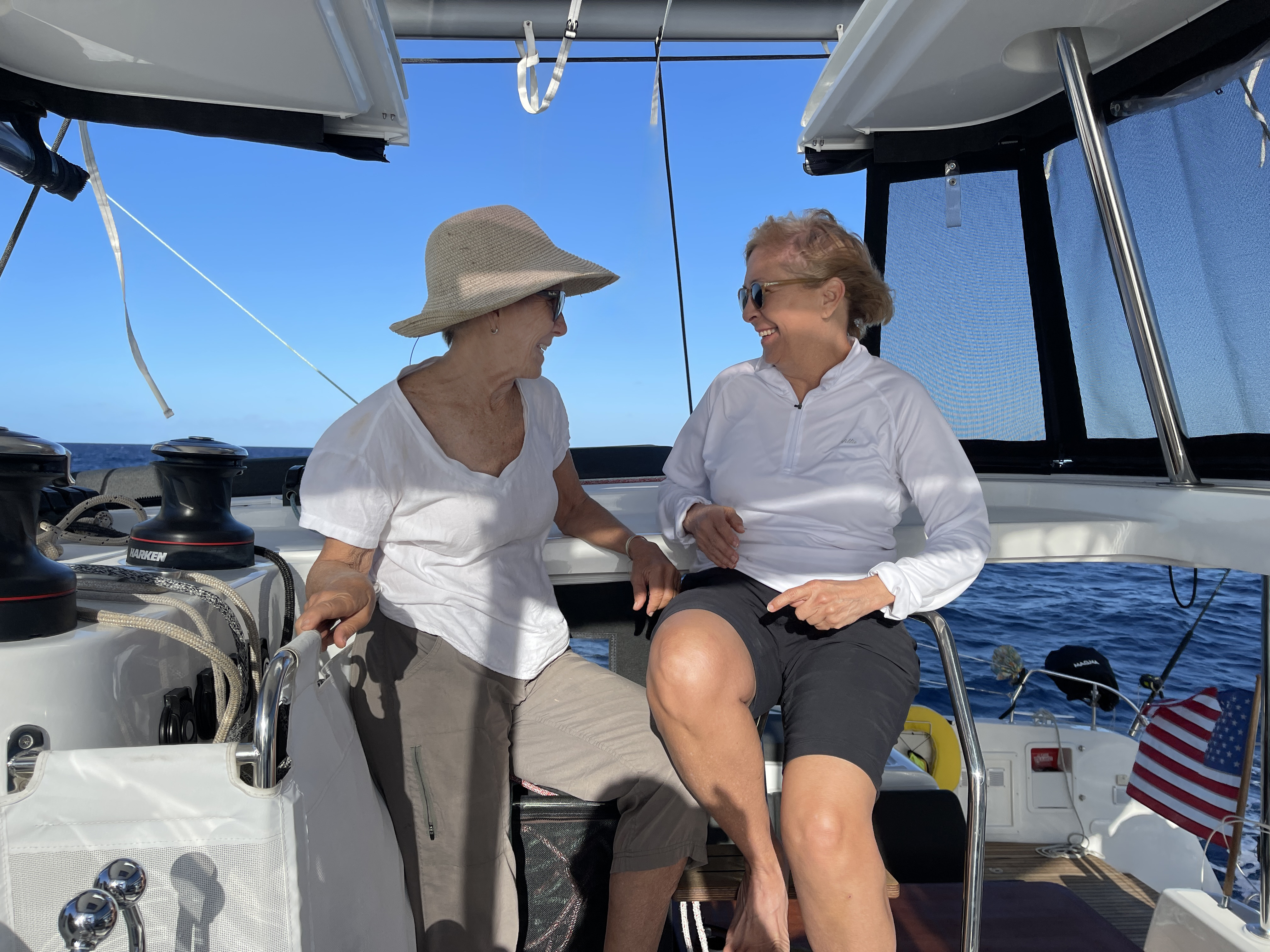
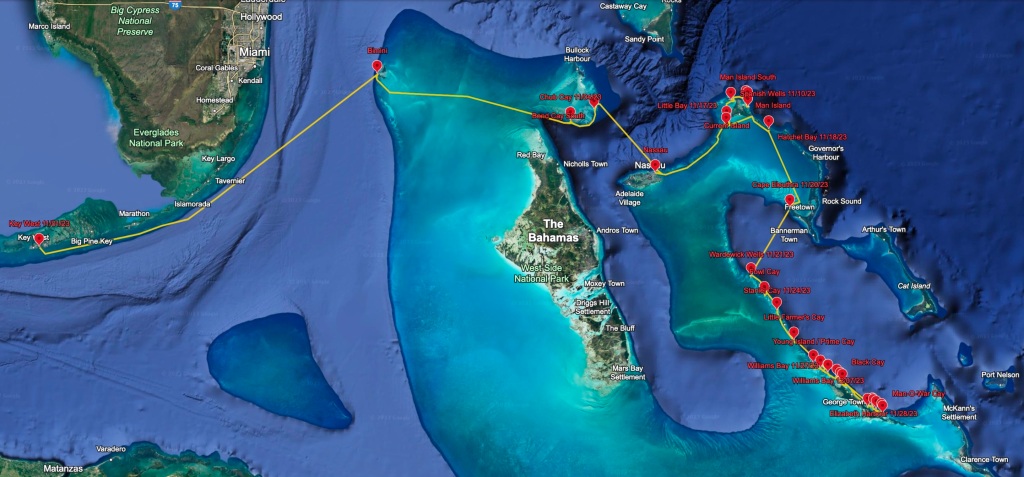
Trimming the sails again for the out islands of the Bahamas, we headed east and south toward Eleuthera and the Exumas Cays. My brother Bob joined me for the crossing from Key West to Nassau. Ginny and two dear friends, Carol and Gerald, joined Stella Maris from Nassau to Exuma. Highlights were food gathering with Bob, an accomplished free diver, standing watch with Gerald, who is focused and enthusiastic, and watching Ginny and Carol sing and dance through the islands like schoolgirls. As principally a solo sailor, I had forgotten the joy of sailing with a good crew. Stella Maris is now moored in Exuma while I spend the holidays with family in Key West. The year 2024 will find us heading south once again. Please join us here to continue the voyage in the new year.

As always, sailing is not just about the wind and the sea; the places, the flora, fauna, and people encountered along the way are equally important.

Please click “Follow” so that you don’t miss a new update,- and please consider sharing this post with others who might enjoy following the voyage. I welcome your comments and will always respond when I have an Internet connection. I will never share your personal information.

Instagram: StellaMarisSailing

Facebook: Jeffrey Cardenas

Text, Photography, and Videos © Jeffrey Cardenas 2024

Let this be a time of grace and peace in our lives – Rev. John C. Baker
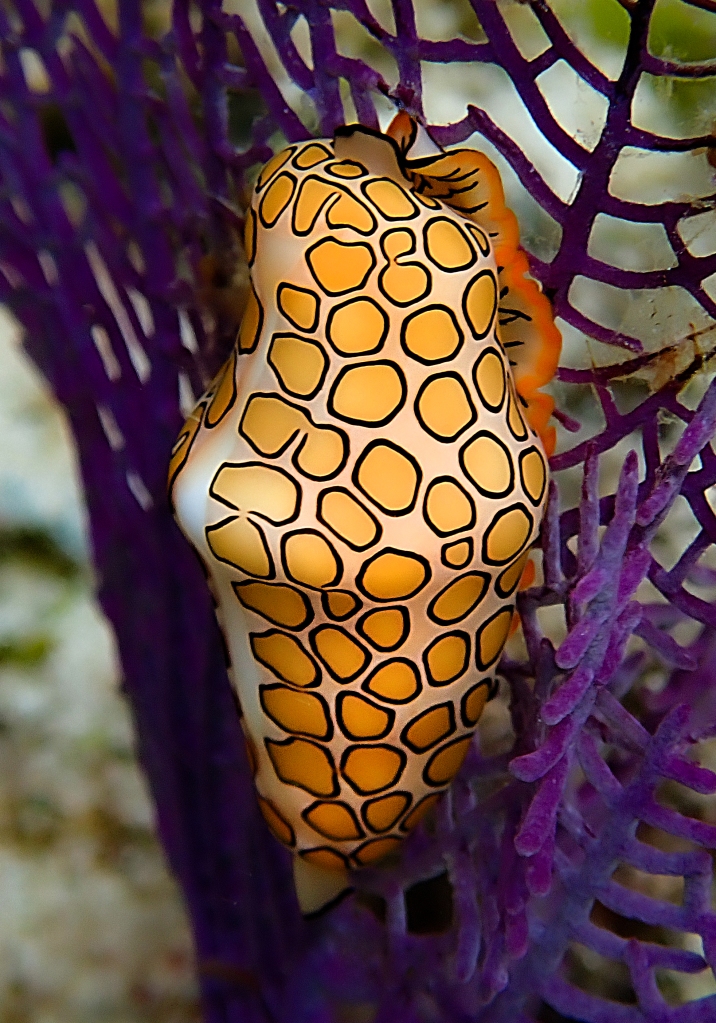
Flamingo Tongue Snail

Don’t kill me because I’m beautiful

The spotted mantle of the flamingo tongue snail warns predators that, despite being pretty, it is also poisonous. Photograph: © Jeffrey Cardenas 2023

The bare shell of the flamingo tongue snail looks like a characterless white rock. It is the living part of this animal–the mantle–that dresses up the shell with its outrageous leopard-print cloak. It does this to impress its underwater neighbors. The flamingo tongue is not looking for a date. It simply wants to avoid being eaten. The colorful spots tell predators, like lobsters and pufferfish, that, however beautiful it might be, the flamingo tongue is also toxic.

I am weathered-in aboard Stella Maris for several days with 30-knot winds and driving rain. There is no better cure for cabin fever than time spent underwater. I particularly enjoy freediving in shallow water, where I can get up close and personal with the minutiae of the underwater world. The flamingo tongue snail is a part of this world today. At less than an inch long, it might be easily overlooked were it not for its flashy costume.

The snails are most frequently found grazing on toxic soft corals like sea fans and other gorgonians. The flamingo tongue uses its foot, which resembles a long ribbon with teeth, to secrete chemicals that dissolve coral into digestible food. The snail is not concerned by the coral’s toxicity—it repurposes the chemicals by storing those toxins in its own tissues to use as a defense mechanism against predation. 

Not every diver is happy to see flamingo tongues because as they graze, they leave a thin trail of dead coral polyps in their wake. But the snail will rarely kill its host coral. Most damaged gorgonians can regenerate their lost tissues. Marine biologists who have specifically studied snails and their effect on coral say that because the polyps regrow, this predation is part of a well-balanced reef.

Female and male flamingo tongue snails leave behind mucus trails that release pheromones on the soft coral when it is time to breed. Flamingo tongue snails are hermaphroditic, having both male and female reproductive organs. However, they cannot fertilize themselves and require a mate to reproduce. Mating can last up to four hours (snails move slowly). Four days after mating, the female lays her sticky white egg clusters onto part of an exposed gorgonian skeleton. Each egg can contain up to 300 embryos! After ten days, the egg capsules hatch to release free-swimming larvae.

The flamingo tongue snail is not currently considered endangered, but like many marine organisms, it is threatened by human activities. It is listed in Appendix II of the Convention on International Trade in Endangered Species of Wild Fauna and Flora (CITES), meaning that international trade in this species is regulated to ensure that it does not become threatened with extinction.

Conservation efforts for the flamingo tongue snail include protecting its coral reef habitat through marine protected areas. Some countries, such as Jamaica, have implemented regulations to limit the collection of flamingo tongue snails, and the United States has banned the import of these snails for the souvenir trade. Flamingo tongues are often collected by people who mistakenly think that the shells themselves are colorful when they see the leopard spots on the mantle. Once a flamingo tongue snail dies, the mantle is gone and the surface of its shell becomes a bleached bone-white piece of calcium. 

Flamingo tongue snails may not yet be endangered. Still, as I swim in this gorgonian garden and see so much beauty on a windy and rainy day, it makes me wonder: what is so toxic about human nature that makes some people, when they see something beautiful, want to kill it for a collection? Life on coral reefs is already seriously threatened by climate change, ocean acidification, and mass tourism. The one thing we can do right now is minimize our impact by moving more slowly–and less possessively–in this fragile underwater world.


Beautiful in life, a souvenir trinket in death.
Photograph: © Jeffrey Cardenas

REFERENCES:

  • National Marine Sanctuary Foundation (21 Feb, 2020) Sea Wonder: Flamingo Tongue Snail
  • Oceanus (26 Aug, 2008) Biochemical Warfare on the Reef, Kristen Whalen–Woods Hole Oceanographic Institution
  • One Earth (8 Aug 2023) Flamingo tongue snail: the beautiful tropical creature of the Caribbean, Lindsey Jean Schueman
  • Ocean Conservancy (10 Sep 2021) What is the Flamingo Tongue Snail?, Eric Spencer

Thanks for sailing along with Stella Maris on this Bahamas leg of our journey.

As always, sailing is not just about the wind and the sea; equally important are the places, the flora, fauna, and people encountered along the way.

Please click “Follow” so that you don’t miss a new update,- and please consider sharing this post with others who might enjoy following the voyage. I welcome your commentsand I will always respond when I have an Internet connection. I will never share your personal information.

Instagram: StellaMarisSailing
Facebook: Jeffrey Cardenas

Text, Photography, and Videos © Jeffrey Cardenas 2023

Let this be a time of grace and peace in our lives – Fr. John Baker

Breathe In, Breathe Out…

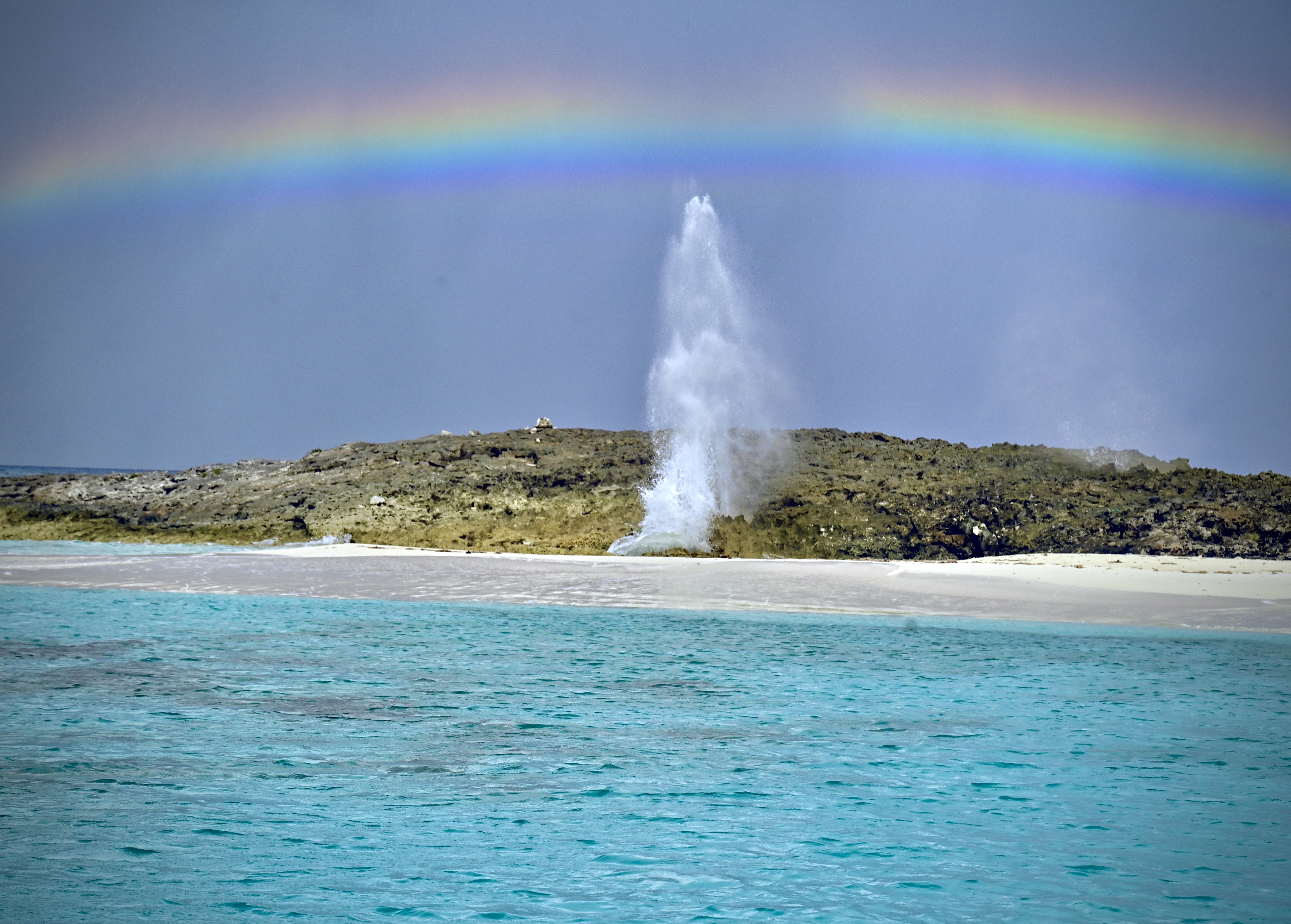
I am anchored tonight next to an island blowhole.

As ocean swells from a distant storm meet the iron rock shoreline, water travels under great force through a labyrinth of ancient passages in the limestone until it emerges as a fountainhead roaring with a blast of sea air.

Breathe in, breathe out… I will sleep in peace listening to this tonight.


A secluded anchorage with a hydrodynamic soundtrack. Turn up the volume…

Thanks for sailing along with Stella Maris.

As always, sailing is not just about the wind and the sea; equally important are the places, the flora, fauna, and people encountered along the way.

Please click “Follow” so that you don’t miss a new update,- and please consider sharing this post with others who might enjoy following the voyage. I welcome your commentsand I will always respond when I have an Internet connection. I will never share your personal information.

Instagram: StellaMarisSailing
Facebook: Jeffrey Cardenas

Text, Photography and Videos © Jeffrey Cardenas 2023

Let this be a time of grace and peace in our lives”   – Fr. John Baker

Dry Land Feels Weird

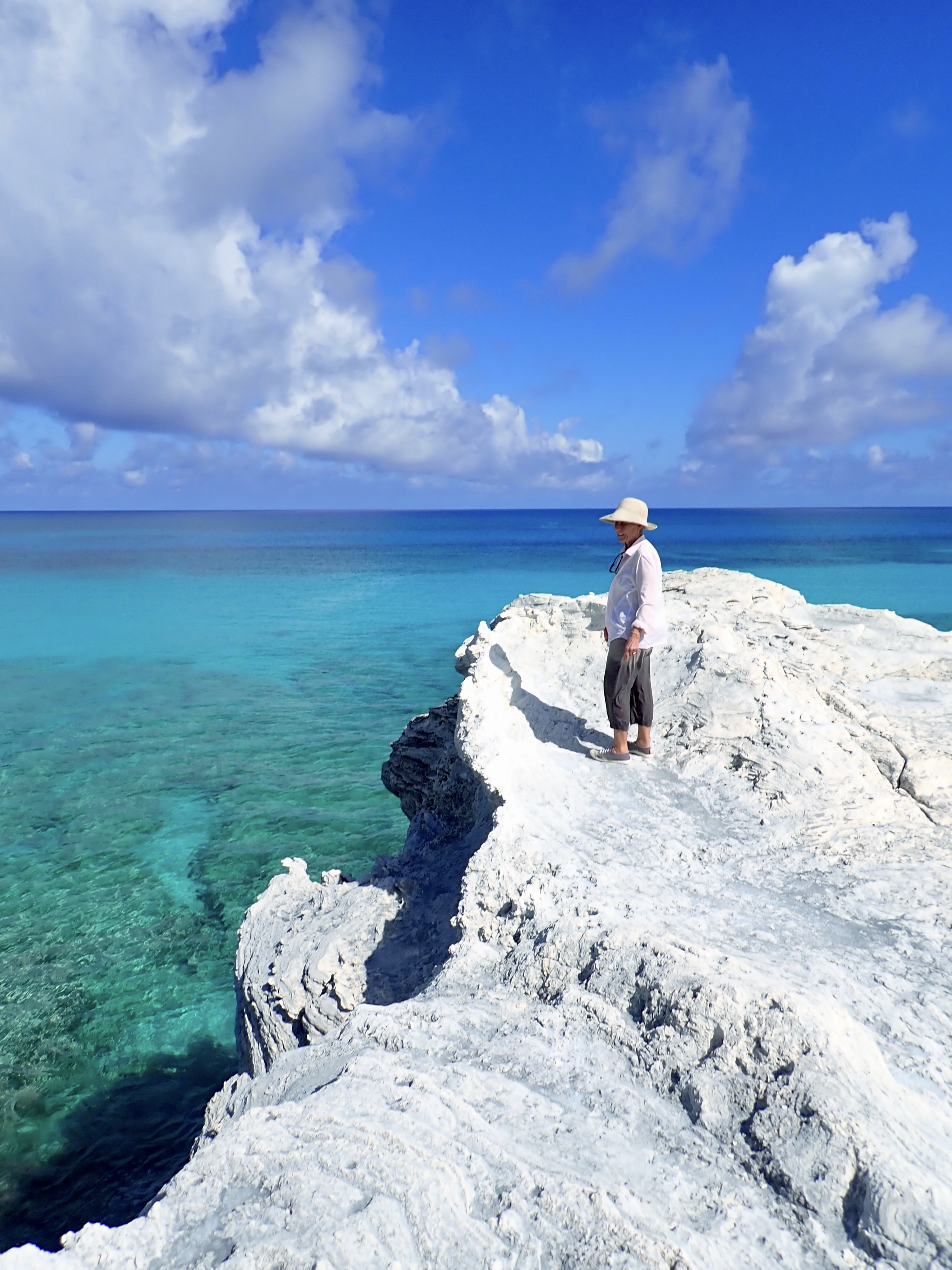
I am most comfortable on the water and underwater. Things get weird when I reach dry land.
Photograph: © Jeffrey Cardenas

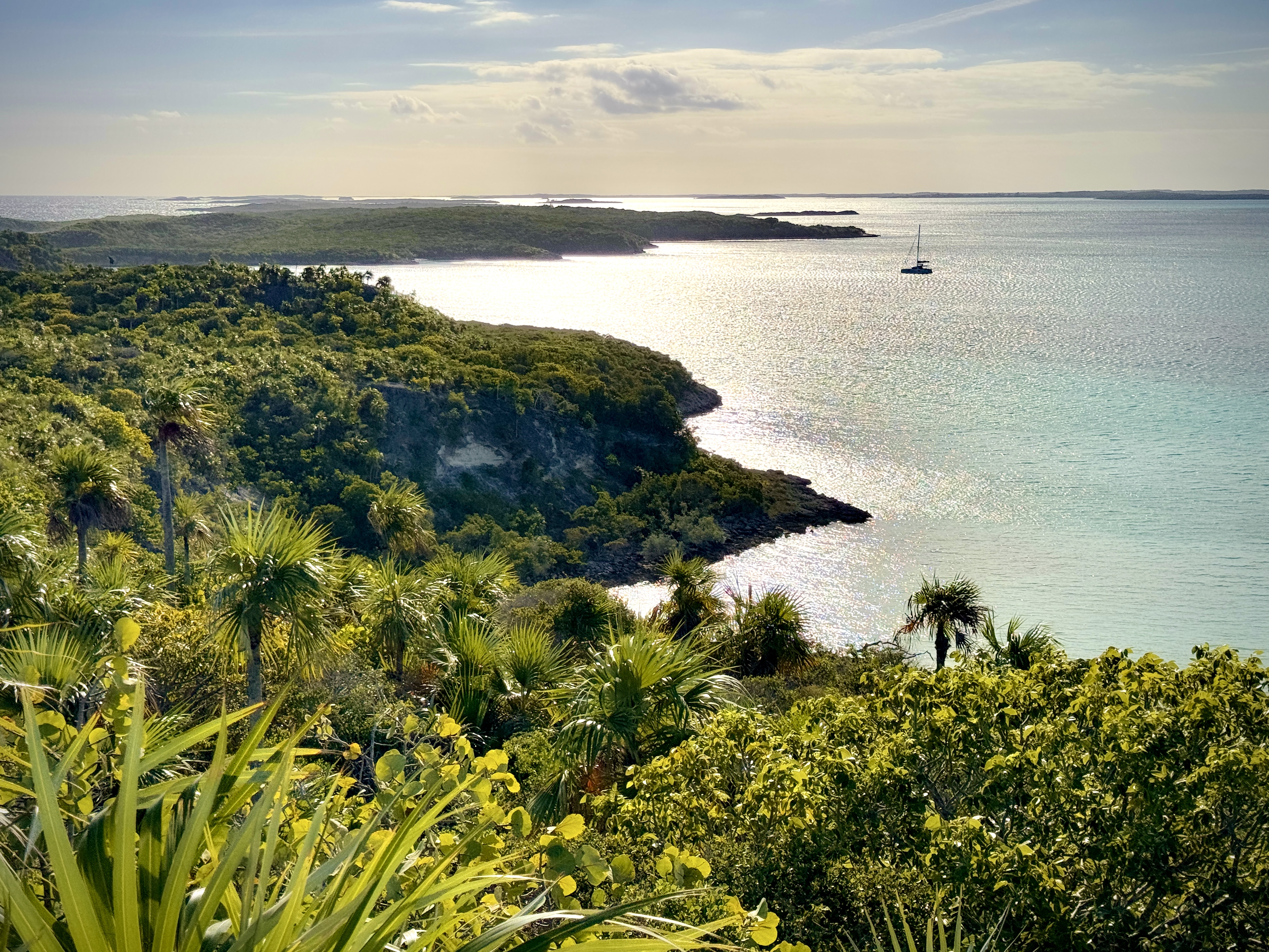
At the Moriah Harbour Cays National Park in the southern Exuma Cays, conservationists understand that not everyone wants to get wet. What is dry on these islands is as spectacular as the underwater world that surrounds them. The addition of a little human waggishness adds to the experience. On the southern tip of Stocking Island an “Art Trail” has been cut through the coppice allowing restless sailors to stretch their legs and express personal wit.

Wilson was here…

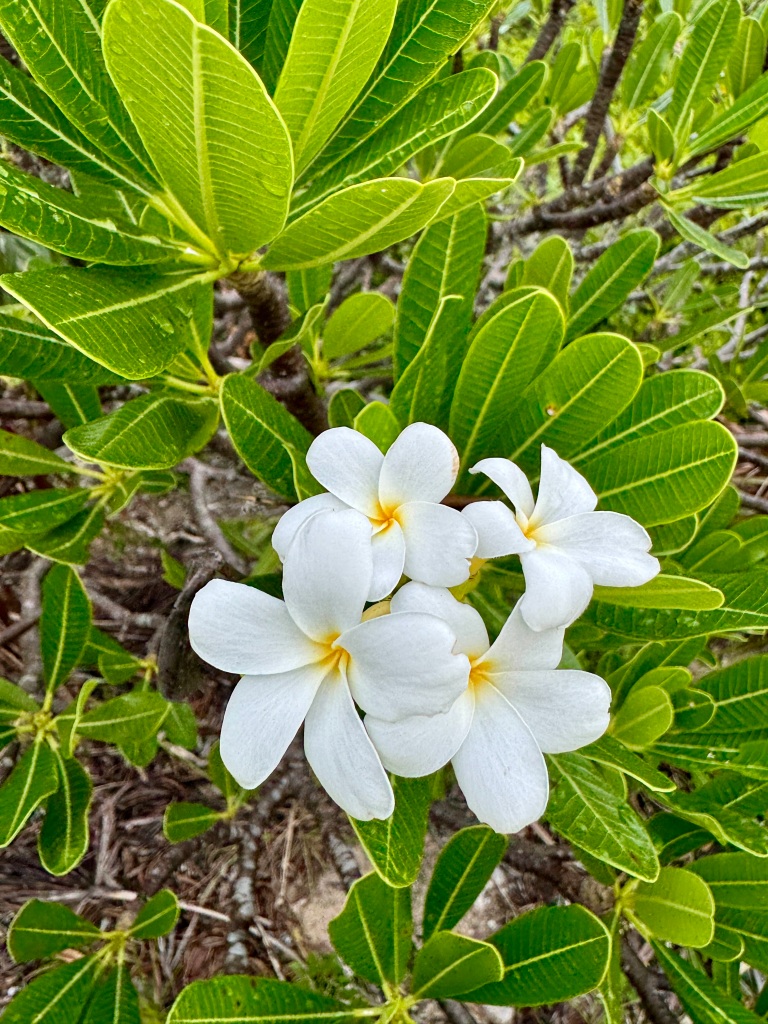
Of course, nature always has the last laugh. The natural beauty of the coppice (a Bahamian hardwood forest) is breathtaking. In the 22,833 acres of Moriah Harbour Cays National Park, trails pass through exotic palm groves. Caves are cut into calcium carbonate limestone. Lowlands are alive with American Oystercatchers and Giant White Landcrabs. An upland hiker might be startled by a Bahamian Blind Snake or an Antillean Nighthawk. And, growing so thick that it nearly shuts off sunlight, is flora that includes Drawf Frangipani, dominant stands of Bahamian Poisonwood, and wild Oncidium Orchids.

Dry land, I learned, can be a wonderland. All I need to do to experience it is step ashore once in a while.


And, at the end of the trail, there is always the sea.

Thanks for sailing along with Stella Maris.

As always, sailing is not just about the wind and the sea; equally important are the places, the flora, fauna, and people encountered along the way.

Please click “Follow” so that you don’t miss a new update,- and please consider sharing this post with others who might enjoy following the voyage. I welcome your commentsand I will always respond when I have an Internet connection. I will never share your personal information.

Instagram: StellaMarisSailing
Facebook: Jeffrey Cardenas

Text and Photography © Jeffrey Cardenas 2023

Let this be a time of grace and peace in our lives”   – Fr. John Baker

A Hidden World Protected

Eleuthera’s New Seahorse National Park

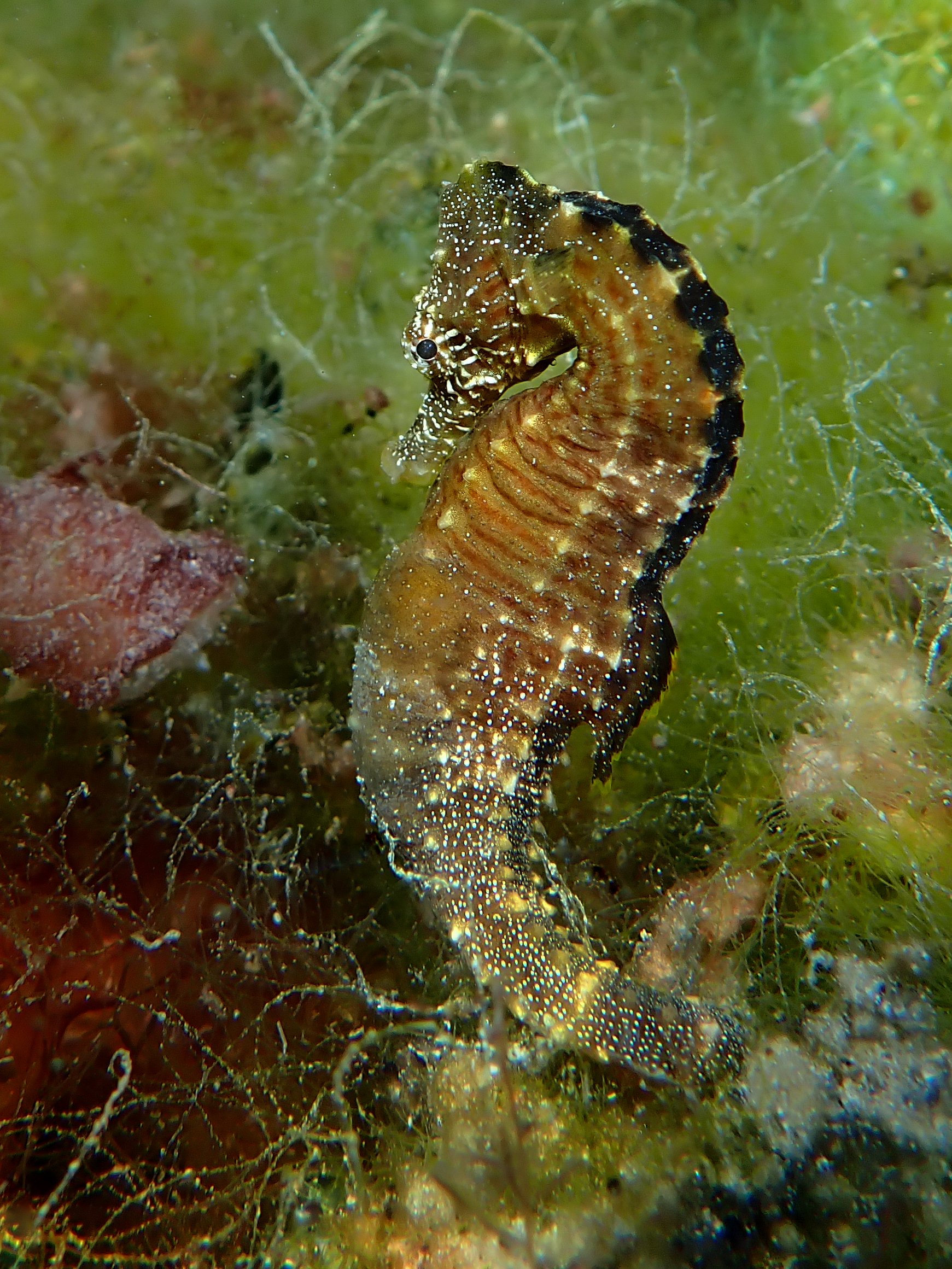
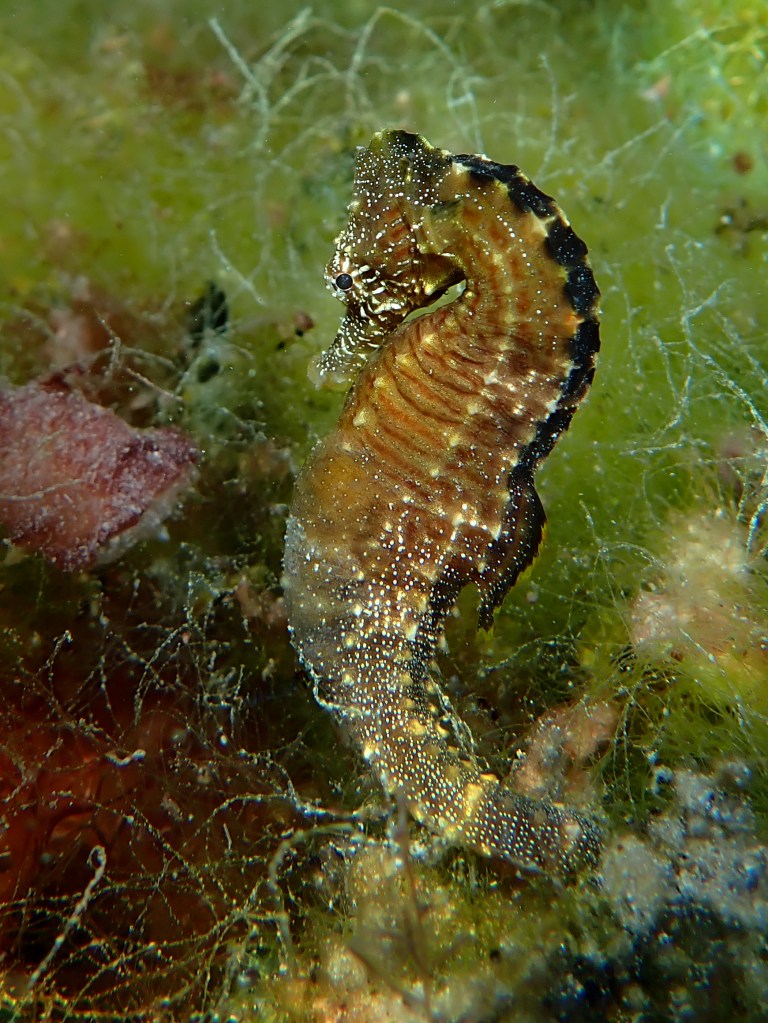
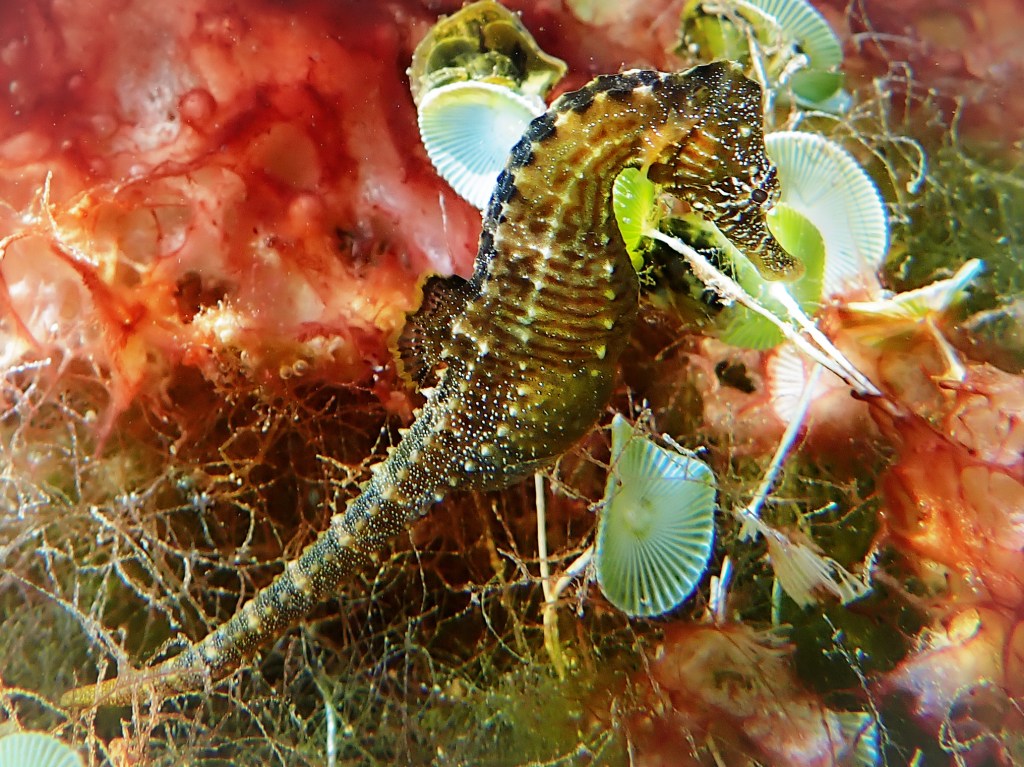
This proud papa, a lined seahorse, flaunts his pregnancy with a swollen brood pouch and will soon give live birth to hundreds of baby seahorses. Photograph: © Jeffrey Cardenas

I am channeling Charles Darwin today as I step out of the thick Bahamian scrub and into a landlocked pool of anchialine water in Central Eleuthera known as Sweetings Pond.

This body of water, fed from a maze of subterranean connections to the ocean, is teeming with bizarre life forms. They include the red flame scallop (which is actually a clam) that can dislodge itself from the seabed and “walk” away from predators by clapping its valves together. And then there is a gelatinous sea slug called a fringeback nudibranch with sharply serrated gill fingers and long tendrils that pulsate in shades of aquamarine. But the show-stopper is a mutated miniature lined seahorse with enough characteristics from two distinctly different types of seahorses that some marine biologists think we could be witnessing the evolution of an entirely new species.

Protecting the 500-acre Sweetings Pond with its unique biodiversity has been a quiet mission for conservationists. Until recently, researchers and locals managed to keep its location a secret. In its anonymity, the pond faced no immediate danger. However, the rampant development of resorts and marinas in the Bahamas, as well as other threats including agricultural runoff and poaching has encouraged marine researchers and governmental organizations like the Bahamas National Trust to push for the preservation of this rare habitat.

One of those researchers, Dr. Heather Masonjones from the University of Tampa, has been studying the seahorse population in Sweetings Pond for over five years. In an interview with BBC Wildlife magazine, she said that the pond may have one of the most densely populated seahorse communities anywhere on Earth. She hopes the protection of the pond brings sustainable tourism that will educate people about seahorses and contribute to improving their conservation worldwide. “If we don’t take action it could be lost forever.”

Several weeks ago, the Bahamian government formally designated Sweetings Pond as its newest National Park. “The declaration of Seahorse National Park is more than just a designation,” said Lakeshia Anderson-Rolle, Executive Director of Bahamas National Trust. “It is our shared promise to our community, to future generations, and to the world that we are committed to conserving our unique and diverse ecosystems.”

Click on a photograph above for a larger, full-resolution image. All photographs © Jeffrey Cardenas


Thanks for sailing along with Stella Maris.

As always, sailing is not just about the wind and the sea; equally important are the places, the flora, fauna, and people encountered along the way.

Please click “Follow” so that you don’t miss a new update,- and please consider sharing this post with others who might enjoy following the voyage. I welcome your commentsand I will always respond when I have an Internet connection. I will never share your personal information.

Instagram: StellaMarisSailing
Facebook: Jeffrey Cardenas

Text and Photography © Jeffrey Cardenas 2023

Let this be a time of grace and peace in our lives”   – Fr. John Baker