A Beautiful Thing

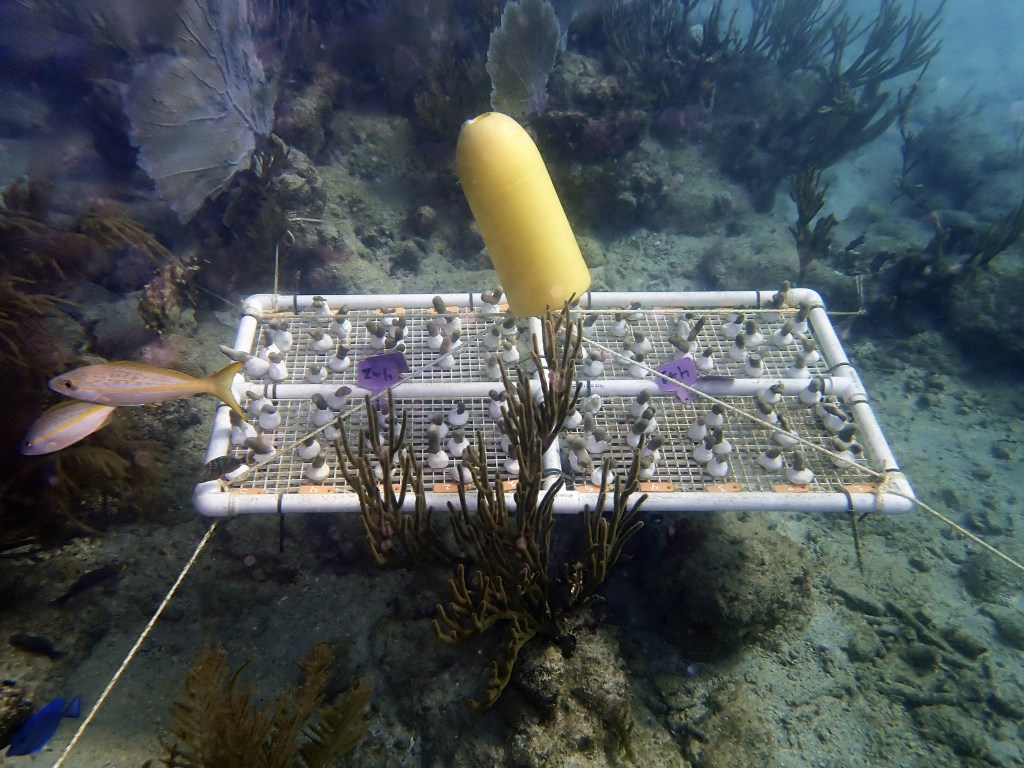
As I sail north out of the Caribbean Sea, I have spent much of the last month diving over dead and dying coral reefs. I try not to focus on this. There is enough despair in the world these days without highlighting any more of it. I prefer instead to acknowledge isolated moments of beauty and hope. This morning, while snorkeling over another reef of broken coral rubble, I was heartened by the sight of a tiny coral farm attached to the bottom of the bay.

Bahía Tamarindo Grande is on the northwest coast of the island of Culebra in the Spanish Virgin Islands. It is an isolated stretch of land with no development and no roads. There are flowering frangipani, a symphony of birdsong echoing in the trees, and a deserted white sandy beach. In contrast, a sign warns visitors not to pick up unexploded ordnance. This area east of Puerto Rico was once a bombing and artillery range for the U.S. military. Nearby, a Sherman tank is rusting on the beach.

The coral farm, suspended 20 feet underwater, has no identification plate or surface buoy to mark its location. It’s not shown on any nautical charts. It is simply a submerged platform the size of a backyard vegetable plot. Instead of growing lettuce and carrots, some anonymous person has planted branched finger coral. About 80 coral nubs are mounted on a plastic grid, and they are thriving.

There is nothing new about the aquaculture of coral. One of the first successful coral propagation attempts occurred at New Caledonia’s Nouméa Aquarium in 1956. Commercial coral propagation began in the United States in the 1960s. Still, it wasn’t until worldwide coral populations began to crash in the 1980s that the industry focused on propagating coral for oceans instead of aquariums.

Then, in April 2006, the Margara, a 750-foot tanker carrying over 300,000 barrels of fuel oil, ran aground on a shallow coral reef in Puerto Rico’s Bahía de Tallaboa. No oil was spilled, but the grounding and efforts to remove the vessel destroyed 6,755 square meters of reef, including six species of coral protected under the Endangered Species Act. Emergency restoration by NOAA and the Puerto Rico Department of Natural and Environmental Resources saved approximately 10,500 coral colonies in the affected reef by using farmed corals from nurseries and transplanting them back onto the ocean floor.

As coral populations diminish due to human negligence and climate change, it may seem that coral is disappearing faster than it can be replaced. This does not deter the efforts of research and conservation groups such as the Mote Marine Laboratory, which has restored more than 216,000 corals to Florida’s reefs. Notably, some restored corals are now naturally reproducing to create new generations of coral.

The Coral Restoration Foundation in the Florida Keys is also succeeding in growing coral that reproduces both sexually through spawning and asexually through fragmentation (where a small piece of coral can reattach and develop into a new colony). Since 2012, the Coral Restoration Foundation has transplanted more than 220,000 corals onto Florida’s reef, restoring over 34,000 square meters of habitat.

Back in Culebra, local commercial fishermen proposed the establishment of the Luis Peña Channel Natural Reserve to replenish local fish stocks and protect the coral reefs. This reserve encompasses Bahía Tamarindo Grande, home to the coral farming garden plot. It is the first no-take marine protected area designated in Puerto Rico. The mission statement is simple: The health of coral reefs directly depends on strong reef fish populations. Fish and other animals, such as lobsters and shellfish, rely on the health of the coral reef. The livelihoods and culture of the people of Culebra depend on healthy coral reefs.

An image from the NASA Earth Observatory of Culebra Island, located about 17 miles east of Puerto Rico. 

As always, sailing is not just about the wind and the sea; the places, the flora, fauna, and people encountered along the way are equally important.

Please click “Follow” so you don’t miss a new update, and please consider sharing this post with others who might enjoy connecting with the voyage. I welcome your comments and will always respond when I have an Internet connection. I will never share your personal information.

An additional website, www.JeffreyCardenas.com, features hundreds of fine art images—underwater, maritime landscapes, boats, and mid-ocean sailing photography–from exotic locations worldwide.

Upcoming Exhibition: “On the Reef” will be exhibited in The Studios of Key West’s Zabar Project Gallery, on view from January 2–30, 2025. 

Instagram: StellaMarisSailing / Facebook: Jeffrey Cardenas

Text, Photography, and Videos © Jeffrey Cardenas 2024

Let this be a time of grace and peace in our lives – Rev. John C. Baker

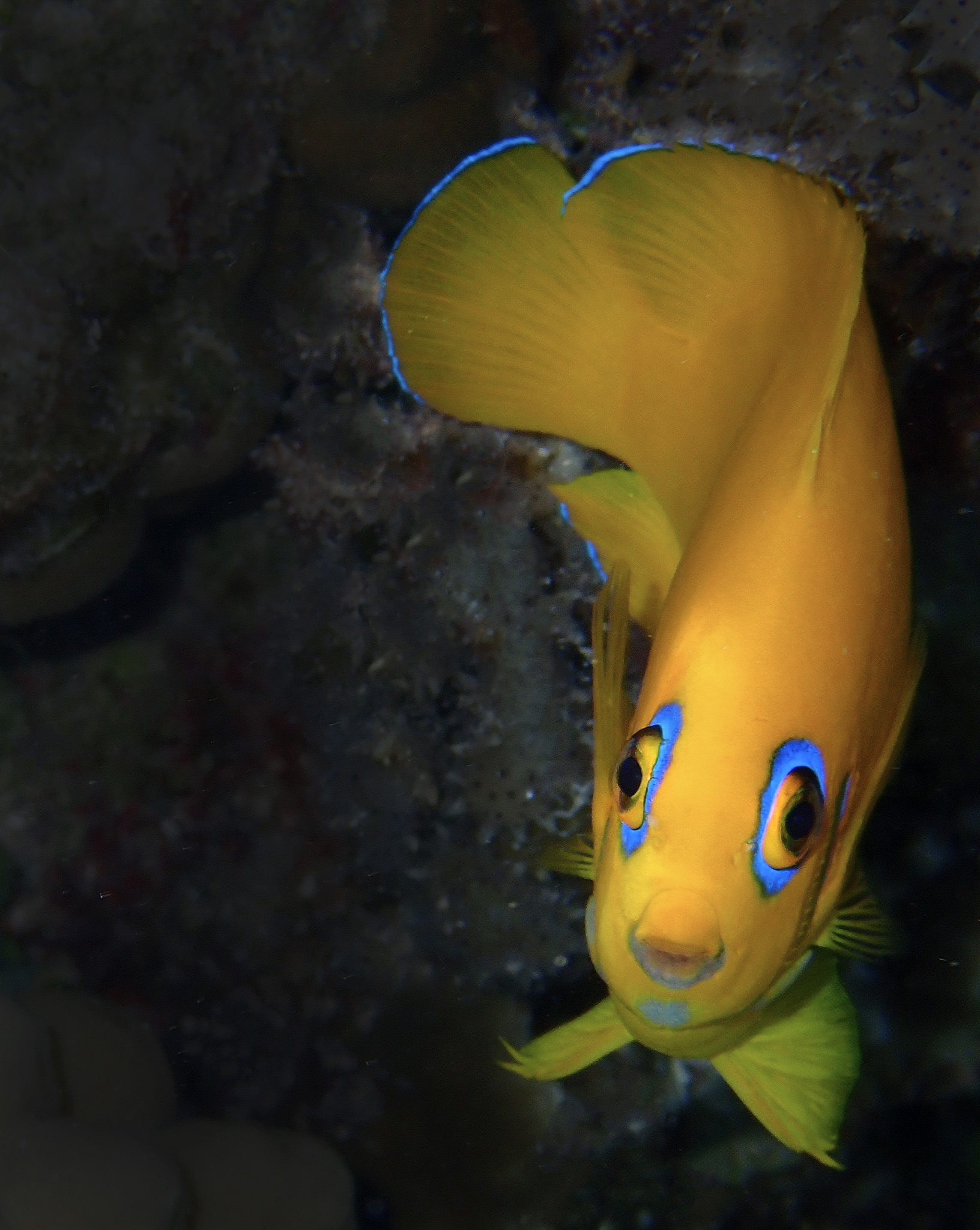
The Eyes Have It!

The Copperband butterflyfish confuses predators with its small camouflaged eye and a more prominent false eye on its posterior fin. Photograph © Jeffrey Cardenas 2024

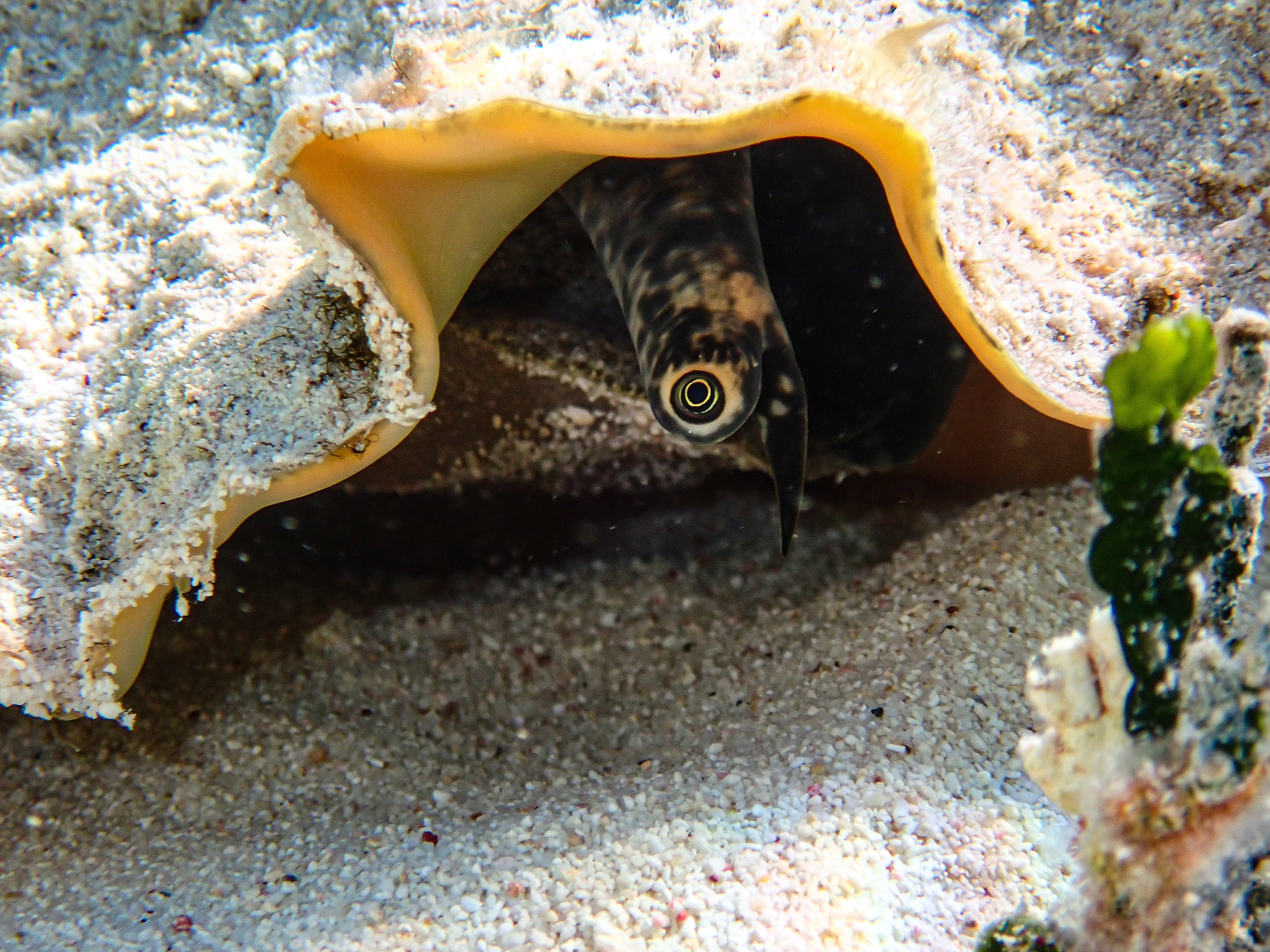
When we dive underwater, we observe a world inhabited by some of the most fascinating creatures on the planet. Imagine what these creatures experience when a terrestrial biped (us) suddenly appears in their environment. Then, it becomes the observer who is being observed. We are, after all, guests in their house.

There is much science regarding what fish and other sea life see underwater. Fish have spherical lenses in their eyes, which provide clarity, whereas human lenses are relatively flat. Our vision is blurred underwater (unless we wear a dive mask), but fish see everything. Fish also see a visible spectrum that is different from humans. Simply put, fish can see things underwater that humans cannot, even when we wear a mask. Marine reptiles are no exception; a sea turtle’s eye allows them to detect the glow of bioluminescent prey. Some fish, like bonefish, have a membrane over their eyes—like a diver’s mask—that allows them to forage in sand and silt to find food. Sharks may rely on scent and sensory input, but their eyesight is also remarkable. Marine biologists suggest that a shark’s vision may be 10 times better than that of humans in clear water.

That’s all fascinating stuff, but I don’t think about science when I put on a mask and snorkel to free dive on a coral reef. Instead, I am grateful for the privilege of sharing this undersea world, so I tread softly. I enter the water quietly, with minimal gear, and move slowly. I know that everything with eyes underwater watches me to perceive what threat I might pose. I de-escalate. When I minimize my presence, fish become as interested in me as I am with them.

The more opportunities I have to interact with the marine environment, the greater my respect is for a world I once took for granted. All it took was a little bit of eye contact.

Select an individual photo for a high-resolution image. Then, click on the information icon for camera data and additional information about the sea life. All images © Jeffrey Cardenas 2024


As always, sailing is not just about the wind and the sea; the places, the flora, fauna, and people encountered along the way are equally important.

Please click “Follow” so you don’t miss a new update, and please consider sharing this post with others who might enjoy connecting with the voyage. I welcome your comments and will always respond when I have an Internet connection. I will never share your personal information.

An additional website, www.JeffreyCardenas.com, features hundreds of fine art images—underwater, maritime landscapes, boats, and mid-ocean sailing photography–from exotic locations worldwide.

Upcoming Exhibition: “On the Reef” will exhibit in The Studios of Key West’s Zabar Project Gallery, on view from January 2–30, 2025.

Instagram: StellaMarisSailing / Facebook: Jeffrey Cardenas

Text, Photography, and Videos © Jeffrey Cardenas 2024

Let this be a time of grace and peace in our lives – Rev. John C. Baker

Be Like Ike

Photograph © Jeffrey Cardenas 2024

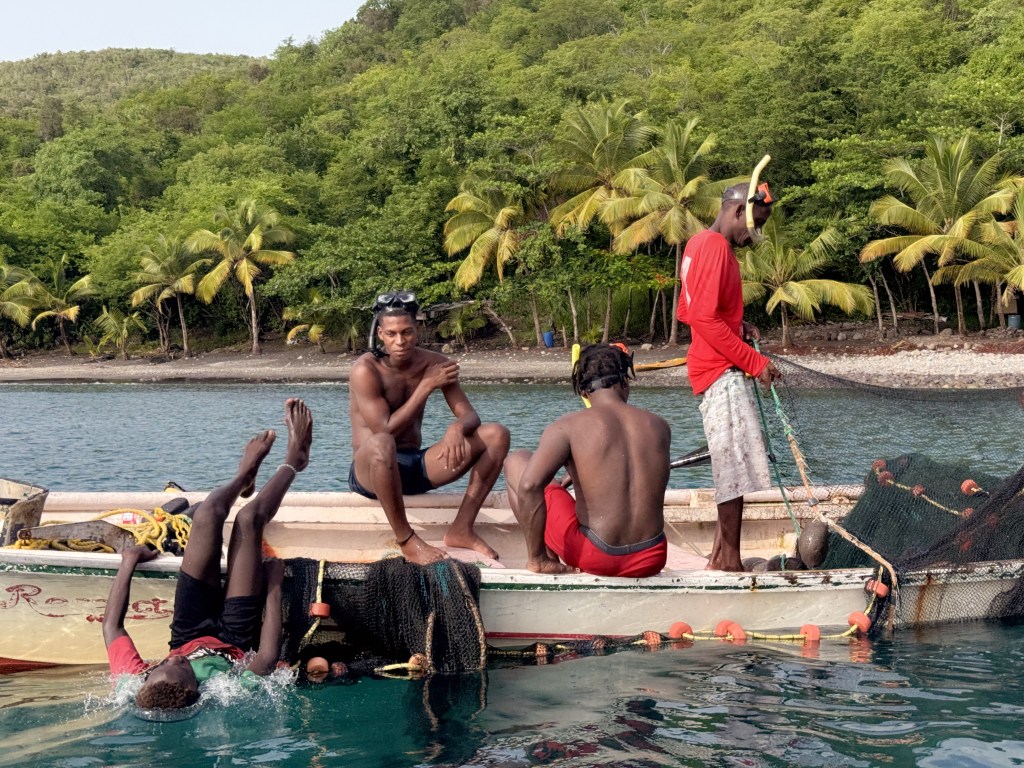
Meet Ike Albert, unofficial yacht ambassador, accomplished net fisherman, and grassroots conservationist. He’s 15 years old.

When foreign-flagged boats arrive in Saint Lucia’s Anse Cochon, Ike is there quickly in his tiny yellow kayak to assist with mooring lines or anchoring help. He will bring mangoes and avocados and freshly baked bread. Unlike other boat boys who aggressively swarm new arrivals with demands for beer and money, Ike knows that a soft sell is more effective.

“Welcome,” he says. “Tell me how I can help you.

Ike lives in a nearby fishing village called Canaries. On this day, when his family’s relatives arrive in Anse Cochon to fish from a small wooden net boat called Respect, Ike dives in to help. He is the point man pulling the rope of a net that is weighted with boulders. Several hundred feet of net are set to catch sardines, small jackfish, and ballyhoo. This fishing uses no winches or pulleys; it is an art of pure manual labor.

An hour later, when the net is finally at the boat side, it reveals a subsistence catch. The family is delighted. They will eat fresh fish tonight, and maybe have a little extra to sell in the market.

Afterward, covered in fish scales and sweat, Ike climbs back onto his kayak. But before he embarks on the long paddle home to Canaries, he dives back into the water and surfaces with an armful of empty beer bottles, Coke cans, and plastic bags thrown into the water by day trippers on the tourist catamarans.

“The people on these tourist boats think that when they throw garbage into the water, it just goes away.”

That’s progressive thinking for a 15-year-old.

Be like Ike.

All images © Jeffrey Cardenas 2024


As always, sailing is not just about the wind and the sea; the places, the flora, fauna, and people encountered along the way are equally important.

Please click “Follow” so that you don’t miss a new update,- and please consider sharing this post with others who might enjoy following the voyage. I welcome your comments and will always respond when I have an Internet connection. I will never share your personal information.

Instagram: StellaMarisSailing / Facebook: Jeffrey Cardenas

StellaMarisSail.com has spawned a new website: www.JeffreyCardenas.com. This site, Jeffrey Cardenas Photography, features hundreds of fine art images — Underwater, Maritime Landscapes, Boats, and Mid-Ocean Sailing photography from exotic locations worldwide.

Text, Photography, and Videos © Jeffrey Cardenas 2024

Let this be a time of grace and peace in our lives – Rev. John C. Baker

Kingdom of Fire

“Fire coral will be the last remaining living coral on earth.”

I remember writing those words once, in a bluster of prophetic arrogance. That’s not exactly the most positive Earth Day message to consider as I dive this week on a shallow reef in the French West Indies at Île Fourchue, Saint Barthélemy.

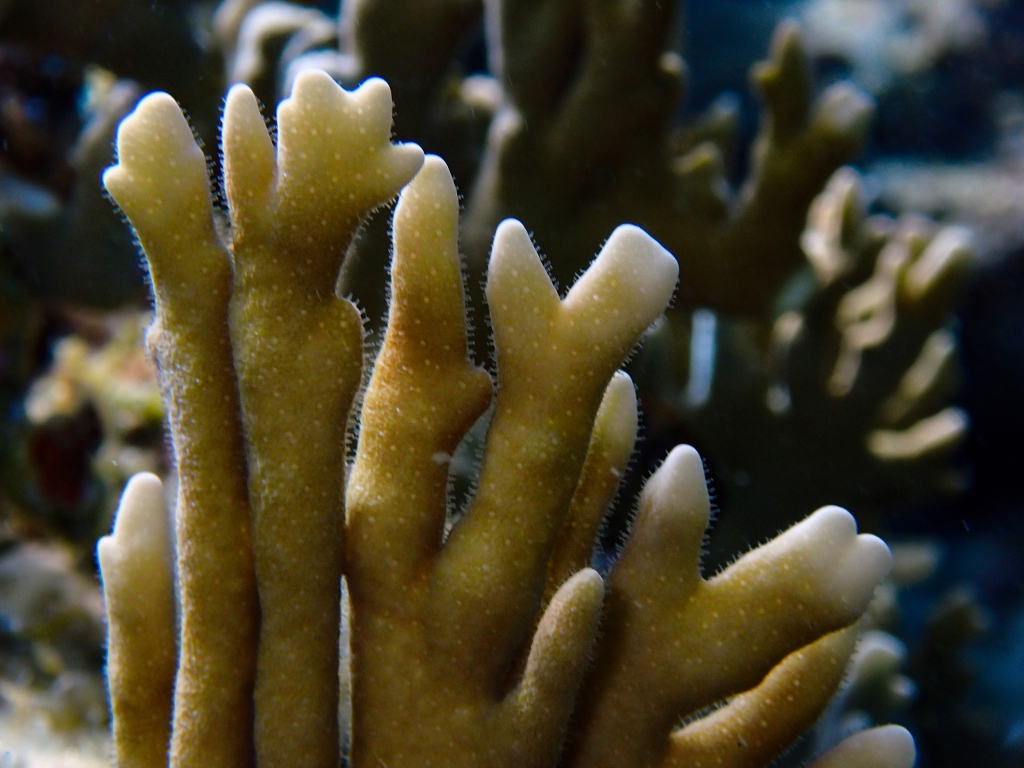
First of all, fire coral is not even a true coral. Instead, it is more closely related to hydra, a very small predatory animal similar to jellyfish and other stinging anemones. But, for the sake of consistency, I will still refer to it as fire coral.

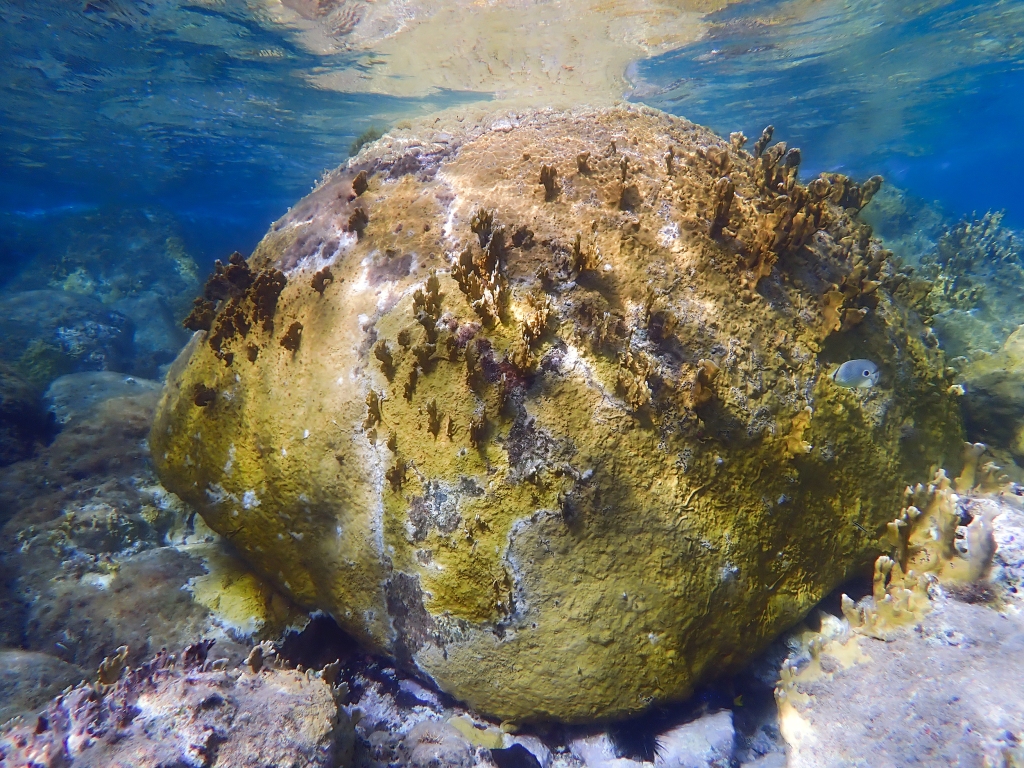
Fire coral can be either blade-like or encrusting. It is colored a mustard-yellow to dark orange, often with white edges. It has strong stinging cells that on contact cause intense pain lasting from two days to two weeks. Relapses of inflammation, itching, and welts are common. Fire coral releases venom through tiny hairs called cilia. It is their only defense mechanism against predators, including thoughtless human beings. Do not touch it, or any coral.

Microscopic venomous hair–cilium–inflicts intense pain that can last from two days to two weeks. Photograph: © Jeffrey Cardenas

Because fire coral has the unusual ability to grow in two different forms, some marine biologists believe it has a survival edge over other Caribbean corals. It can grow like a bush with a stem and branches sprouting upward, or in sheets that appear as a flat coating across rocks and other surfaces.

“Fire corals have been around for millions of years and what they are doing is pretty darn successful,” says California State University marine biologist Peter Edmunds. For the past 30 years, he has been traveling to the Caribbean to document the life history of fire coral on inshore reefs.

“They are now poised to be… the inheritors of the reef, while other corals, particularly stony corals, die back,” he said. ”When it’s not stormy, they can produce branches and exploit the light and plankton in the water. When it’s storming and everybody gets beaten up, it loses its branches but it still has its sheets, which it can use to spread out and claim more territory.”

A sunken granite boulder near shore is slowly becoming encased in a sheathing of fire coral while fire coral branches take root and sprout from the surface of the dead rock. Photograph: © Jeffrey Cardenas

Researchers believe this adaptation may help save Caribbean reefs, which have been plagued by hurricanes, global warming, disease, and an overabundance of algae. Because fire corals are thriving as other corals die off, they are creating structures for fish and other organisms. Fire corals “are going to be very important habitat providers because they are able to survive under these stresses,” says Colleen Bove, a marine ecologist at Boston University.

But fire coral is not bulletproof. Some species have brittle skeletons that can easily be broken during storms, by anchors, or by careless divers and collectors who are taking fish for the aquarium trade. I watched blueheaded wrasse spawn over fire coral. Rock beauties, butterfly fish, yellow tangs, and the aggressive beau gregory retreat into branches of fire coral when threatened. In Brazil, fire coral colonies are extensively damaged by divers harvesting yellowtail damselfish. The fire coral is deliberately smashed and the fish hiding among the branches are captured in plastic bags.

Bluehead wrasse spawn at midday on a full moon over a pinnacle of fire coral at Île Fourchue, Saint Barthélemy in the French West Indies Video © Jeffrey Cardenas

Reproduction in fire corals is more complex than in other reef-building corals. The polyps reproduce asexually, producing the jellyfish-like medusae. These contain the reproductive organs that release eggs and sperm into the water. Fertilized eggs develop into free-swimming larvae that will eventually settle on the substrate and form new colonies. 

Most divers wouldn’t mind seeing less fire coral on the reef, but I like to think of fire coral as a tactile warning to tread more carefully underwater. When the alternative may be a reef of dead rock, the sting of fire coral is a potent reminder that there is still life on that reef. And, it is one of the few ways the habitat has of fighting back.

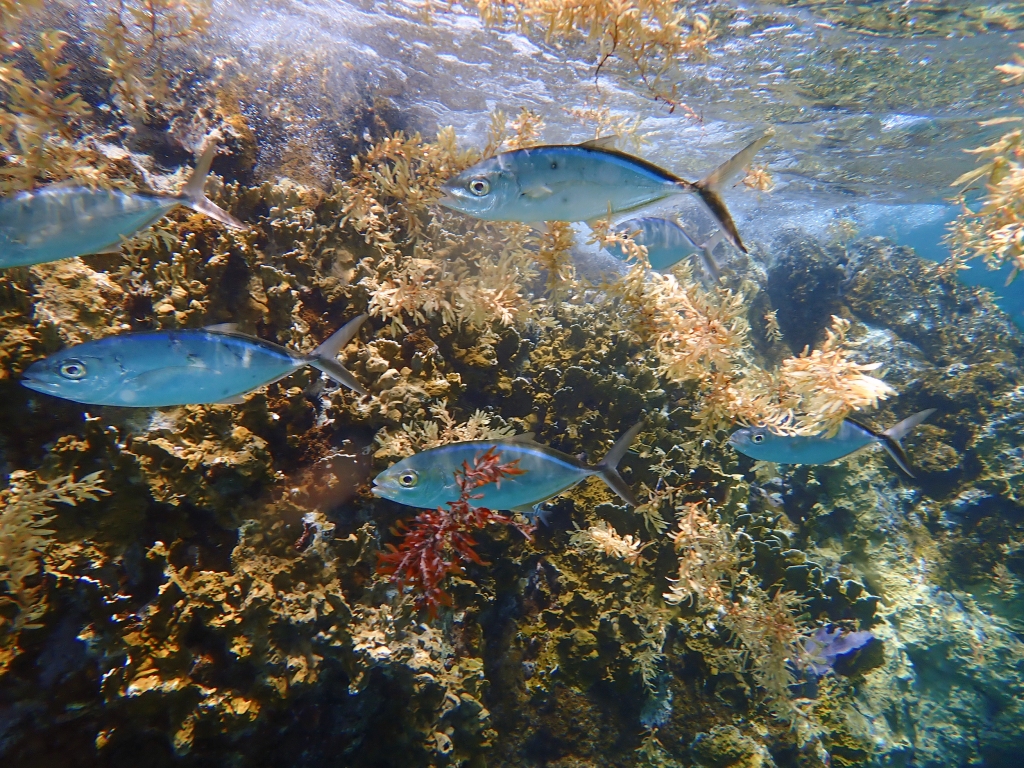
Blue runners feed amid clusters of sargasso being swept over a West Indian reef of fire coral. Photograph © Jeffrey Cardenas

As always, sailing is not just about the wind and the sea; the places, the flora, fauna, and people encountered along the way are equally important.

Please click “Follow” so that you don’t miss a new update,- and please consider sharing this post with others who might enjoy following the voyage. I welcome your comments and will always respond when I have an Internet connection. I will never share your personal information.

Instagram: StellaMarisSailing / Facebook: Jeffrey Cardenas

Text, Photography, and Videos © Jeffrey Cardenas 2024

Let this be a time of grace and peace in our lives – Rev. John C. Baker

Transatlantic

Quarantine and courtesy flags for the West Indian island nation of Antigua are raised to the spreaders as Flying Fish enters territorial waters. Photograph: © Bob Cardenas

There is a story from every leg of the journey as Flying Fish has traveled around the world. The story for this passage across the Atlantic is one of brotherhood.

My brother Bob and I are salt and pepper, and I don’t just mean our hair color. Bob is an analytical thinker; I look at clouds and think they resemble dogs. Bob sees something broken, and he repairs it; I see something broken, and although I try to repair it, I inevitably make the problem worse. Bob is gregarious; I am a social misfit. Bob sells dream houses; I sell dreams.

We have just completed a 2,500-mile passage from Cape Verde to Antigua aboard Flying Fish. This is not our first transatlantic passage together. In 1976, we sailed with our sisters and parents from Florida to Portugal in a Cal 43 named Free Spirit. Two years later, our parents allowed Bob and me to sail Free Spirit from Gibraltar back to Florida. That’s when things went sideways. That voyage led to a weird estrangement with my brother, lasting over 45 years.

Those many years ago, I had been caretaking Free Spirit in the Mediterranean. Bob was writing his thesis on the sexual behavior of clams at Florida State University. When our parents asked us to bring the boat home, they gave Bob $500 for provisions. Bob arrived in Gibraltar with two buddies, an Israeli hitchhiker named Dadi, and a Moroccan rug. Bob had made a side trip to Tangier and used the $500 to buy the rug. There was no money remaining for provisions.

“How are we going to eat, Bob?” I asked.

“Haven’t you ever scavenged behind restaurants and grocery stores?” he answered. “They throw away a bunch of really good food.”

And so Free Spirit was provisioned for a long ocean passage with sacks of rotting produce obtained by dumpster-diving behind Gibraltar’s restaurants and grocery stores.

Bob is three years older than me. Before he arrived in Gibraltar, I sailed Free Spirit for months through the Mediterranean. Once we met up, Bob and I each assumed that we personally had the responsibility as captain to bring the ship safely home. Our parents never made the designation. They probably thought that their two boys were mature enough to work it out for themselves. Apparently, we were not.

We fought about everything from sail changes to course plotting to who slept where. It got worse as we got hungrier. Not even the fish cooperated by taking our trolled lures. We began rationing food (Here’s a quarter of a rotten potato for your supper.) To make matters worse, we had sailed into a high-pressure ridge west of the Canary Islands and were becalmed for days. Free Spirit’s engine didn’t work. The battery had no power to start the engine, and there was no way to charge the battery. It was an ill-fated voyage. I kept thinking, “This is going to end up being a sea-going Lord of the Flies.”

Halfway across the ocean, the fishing line we trailed behind Free Spirit finally came tight. A marlin had become entangled with a white rag lure we had been trolling behind the boat. Bob and I battled to reach the rod first. He strong-armed the marlin to the side of the sailboat. Then, with savage appetite, the crew of Free Spirit descended upon the marlin with knives, cutting fillets and eating some of the fish raw.

After 30 days at sea, we made landfall in Tobago. I left Free Spirit soon after that. Bob and his two buddies continued onward. (The Israeli hitchhiker vanished, much to the wrath of local immigration authorities.) My brother and I never fully recovered from the acrimony of that trip. Our lives went in different directions. We were always polite when we saw one another, but for nearly a half-century, there was a distance between us that we had not found a way to bridge.

Rain? What rain? Bob Cardenas, reveling in the elements aboard Flying Fish. Photograph: © Jeffrey Cardenas

Late last year, as my wife Ginny and I were en route from the Canary Islands to the Caribbean aboard Flying Fish, we encountered a serious issue that jeopardized not only the completion of that passage but our safety as well. We had communication via satellite phone. I called on my family for help–including my brother, who was quick to respond. Bob stepped up and, at all hours of the day and night, he helped work the problem. Ginny and I diverted to Cape Verde to complete repairs. Bob’s efforts over those difficult four days were the catalyst that reactivated our brotherhood. Sadly, Ginny’s trip was over, but Bob agreed to join me aboard Flying Fish for another shot at the transatlantic.

This 2,500-mile passage across the ocean with Bob was fast–15 days in sloppy weather with spitting rain, wind speeds to 35 knots, and steep swells from different directions that rolled the boat from gunwale to gunwale. We split our time into four-hour watches, but when one of us needed more rest, the other was happy to pick up the slack. Bob did more than his share of feeding us. This time the fish did cooperate, and Bob exhibited his culinary skills, including a creative dish of fried sargassum weed (no rotten potatoes.)

Our night watch conversations aboard Flying Fish danced around the fateful voyage of Free Spirit 45 years ago. But, because of our selective memories, or for the simple desire not to dredge up ill will, we chose instead to focus on the present. On this passage to the Caribbean, I think my brother and I both understood that we were experiencing something that far transcended just another sailboat ride. We were strengthening our brotherhood and rebuilding the bridge.

Passage completed with no squabbles and minimal bloodshed (a gaff wound to the wrist). Photograph: © Jeffrey Cardenas

For the daily details and observations of our passage from Cape Verde to Antigua, check out the notes on this page. Click on the box labeled “Legends and Blogs” for the daily passage notes.


Thanks for sailing along with us as Flying Fish resumes its passage into the Caribbean and toward Key West.

As always, Sailing is not just about the wind and the sea; equally important are the places, the flora, fauna, and people encountered along the way.

Please click “Follow” at the bottom of this page so that you don’t miss a new update,- and please consider sharing this post with others who might enjoy following the voyage of Flying Fish. I welcome your commentsand I will always respond when I have an Internet connection. I will never share your personal information.

You can follow the daily progress of Flying Fish, boat speed (or lack thereof), and current weather as we sail into the Atlantic by clicking this satellite uplink: https://forecast.predictwind.com/tracking/display/Flyingfish

To see where Flying Fish has sailed since leaving Key West in 2017, click here: https://cruisersat.net/track/Flying%20Fish.

Instagram: FlyingFishSail
Facebook: Jeffrey Cardenas

Text and Photography © Jeffrey Cardenas 2021

Let this be a time of grace and peace in our lives   – Fr. John Baker