Flamingos of Las Salinas

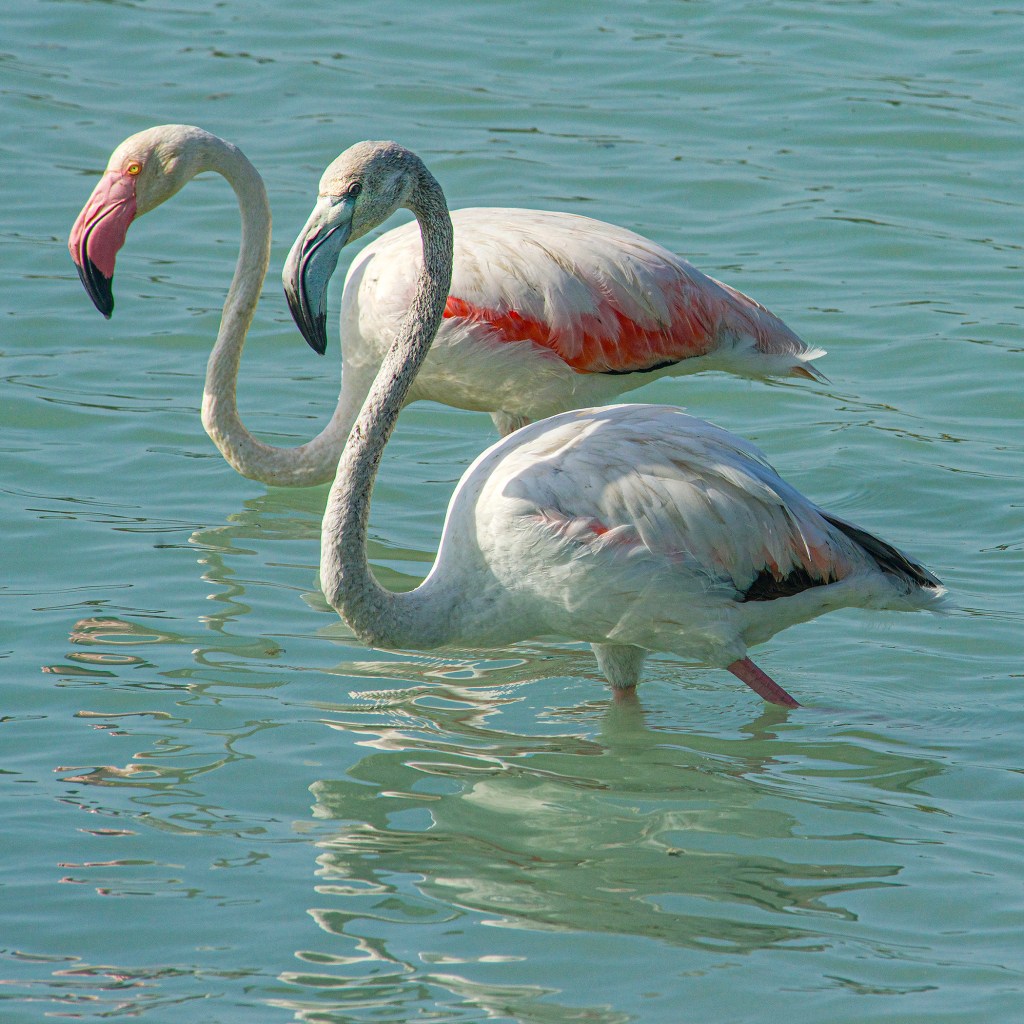
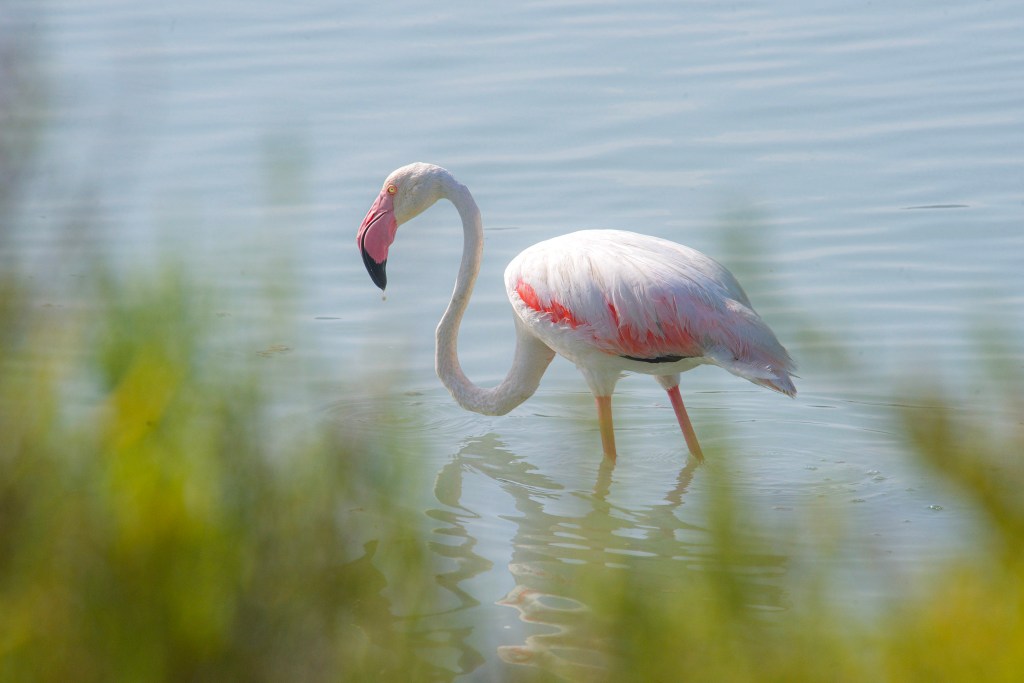
The earth’s Prime Meridian transits the salt flats of Calpe, where Flying Fish lays at rest after a passage from Ibiza. In a sense, this line of longitude is where time begins and ends each day. Time modifies and reorders the natural world: adaptation or extinction. These random thoughts occupy my mind as I share space on the salt flats with one of the world’s most iconic bird species. The greater flamingo has adapted and survived thousands of years of extraordinary change along Spain’s Costa Blanca.

The salt flats of Las Salinas were first utilized during the great Roman era of the 2nd century AD. Now, a busy marina and a European holiday center surround the edges of these ancient alluvial deposits. The greater flamingo continues to thrive here despite the high-rise apartments, Jet Skis, and música electrónica that have changed the shadow and sound of its environment. These flamingos are wild birds. Their wings are not clipped. They are not fenced in or fed. That they choose to return to Las Salinas, in the middle of this urban setting, is a testament to how nature adapts.

The salt flats and the city of Calpe are at the base of the massive rock Peñón de Ifach, a 1,000-foot massif of limestone rising from the Mediterranean Sea. Ifach is an important homing beacon for birds. Some 173 species, both nesting and migrating, have been recorded here, including black-winged stilts, avocets, the black wheatear, and the white wagtail. There is some ornithological tourism in Calpe, but most tourists come instead for a different variety of wagtail, and to get sunburned and drink sangria.

Tourists sharing Calpe with the birds date back at least two millennia. Across the sandbar delineating the salt flats and the edge of the sea, archeologists excavated the “Baños de la Reina.” Ancient Roman engineers designed a thermal complex including pools of different temperatures, a sophisticated heating system, and a piscinae for sunken gardens and the farming of live fish. But for whom this ultimate vacation villa was constructed is still unknown. Archeologists know that hidden tunnels allowed private access to the Baths of the Queen, but they do not know who the queen was. Whoever merited this elaborate architecture of marble and mosaics was most certainly “a person with a high purchasing power.”[1] Marcus Aurelius is famously quoted saying, “Accept the things to which fate binds you, and love the people with whom fate brings you together, but do so with all your heart.” Perhaps Marcus Aurelius kept a mistress at the salt flats of Calpe.

The history that has shaped the landscape of Las Salinas has also helped maintain its natural habit and biodiversity. Salt was a necessity for fish preservation, which Calpe used to market its catch. Eventually, salt from these lagoons supplied fishing industries in over 40 Spanish municipalities. At the end of the 18th century, Salt production declined when Las Salinas was thought to harbor yellow fever. In 1993, Spain declared Las Salinas a protected maritime-terrestrial zone.
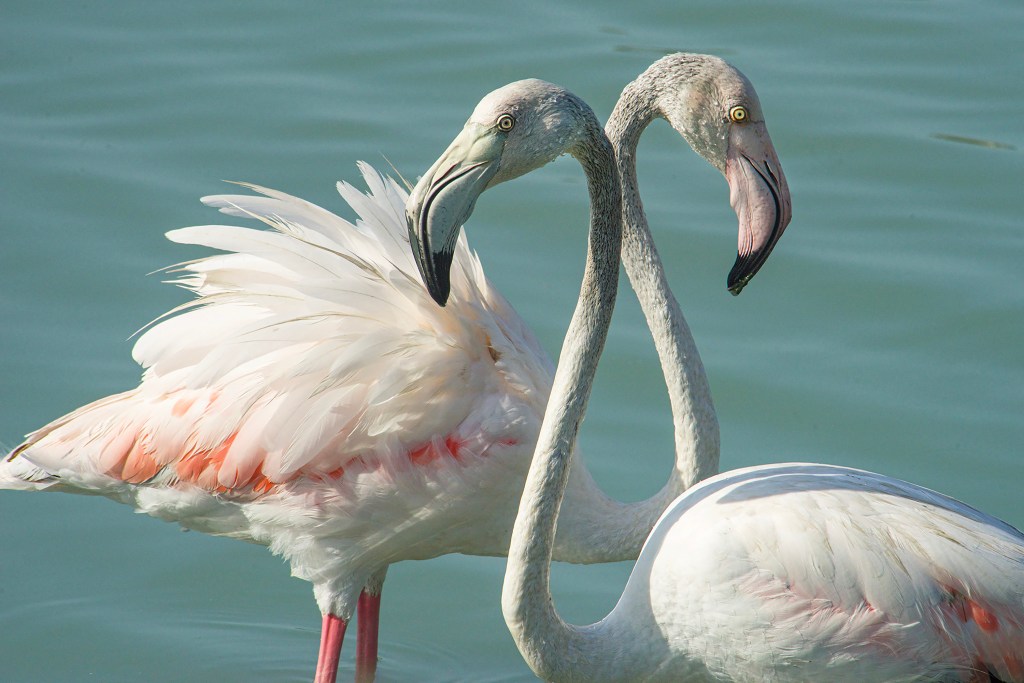
While many species make up the Las Salinas habitat, the population of flamingos generates the most attention. The coloration of all flamingos comes from the carotenoid pigments in the organisms that live in their feeding grounds. The greater flamingo, one of four distinct species, is less flashy than some of its genetic relatives like the hot-pink American flamingo. That doesn’t prevent them from wanting to look good. Secretions of their uropygial “preening” gland contain carotenoids–red pigments. During the breeding season, greater flamingos preen to spread these uropygial secretions over their feathers, enhancing their color. Ornithologists have described this cosmetic use of uropygial secretions by greater flamingos as “applying make-up.”[2]

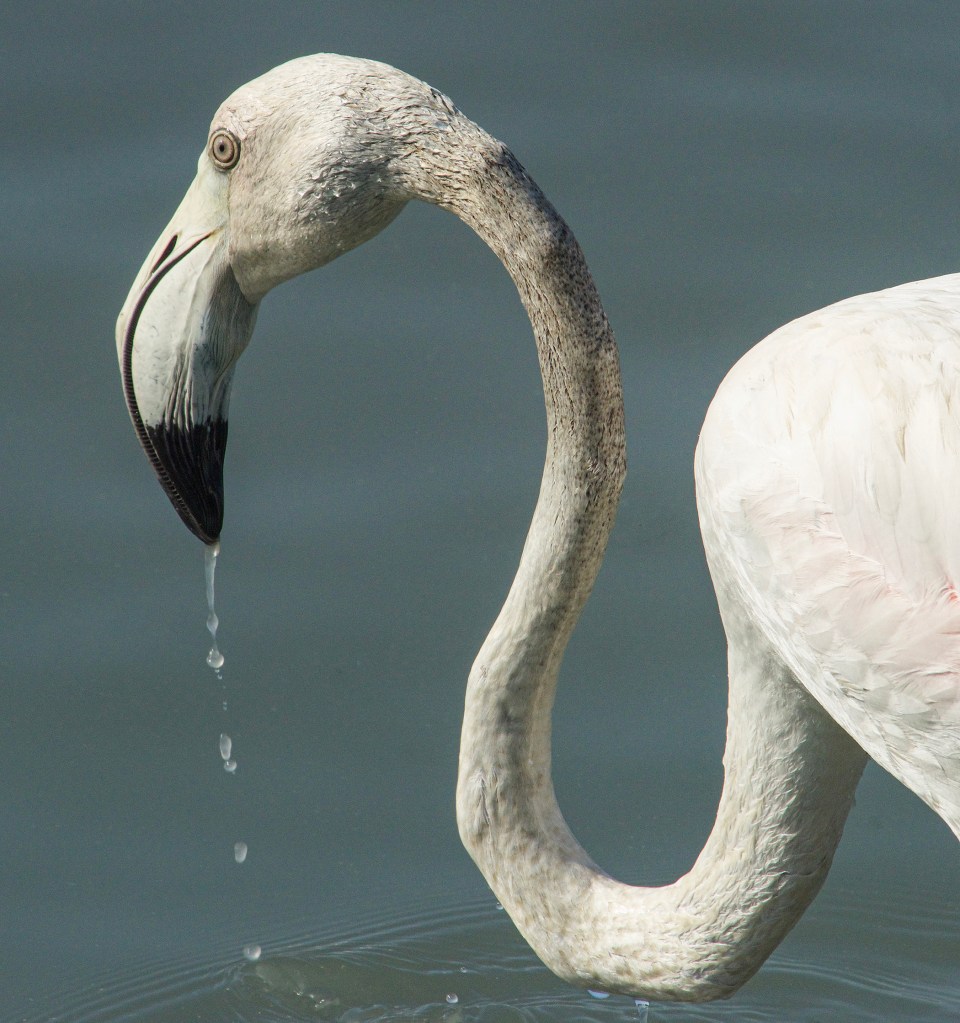
The greater flamingo is an enthusiastic eater. It feeds with its head down; its upper jaw is movable and not rigidly fixed to its skull.[3] Using its feet, the bird stirs up mud, then sucks the slurry through its bill to filter small shrimp, seeds, blue-green algae, microscopic organisms, and mollusks. It is a healthy diet. Wild greater flamingos have an average lifespan of 30 – 40 years. The oldest known greater flamingo, named Greater, (duh) lived in an Adelaide, Australia zoo for between 85-93 years.[4] The bird’s exact age is unknown; he was already a mature adult when he arrived in Adelaide in 1933. Greater was euthanized in January 2014 due to “complications of old age.”

It is zero hundred hours, at zero degrees longitude. A full moon has risen in direct alignment with Jupiter and Saturn. Flying Fish is secure nearby at her mooring. Somewhere in the ruins of a partially submerged palace, the legacy of an unknown queen waits to be discovered. And on the salt flats of Las Salinas, flamingos secrete pigment over their feathers. Some days I, too, feel the complications of aging, but I’m not ready to be euthanized yet. There is still so much to see and so much to know.

###


References:

[1] “The Baths of the Queen, a Roman Palace,” The World (2012)

2] “Greater flamingos Phoenicopterus roseus use uropygial secretions as make-up,” . Behavioral Ecology and Sociobiology, J.A., Rendón, J Garrido-Fernández, A Garrido, M, Rendón-Martos, and A Pérez-Gálvez. (2011).

[3] Flamingo, Wikipedia

[4] “Flamingos at Adelaide Zoo,”  Vaughan Wilson; at Conservation Ark / Zoos South Australia 2008

Ornithologists have described the cosmetic use of secretions on the feathers of greater flamingos as “applying make-up.” Photograph: © Jeffrey Cardenas

Sailing is not just about the wind and the sea; equally important are the places to which Flying Fish carries me.

Please click Follow at the bottom of this page so that you don’t miss a new update, and please consider sharing this post with others who might enjoy following the voyage of Flying Fish. I welcome your comments. I will always respond to your comment when I have an Internet connection. And I will never share your personal information.

You can follow the daily progress of Flying Fish, boat speed (or lack thereof), and current weather as I sail into the Mediterranean by clicking this satellite uplink: https://forecast.predictwind.com/tracking/display/FlyingfishClick the “Legends and Blogs” box on the right side of the tracking page for en route Passage Notes. 

To see where Flying Fish has sailed since leaving Key West in 2017, click here: https://cruisersat.net/track/Flying%20Fish.

Instagram: FlyingFishSail
Facebook: Jeffrey Cardenas

Text and Photography © Jeffrey Cardenas 2021

Let this be a time of grace and peace in our lives   –Fr. John Baker

Casu Marzu

Eating the Rare Sardinian Delicacy of Maggot-Infested Cheese

Cheese aficionados pair maggot-infested casu marzu with traditional carasau bread and a good local red wine such as Cannonau. Lots of Cannonau. Photograph: © Jeffrey Cardenas

In the spirit of, “I may never pass this way again,” I could not leave Sardinia without first having eaten casu marzu–the rare and illegal delicacy of maggot-infested cheese. What could go wrong?

Translation first: Casu marzu in Italian literally means, “putrid, rotten cheese.” The beauty of the Italian language is that it is direct; Italians say exactly what they mean. Casu marzu is not a “fragrant” cheese or a “bold” cheese. Casu marzu is a decomposing cheese. It is crawling with worms. And Italians will risk breaking the law just to get a taste of it.

The creation of a fine casu marzu begins normally enough as a classic sheep’s milk pecorino. Then the process gets a little weird. The cheese is left outside in the heat of summer with part of the rind removed. This attracts the cheese fly, Piophilidae, which can lay more than 500 eggs at one time. The larvae hatch and emerge as translucent white worms eating through the cheese. The process then goes from fermentation to a stage of decomposition, brought about by the acid from the maggots’ digestive system breaking down the cheese fats. The cheese texture becomes soft and creates a weeping liquid called làgrimas–teardrops. By the time it is ready for consumption, a typical casu marzu will contain thousands of maggots.

When I first asked about casu marzu, the local formaggiaio in Carloforte wagged his finger at me and then turned away. A street vendor was more forthcoming. “There is an open market on Wednesday,” he said. “Follow your nose.” At the open market, there were several cheese vendors. One said, in English, “Casu marzu? Of course. We have.” When he showed me the cheese, I asked where the worms were. “Ah,” he said, “the worms were here, but now they have gone away.” Casu marzu is considered by many Sardinians to be unsafe to eat when the maggots in the cheese have died.

Another cheese vendor, working out of the back of a truck, was cautiously watching our exchange. That’s the guy, I thought.

When I asked him for casu marzu he looked to his right, then looked to his left, and said, “Sei la polizia?” I laughed, “Do I look like the police?” He laughed and pulled out a white plastic construction bucket he had hidden under a table near his truck. When he took the towel off the top of the bucket it was filled with wheels of foul-smelling cheese crawling with worms. “I’ll buy a half-kilo,” I said, “but please hold the cheese in your hands so that I can make a photograph.” His face went serious. He shook his head no and then held out his arms with his wrists crossed like he was in handcuffs. “No photo,” he said. “Formaggio, si. Io, no.”

Casu marzu presents an interesting paradox for Italian cheese aficionados. It has been considered illegal by the Italian government since 1962, due to laws that prohibit the consumption of food infected by parasites. Those who sell casu marzu can face fines up to €50,000. European regulators in 2002 reinforced the law making the cheese illegal not only in Italy but also in all the common EU markets. Casu marzu is also illegal in the United States.

The cheese remains a revered delicacy. Despite official health concerns, Sardinians consider casu marzu safe. (Sardinia has the highest percentage of people living to 100 years or beyond. The proportion of centenarians in the population is twice the rate considered normal for the rest of the world.) Also, as a traditional product of Sardinia, it is locally protected, although it still remains available only on the black market. There is, however, a formal proposal pending before the EU to give casu marzu DOP (Protected Designation of Origin) status like other cheeses and fine wines.

So what is it like to eat cheese infested with worms? You had better enjoy eating strong cheese, and cover your eyes. Casu marzu has the taste and texture of aged gorgonzola, but it moves. Writer Kara Goldfarb describes it best:

“When eating the cheese, one is meant to close their eyes. It’s not to avoid looking at the maggots as you eat them but to protect your eyes from them. When bothered, the maggots will jump up, sometimes going as high as six inches. Next tip, it is imperative for one to properly chew and kill the maggots before swallowing. Otherwise, they can live in the body and rip holes through the intestines… The next step is less of a safety precaution and more of a way to just enhance the culinary experience. It’s advised to enjoy the casu marzu with a moistened flatbread. It also pairs well with a glass of strong red wine. Potentially because the two go well together, possibly because of the added liquid courage.”

In the end, being able to taste casu marzu is a cultural experience that I consider a necessity of travel. I remember eating the fruit durian when I was sailing through Sumatra. It smelled like raw sewage but tasted like a rich custard. Years ago, in a no-name restaurant in the Chinese ghetto off Tiananmen Square, I asked for the house specialty and was served a bull’s penis. These are the things that make our journeys rewarding.

Yes, those are maggots crawling out of the cheese… Photograph: © Jeffrey Cardenas

Sources:

“Maggot Cheese,” Gordon Ramsey, https://youtu.be/vZ_-JzM-YQg

Casu Marzu Cheese Is Dangerous, Illegal, And Filled With Maggots,” ATI, Kara Goldfarb

“Cazu Martzu,” Wikipedia

Most Rotten Cheese,” The World’s Worst: A Guide to the Most Disgusting, Hideous, Inept, and Dangerous People, Places, and Things on Earth, Mark Frauenfelder


Sailing is not just about the wind and the sea; equally important are the places to which this boat takes me.

Please click Follow at the bottom of this page so that you don’t miss a new update, and please consider sharing this post with others who might enjoy following the voyage of Flying Fish. I welcome your comments. I will always respond to your comment when I have an Internet connection. And I will never share your personal information.

You can follow the daily progress of Flying Fish, boat speed (or lack thereof), and current weather as I sail into the Mediterranean by clicking this satellite uplink: https://forecast.predictwind.com/tracking/display/FlyingfishClick the “Legends and Blogs” box on the right side of the tracking page for en route Passage Notes. 

To see where Flying Fish has sailed since leaving Key West in 2017, click here: https://cruisersat.net/track/Flying%20Fish.

Instagram: FlyingFishSail
Facebook: Jeffrey Cardenas

Text and Photography © Jeffrey Cardenas 2021

Let this be a time of grace and peace in our lives   –Fr. John Baker

Passage to the Middle Sea

The rigging and foredeck of Flying Fish on passage in light air from Turkey to Malta. © Jeffrey Cardenas

A passage has a life of its own. Like a good book, there is a beginning, various plotlines, drama, and then it ends. The 680-mile passage of Flying Fish last week across the eastern Mediterranean from Turkey to Malta was no exception.

  • I felt some anxiety about my routing to Malta through Greek territorial waters. Greece and Turkey prohibit transit between their countries, and their war of words has recently escalated to saber-rattling.
  • Weather became an issue. A ferocious meltemi wind developed, unforcasted, soon after I departed from Turkey.
  • I experienced a startling “bump in the night” as Flying Fish’s keel met unseen rocks in a dark anchorage.
  • The meltemi turned into winter with freezing rain coating the deck.
  • As I continued into the Mediterranean, hundreds of merchant ships were stalled en route to Suez because a massive container ship had gone aground, closing the entire canal.
  • And in the middle of it all, I once again lost critical onboard electronics. Both the AIS and the autopilot became inoperative. I was electronically invisible to shipping traffic and, with my autopilot gone, I couldn’t even take my hands off the wheel to pee overboard.

Nobody said this was going to be easy.

The route from Turkey to Malta was an initial point of concern. Travel between ports in Turkey and Greece–COVID notwithstanding–has been shut down for months because of territorial sea disputes. Tensions are inflamed over an area of the continental shelf in the Aegean Sea believed to hold rich oil reserves. Territorial waters give the respective state(s) control over shipping. However, foreign ships usually are guaranteed “innocent passage” through those waters. Nevertheless, the Greek military continued a non-stop VHF radio broadcast, warning all vessels from Turkey not to “violate sovereign waters.” Short of heading several hundred miles south toward Egypt, transit through Greek territorial waters would be the only routing option for Flying Fish to sail west.

The passage began with a raging meltemi wind out of the Aegean. Meltemi winds form when a high-pressure system over Greece meets a low-pressure system over Turkey. North winds near gale force are often created in the chute between the two counter-rotating systems. Flying Fish struggled to make forward progress in steep, short-period seas between the islands. Temperatures plummeted as the northerly wind increased. Fortunately, there are abundant sanctuaries for protection from the meltemi among the Greek Islands. I dropped anchor to get some rest in a protected bay at sparsely inhabited Levitha Island, despite the questionable legality of doing so.

At 3 AM, I awoke to the sound of rock meeting fiberglass–never a good sound–and I realized that Flying Fish was not where I had dropped the anchor. In nearly 12,000 miles of sailing since leaving Key West, I had never, until this night, grounded the keel of Flying Fish. As the meltemi roared in the tight anchorage of Levitha, it created a vortex of wind spinning the boat around the anchor and into a rock below the surface. In my state of exhaustion hours earlier, I had made the cardinal error of situational awareness: I did not thoroughly examine my anchorage and allow adequate swing room. Awakened by this startling bump in the night, I sprung out of my berth, started the engine, winched up the anchor, and checked the bilge. There was no water ingress (external inspection would have to wait.) Flying Fish was floating. In pitch-black darkness and violent wind, I reversed my inward GPS track and motored out of the bay to deeper water. Only then I realized that I was half-naked and very, very cold.

“Being from the tropics, I like ice. I’m just not too fond of it when it comes out of the sky.”

By morning there was sleet on the deck of Flying Fish. Temperatures were above 0°C on deck, but freezing rain was falling from the sky. I was still wet from the night’s activity. Being from the tropics, I like ice. I’m just not too fond of it when it comes out of the sky. I needed to find shelter and regroup. The Greek Waters Pilot guide recommends a secure anchorage at Nísos Íos. The book says of the Manganari Bay anchorage: “The island is extremely popular with young sun-lovers. Nude bathing is tolerated here.” A caïque brings beachgoers “topless and bottomless” daily from Íos. But that wasn’t happening today.

News about the blockage of the Suez Canal was scarce over my satellite reports, but I began to see an unending line of merchant ships jamming the shipping lanes toward Port Said. Deciphering lights, radio calls, radar blips, and other electronic information can be like reading code. Why is one ship moving one way while all the others are doing something different? Much of that information transmits by AIS (Automatic Identification System) to my mapping electronics. The AIS tells me who is navigating the same water as Flying Fish, essential information for collision avoidance. Most of the ships noted on AIS were tankers (empty tankers, it turned out, heading to the Middle East for more oil). One vessel was moving much faster than the others. It was listed on AIS as a “Dredging Operator,” expertise much needed considering the current circumstances. The Suez Canal blockage was now a critical event with global economic implications.

And then–poof!–all of the AIS targets vanished from my navigation screens. Simultaneously, Flying Fish turned abruptly to windward as the autopilot disengaged. Not again! A year earlier, as I began a 3,000-mile passage across the Indian Ocean, Flying Fish experienced an identical system failure. Unable to resolve the problem, I diverted first to Sumatra and afterward to Phuket for repairs (and then came COVID and a circumnavigation interrupted… but that is a different chapter for another day.) Now, 150 miles out of Malta, the situation (it always happens at night) was frustrating but manageable. I would sail the final stretch into the historic Valletta harbor the way my forebears did, using my eyes for navigation and my hands to steer. Even at night, every cloud has a silver lining.

The historic walled city of Valletta, Malta glows in the evening light. Photograph © Jeffrey Cardenas

Please click Follow at the bottom of this page so that you don’t miss a new update, and please consider sharing this post with others who might enjoy following the voyage of Flying Fish. I welcome your comments. I will always respond to your comment when I have an Internet connection. And I will never share your personal information.

You can follow the daily progress of Flying Fish, boat speed (or lack thereof), and current weather as I sail into the Mediterranean by clicking this satellite uplink: https://forecast.predictwind.com/tracking/display/FlyingfishClick the “Legends and Blogs” box on the right side of the tracking page for en route Passage Notes. 

To see where Flying Fish has sailed since leaving Key West in 2017, click here: https://cruisersat.net/track/Flying%20Fish

Instagram: FlyingFishSail
Facebook: Jeffrey Cardenas

Text and Photography © Jeffrey Cardenas 2021

Let this be a time of grace and peace in our lives   –Fr. John Baker

Easter Celebrations Canceled

The rounded dome of the Basilica of Our Lady of Mount Carmel and the iconic spire of St. Paul’s Anglican Cathedral’s in Valletta’s harbor. Photograph: © Jeffrey Cardenas

Good Friday. In this context, it has always been difficult for me to understand the use of the word “good.” In Malta today, as COVID lingers like the plague it is, Good Friday takes on an even darker tone. The Archdiocese of Malta suspended the celebration of public Masses on Easter to contain the spread of coronavirus.

On Good Friday, according to the Bible, the son of God was whipped bloody and humiliated as he carried a cross upon which he was nailed before finally being put to death. Good Friday? Historians believe it was simply a question of etymology, a word developed from an older name, possibly “God’s Friday.” Theologians look at it differently. Good Friday is holy, they believe, because on this day when Jesus Christ gave his life in sacrifice for people’s sins it was an embodiment of compassion, love, and empathy.

I think about this as I walk the narrow streets of Valletta on this tiny island with 359 churches. I look out at the rounded dome of the Basilica of Our Lady of Mount Carmel and the iconic spire of St. Paul’s Anglican Cathedral. Easter Sunday Mass, with the parishioners of Malta and Caravaggio’s masterworks in St. John’s Cathedral, is canceled. I resolve to dig deep into my faith to recognize the true meaning of Good Friday.

malta-waterfront-pram.sm_


Please click Follow at the bottom of this page so that you don’t miss a new update, and please consider sharing this post with others who might enjoy following the voyage of Flying Fish. I welcome your comments. I will always respond to your comment when I have an Internet connection. And I will never share your personal information.

You can follow the daily progress of Flying Fish, my boat speed (or lack thereof), and current weather as I sail into the Mediterranean by clicking this satellite uplink: https://forecast.predictwind.com/tracking/display/FlyingfishClick the “Legends and Blogs” box on the right side of the tracking page for en route Passage Notes

To see where Flying Fish has sailed since leaving Key West in 2017, click here: https://cruisersat.net/track/Flying%20Fish

Instagram: FlyingFishSail
Facebook: Jeffrey Cardenas

Text and Photography © Jeffrey Cardenas 2021

Let this be a time of grace and peace in our lives   –Fr. John Baker