Don’t kill me because I’m beautiful
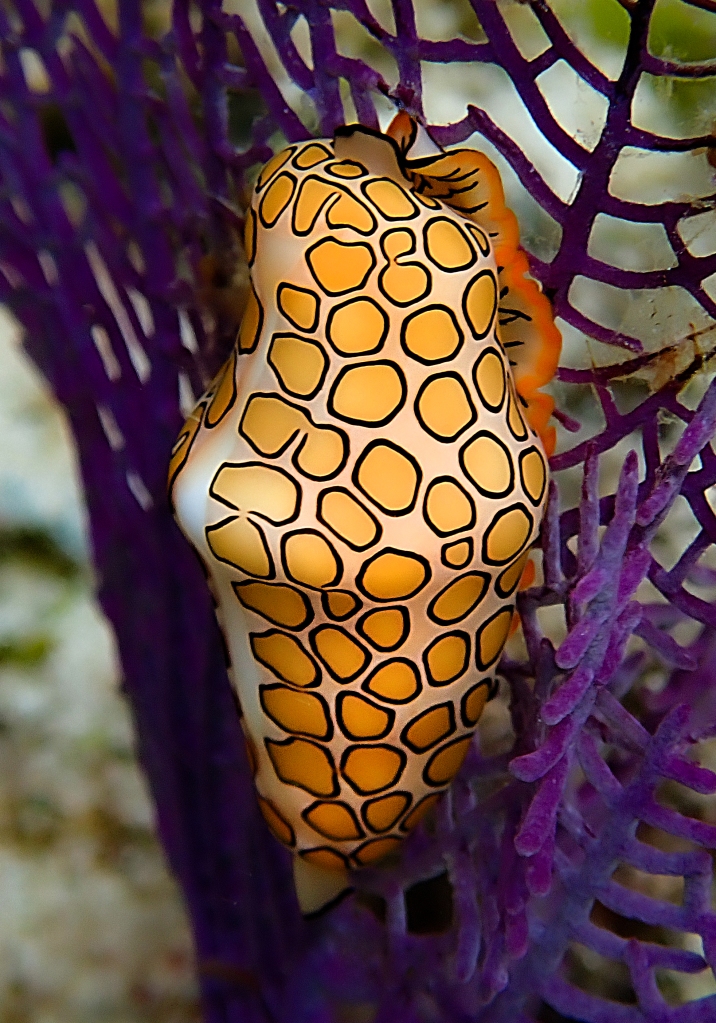
The bare shell of the flamingo tongue snail looks like a characterless white rock. It is the living part of this animal–the mantle–that dresses up the shell with its outrageous leopard-print cloak. It does this to impress its underwater neighbors. The flamingo tongue is not looking for a date. It simply wants to avoid being eaten. The colorful spots tell predators, like lobsters and pufferfish, that, however beautiful it might be, the flamingo tongue is also toxic.
I am weathered-in aboard Stella Maris for several days with 30-knot winds and driving rain. There is no better cure for cabin fever than time spent underwater. I particularly enjoy freediving in shallow water, where I can get up close and personal with the minutiae of the underwater world. The flamingo tongue snail is a part of this world today. At less than an inch long, it might be easily overlooked were it not for its flashy costume.
The snails are most frequently found grazing on toxic soft corals like sea fans and other gorgonians. The flamingo tongue uses its foot, which resembles a long ribbon with teeth, to secrete chemicals that dissolve coral into digestible food. The snail is not concerned by the coral’s toxicity—it repurposes the chemicals by storing those toxins in its own tissues to use as a defense mechanism against predation.
Not every diver is happy to see flamingo tongues because as they graze, they leave a thin trail of dead coral polyps in their wake. But the snail will rarely kill its host coral. Most damaged gorgonians can regenerate their lost tissues. Marine biologists who have specifically studied snails and their effect on coral say that because the polyps regrow, this predation is part of a well-balanced reef.
Female and male flamingo tongue snails leave behind mucus trails that release pheromones on the soft coral when it is time to breed. Flamingo tongue snails are hermaphroditic, having both male and female reproductive organs. However, they cannot fertilize themselves and require a mate to reproduce. Mating can last up to four hours (snails move slowly). Four days after mating, the female lays her sticky white egg clusters onto part of an exposed gorgonian skeleton. Each egg can contain up to 300 embryos! After ten days, the egg capsules hatch to release free-swimming larvae.
The flamingo tongue snail is not currently considered endangered, but like many marine organisms, it is threatened by human activities. It is listed in Appendix II of the Convention on International Trade in Endangered Species of Wild Fauna and Flora (CITES), meaning that international trade in this species is regulated to ensure that it does not become threatened with extinction.
Conservation efforts for the flamingo tongue snail include protecting its coral reef habitat through marine protected areas. Some countries, such as Jamaica, have implemented regulations to limit the collection of flamingo tongue snails, and the United States has banned the import of these snails for the souvenir trade. Flamingo tongues are often collected by people who mistakenly think that the shells themselves are colorful when they see the leopard spots on the mantle. Once a flamingo tongue snail dies, the mantle is gone and the surface of its shell becomes a bleached bone-white piece of calcium.
Flamingo tongue snails may not yet be endangered. Still, as I swim in this gorgonian garden and see so much beauty on a windy and rainy day, it makes me wonder: what is so toxic about human nature that makes some people, when they see something beautiful, want to kill it for a collection? Life on coral reefs is already seriously threatened by climate change, ocean acidification, and mass tourism. The one thing we can do right now is minimize our impact by moving more slowly–and less possessively–in this fragile underwater world.

Photograph: © Jeffrey Cardenas
REFERENCES:
- National Marine Sanctuary Foundation (21 Feb, 2020) Sea Wonder: Flamingo Tongue Snail
- Oceanus (26 Aug, 2008) Biochemical Warfare on the Reef, Kristen Whalen–Woods Hole Oceanographic Institution
- One Earth (8 Aug 2023) Flamingo tongue snail: the beautiful tropical creature of the Caribbean, Lindsey Jean Schueman
- Ocean Conservancy (10 Sep 2021) What is the Flamingo Tongue Snail?, Eric Spencer
Thanks for sailing along with Stella Maris on this Bahamas leg of our journey.
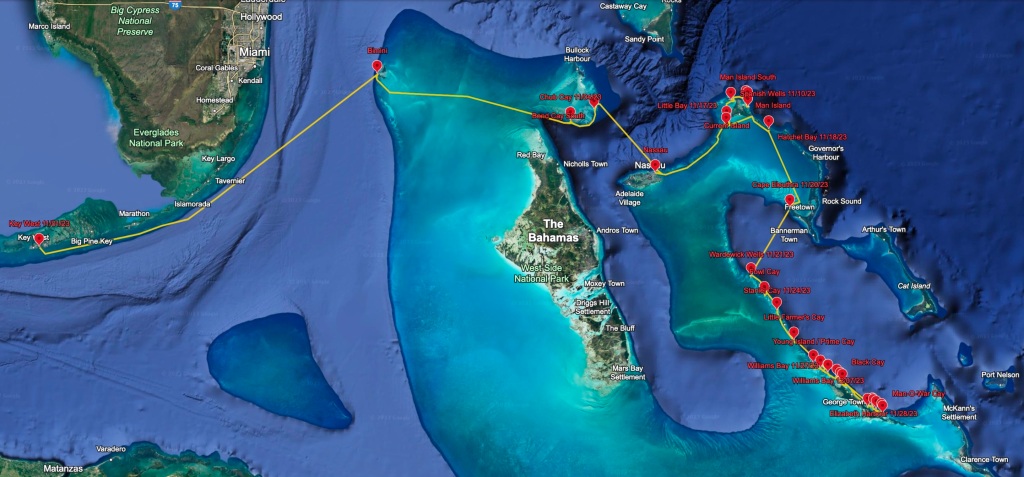
As always, sailing is not just about the wind and the sea; equally important are the places, the flora, fauna, and people encountered along the way.
Please click “Follow” so that you don’t miss a new update,- and please consider sharing this post with others who might enjoy following the voyage. I welcome your comments, and I will always respond when I have an Internet connection. I will never share your personal information.
Instagram: StellaMarisSailing
Facebook: Jeffrey Cardenas
Text, Photography, and Videos © Jeffrey Cardenas 2023
Let this be a time of grace and peace in our lives – Fr. John Baker