Sailor Boy

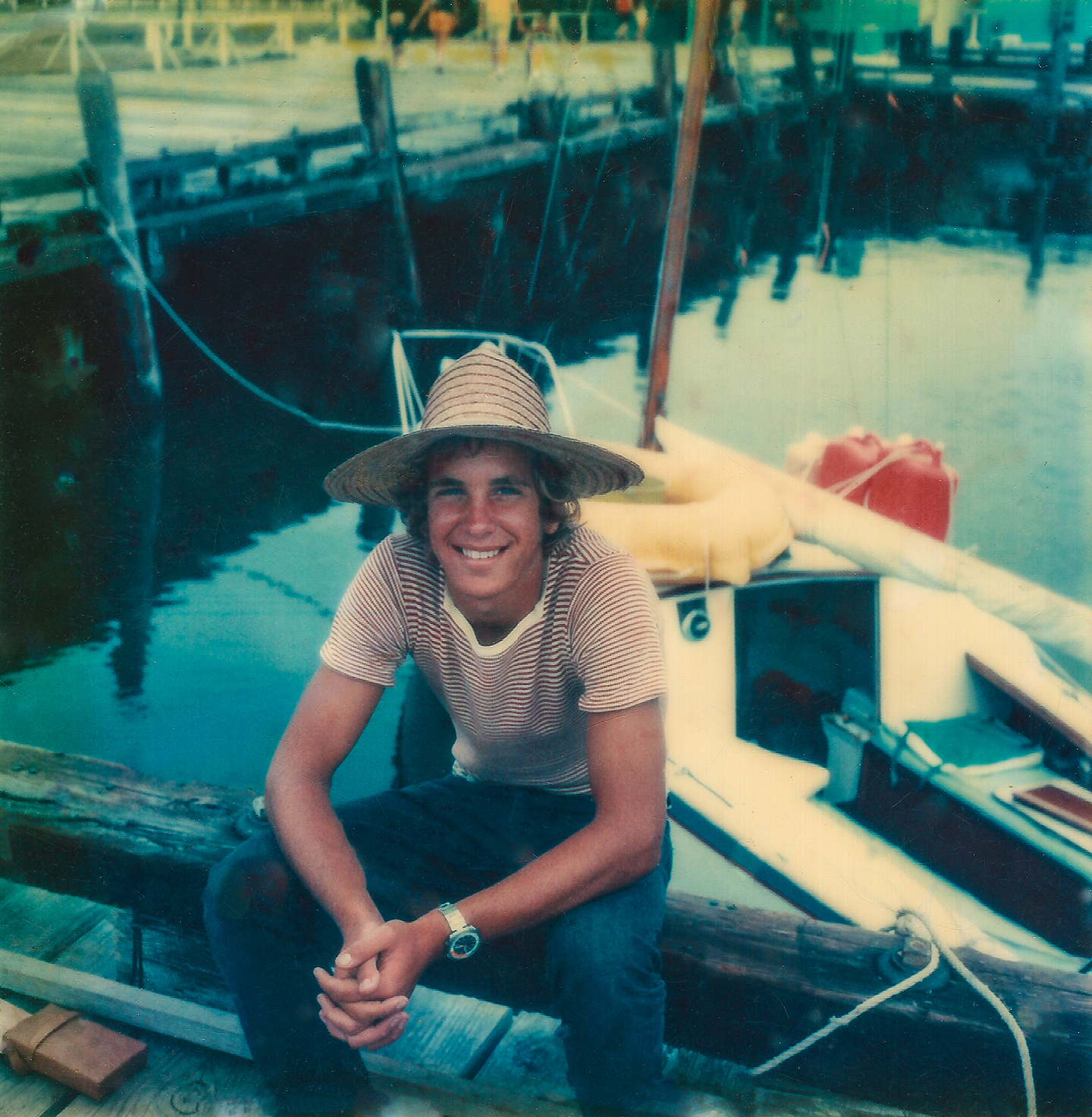
As a boy sailor I was given a long lead to chase my dreams. Here I pose with with 18-foot Icarus during a teenage sailing adventure from Ft. Lauderdale, FL to Newport, RI

As a boy sailor I was given a long lead to chase my dreams. Here I pose with 18-foot Icarus during a teenage sailing adventure from Ft. Lauderdale, FL to Newport, RI

Sailing memories flood my mind as I lay restless in bed today, still unable to walk 10 days after a knee replacement surgery.


I could obsess about the excruciating pain and second-guess my decision to have a prosthesis inserted into one of the most critical parts of my body–but it is better for me to meditate on the positive.


I am remembering myself as a sun bleached 14-year-old South Florida boy. I was restless then, too. With hormones raging and frustrated in school, I was trying to figure out what I wanted from life. All I knew was that I wanted to go sailing.


“I’m running away from home,” I told my parents one day. “I love you, but I gotta go.”


Why? Who knows? No child could have asked for better parents, or for better siblings. My life was perfect. I just needed the time to discover that on my own.


I had a 12-foot wooden sloop that I had named Cutty Shark. I wasn’t thinking about the nautical history of the great clipper ship Cutty Sark when I named my boat. I was thinking about the Scotch whiskey by the same name. I painted the boat bright yellow to match the label on the whiskey bottle. My parents did not think it was nearly as funny as I did.


My Dad said, “Well, if you are running away in that boat let me give you a ride to the boat ramp.” And my Mom said, “I’ll pack up some food for you.” It was not exactly the response to my rebellion that I had in mind.


“I’m going to Key West,” I told them. The year was 1969. Key West was 150 miles away. “Give us a call when you get there,” Dad said, waving goodbye. And that was that. I ran away to sea at age 14 in a tiny yellow boat named after a bottle of whiskey.


The story has a happy ending. A couple of weeks later, Mom and Dad drove down to Key West in our family station wagon towing my boat trailer. There were smiles all around. They even treated me to a seafood dinner at the A&B Lobster House. I was hungry.


What amazing parents I have. To allow their 14-year-old kid to leave home, in the middle of the school year, and just go sailing alone over the horizon. It was remarkable. It was probably the single best example of parenting I have ever known. It cured my restlessness (for a while). I was a better boy because of it.


Right now these memories are better than morphine for the knee pain. I close my eyes and smile as I think of a fresh breeze filling my sails. Those were days when I had the freedom to be anybody I wanted to be.


Those days will come again.
All is (not) Lost

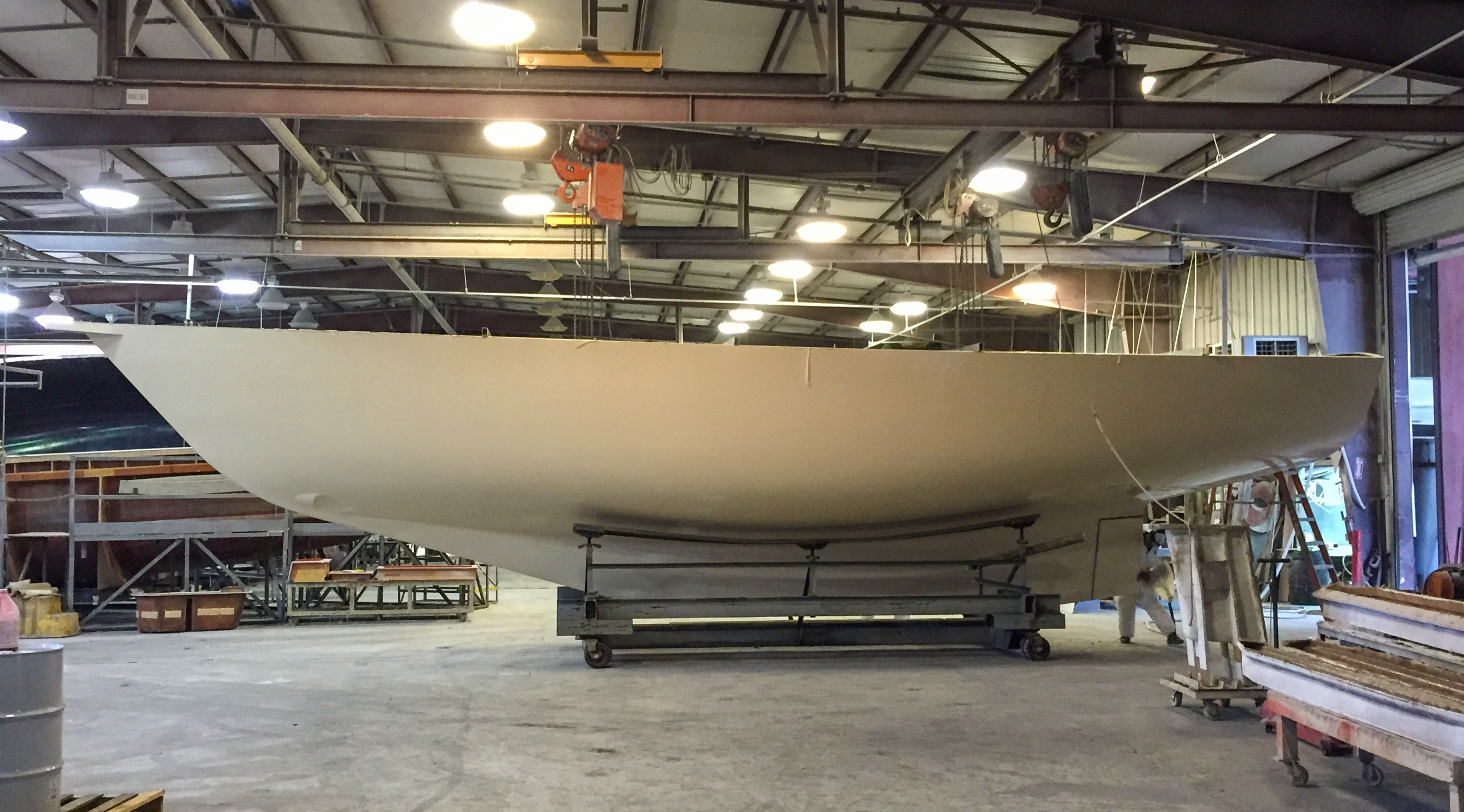
IP460 Flying Fish shows her lines as the bare hull is released from the mold

IP460 Flying Fish shows her lines and traditional full keel as the bare hull is released from the mold

It may not be prudent to view the Robert Redford film All is Lost when you are planning a long, singlehanded ocean passage.

It is definitely not a good movie to watch if you are also recovering from knee replacement surgery and you are semi hallucinating on the narcotic painkiller Percocet.

In the film, Redford is sailing alone through the Indian Ocean when his boat collides with a partially submerged shipping container. His hull is gashed by the collision and much drama ensues. The nightmare scene for me, however, is when the boat is being ravaged by a storm that turns the hull upside down. The view through the hatches and portholes becomes one of bottomless ocean–a view I hope never to see when I look out of the windows in my boat.

This is why in the selection of a builder for Flying Fish I wanted to know about stability curves and ratios, and the critical point of boat heel and recovery. In physics, these forces work like a lever arm. The center of gravity pushes down on one end and the center of buoyancy pushes up on the other. This combined force is known as the righting moment and it works to rotate the hull back to an upright position. But it is not enough that the design simply resist rollover; if a capsize does occur what is critical is the recovery time for the hull to return to the upright position. A more detailed explanation of stability curves and righting moment is attached here.

Heavy displacement full keeled sailboats like the IP460 being built for me are not considered very sexy in this new world of lightweight wing keeled supersonic sailing machines. I’m okay with that. I’m not one of those sailors who needs to get there first; I just need to get there. And when I look through my hatches, I want the view to be sunny side up.

Anatomical Refit

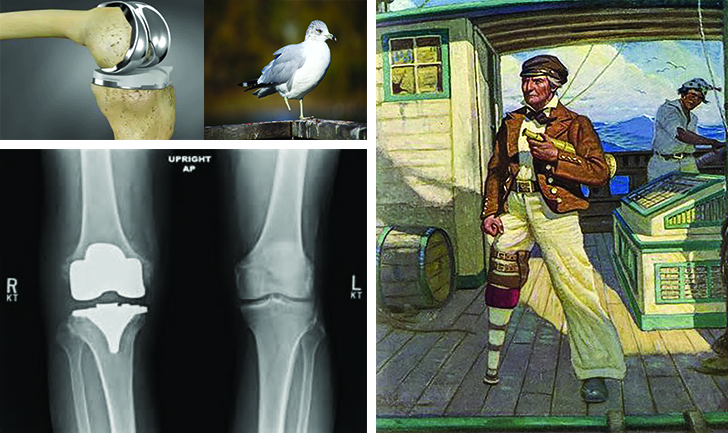
A complete knee replacement is what I need to become seaworthy. Leg issues didn't seem to slow down Ahab in pursuit of his obsession.

A complete knee replacement is what I need to become physically seaworthy. Leg issues didn’t seem to slow down Ahab in pursuit of his obsession.

I don’t want to be a bionic anything.

I am attached to my own flesh and bone. But when I walk, my knee joint grinds bone against bone and that’s when the neuropathic fireworks begin. The cartilage in my left knee is gone. Aging and accidents and osteoarthritis have taken a toll. God’s own caulking compound in my knee has worn away leaving a raw set of nerve endings that hurts so bad it makes me want to whack a white whale.

So tomorrow I go to the University of Miami Hospital where a surgeon will replace my flesh and bone with titanium, ceramic, and ultra-high molecular-weight polyethylene (UHMWPE). I’m getting a new knee. I’m going in for an anatomical refit.

I have been assured that knee joint replacement surgery is hardly more complicated than filling a tooth cavity. More than 600,000 knee replacements are performed each year in the United States. With an aging population and obesity on the rise, demand for total knee replacement surgery is expected to exceed 3 million by the year 2030. Note to daughter Lilly: Forget about sailing for a living and consider orthopedic medicine–ka-ching!

Recovery is said to be quick. A healthy person can be ambulatory in six to eight weeks, if they pay attention to the counsel of their physical therapist. Pay attention? Heck, I’m thinking about moving in with her! I want my legs back.

I would never consider setting sail across three oceans if my boat was in any way unseaworthy. Likewise, I feel I have a responsibility to myself and to my family to be physically fit for this voyage. I need to be kneeworthy.

Home Port

The Schooner America reefed and reaching through Key West Harbor

The schooner America reefed and reaching through Key West Harbor

While it may seem odd to become nostalgic about a home port before having even left it, Key West is the kind of place that a person cannot leave lightly. I am thinking about my home port today as I watch schooners tack across the harbor in preparation for the annual Wreckers Race.

The schooners represent a golden age of sail when over 100 ships per day passed by Key West. The waters they were sailing were known as some of the most treacherous in the world. On average, at least one ship per week would wreck somewhere along the Florida reef. The captain of the first ship to reach a wreck became the “wrecking master” and he controlled the salvage operation. The goods salvaged from the wreck would later be sold at auction in Key West with the wrecking courts awarding anywhere between 25 and 50 percent of the profit to the wreckers.  In 1822, the U.S. Navy chose Key West as its base for suppressing piracy in the West Indies but by 1860 wrecking had made Key West the largest and richest city in Florida, and the wealthiest town per capita in the United States.

The Key West economy has always been fueled by a little bit of piracy. The wreckers were followed by sailors running guns and ganja. Refugees still wash ashore clutching figurines of the virgin Caridad del Cobre, the patron saint of Cuba and protector of those who go to sea.

These days the schooners race to the reef with a cargo of sunburn tourists but Key West is still a seafaring town. From the vantage point of a balcony on a widow’s walk over Duval Street it is possible to look north to the Gulf of Mexico and south to the Atlantic Ocean. Our little Island in the Stream is less than a mile wide. I’ve made my living on the water in Key West for more than three decades. Our daughter was born here. It is home.

Two thousand years ago the Roman philosopher Pliny said, “Home is where the heart is.”

I will keep those words close to me as I set my sails for points west next year. It may end up being a voyage of 36 months and 36,000 miles, but I know if I just keep following the setting sun that it will eventually lead me back to Key West.

Into the Night

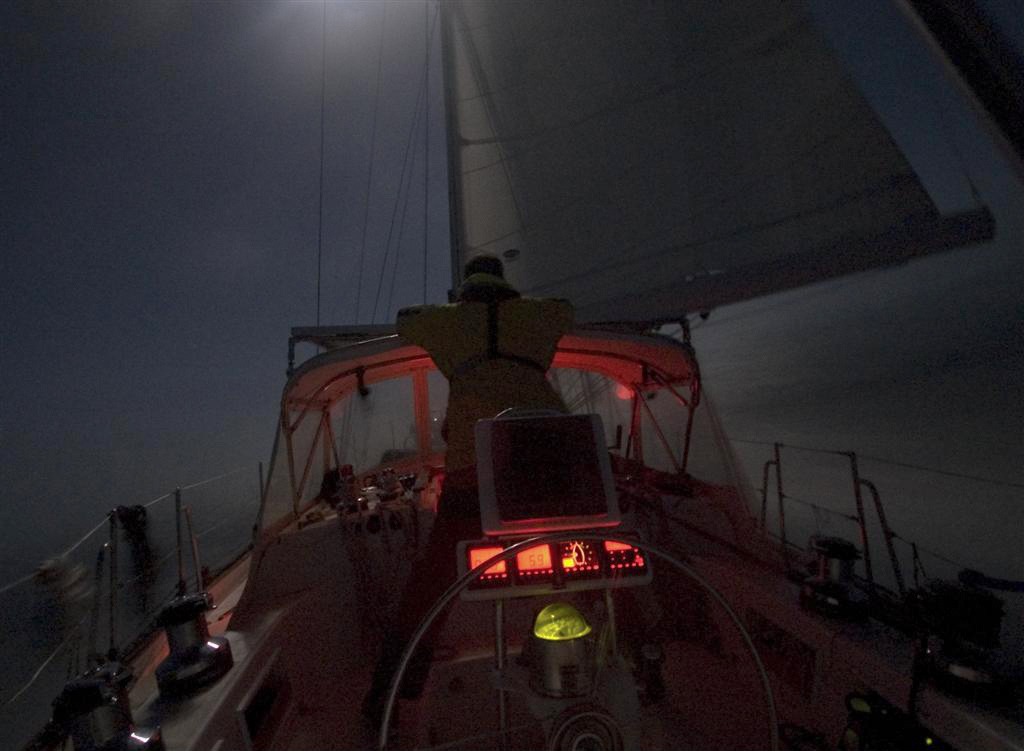
Sailing at night, without a horizon, and only a star to steer her by. Photo: Paul Carson / www.SailValis.com

Sailing at night, without a horizon, and only a star to steer her by.
Photo: Paul Carson / http://www.SailValis.com

On a dark morning this week I will be en route to the Marquesas–the Marquesas Keys west of Key West, not the Marquesas Islands of French Polynesia. That trip across the Pacific will come later–next year, God willing. Nonetheless, the Marquesas in the Key West National Wildlife Refuge is still one of the most beautiful places on this earth. I know these islands well having made this 20-mile passage from Key West more than a thousand times during my 30-year tenure as a Florida Keys fishing guide.

I have always loved the pre-dawn departures, especially on moonless nights when when the sea and the sky seem to blend together as one. Those passages to the Marquesas were made in a small skiff, not a sailboat. It was work then and not what John Masefield called the “vagrant gypsy life.” Still, I cherished these mornings. The route west of Key West is away from civilization. There are no city lights, although on a very dark night in the Marquesas it is possible to see the lume of Havana glowing in the clouds 90 miles to the south.

These dark nights on the water have always reminded me of being alone on my transatlantic passage nearly 35 years ago. In mid-ocean on a calm night the stars would reflect off the water. Without a horizon it would seem as if I was a celestial being hurtling through space; as if the little sloop was in a physical universe beyond the surface of the earth. And how often is that possible without the help of mind-altering substances?

So, as I wait for my new ship to be built, and my star to steer her by, I will be content to to find my way on the water by whatever means possible and I will consider myself blessed when I can make a passage through the darkness.

“Sea Fever
I must down to the seas again, to the lonely sea and the sky,
And all I ask is a tall ship and a star to steer her by,
And the wheel’s kick and the wind’s song and the white sail’s shaking,
And a grey mist on the sea’s face, and a grey dawn breaking.

I must down to the seas again, for the call of the running tide
Is a wild call and a clear call that may not be denied;
And all I ask is a windy day with the white clouds flying,
And the flung spray and the blown spume, and the sea-gulls crying.

I must down to the seas again, to the vagrant gypsy life,
To the gull’s way and the whale’s way where the wind’s like a whetted knife;
And all I ask is a merry yarn from a laughing fellow-rover
And quiet sleep and a sweet dream when the long trick’s over.

By John Masefield (1878-1967).
(English Poet Laureate, 1930-1967.)