Piracy: Then and Now

portobelo boats2sm

The public wharf at Portobelo, Panamá with two local boats, Benedicion por Dios (Blessed by God) and Pirates

In an outdoor bar on the historic waterfront of Portobelo, Panamá I watch as a sailor shuffles out of his dinghy and slumps into a seat at a table next to mine. A waiter is quick to bring him a steaming mug of coffee. As the sailor shovels his seventh spoonful of sugar into the cup I ask, “Tough passage?”

“You could say that,” he says, in a thick eastern European accent.

“A few weeks ago I was boarded by 20 guys in three go-fast boats 35 miles offshore between the Nicaraguan coast and the island of Providencia. They ransacked my sailboat, in the middle of the day, taking everything of value—money, computers, electronics. They wanted drugs, which of course I didn’t have. I’m just a guy from Poland sailing my boat in the Caribbean.”

He is Jarek Glistak, a singlehanded sailor aboard the 44-foot sloop Draga (Darling).

After a terrifying hour looting the boat the pirates gave him back a laptop and portable GPS so that he could navigate to land. He reported the incident to Colombian officials upon his arrival in Providencia.

Sailors’ stories are sometimes just that—tall tales. But there is an organization called The Caribbean Safety and Security Net (CSSN) that monitors incidents such as these and their reports confirmed the details of this event happening in the disputed waters off the Honduras/Nicaragua border about six weeks ago. In fact, CSSN reports that there were four other incidents of piracy this year alone in this remote area of the Caribbean.

Jarek has finally made his way to Portobelo as he tries to reorganize his life. He said he is “scarred” from the attack but thankful that he was left with his Darling, and his life.

Portobelo has a rich history of piracy that dates back to the 1500s when this port was the transshipment center for the gold, silver, and precious jewels looted by the Spaniards from the New World.

Sir Francis Drake was considered one of the most ruthless privateers to prey upon the treasure galleons in Portobelo’s harbor. He was slave trader who went on to be a famed circumnavigator and knighted by Queen Elizabeth I. To the Spaniards he was simply a cold-blooded pirate known as “The Dragon.”

He was 55 when he died. The official cause of death was dysentery. Drake was interred in a lead casket that was dumped into the bay at Portobelo. There is speculation that he may have still been breathing when the coffin went overboard.

No trace of the lead coffin has ever been found but it is likely somewhere in the vicinity of where Flying Fish lays at anchor tonight in Bahia de Portobelo.

A Wild Ride

JC rain pic.sm

A sailing passage can be like a small-scale version of life. There is joy and hardship, wonder and despair. It was only eight days from Key West to Panamá aboard Flying Fish, but it seemed like forever–and that is a good thing. How many more times will two brothers sail together with a father who introduced them to this world?

Each of us knew that this passage south would be a test. None of us realized how close this test came to be the final exam. There was a sweeping low pressure system that dropped deeper into the Caribbean than was forecast and it brought with it gale force winds and huge disoriented seas. We could not outrun this storm. Torrential rain and breaking waves shut down our temperamental navigation system. An electrical fault in the ship’s generator filled the cabin of Flying Fish with smoke from burning wires. Our landfall at Bocas del Toro, Panamá, at 1AM in a shrieking squall with zero visibility through an unmarked channel, was nothing but by the grace of God.

Selective memory usually means bad things that happen are forgotten and good things are retained. On this passage we took such a beating that those moments of wonder and joy are returning more slowly. The takeaway is (after two days of solid sleep), that despite this first passage nearly terminating in a catastrophic end, I have never felt more alive.

I remember a short period of time off the northwestern coast of Cuba when the winds moderated at sunset and we were able to tune in the radio to a baseball game between the Havana Industriales and the Vegueros of Pinar del Río. Our stomachs even tolerated a Cuban Cerveza Cristal and some salted peanuts in the shell.  In the Yucatán Channel, the fishing rod bent double and brother Bob pulled in a bull dolphin (mahi) which he then cooked into one of the best meals of the passage. And on one evening watch off Nicaragua’s Miskito Coast, during the intense black of night that precedes a moonrise, we sailed through a massive school of our namesake flying fish. Illuminated by the green glow of the starboard running light and their own bioluminescence, the flying fish exploded away from the hull of the boat like a fuselage of fireworks. Watching this with Dad at my side I asked, “Is this a dream?” The question was immediately answered with a thud to the back of my head. A flying fish had miscalculated its airspace.

These are the memories we keep. To be able to share them with family is an extraordinary privilege. I am stronger today because of these eight days together on Flying Fish. In life, and on this sailing passage to Panamá, my brother and my father have always had my back.

Onward!

FF sunrise pic

Flying Fish departs soon from Key West bound for the Panama Canal, Polynesia, New Zealand, Indonesia, Africa, the Caribbean, and then home again to Key West. It’s a three-year cruise. In my pre-launch discombobulation this morning I lamented to a friend that I could not even find my car keys; how was I going to find my way around the world?

His advice to me was perfect: “Just keep sailing in the same direction.”

Most voyagers, whether they are using a sailboat or some other conveyance of transit—mental or physical—depart on the journey with some level of trepidation. It is hard to step into the unknown. We take comfort in what is familiar. But, at the same time, those of us with restless souls cannot wait to see what is on the other side of the looking glass.

I guess that is one way to explain why I am leaving a happy marriage, a beautiful home, and a loving family to sail for three years across open water to distant islands. At age 61, the journey will be difficult. And it will be lonely. Somebody suggested I bring along a cat for company. That would end badly.

The first leg of this voyage will be 7 to 10 days en route to Panama. I will have a strong crew for this passage. My father, who celebrated his 91st birthday this year, is a master mariner and has inspired this voyage with extraordinary sailing adventures of his own. He was also onboard Flying Fish during her maiden voyage when we caught a blue marlin while trolling behind the sailboat in the Gulf of Mexico. Dad is coming along to catch our dinner. My brother Bob will also be aboard for the passage to Panama. Bob and I have a long and interesting history together on boats that includes a transatlantic crossing so under-provisioned that we ate food castoffs scavenged behind restaurants in Gibraltar. And upon arrival in the Caribbean after 30 days at sea we were so hungry that we roasted road kill over a beachside bonfire. Bob is not in charge of provisioning Flying Fish, but he will be great company nonetheless.

Of course, we all know the “best-laid plans” are subject to change. The 2017 Atlantic Hurricane Season is a case in point. But if adversity makes us stronger then change is the dynamic that challenges us to seek new horizons. I will consider this journey a success the day after tomorrow when we finally raise the sails on Flying Fish and point her bow to the west.

The Resurrection of Flying Fish

ff-under-sail

Flying Fish on its maiden sail near Sarasota, Florida. Image courtesy of Deb at theretirementproject.blogspot.com

After two years of a stormy passage on land that included the financial failure of a legendary boat company, legal challenges, and three different owners of the Island Packet brand, the magnificent Flying Fish has finally been launched in Palmetto, Florida. The course ahead has never looked brighter.

A parable: Threatened by sub-aquatic predators, a flying fish instinctively leaves its element and becomes airborne. Once in flight, however, the trouble is multiplied. The flying fish that was driven skyward by pursuing mahi-mahi is now also being attacked from above by diving frigate birds. Survival for the flying fish is predicated on its ability to navigate the contours of the water until the path forward is clear sailing.

The new owners of Island Packet Yachts, Darrell and Leslie Allen, have provided that path forward, not only for Flying Fish but for the thousands of sailors who for decades have come to know and love this boat company. The Allens are sailors with a strong moral ethic, which is refreshing in these days of temporary corporate ownership. The Allens are in it for the long haul. For those of us who have invested our life’s savings, and will depend on our boats to carry us safely over rough water, that kind of commitment is priceless.

There are heroes and villains in every drama. The men and women at Island Packet who physically built, and then against all odds completed Flying Fish, are heroes. They will have my highest regard every time I set sail. The trade craft in the construction of this boat was flawless, even at a time when there was real concern that the workers at IPY might never see another paycheck. When I look at their spectacular woodwork in the interior of Flying Fish, or the meticulous mechanical systems they assembled, or the minute detail of finish work that they focused on this boat, I realize that their calling was to a higher purpose than simply an hourly wage.

So where does Flying Fish go from here? The sea trials and inspections are complete. Darrell Allen and his crew are addressing every item on the punch list with patience and extraordinary customer service. Flying Fish sails like a dream; in light air the boat speed is half of the apparent wind speed, and yet the boat is built solidly enough to cross any ocean.

Those distant oceans still beckon but there will be complications restarting the planning of a voyage that had been put on hold indefinitely while bankers and lawyers decided whenor if—Flying Fish would ever set sail.

But sail she does, and for now my next passage will be the 375-mile run from Tampa Bay to Miami for the Strictly Sail Miami Boat Show, which begins February 16. Come by to take a look at Flying Fish in Miami because after that there is no telling where she might be. I only know that I will be grateful to be at the helm for every mile that passes under her keel.

Familiar Water

betelgeuse underway small

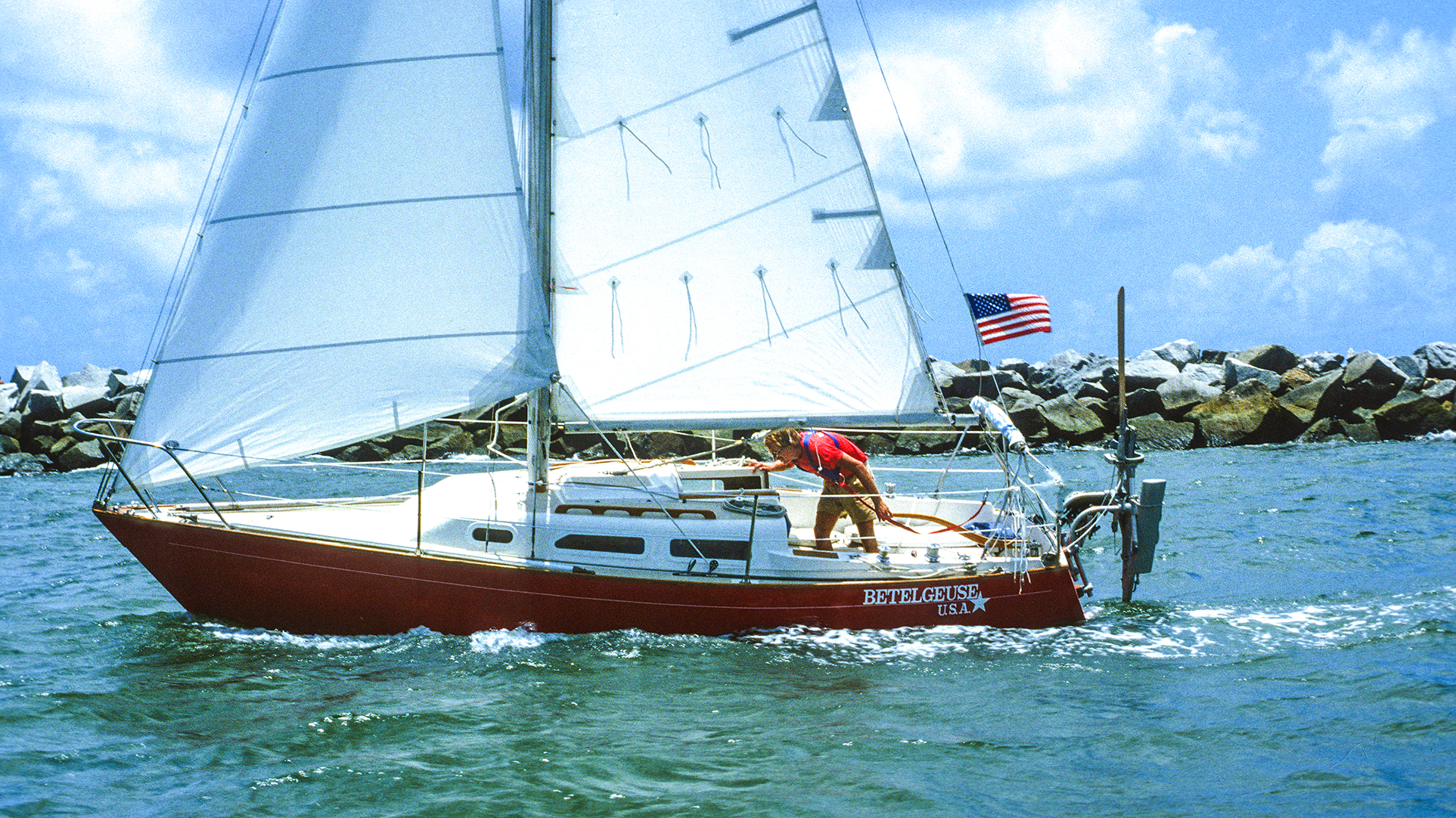
Setting sail on a singlehanded transatlantic passage in 1981, Betelgeuse my Ranger 23, departs Port Everglades in Ft. Lauderdale bound for Europe.

It is the summer of 1981 and I am crossing the Atlantic Ocean alone in my 23-foot sloop Betelgeuse.

It had been a week since I had known definitively where I was. I had been becalmed for days in the Sargasso Sea. I barely escaped disaster as a freighter on a collision course passed less than a boat length away on a moonless night. I was hungry and I was ill prepared. These were the days before GPS and I was depending–without much confidence–on celestial navigation to find my first landfall. I had never before used a sextant in real world conditions. Four legal-sized pages of scribbled calculations showed my noon sight intersecting with an earlier celestial line of position. It created an X on the chart. The black magic of celestial navigation told me I was over the Challenger Bank, some 20 miles southwest of Bermuda, a landfall surrounded by coral. How accurate was that position, I wondered? I scanned the horizon and saw nothing.

It is now the summer of 2015 and I am once again on the water over the Challenger Bank.

The circumstances are radically different this time, and yet there are some eerie similarities. I am fishing for tuna with friends in the Bermuda Flyfishing Invitational. We are with an experienced captain in a seaworthy boat but there are elements outside of our control. Wind speed is consistent at 25 knots and seas are 10 to 12 feet. The ocean swells meet the relatively shallow water of the seamount creating steep, anvil-shaped waves that that throw the sportfishing boat on its beam ends. Portuguese man-o-war and flying fish navigate the sloppy seas but there is a feeling by those of us aboard the boat that maybe human beings don’t belong out here today. A vicious squall drops down on us from the northwest and with it comes driving rain powered by gusts of 40 to 50 knots. Our anchor loses its hold and now we are drifting.

Adversity on the ocean is what attracts many of us to it. While it may seem that Divine Providence is what sees us through  difficult times, other people view it less theologically and say personal experience and even luck helps resolve challenges. I consider it a combination of all three. When I left Ft. Lauderdale at age 26 to sail alone across the ocean I was not adequately prepared for the endeavor. I survived that ocean crossing by the grace of God, by good fortune, and by a determination to learn at sea what I should have known before I set sail.

Now, as I look at this familiar water on the Challenger Bank, I think back to that day in Betelgeuse when anxiety and lack of confidence prefaced the moment of triumph that accompanies landfall. I realize now that I am on the same piece of water, on the same day of the month, at exactly the same time of the day, when I made that celestial calculation 34 years ago.

Then, as the sportfishing boat drifts wildly across the bank with a dragging anchor, the squall suddenly breaks. There is sunshine to the northeast. We crest a wave I see the faint outline of Gibbs Hill, Bermuda etched upon the horizon. It is without question–then and now–that we have been delivered by Divine Providence.