It is only with a calendar that I am reminded it has been nearly six months since my departure from Key West aboard Flying Fish. My reality now is that I have lost track of time. On the ocean, under the sun and stars, I don’t know the date or even the day of the week. This is not as frivolous or irresponsible as it might seem. It is simply a new way of living. Complete and present. It is a privilege and I am grateful.
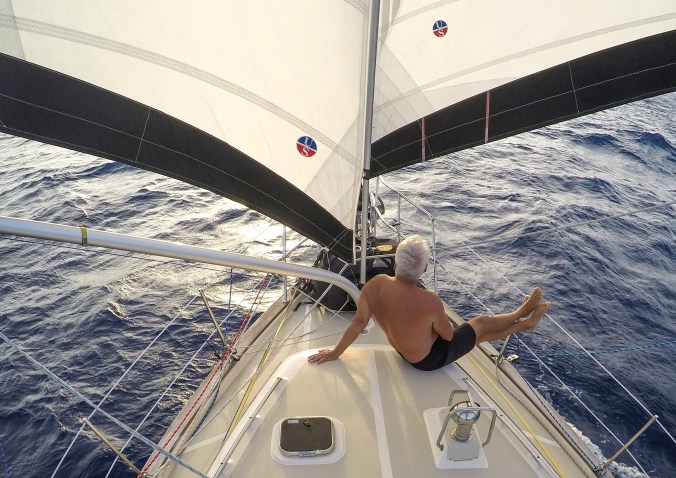
The passage of time becomes less defined on a transoceanic passage
The 4,000 miles and 24 days from Panama to Fatu Hiva, Polynesia were never counted individually. Each day blended into the next in a smooth transition determined by the celestial cycle. The sun would rise and it would set, the moon would wax and it would wane. There was none of the drama of scheduling and itineraries that can sometimes be all consuming in land-bound life. When the wind shifted we adjusted our sails.
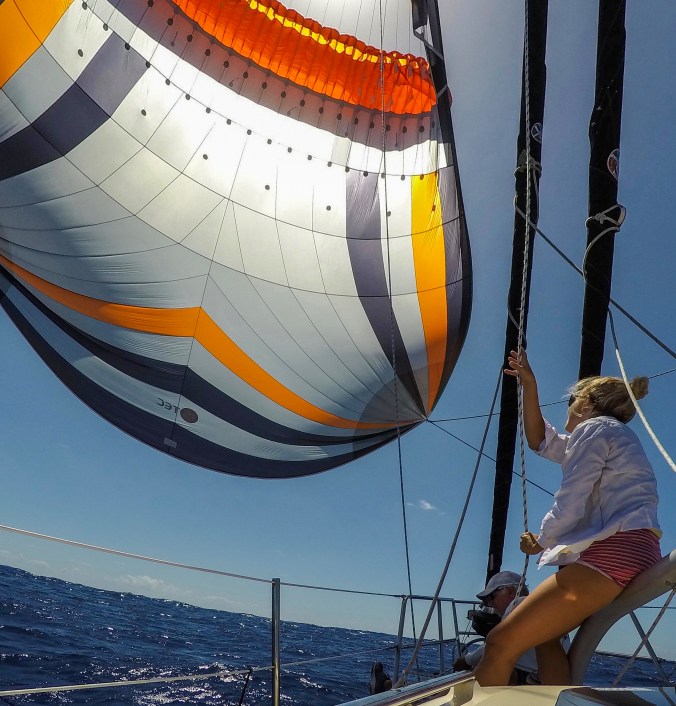
Lilly wrangles the spinnaker aboard Flying Fish on the downhill run to Fatu Hiva
I sailed with my daughter Lilly. The passage was pure tradewind sailing. The wind blew from the east and Flying Fish sailed west. After five days we passed the Galapagos to starboard. The islands have become an expensive cruise ship destination that discourages unguided visits aboard sailboats. Flying Fish continued on toward Polynesia. We confronted none of the tumultuous seas and violent storms that Flying Fish will certainly encounter later during her circumnavigation. For these 4,000 miles and 24 days Lilly and I were given the gift of tranquility at sea.
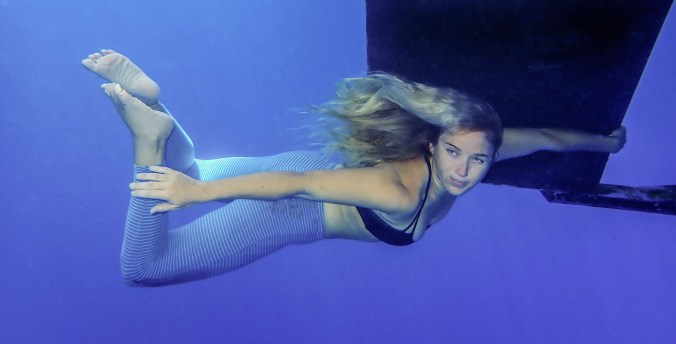
Crossing the Equator, becalmed, nearly 1,000 miles from land
Sailing with Lilly was a gift. She understands the rhythm of the wind and ocean, and their resulting dynamics on the performance of a sailboat. She is strong and determined. But there was a wide gulf of 31 years between father and daughter aboard Flying Fish, and it was exacerbated by the fact that Lilly and I live on opposites sides of the earth. The relationship between the two of us occasionally chafed like a rope against a sail: Her Dad was hard of hearing, he couldn’t see clearly, he was cognitively slow and responsively sluggish. For Lilly it was like sailing with the Old Man and the Sea–Come on already, pull the fish in and let’s go home! Still, Lilly had my back on this passage. She kept me onboard the sailboat. She made beautiful, creative meals every night. She outlined a program of exercise and yoga for us. She even tried to teach me French. I will miss the time that Lilly and I spent together crossing the Pacific Ocean.
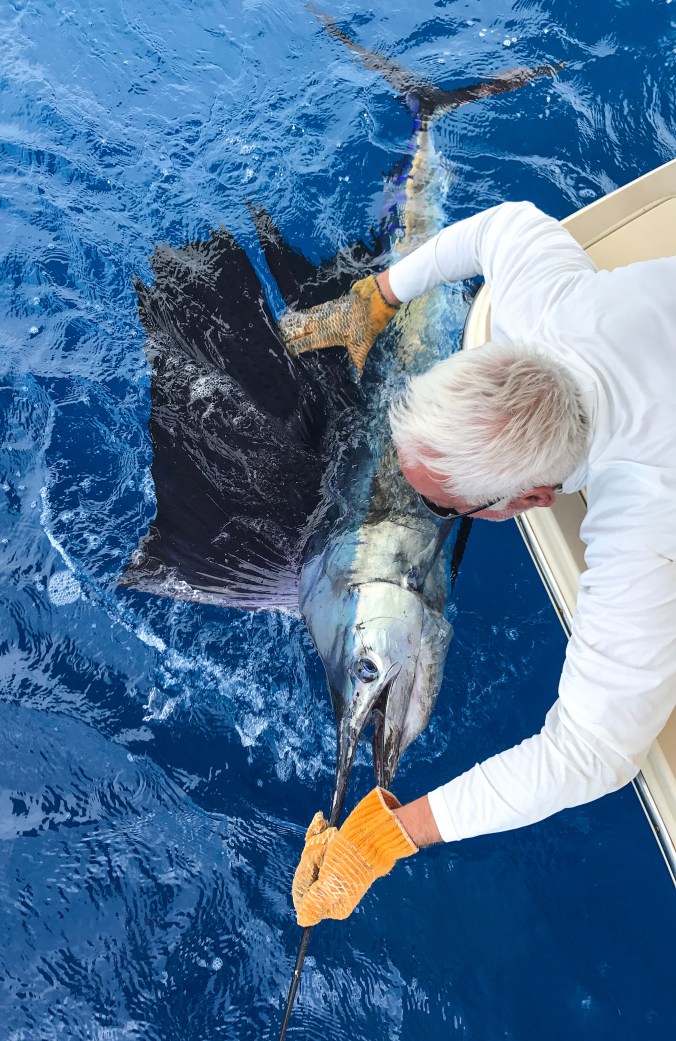
Eye to eye. This Pacific Sailfish was far too beautiful to kill for supper
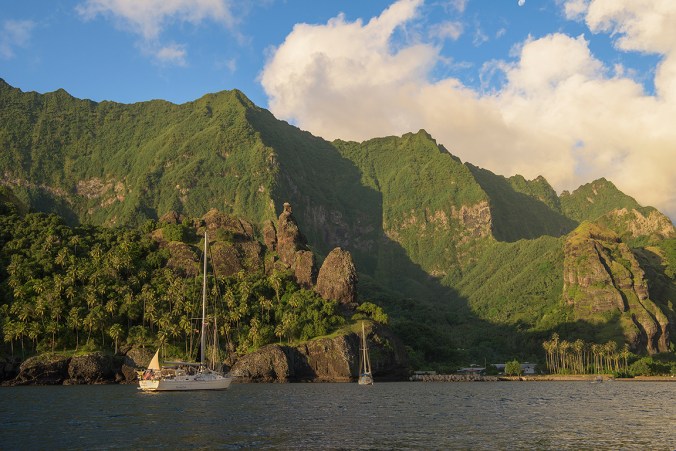
There is a wealth of riches that come from moving slowly. The feeling of wind on the back of your neck is a caress. Stars are crystalline. When a porpoise surfaces close to the boat on a calm night it is possible, literally, to breathe in the scent of her exhale. Landfall came too quickly for me at the end of this passage. It was like awakening from a good dream. But, awakening from a good dream and finding yourself in French Polynesia… that is a very fortunate reality.

Sailing the tradewinds and looking for land
NOTE: One the many wonderful things that take becoming accustom to at sea and in French Polynesia is the disconnect from Internet, email, and social media. I am overwhelmed by the outpouring of love and encouragement from those of you who follow the voyage of Flying Fish. Please understand that my lack of communication and response to your comments and correspondence does not reflect any lack of gratitude. Thank you for being here with me.
Track the passage of Flying Fish here: https://forecast.predictwind.com/tracking/display/Flyingfish



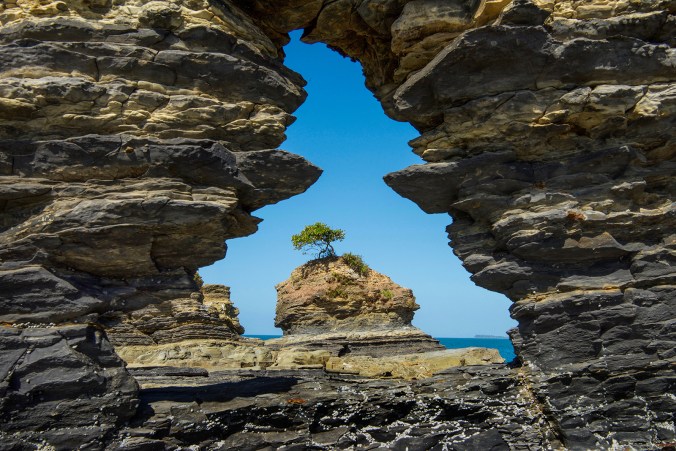


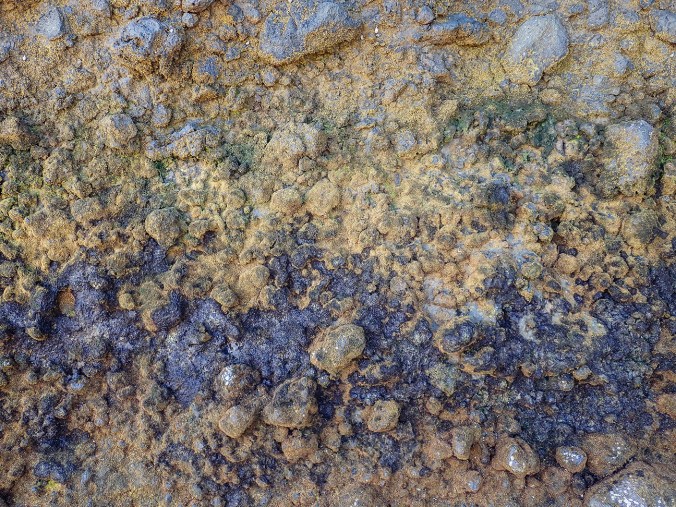 Last night was the Super Moon and it brought extraordinarily low tides to my anchorage at Isla de Fuenche. Many of the exposed rocks are ancient coral reefs that have been pushed to the surface of the ocean by tectonic forces. Geologists call it “marine sedimentary limestone,” but what I see in these rocks is fossilized proof of life. I see an imprint in a boulder where brain coral was once attached. Individual coral polyps are etched into the surface. What is now static was once alive. Millions of life forms lived right here. There were communities. Some colonies thrived while others struggled and then simply died out. The life and death recorded in these ancient coral reefs parallels the life cycle of the human beings who settled on these islands.
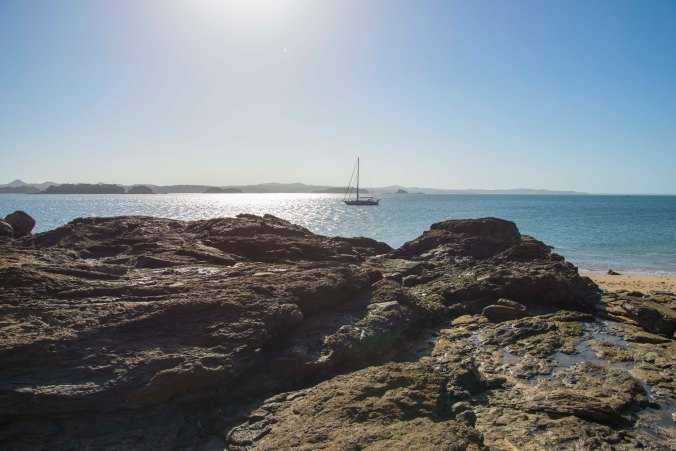 Panama is a young landmass, relatively speaking. The rise of the isthmus three million years ago was the “last big episode of global change,” according to former Smithsonian Geologist Tony Coates, who has also written that the changing shape of Panama played a significant role in ocean circulation coinciding with the last Ice Age. Three million years ago was the Pleistocene Epoch when glaciers covered huge parts of the earth. One could argue now that the melting of the glaciers are an indication of the next “big episode of global change.”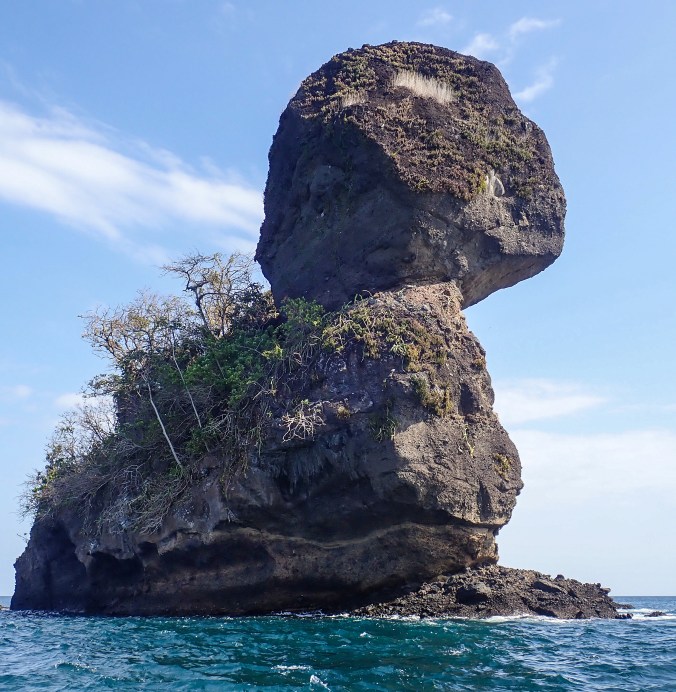
 Stella Maris Sail