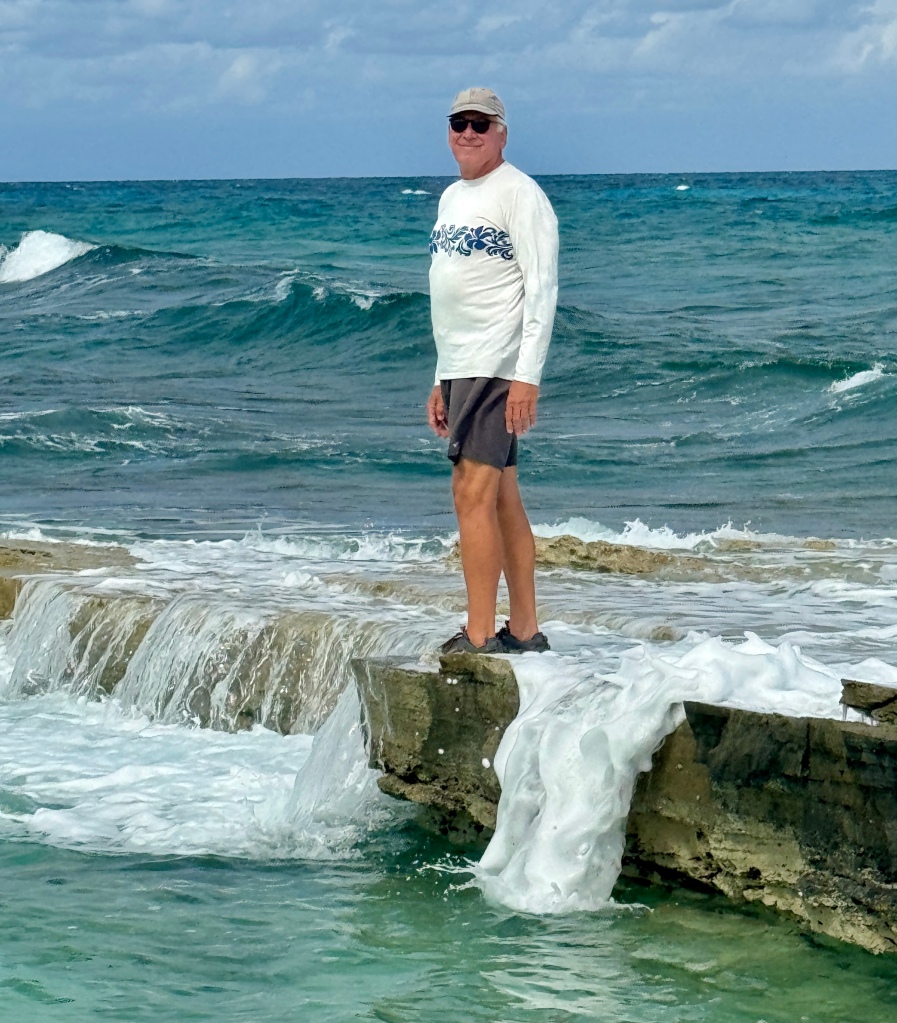
As ocean swells from a distant storm meet the iron rock shoreline, water travels under great force through a labyrinth of ancient passages in the limestone until it emerges as a fountainhead roaring with a blast of sea air.
Breathe in, breathe out… I will sleep in peace listening to this tonight.
A secluded anchorage with a hydrodynamic soundtrack. Turn up the volume…
Thanks for sailing along with Stella Maris.
As always, sailing is not just about the wind and the sea; equally important are the places, the flora, fauna, and people encountered along the way.
Please click “Follow” so that you don’t miss a new update,- and please consider sharing this post with others who might enjoy following the voyage. I welcome your comments, andI will always respond when I have an Internet connection. I will never share your personal information.
At the Moriah Harbour Cays National Park in the southern Exuma Cays, conservationists understand that not everyone wants to get wet. What is dry on these islands is as spectacular as the underwater world that surrounds them. The addition of a little human waggishness adds to the experience. On the southern tip of Stocking Island an “Art Trail” has been cut through the coppice allowing restless sailors to stretch their legs and express personal wit.
Wilson was here…
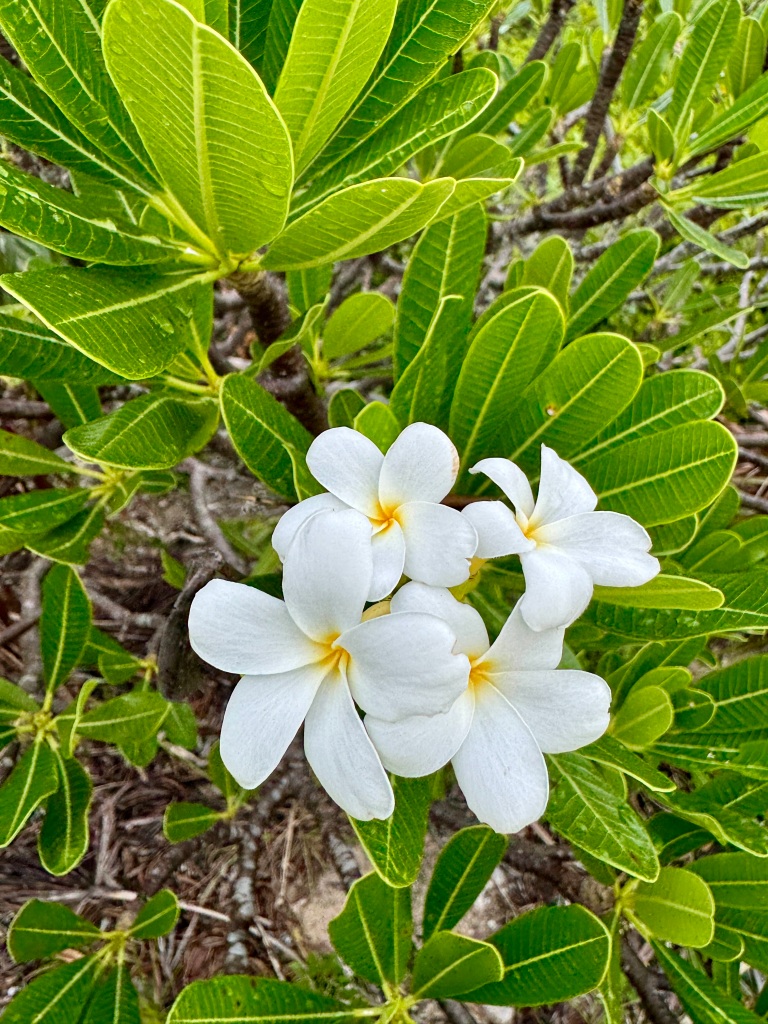
Of course, nature always has the last laugh. The natural beauty of the coppice (a Bahamian hardwood forest) is breathtaking. In the 22,833 acres of Moriah Harbour Cays National Park, trails pass through exotic palm groves. Caves are cut into calcium carbonate limestone. Lowlands are alive with American Oystercatchers and Giant White Landcrabs. An upland hiker might be startled by a Bahamian Blind Snake or an Antillean Nighthawk. And, growing so thick that it nearly shuts off sunlight, is flora that includes Drawf Frangipani, dominant stands of Bahamian Poisonwood, and wild Oncidium Orchids.
Dry land, I learned, can be a wonderland. All I need to do to experience it is step ashore once in a while.
And, at the end of the trail, there is always the sea.
Thanks for sailing along with Stella Maris.
As always, sailing is not just about the wind and the sea; equally important are the places, the flora, fauna, and people encountered along the way.
Please click “Follow” so that you don’t miss a new update,- and please consider sharing this post with others who might enjoy following the voyage. I welcome your comments, andI will always respond when I have an Internet connection. I will never share your personal information.
I am channeling Charles Darwin today as I step out of the thick Bahamian scrub and into a landlocked pool of anchialine water in Central Eleuthera known as Sweetings Pond.
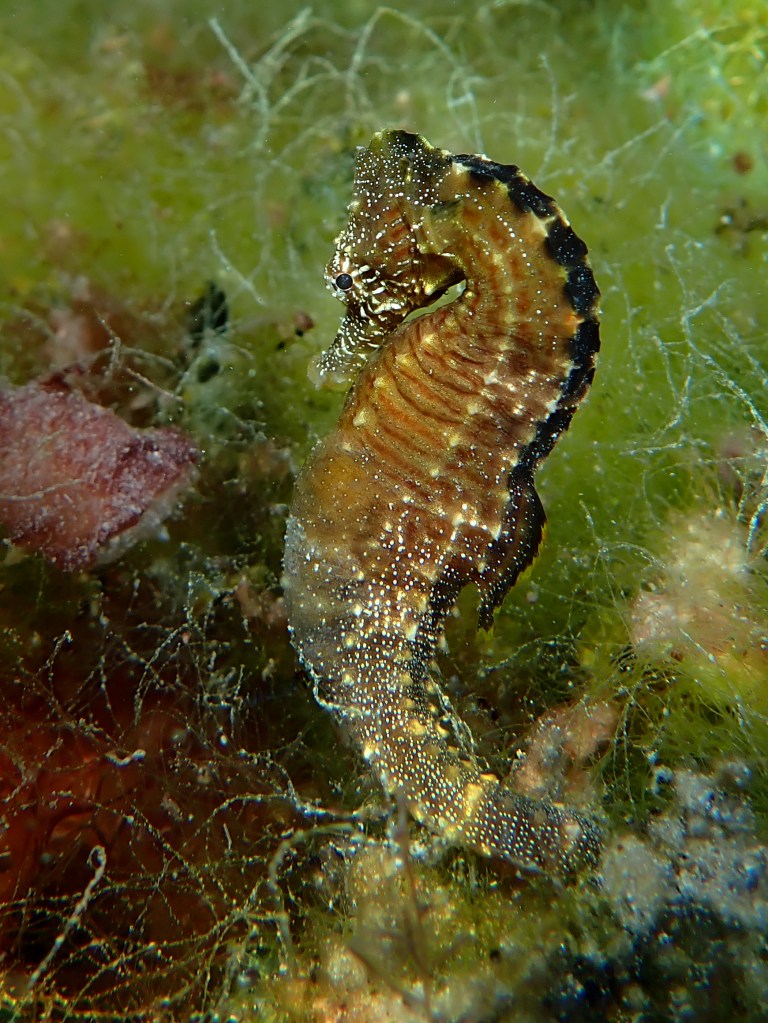
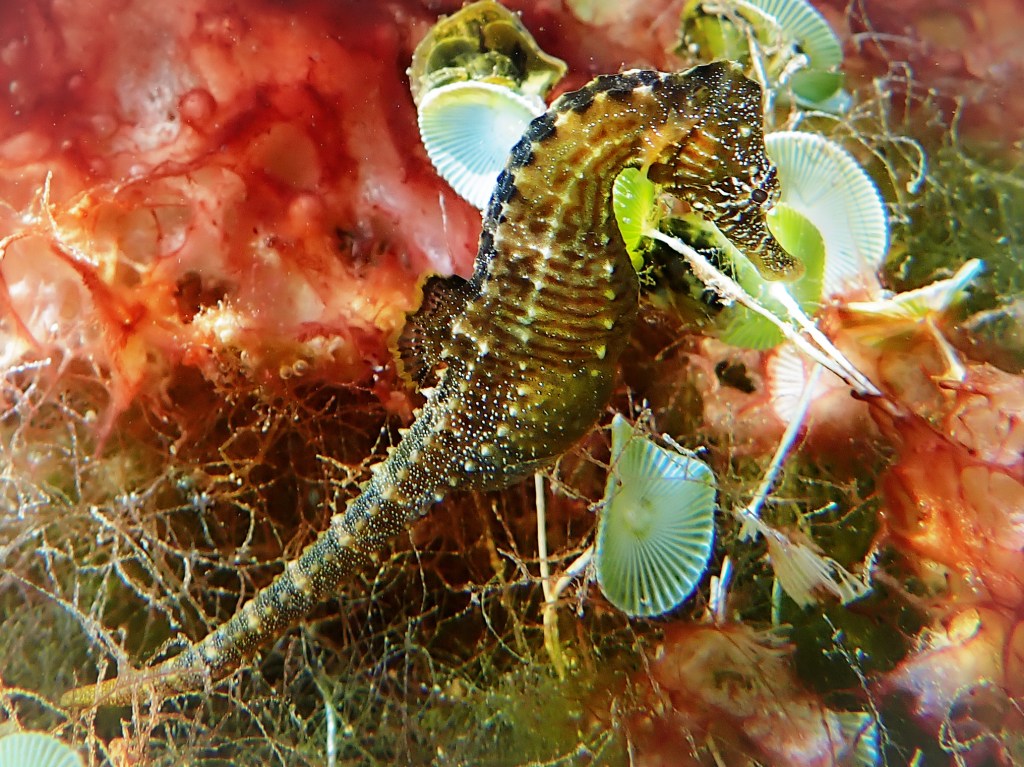
This body of water, fed from a maze of subterranean connections to the ocean, is teeming with bizarre life forms. They include the red flame scallop (which is actually a clam) that can dislodge itself from the seabed and “walk” away from predators by clapping its valves together. And then there is a gelatinous sea slug called a fringeback nudibranch with sharply serrated gill fingers and long tendrils that pulsate in shades of aquamarine. But the show-stopper is a mutated miniature lined seahorse with enough characteristics from two distinctly different types of seahorses that some marine biologists think we could be witnessing the evolution of an entirely new species.
Protecting the 500-acre Sweetings Pond with its unique biodiversity has been a quiet mission for conservationists. Until recently, researchers and locals managed to keep its location a secret. In its anonymity, the pond faced no immediate danger. However, the rampant development of resorts and marinas in the Bahamas, as well as other threats including agricultural runoff and poaching has encouraged marine researchers and governmental organizations like the Bahamas National Trust to push for the preservation of this rare habitat.
One of those researchers, Dr. Heather Masonjones from the University of Tampa, has been studying the seahorse population in Sweetings Pond for over five years. In an interview with BBC Wildlife magazine, she said that the pond may have one of the most densely populated seahorse communities anywhere on Earth. She hopes the protection of the pond brings sustainable tourism that will educate people about seahorses and contribute to improving their conservation worldwide. “If we don’t take action it could be lost forever.”
Several weeks ago, the Bahamian government formally designated Sweetings Pond as its newest National Park. “The declaration of Seahorse National Park is more than just a designation,” said Lakeshia Anderson-Rolle, Executive Director of Bahamas National Trust. “It is our shared promise to our community, to future generations, and to the world that we are committed to conserving our unique and diverse ecosystems.”
As always, sailing is not just about the wind and the sea; equally important are the places, the flora, fauna, and people encountered along the way.
Please click “Follow” so that you don’t miss a new update,- and please consider sharing this post with others who might enjoy following the voyage. I welcome your comments, andI will always respond when I have an Internet connection. I will never share your personal information.
In the Bahamas, it is often about what’s for dinner. Conch fritters, conch salad, conch chowder, cracked conch.
But today, near a nursery of wild baby conch, we swim among the queens and there are no thoughts of putting them on a supper plate. Seeing these threatened creatures thrive in a natural environment of crystal-clear water is reassuring.
A queen conch in full camouflage“You lookin’ at me?”
Queen conch had been collected at a sustainable level by local subsistence fishers for centuries. But beginning in the 1970s, according to research by the Shedd Aquarium, increasing commercial fishing has caused conch populations to decline or collapse in much of the species’ range, including the Bahamas.
If the conch fishery collapses, it could put more than 9,000 Bahamian fishers—two percent of the country’s small population—out of work, according to a National Geographic report. Nearly all exported Bahamian conch meat is shipped to the U.S. In 2015, about 400 metric tons of conch were caught in the Bahamas, and about half of that was exported to the U.S., which prohibited the taking of conch in the mid-1980s.
A limit of six queen conch in possession aboard a foreign-registered vessel is the limit in the Bahamas. That is a privilege. Queen conch is a delicacy.
But today, in Eluthera, they look better to me alive than they would in a frying pan.
The next generation of queen conch
Thanks for sailing along with Stella Maris.
As always, sailing is not just about the wind and the sea; equally important are the places, the flora, fauna, and people encountered along the way.
Please click “Follow” so that you don’t miss a new update,- and please consider sharing this post with others who might enjoy following the voyage. I welcome your comments, andI will always respond when I have an Internet connection. I will never share your personal information.
Is this thing–this UFO–really even a sailboat? Tonight she is.
All weather forecasting models show that by morning we will have a strong northerly blast of 30-knot winds and 12-foot seas funneling into wedding-cake seas against a 2.5-knot current. They will be hellish conditions in which to cross the Gulfstream.
The good news is that morning is 12 hours away and we are on a fast broad reach. If Stella Maris continues to move like the scalded cat that she is, we will be in the safe harbor of Bimini for the duration of this blow.
Stella Maris, a Lagoon 42 catamaran, is a different animal compared to Flying Fish, the Island Packet 46 monohull that I sailed around the world. If the Island Packet is a boat that can sail through any weather anywhere in the world, the Lagoon is more akin to a beach cabin with a stick and a sail. I sold the Island Packet because my world voyage had come to an end, and I bought the Lagoon because it is a far more family-friendly sailboat. Tonight I have family aboard; my brother Bob is sailing with me.
This is a sea change in my sailing life. I am learning that extreme adventure is not necessarily a requirement for a fulfilled life. Now at age 67, I don’t feel the need to cheat death to feel alive. The catamaran is perfect for that. It can take me to foreign places comfortably and still pump just the right amount of adrenaline into my bloodstream.
On the forecasting map tonight the heavy weather continues to rumble southward as we sail north and east toward the Bahama Bank. Sailing at eight knots, we reef the mainsail as the wind increases and Stella Maris skims across the building seas.
“It’s a good boat,” Bob says. I am also warming up to her. A full moon lights our passage. We will beat the weather into Bimini. I am grateful to be underway again, and who knows where this new boat will take me.
Night watch aboard Stella Maris as she crosses the Gulfsteam. Video credit: Bob Cardenas
Thanks for sailing along with Stella Maris.
As always, sailing is not just about the wind and the sea; equally important are the places, the flora, fauna, and people encountered along the way.
Please click “Follow” at the bottom of this page so that you don’t miss a new update,- and please consider sharing this post with others who might enjoy following the voyage. I welcome your comments, andI will always respond when I have an Internet connection. I will never share your personal information.








 Stella Maris Sail