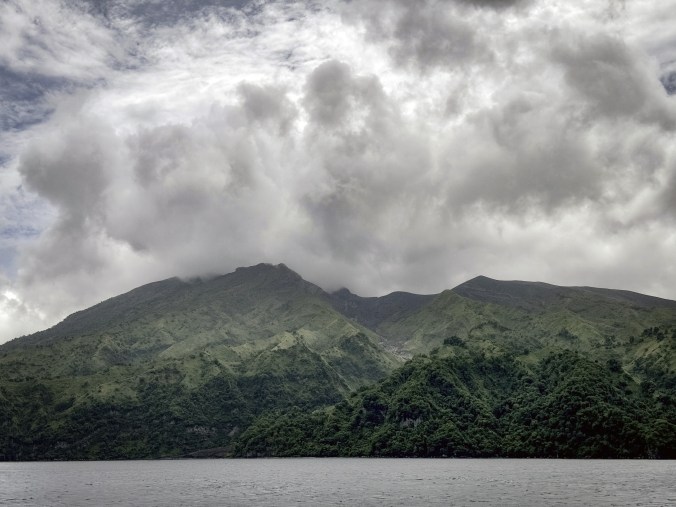
The crater of St. Vincent’s La Soufrière, which erupted in 2021
This lovely coastline of Wallibou, in northwest St. Vincent, has suffered greatly in recent years from both man and nature.
Three years ago, the still-active volcano La Soufrière erupted with a devastating blast that displaced 16,000 residents. Smoke and ash covered the island and closed airspace as far away as Barbados.
Then, only several months ago, the sailing catamaran Simplicity was discovered abandoned here with “copious amounts of blood” covering the interior. Police said the American-owned sailboat was hijacked in nearby Grenada by three West Indian assailants and brought to Wallibou. The bodies of Kathy Brandel, 71, and Ralph Hendry, 66, were never found.
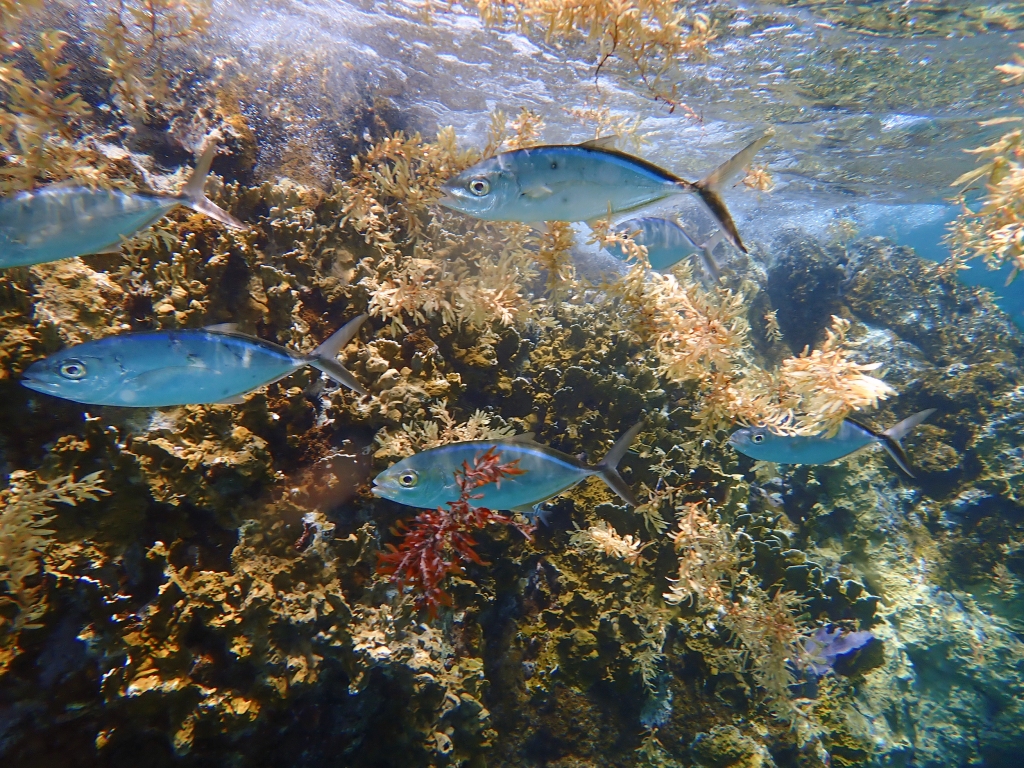
Life continues despite the tragedies here. When I arrived in the Chateaubeliar village yesterday, a fisherman in a rowboat dropped off three avocados as a welcoming gift. Ashore, boys fished with handlines for jack mackerel from the rebuilt village pier. And at midnight, I was awakened by the local church’s gospel singing.
I could have avoided this small fishing village along Wallibou’s coastline. Guidebooks recommend caution, and not many sailboats anchor here anymore. Instead, my visit to Chateaubeliar gave me a lesson in the power of perseverance and hope.
As always, sailing is not just about the wind and the sea; the places, the flora, fauna, and people encountered along the way are equally important.
Please click “Follow” so you don’t miss a new update, and please consider sharing this post with others who might enjoy connecting with the voyage. I welcome your commentsandwill always respond when I have an Internet connection. I will never share your personal information.
An additional website, www.JeffreyCardenas.com, features hundreds of fine art images—underwater, maritime landscapes, boats, and mid-ocean sailing photography–from exotic locations worldwide.
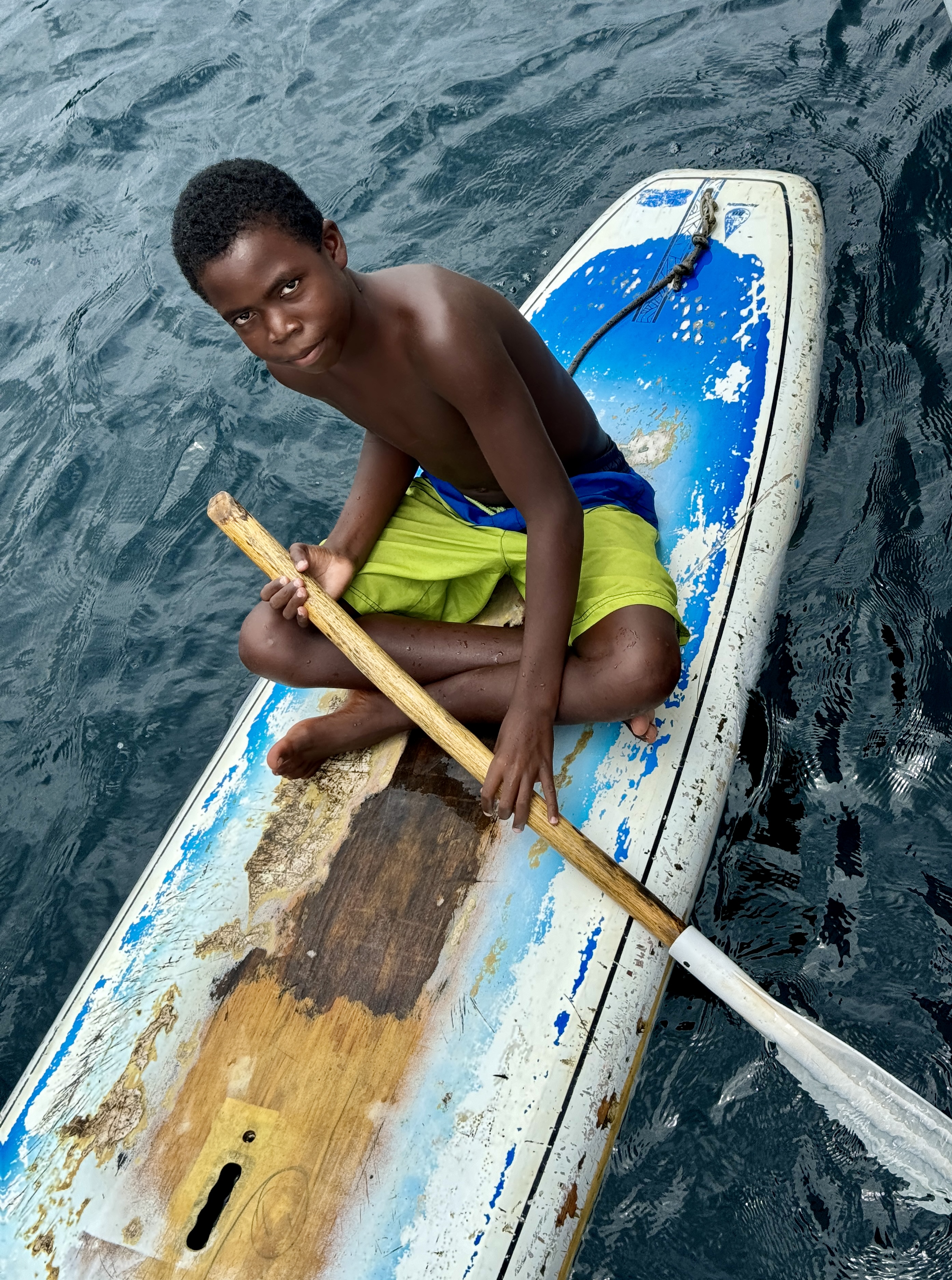
Meet Ike Albert, unofficial yacht ambassador, accomplished net fisherman, and grassroots conservationist. He’s 15 years old.
When foreign-flagged boats arrive in Saint Lucia’s Anse Cochon, Ike is there quickly in his tiny yellow kayak to assist with mooring lines or anchoring help. He will bring mangoes and avocados and freshly baked bread. Unlike other boat boys who aggressively swarm new arrivals with demands for beer and money, Ike knows that a soft sell is more effective.
“Welcome,” he says. “Tell me how I can help you.
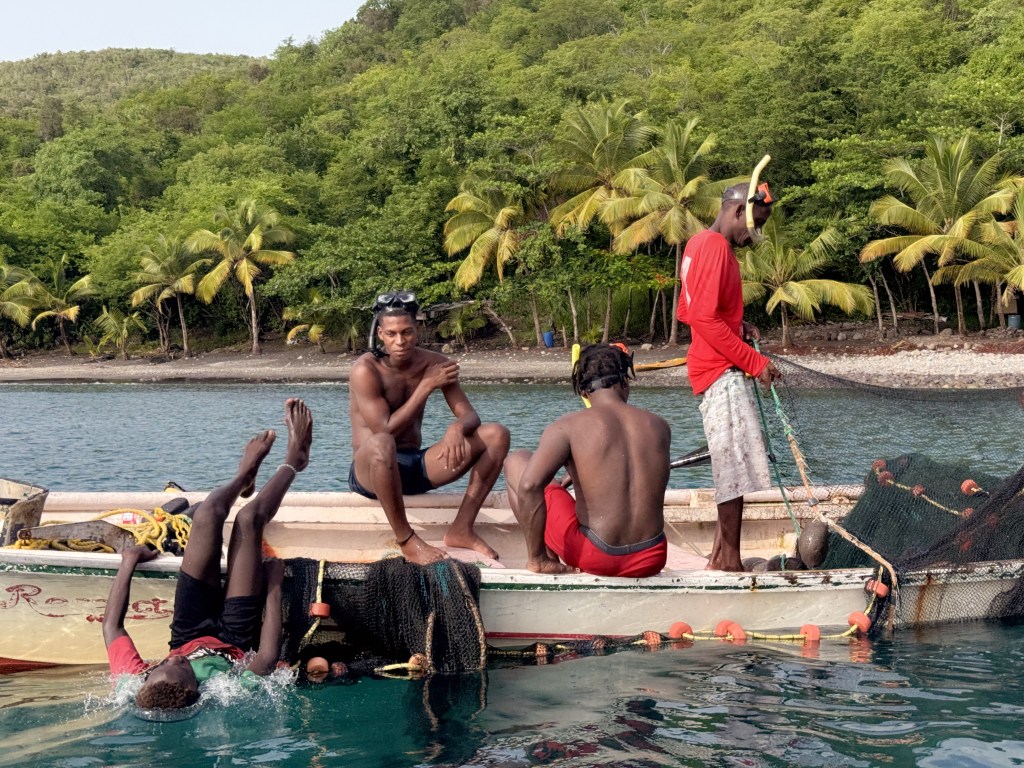
Ike lives in a nearby fishing village called Canaries. On this day, when his family’s relatives arrive in Anse Cochon to fish from a small wooden net boat called Respect, Ike dives in to help. He is the point man pulling the rope of a net that is weighted with boulders. Several hundred feet of net are set to catch sardines, small jackfish, and ballyhoo. This fishing uses no winches or pulleys; it is an art of pure manual labor.
An hour later, when the net is finally at the boat side, it reveals a subsistence catch. The family is delighted. They will eat fresh fish tonight, and maybe have a little extra to sell in the market.
Afterward, covered in fish scales and sweat, Ike climbs back onto his kayak. But before he embarks on the long paddle home to Canaries, he dives back into the water and surfaces with an armful of empty beer bottles, Coke cans, and plastic bags thrown into the water by day trippers on the tourist catamarans.
“The people on these tourist boats think that when they throw garbage into the water, it just goes away.”
As always, sailing is not just about the wind and the sea; the places, the flora, fauna, and people encountered along the way are equally important.
Please click “Follow” so that you don’t miss a new update,- and please consider sharing this post with others who might enjoy following the voyage. I welcome your commentsandwill always respond when I have an Internet connection. I will never share your personal information.
StellaMarisSail.com has spawned a new website: www.JeffreyCardenas.com. This site, Jeffrey Cardenas Photography, features hundreds of fine art images — Underwater, Maritime Landscapes, Boats, and Mid-Ocean Sailing photography from exotic locations worldwide.
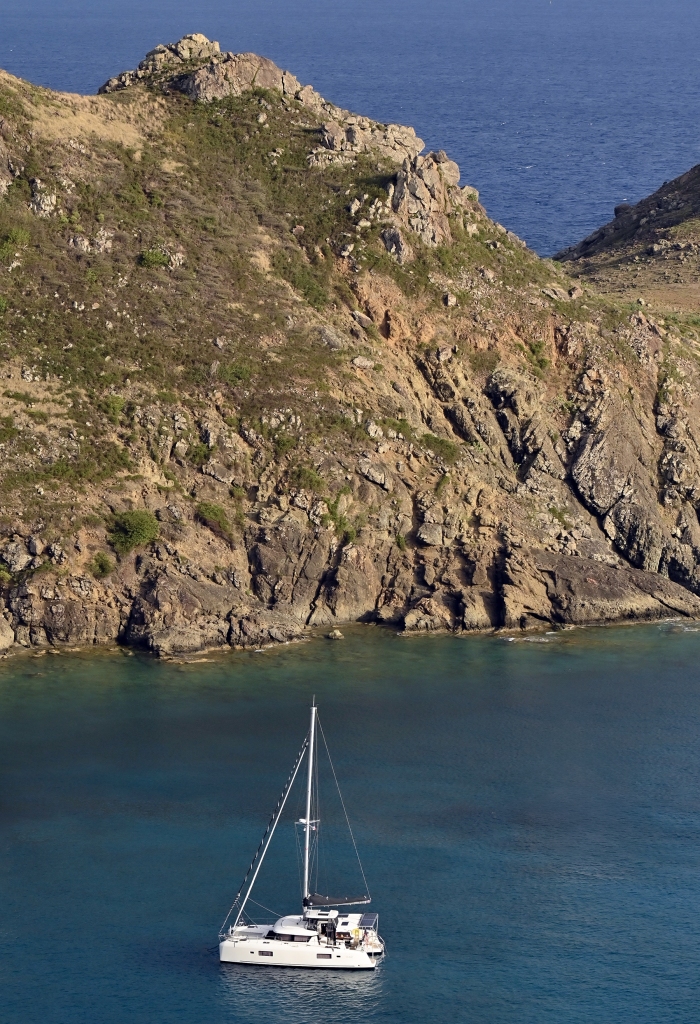
Stella Maris is anchored at Île Fourchue, an uninhabited rock near Saint-Barthélemy, and the only celebrity in sight is an elegant tropicbird flying in graceful pirouettes above the sailboat.
As a gentle swell rolls in from the Caribbean Sea, I reflect on disparity in nature, including human nature. Life is more polarized than I remember it being: wealth and poverty, feast and famine, politics, Israel, Palestine, Ukraine, Russia. Common sense tells me it has always been this way. It just feels different now. The nature of a place like Île Fourchue helps put these contrasts into perspective. It is also a balm in troubling times.
Île Fourchue can only be reached by boat. There are no airstrips, roads, homes, or hotels. I am spending a week at anchor in what was once the caldera of an ancient volcano. The island is now part of the Réserve Naturelle. The other St. Barth, the St Barth of the Kardashians, is just over the horizon. Île Fourchue is a world apart.
A few other boats, primarily day-trippers, come and go in this small bay. When they leave, during that magic time at the end of the day when the light becomes soft, I roam freely across the empty hillsides of Île Fourchue and it becomes a place of my own. I feel the nature around me. I am included.
Another man who sought the solitude of Île Fourchue was named Balthazar Biguard, an immigrant from Marseilles fleeing the French Revolution. Not much is known about Monsieur Biguard except that the island of Saint-Barthélemy was not the refuge he hoped it would be. He fled St. Barth to live with the birds and the cactus on Île Fourchue. Balthazar Biguard is the only human known to have lived on this island. After what must have been a hard-scrabble life here, he died in 1827 at the age of 85. His remains are unmarked.
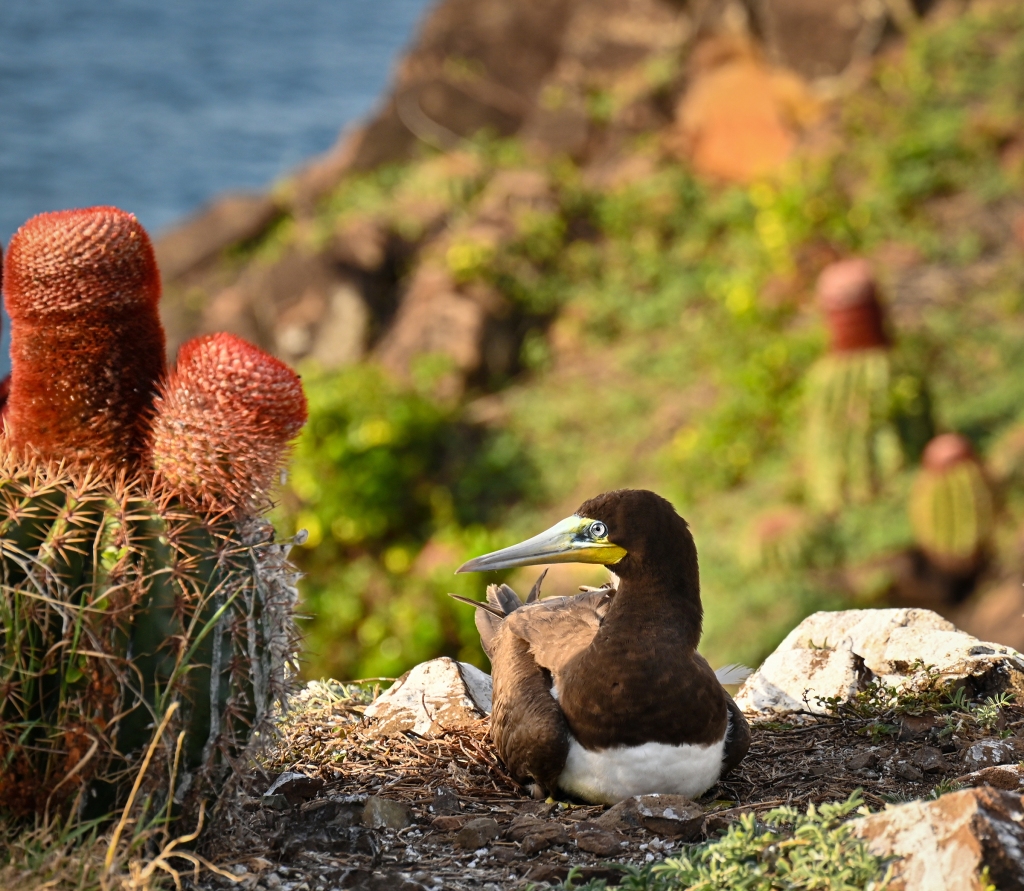
Today, the only inhabitants of Île Fourchue are its flora and fauna. Among those with feathers are the handsome ground-nesting brown boobies that oil and comb their plumage with a serrated toenail called a preen-claw. The boobies are spectacular divers, plunging into the ocean at high speed to capture swimming prey. They also pursue flying fish in the air. The brown boobies regurgitate what they catch into the mouths of their chicks, perpetuating the life cycle in what is one of the most important breeding sites of the Caribbean.
Glamorous red-billed tropicbirds share the cliffside roosts of Île Fourchue. They communicate with a melodious chitter as they spiral in the thermals above the rock. These tropicbirds mature to the size of a common gull, but most adults have tail streamers that are two times their body length. Some ornithologists describe the streamers as sexual ornaments. I get it. This beautiful flier spends most of its life in the air because it cannot stand on land. Tropicbirds require an unobstructed launching pad to take flight.
Taxonomy is usually too tedious to include in casual conversation. Still, the scientific name for the tropicbird—Phaethon aethereus—deserves mention: Phaethon is derived from the Ancient Greek meaning “sun,” while the species name comes from the Latin aetherius meaning “heavenly.”
Heavenly Sun. Who says there is no romanticism in science?
Goats once roamed Île Fourchue, but like their human neighbors in the cafes of St. Barth, they were conspicuous consumers. They devoured everything on the island, leaving it a wasteland. Conservationists finally took notice a couple of decades ago, and when the goats were “banished,” wild grasses returned. Île Fourchue was given new life.
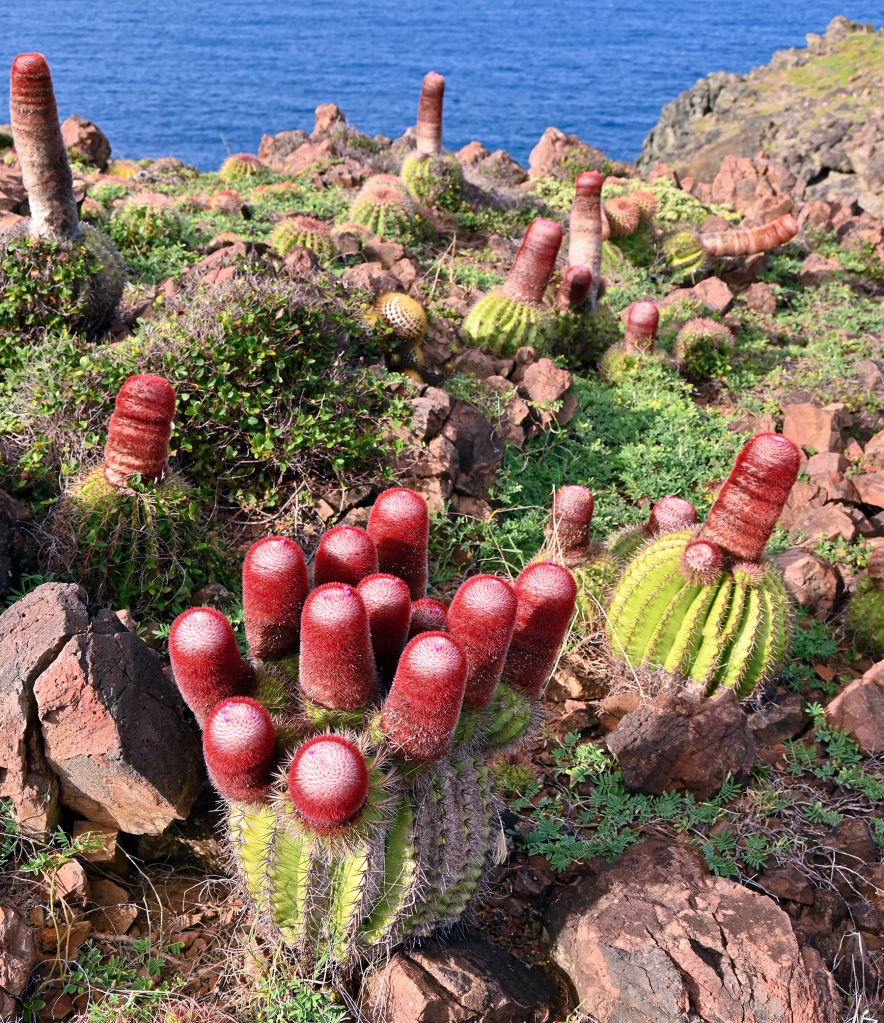
Once the fauna was under control on Île Fourchue, the indigenous flora rooted in volcanic rock flourished. Sweeping grass meadows provide fertile soil for the most stunning wild cactus gardens imaginable. Hundreds, possibly thousands, of cacti thrive on the island. This genus of Melocactus has over 30 species with fun common names such as Turks Cap, Pope’s Head, Devil’s Head, Mother-in-Law’s Pincushion, and Horse Crippler. The tourism website AntiguaNice.com calls it the most “grotesque cactus with the wickedest of spines,” but I think it is one of the most beautiful plants I have ever seen. Those “wickedest of spines” on the cactus barrel give way to a mass of areoles growing distinctive round caps resembling a Turkish fez. Tiny hot pink fruit that looks like spicy chili peppers adorn the cap like jewels.
But even in paradise, nothing is perfect (thanks to that guy and his girlfriend who snacked on an apple in the Garden). As I climb along the edge of a cliff, I watch a large iguana–the only one I have seen during a week here–stalking the nest of a brown booby. It will likely eat the hatchling when the parent leaves the nest to find food. On another cliff face, a frigatebird engaged in kleptoparasitism (food stealing) hassles an unfledged booby chick and forces it over the rocks and into the sea. Boobies, in turn, have been observed stealing prey from frigatebirds as they transfer food to their young.
I come to no life-changing conclusions during my week at Île Fourchue. There will always be beauty and conflict in nature, just as there is in human nature. Some things we can change, and other things like politics and war leave most of us powerless. Nature helps me understand that while we don’t have to acquiesce, we do need to adapt. While the beautiful people an island away dance to Nero’s fiddle, I will adapt to the song of nature on Île Fourchue.
As always, sailing is not just about the wind and the sea; the places, the flora, fauna, and people encountered along the way are equally important.
Please click “Follow” so that you don’t miss a new update,- and please consider sharing this post with others who might enjoy following the voyage. I welcome your commentsandwill always respond when I have an Internet connection. I will never share your personal information.
StellaMarisSail.com has spawned a new website: www.JeffreyCardenas.com. This site, Jeffrey Cardenas Photography, features hundreds of fine art images — Underwater, Maritime Landscapes, Boats, and Mid-Ocean Sailing photography from exotic locations worldwide.
“Fire coral will be the last remaining living coral on earth.”
I remember writing those words once, in a bluster of prophetic arrogance. That’s not exactly the most positive Earth Day message to consider as I dive this week on a shallow reef in the French West Indies at Île Fourchue, Saint Barthélemy.
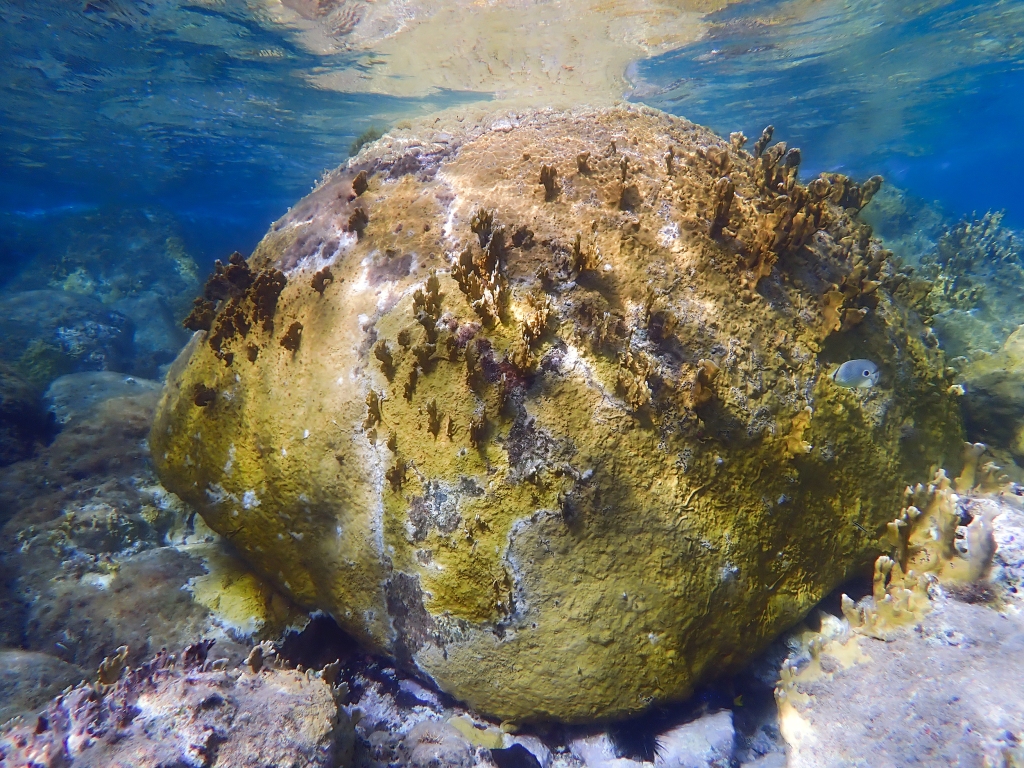
First of all, fire coral is not even a true coral. Instead, it is more closely related to hydra, a very small predatory animal similar to jellyfish and other stinging anemones. But, for the sake of consistency, I will still refer to it as fire coral.
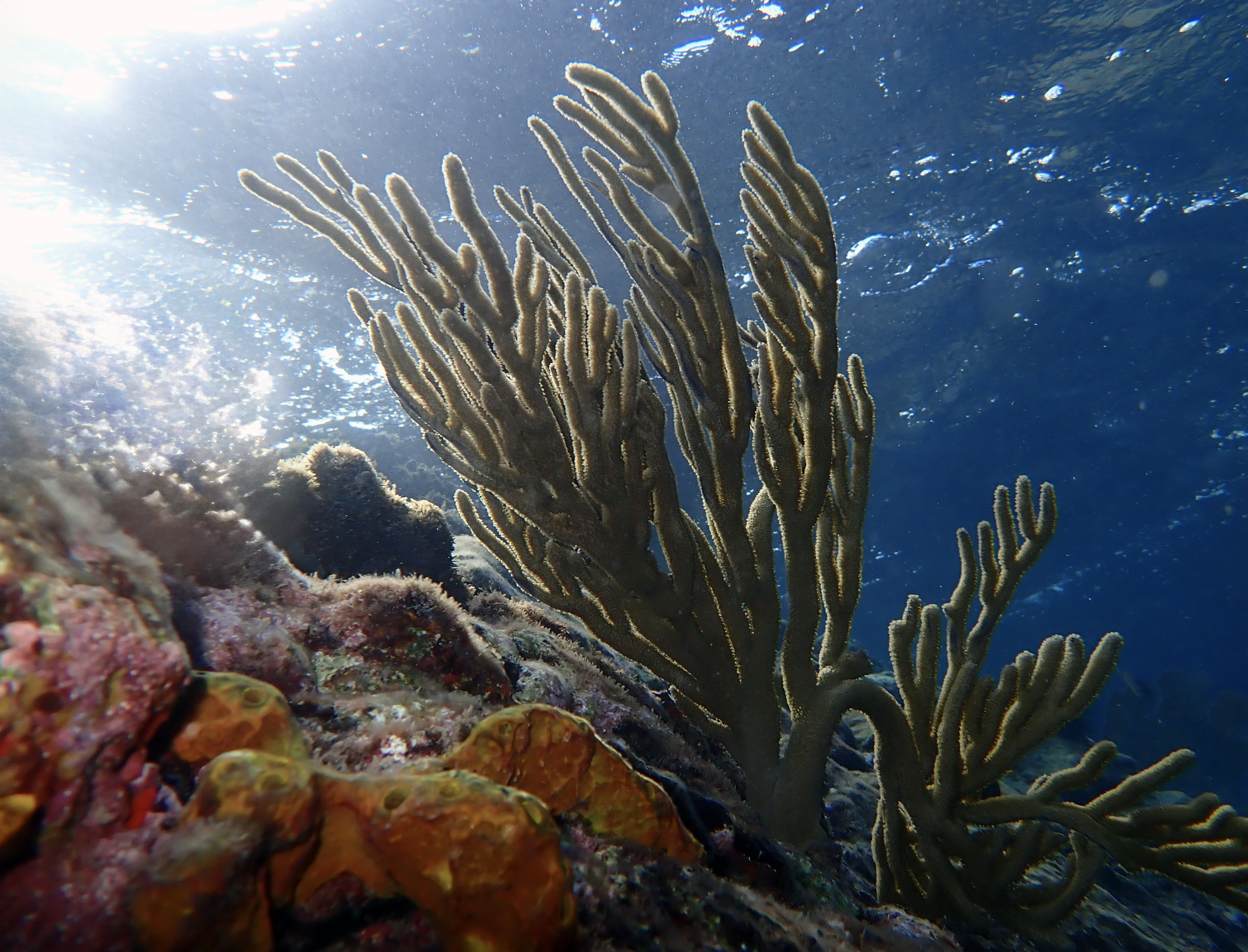
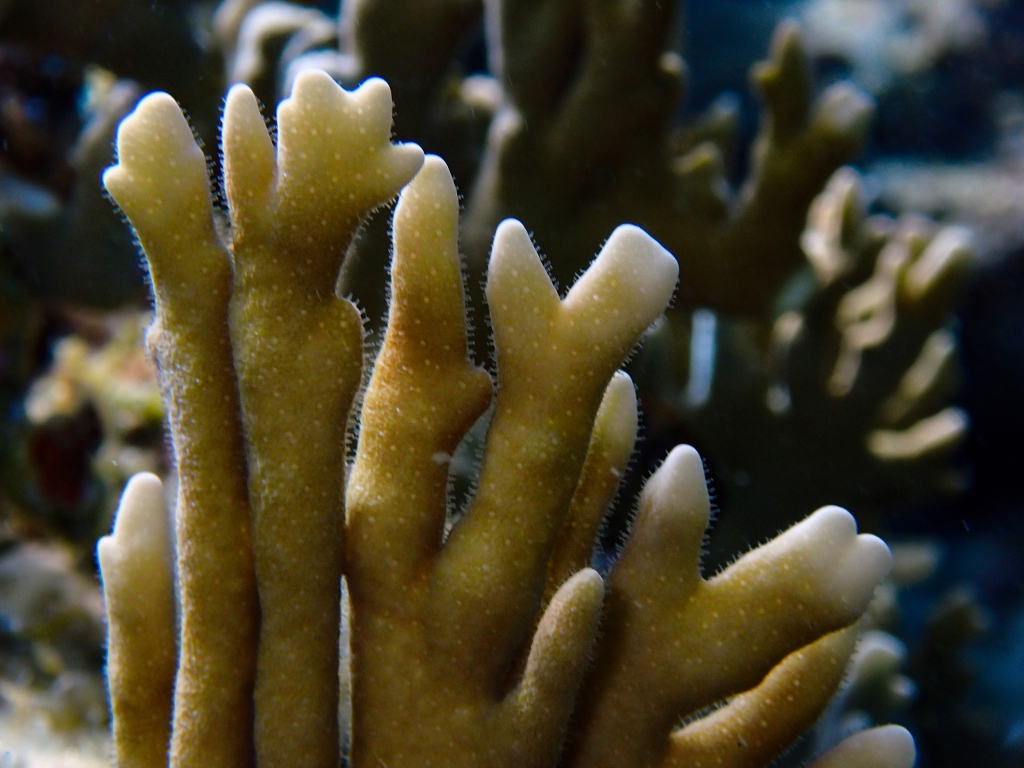
Fire coral can be either blade-like or encrusting. It is colored a mustard-yellow to dark orange, often with white edges. It has strong stinging cells that on contact cause intense pain lasting from two days to two weeks. Relapses of inflammation, itching, and welts are common. Fire coral releases venom through tiny hairs called cilia. It is their only defense mechanism against predators, including thoughtless human beings. Do not touch it, or any coral.
Because fire coral has the unusual ability to grow in two different forms, some marine biologists believe it has a survival edge over other Caribbean corals. It can grow like a bush with a stem and branches sprouting upward, or in sheets that appear as a flat coating across rocks and other surfaces.
“Fire corals have been around for millions of years and what they are doing is pretty darn successful,” says California State University marine biologist Peter Edmunds. For the past 30 years, he has been traveling to the Caribbean to document the life history of fire coral on inshore reefs.
“They are now poised to be… the inheritors of the reef, while other corals, particularly stony corals, die back,” he said. ”When it’s not stormy, they can produce branches and exploit the light and plankton in the water. When it’s storming and everybody gets beaten up, it loses its branches but it still has its sheets, which it can use to spread out and claim more territory.”
Researchers believe this adaptation may help save Caribbean reefs, which have been plagued by hurricanes, global warming, disease, and an overabundance of algae. Because fire corals are thriving as other corals die off, they are creating structures for fish and other organisms. Fire corals “are going to be very important habitat providers because they are able to survive under these stresses,” says Colleen Bove, a marine ecologist at Boston University.
But fire coral is not bulletproof. Some species have brittle skeletons that can easily be broken during storms, by anchors, or by careless divers and collectors who are taking fish for the aquarium trade. I watched blueheaded wrasse spawn over fire coral. Rock beauties, butterfly fish, yellow tangs, and the aggressive beau gregory retreat into branches of fire coral when threatened. In Brazil, fire coral colonies are extensively damaged by divers harvesting yellowtail damselfish. The fire coral is deliberately smashed and the fish hiding among the branches are captured in plastic bags.
Reproduction in fire corals is more complex than in other reef-building corals. The polyps reproduce asexually, producing the jellyfish-like medusae. These contain the reproductive organs that release eggs and sperm into the water. Fertilized eggs develop into free-swimming larvae that will eventually settle on the substrate and form new colonies.
Most divers wouldn’t mind seeing less fire coral on the reef, but I like to think of fire coral as a tactile warning to tread more carefully underwater. When the alternative may be a reef of dead rock, the sting of fire coral is a potent reminder that there is still life on that reef. And, it is one of the few ways the habitat has of fighting back.
As always, sailing is not just about the wind and the sea; the places, the flora, fauna, and people encountered along the way are equally important.
Please click “Follow” so that you don’t miss a new update,- and please consider sharing this post with others who might enjoy following the voyage. I welcome your commentsandwill always respond when I have an Internet connection. I will never share your personal information.
It seems like another lifetime ago that I was obsessed with this fish.
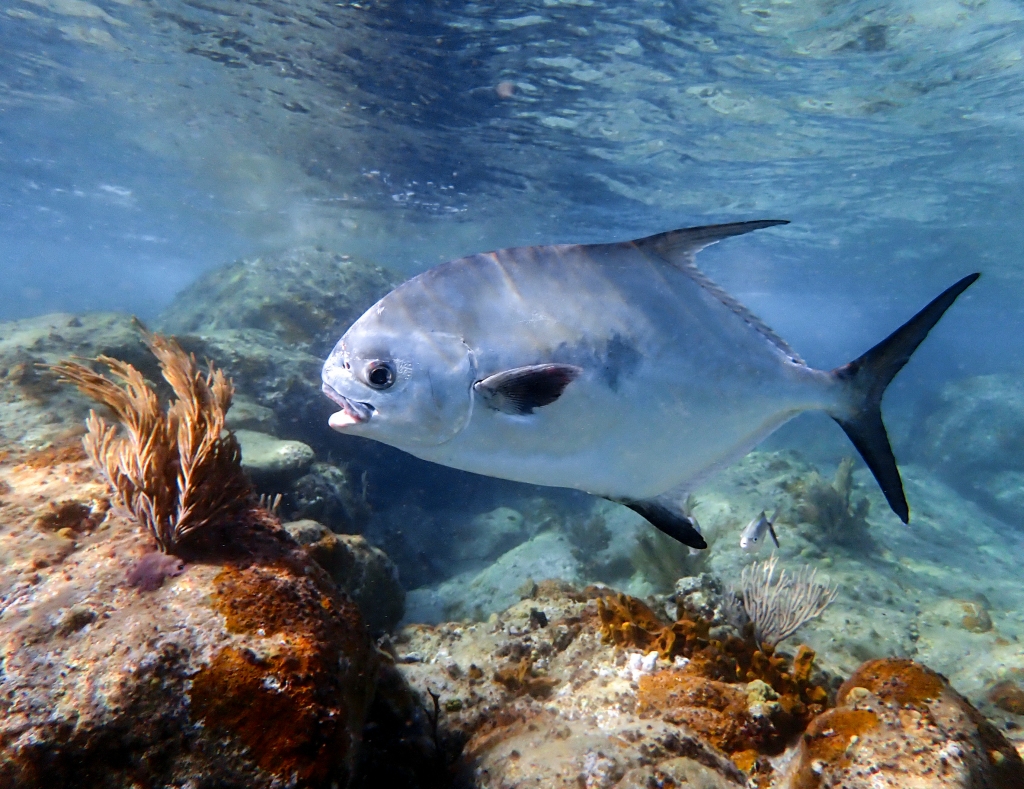
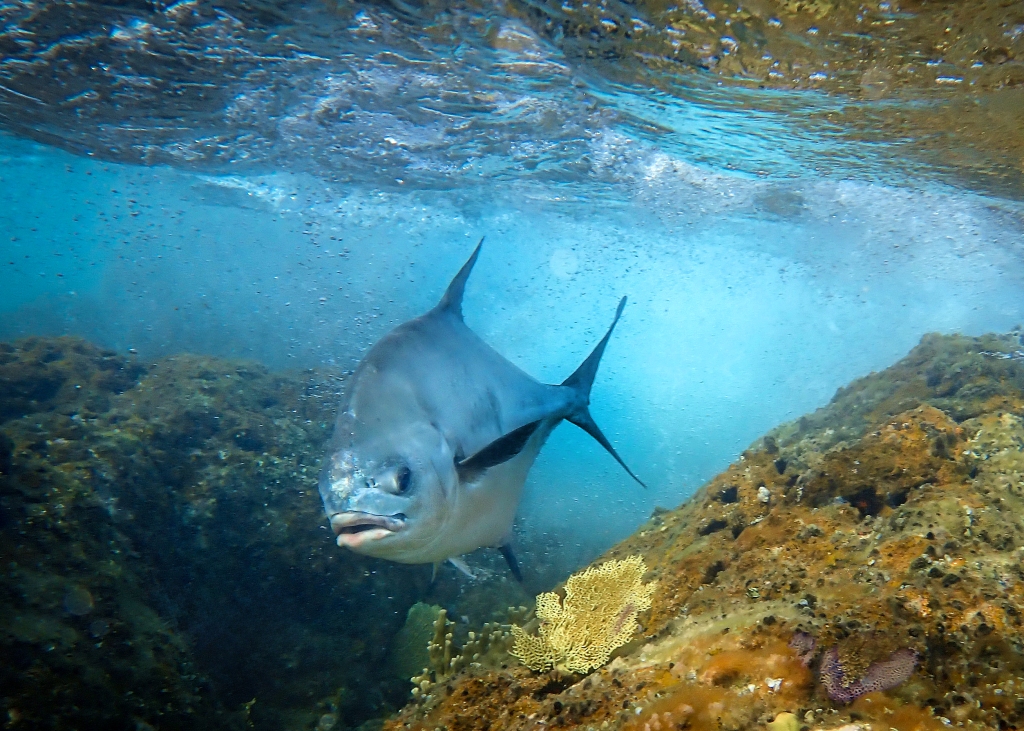
This fish is a permit, for those who may not know. For those of you who do know permit, you probably understand my obsession. It is regarded as the most challenging fish to catch on a fly rod. Some saltwater fly fishermen consider catching a permit in shallow water a lifetime achievement. Just look at that eye; it sees everything and quickly senses danger. It’s spooky; it perceives movement above and below the surface of the water. A permit often vanishes before an angler even sees it.
I was a fly fishing guide for several decades in my youth. Serious saltwater anglers made pilgrimages to my home waters of Key West each year for an opportunity to catch a permit. I hunted these fish all day, nearly every day, for years. Some days the results were heroic. Other days ended in humiliation. Many anglers fished for a week, never made contact, and went home in despair.
A few years ago, I traded my skiff for a sailboat, I migrated from shallow water to blue water, and I exchanged my fly boxes for a locker full of charts to navigate around the world. I don’t fish for permit anymore–it’s another story for another time–but I dearly miss my encounters with this great fish. I loved seeing them feed on the flats, their tails quivering with excitement as they discovered a crab, shrimp, or other crustacean on the ocean bottom. But, it has been years since I have even seen a permit.
These two worlds united serendipitously yesterday on a shallow reef off the Caribbean island of St. John. I was underwater photographing a living stand of elkhorn coral in the Virgin Islands National Park when I sensed movement behind me. I swirled around, saw the shadow of a fin, and found myself face-to-face with the lucid eye and the goofy rubber lips of a mature permit. My heart was apparently beating faster than this fish’s heart because while I hyperventilated, the permit merely looked on in curiosity. In all my years of fishing for permit, I have never seen one not flee from contact with a human being. This permit allowed me to photograph it for 30 minutes while it foraged and actively fed in front of me.
Sometimes wild fish, especially those in a protected environment, acclimate to human contact. They hang out with snorkelers in tourist locations because they are being fed junk food. The location of this reef, however, is not a marked dive spot where tourists swim and chum fish for photographs. I never saw another person in the water during the three days I swam on that reef. What is also unique is that this encounter was in national park waters where sport fishing and the taking of fish is allowed. This permit should have been wary of being caught, like every other permit I have seen.
Instead, this was truly a rare moment of coexistence with a wild creature. I’ll mark this day in the logbook of Stella Maris as a reunion with an old friend.
As always, sailing is not just about the wind and the sea; the places, the flora, fauna, and people encountered along the way are equally important.
Please click “Follow” so that you don’t miss a new update,- and please consider sharing this post with others who might enjoy following the voyage. I welcome your commentsandwill always respond when I have an Internet connection. I will never share your personal information.





 Stella Maris Sail