The Happiest People on Earth

Tanna Sheila cooking

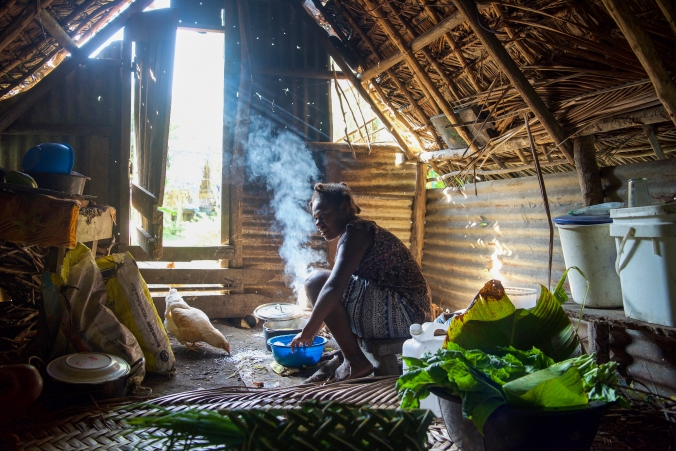
In the bush village of Enkahi under the Mount Yasur volcano on the island of Tanna, Sheila Willie prepares a meal of roots and boiled bananas over an indoor fire. Photograph: © Jeffrey Cardenas

A group called the New Economics Foundation (NEF) rates the happiness of human beings worldwide. Several years ago they concluded that the small Melanesian island nation of Vanuatu had the happiest people on earth.

Flying Fish was introduced to the Ni-Vanuatu people at Port Resolution on the island of Tanna. My welcome was tumultuous. A pack of schoolboys descended onto the beach laughing, singing, jumping, and talking all at once.

“Where you from? Why is your hair white? Where is your wife? What is in your bag? Want a coconut?”

After a while the boys’ school teacher, Willie Jila, 33, appeared and brought order to the joyous melee. “They have too much energy in the classroom,” he says in perfect English. To settle them down he sent the kids to the beach to fill sandbags to be used in the village for construction and for barriers against sea level rise. I help load the sandbags and then together we all walk to the village.

“What is the most important lesson you teach these children?” I ask Willie Jila. Without hesitation he responds, “I teach them to remember who they are, and who their father’s fathers were.” He said there are nearly 100 children in the tiny Port Resolution village and they all attend school. “The most important thing I can teach them,” Willie Jila says, “is not to forget their heritage.”

The Ni-Vanuatu are the indiginous Melanesian population of 83 islands in the Republic of Vanuatu. Many of these islands were formed by volcanoes, others by the buildup of coral. The island chain was previously called the New Hebrides, named like so many other South Pacific islands by Capt. James Cook who sailed into Port Resolution 245 years ago. The country gained independence from Britain and France in 1980. Vanuatu is probably best known to Americans as the setting for James Michener’s novel Tales of the South Pacific

Despite the importance the Ni-Vanuatu place on maintaining their traditional culture in the face of Western influences, Willie Jila invites me to his home in the bush for a traditional meal prepared by his wife Sheila. The role of women varies among the Ni-Vanuatu. In some areas, men are in charge. In others, especially parts of Espiritu Santo and Efate, women have more power. In these societies, descent is traced through the female side of the family. For the rural Ni-Vanuatu, the choice of a marriage partner is determined by family. The marriage itself is usually accompanied by an exchange of gifts, including woven mats and pigs. Women are often the main food producers. With this invitation to their home Willie and Sheila ask for nothing other than the opportunity to talk with a person who’s culture is so radically different from their own.

Over one hundred distinct languages are spoken in Vanuatu. English and French are the official languages, a result of the countries’ colonial past. Bislama, a pidgin-English, is the common language spoken by nearly all Ni-Vanuatu (How are you? / Yu oraet?The main religion of the Ni-Vanuatu is Christianity. Still, many Ni-Vanuatu practice traditional ceremonies including ritual dancing and the drinking of kava which are considered pagan by some church authorities. 

Tradition is an essential part of life here. Some Ni-Vanuatu practice male initiation, which usually involves circumcision, Willie Jila said. “Do the boys cry?” I ask. Yes, he says, but a boy who refuses to undergo circumcision may not be considered an adult man. Following the ritual, a young man wears a cover of braided fibers over his genitals. Tradition dictates other interpersonal relations among the Ni-Vanuatu. For example, in some communities there is a strict rule that brothers and sisters must avoid each other at a certain age. After reaching adolescence, they are not permitted to speak to each other, or even to be in the same place. In these communities, brothers and sisters must communicate through a young girl who acts as a go-between.

Willie and Sheila’s home, which they share with their young daughter Nahio, is in a family community called Enkahi located deep in the Tanna bush under the active volcano Mt. Yasur. It is a 45-minute walk from the Port Resolution village along a steep and narrow dirt pathway. My guide to the village is a young boy named Kennedy. He moves with quick grace as he leads me up a steep ascent into the bush. He occasionally turns around to say, “Are you okay, sir? Can I help you, sir?”

Sheila welcomes me to Enkahi with a wide smile. “Welcome to my home,” she says. “I think it must be different from your home.”

In cities, Ni-Vanuatu live in the style of western nations; houses, apartments, and condominiums. Rural housing such as this one at Enkahi includes traditional elements, such as woven bamboo walls and dirt floors with thatched roofs. There is no electricity at Enkahi but, more importantly, there is no fresh water either. Wells were dug some time ago but they have gone dry. There are no springs. A small creek several kilometers aways flows from the direction of the volcano but the water is “poisonous” Sheila says, and only drinkable if it is boiled for a long time. Willie’s family must hand-carry heavy jugs of water from Port Resolution, up the mountainside to their homes.

Most island families grow food in their gardens, and food shortages are rare. Papayas, pineapples, mangoes, plantains, and sweet potatoes are abundant through much of the year. Coconuts are used to flavor many dishes. Food is usually cooked using hot stones or by boiling and steaming over open fires.

Sheila starts an indoor cooking fire in her hut and puts some of her precious water into a smoke-blackened pot. There are pigs and chickens in the village but eating them is reserved for special occasions like circumcision, which is not happening today. She instead prepares namambe, a delicious seed that tastes like a chestnut, and boiled banana with wailu root. She asks me to grate a couple of coconuts which she then squeezes between her bare hands to make coconut cream. She garnishes the food with a flourish, sprinkling it with green onions from her garden. We hold each other’s hand and give thanks. I feel honored to share this meal.

Willie Jila arrives after the meal has ended and receives a few sharp words from his wife (as would happen in any culture, in any part of the world, when a spouse is late for supper.) He explains that he is building a stronger house in the bush, one more capable of standing up to storms like Cyclone Pam which devastated these islands four years ago. He has been shoveling coral rock for hours to make a foundation for the new home. He is thirsty. He has carried five gallons of water back to Enkahi, holding the jug aloft like a trophy.

The British think-tank NEF which has created the Happiness Index recognizes that a country’s well-being does not come simply from consumer-driven goals.  Vanuatu has no military (Ni-Vanuatu like to say, “Our culture is our strength”), and the GDP per capita is more than twenty times smaller than neighbouring Australia. The country has been consistently democratic and peaceful despite its immense cultural diversity. Ni-Vanuatu in tight-knit social communities like Enkahi meet often to discuss family matters from conflict resolution to ceremonial planning. These social meetings, according to NEF, are a key factor contributing to Vanuatu’s high level of well-being.

Vanuatu also rated high in the world index for its use of renewable energy from hydropower, wind, solar, and coconut bio-fuel. In 2011, according to data from the World Bank, 34% of the energy Vanuatu consumed came from these renewables. The country aims to be completely powered by renewable energy by 2030. Earlier this year Vanuatu banned all single-use plastic bags and drinking straws.

Willie and his wife Shelia don’t need a happiness index to define their lives. Vanuatu is has a rich Melanesian culture full of tradition, magic and ritual, and love of family. Ni-Vanuatu goals are immediate and personal. They want clean water to drink and stable weather for their crops to flourish. They want their children to be healthy and to remember the traditions of their ancestors. Vanuatu’s ranking in the index slipped recently (Costa Rica is now ranked first) but if the radiance of the smiles and the music in the laughter of the Ni-Vanuatu is any indication I’d still consider them the happiest people on earth.

###
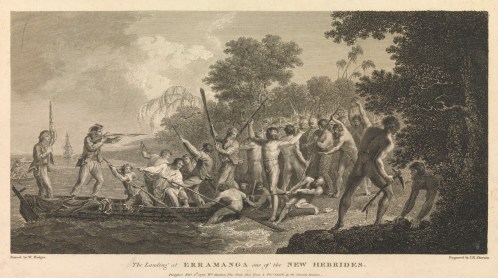
The Landing at Erramanga PAI4086

The Ni-Vanuatu were not always so happy to receive guests, especially when the visitors arrived bearing guns. This engraving, after a drawing by artist William Hodges, comes from the official account of Capt. James Cook’s second voyage and his landing on the Vanuatu island of Erromango. © Image in public domain.


Please subscribe at the bottom of this page so that you don’t miss a new post, and consider sharing this post with others who might enjoy following the voyage of Flying Fish

To see where Flying Fish has sailed in the past year click here: https://cruisersat.net/track/Flying%20Fish

For current weather along the route click here: https://forecast.predictwind.com/tracking/display/Flyingfish

Text and Photography © Jeffrey Cardenas 2019
The Last Voyage of Blue Gold

Efate Blue Gold.sm

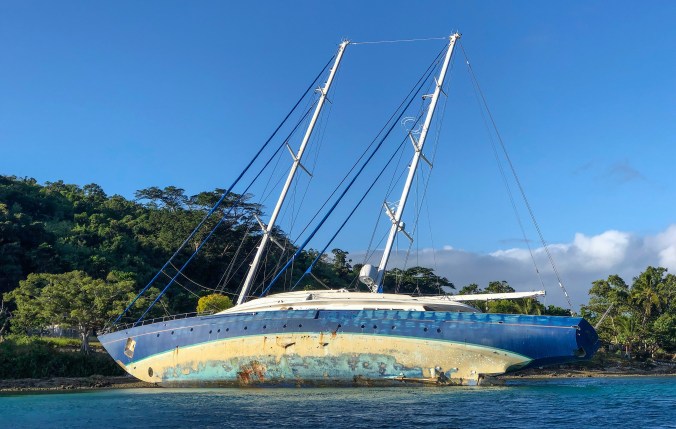
Super Yacht Blue Gold was grounded in 2015 during Cyclone Pam in Vanuatu. She is still abandoned on a remote beach and islanders say the wreck is a hazard causing damage to the reef and the environment. They want it removed. Photograph: © Jeffrey Cardenas

Blue Gold was once the flagship of Italy’s prestigious Benetti Group. This 165-foot three-deck super yacht had every luxury imaginable. When it was built in 1982, Blue Gold was the largest sailing yacht to come out of the Benetti shipyard. It had accommodations for up to 12 guests, a master suite on the main deck, an office with video conferencing and internet facilities — and, reflecting her name, there was gold trim throughout.

Then, on Friday the 13th of March, 2015, Cyclone Pam ripped through the islands of Vanuatu. The storm caused unprecedented devastation. Classified as Category 5, Port Vila recorded wind speeds of 116 knots gusting to 185 knots. The anchors on Blue Gold dragged. When the wind stopped the yacht was lying wrecked in a bed of pristine coral near the Sunae village on the island of Moso.

According to the database SuperYacht, Blue Gold was owned by Joep van den Nieuwenhuyzen, a Dutch investor. In the 1980’s he bought bankrupt companies and turned them around to profitability. In 1985, he acquired the Royal Begemann Group and it grew into a company with 140 subsidiaries and a value of $1.35 billion. Van den Nieuwenhuyzen was accused of insider trading. In 2006, he was convicted of fraud.

Joep van den Nieuwenhuyzen sailed Blue Gold to the South Pacific but in 2012 when the yacht arrived in Port Vila it was seized by the Vanuatu government for unpaid taxes, according to a report in the Vanuatu Daily Post.

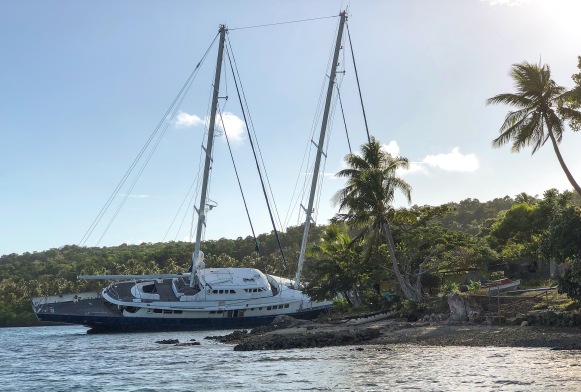
Today Blue Gold lies abandoned on a remote shoreline in Vanuatu. The yacht has not been vandalized or looted. The chiefs and villagers of Moso Island have asked the Government, through Efate Rural Member of Parliament Gillion William, to remove Blue Gold from their reef, according to the Daily Post. The islanders say the ship is a hazard and causing damage to the reef and the environment. They want it out of their backyard.

The parliment minister told the newspaper that the Department of Ports and Harbour, has been working on a resolution. “They had several meetings with the landowners and council of chiefs, (in) which they attempted to address the issue,” he said. “Unfortunately, the current legislation has some loopholes. The responsibility does not lie with the government, it lies solely on the owner of the vessel. We are working on this,” according to the report.

In the meantime life on Moso Island is simple and self-sufficient. Islanders fish from traditional dugout outrigger canoes. Villagers take their produce some 20 miles overland to sell in the markets of Port Vila. There are no roads or cars on Moso. Access is via banana boat. The Ni-Vanuatu villagers are often described as the happiest people on earth, always laughing and smiling. But it must test the limits of their good humor that the view from the tiny village of Sunae (population about 40) is obscured by the wreckage of this mega yacht, of which neither the ship’s owner, their insurance company, or the government seems inclined to take responsibility. 

Efate Blue Gold2.sm

Blue Gold wrecked on an Moso Island where islanders work and travel in hand handcarved dugout canoes. Photograph: © Jeffrey Cardenas

Please subscribe at the bottom of this page so that you don’t miss a new post, and please share this post with others who might enjoy following the voyage of Flying Fish

To see where Flying Fish has sailed in the past year click here: https://cruisersat.net/track/Flying%20Fish

For current weather along the route click here: https://forecast.predictwind.com/tracking/display/Flyingfish

Text and Photography © Jeffrey Cardenas 2019
All rights reserved

New Caledonia’s Living Reef

OLYMPUS DIGITAL CAMERA

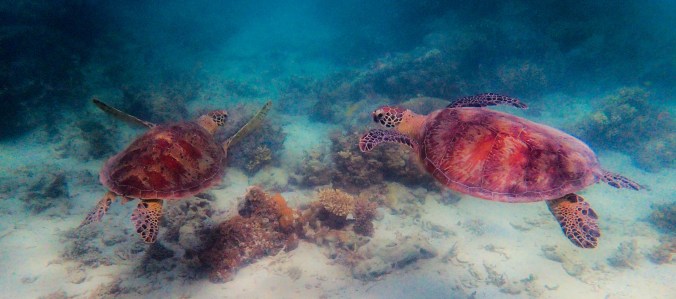
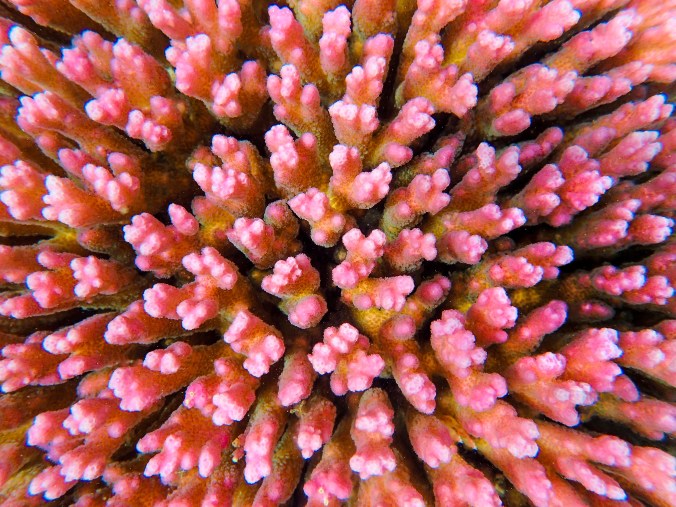
Like a galaxy of muti-hued stars, these coral polyps thrive on the reef in New Caledonia’s Natural Park of the Coral Sea. © Jeffrey Cardenas

I welcome visitors when I am sailing alone, even when those visitors are a curious pair of white tip reef sharks. They seem fascinated with the flash of my underwater camera. Sharks, being the alpha predators, always seem fearless — until they threatened by man, particularly those in this hemisphere who want to cut off their fins to make a bowl of soup. These white tips are a kinder, gentler predator. They seem to know that in this lagoon food is plentiful and they can swim without threat.

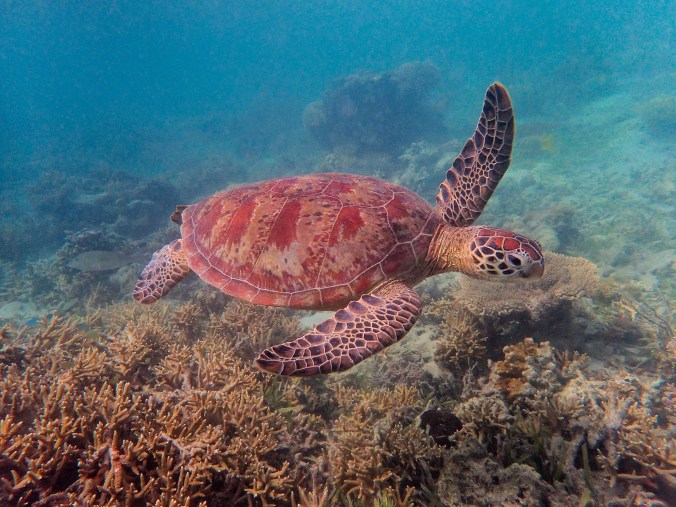
New Caledonia is internationally renowned for its exceptional natural beauty, rich biodiversity, and remarkable coral reefs. The Natural Park of the Coral Sea protects 502,000 square miles of the southwest Pacific islands. It is sanctuary for sharks, whales and turtles. New Caledonia is also home to one of the world’s largest populations of dugong, the last remaining marine mammal on earth that eats strictly plants. These creatures live in a lagoon circled by an epic 618-mile long coral reef. To summarize the superlatives, this tiny, French semiautonomous territory of New Caledonia boasts one of the largest nature reserve on earth.

OLYMPUS DIGITAL CAMERA

All images are of the Natural Park of the Coral Sea. © Jeffrey Cardenas

Paradoxically, New Caledonia’s maritime sanctuary is measured against the country’s unremarkable environmental record on land. As I swim with the sharks and turtles and tropical fish over the shallow coral reef inside the lagoon at Ilot Maître, it is possible to look back at the mainland and see the scars of strip mining. New Caledonia has one of the largest economies in the South Pacific. It is home to a quarter of the world’s known nickel reserves. The foreign dollars earned from nickel mining and smelting account for more than 90% of all exports. It explains the affluence of New Caledonia when compared to its neighbors in the South Pacific. But the wealth has come at a price. Strip mining in the 1970s turned once lush valleys rust red in color and sliced off entire mountaintops. Mining techniques and regulations have improved since then but in the past decade there have still been several serious leaks of acidic effluent flowing directly into this UNESCO World Heritage site.

There are other challenges to this pristine maritime environment. Despite there being literally thousands of boats moored in several modern marinas in New Caledonia, there are few if any functioning sanitary pump out stations in the entire country. Most sewage goes directly into the water. Enforcing the sanctuary’s well-intentioned marine regulations in an area twice the size of Texas is hardly possible with the limited resources here to police it.

Tourism is underdeveloped in New Caledonia with a little more than 100,000 visitors a year, compared to neighboring Fiji where tourism numbers are approaching 900,000 annually. This seems surprising considering the attraction of New Caledonia’s unique natural habitat of 3,700 species of plants, 114 species of birds and 143 species of reptiles. Over 80% of these species are found nowhere else on earth. Its lagoon is a thriving nursery for 25 kinds of marine mammals (including dugongs and humpback whales), 48 species of shark and five different marine turtles.

New Caledonia is proud of its 2019 tourism advertising campaign titled, “Feel The Pulse Of New Cal.” That pulse is clearly in the natural habitat of this island with its spectacular lagoon. Nature is the carotid artery, the life blood of New Caledonia. At some point in the future, as the nickel and other minerals in the land are depleted, the marine environment will be what sustains this beautiful island.

Follow the initiative of groups like Conversation International and the Pew Trust that focus on New Caledonia’s marine environment.

OLYMPUS DIGITAL CAMERA

A white tip reef shark passes by to welcome Flying Fish to the Natural Park of the Coral Sea. © Jeffrey Cardenas

Please subscribe at the bottom of this page so that you don’t miss a new post, and please share this post with others who might enjoy following the voyage of Flying Fish

To see where Flying Fish has sailed in the past year click here: https://cruisersat.net/track/Flying%20Fish

For current weather along the route click here: https://forecast.predictwind.com/tracking/display/Flyingfish

Text and Photography © Jeffrey Cardenas 2019

All rights reserved


A New Neighbor in Nouméa

Endeavor bow.sm

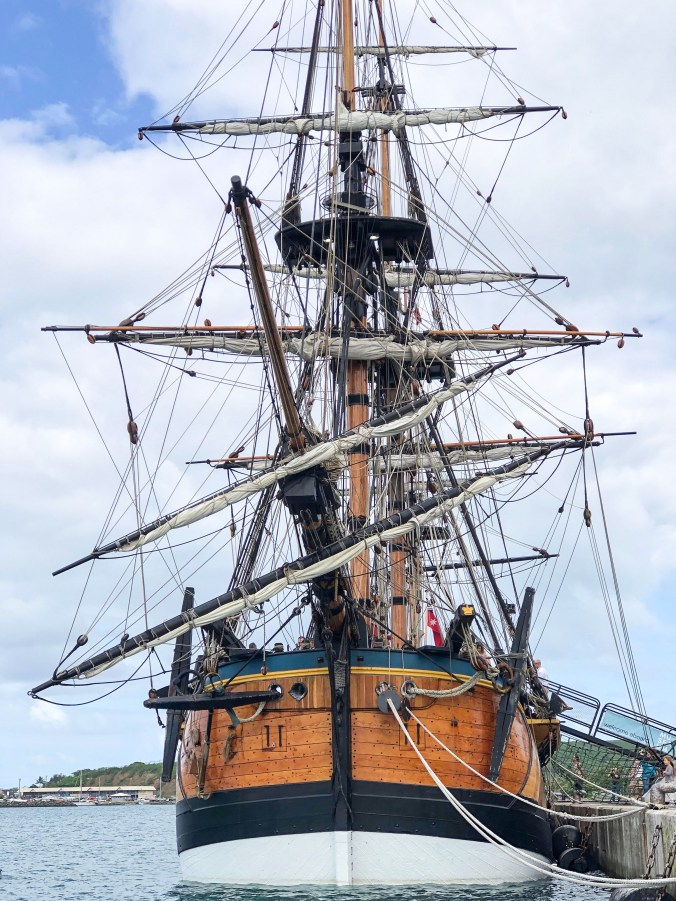
HMB Endeavour, an exact replica of the first ship Capt. James Cook commanded when he charted the Pacific, arrived in Nouméa, New Caledonia this week after having twice circumnavigated the globe. Photograph: © Jeffrey Cardenas

Walking along the wide planked decks of the Endeavour replica, one has the sense of treading two worlds.

There is this vessel, a working reproduction that recently arrived in Nouméa, a tall ship that has twice navigated the globe. And then there is the ship she represents, the HMS Endeavour, launched more than 250 years ago that carried Capt. James Cook and a crew of 94 on an epic voyage of discovery around the world. 

Cook departed England in 1768, ordered to the South Seas to observe the Transit of Venus and to secretly search for the fabled Great Southern Continent (Terra Australis Incognita). The HMS Endeavour rounded Cape Horn east to west against the Roaring Forties and then sailed into the Pacific bound for Tahiti. Cook returned to England by way of South Africa after two years and 11 months, having travelled some 30,000 miles and charted over 5,000 miles of coastline.

“Cook not only redrew the map of the world, creating a picture of the globe much like the one we know today” writes historian Tony Horwitz, “he also transformed the West’s image of nature and man.”

The replica of Cook’s ship is no tourist boat. Construction of the Endeavour replica began in Australia in 1988 and the ship was launched 5 years later. Since her commissioning she has sailed over 170,000 nautical miles–more than five times the distance sailed by James Cook on the original HMS Endeavour.

The Endeavour replica was built using surveys and plans archived by the National Maritime Museum in Greenwich, England. The timbers are of jarrah, a West Australian hardwood with spars from old-growth Douglas fir. The ship’s traditional iron fittings, including lanterns and the large iron firehearth, were handmade in a specially installed blacksmith shop. Traditional manila was used for the standing rigging, handmade on a 140-year-old ropewalk to the exact specifications of the original rope. The necessary concessions to the 21st century–engines, generators, an electric galley, showers, and safety equipment–are all hidden away in the cargo hold where Cook stored his ship’s provisions.

This slideshow requires JavaScript.

In over 200 voyages aboard the Endeavour replica some 8,000 men and women have been able to experience 18th-century seamanship and see how Cook and his men lived. Hundreds of others have joined day sails in harbors and rivers around the world, and many more have worked as guides and volunteers.

With Flying Fish currently undergoing repairs in Nouméa, I was invited by Shipping Agent Chloé Morin to help a group of fourth graders from Nouméa’s Paul Duboisé elementary school tour the Endeavour replica. The children were wide-eyed at the 100-foot, 400-ton ship. The Endeavour was built for endurance, not speed or comfort. It  bluff-bowed and wide beamed with an average sailing speed of 2.5 knots. The ship has been described (unkindly) by one historian as “A cross between a clog and a coffin.”

Endeavour’s Master John Dikkenberg, showed off his ship with enthusiasm to the children. The two areas that most fascinated the kids, Capt. Dikkenberg said, were the sitting boards hanging outboard with holes in them used during the Cook era as toilets (from which one unfortunate seaman plummeted into the ocean while underway), and the flogging rack. “Were sailors really whipped?” one young girl asked Capt. Dikkenberg. “With a cat o’ nine tails,” he replied, and he invited a boy to spread eagle on the rack, much to the delight of his fellow students.

Capt. James Cook’s mission was a voyage of science and discovery, and his legacy continues in the voyages of the Endeavour replica. Who knows in which student this spark of adventure may eventually alight. I know as the passage of Flying Fish crosses the wake of both Endeavours that my adventure is greater for having known their stories.

Endeavor from stern.sm

The rig of the HMB Endeavour carries over 10,000 square feet of canvas with 17 sails. © Jeffrey Cardenas

Please subscribe at the bottom of this page so that you don’t miss a new post, and please share this post with others who might enjoy following the voyage of Flying Fish

To see where Flying Fish has sailed in the past year click here: https://cruisersat.net/track/Flying%20Fish

For current weather along the route click here: https://forecast.predictwind.com/tracking/display/Flyingfish

Text and Photography © Jeffrey Cardenas 2019
All rights reserved


And Then This Happened

DCIM100GOPROG0220798.JPG

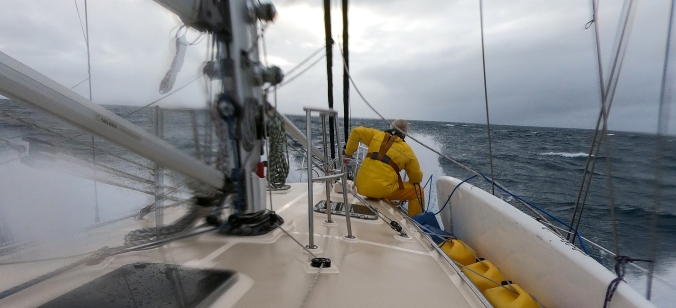
Setting up preventer lines on the rough downwind run to the Coral Sea. © Jeffrey Cardenas

Sleep is a rare pleasure on singlehanded passages and I was deep into a blissful state of REM on the comfortable salon berth of Flying Fish when the cabin around me seemingly exploded from within.

The crash was of such intensity it was as if I had been struck hard by a heavy truck. Still in a dream, I thought how is this possible? I should be floating on water, in an ocean 10,000 feet deep. Instead I awoke to a sound unlike anything I have ever heard on the ocean. First there was first a roar followed immediately by impact and detonation. Then, onto my sleepy head, came an awful shower of broken glass, canned food, cookware, and a drawer full of cutlery.

Flying Fish had been knocked down–mast to the surface of the water–rolled broadside by a wave that must have transcended by multiples any wave I had seen since my departure from New Zealand three days earlier.

An abnormal wave is rare. For years “rogue waves” were thought to be mythical, almost embarrassing to talk about, movie stuff. But, abnormal waves have been scientifically recorded. They are real, unpredictable, and they impact anything in their path with a tremendous and unstoppable force.

When I had gone below to rest some 30 minutes earlier, the wind was a moderate 20 knots and the boat sailing smoothly on a broad reach. The mainsail was double reefed, the jib was furled, and a staysail was rigged on the inner forestay. The sea was rough but manageable with a 6 to 8-foot swell from the east. The autopilot was working effortlessly with minimal weather helm. Radar, AIS, and a visual check showed no shipping traffic. Alarms were set.  The satellite forecast GRIB weather files indicated no change for the next 24 hours. It was the perfect time for a short snooze.

After the wave broke, Flying Fish rolled upright and I dug out of the debris field inside the cabin. My first instinct was to move toward light and air and get topside before another wave broke over the boat. But there was no other wave. The sea and wind conditions were the same as they had been 30 minutes earlier–except that Flying Fish was now wallowing in the foaming wash of the wave. The cockpit was full of water, hundreds of gallons. The canvas weather enclosure (custom built in New Zealand only a month ago) was in tatters. Cockpit cushions gone. Engine gauges underwater. And on the deck a 5-gallon jug of diesel had opened spreading a sheen of fuel oil and noxious fumes across the boat.

Flying Fish is a sturdy vessel. It is a 46′ Island Packet, a traditional cutter with a full keel, 32,000 pounds of displacement, and lots of fiberglass. What Flying Fish may lack in speed and sex appeal compared to modern racing sailboats, it more than makes up for in safety and security. I bought the boat specifically for its high rating of something called the “righting moment.” Simplified, the righting moment is the ability of sailboat to recover from a roll. Some boats will recover and some will not. Flying Fish recovered, which is why I am able to write these words.

While this knockdown was not an emergency situation, it was an event that captured my undivided attention. The initial reaction (after I rubbed the sleep out of my eyes and realized this was not a nightmare) was one of: What First?

Priority One was to get nearly a ton of the water out of the cockpit and regain buoyancy. An errant t-shirt had clogged one of the cockpit drains. Next I checked the bilge. It was dry, although 10 gallons of seawater was sloshing around the engine compartment (how did it get in there?) I knew I would have to get the engine started soon. The ports and hatches were all dogged and secured. The broken glass in the cabin, I am chagrined to say, was from improperly stowed glasses and plates (I just can’t drink fine wine out of plastic glasses). And there was more good news: The rig was intact. Torque from a mast and boom going into the water can be severe enough to rip the rig out of the deck. Amazingly, I was still sailing. The autopilot, God bless her inanimate soul, was holding course.

Then came the clean up. Because it had been such a passive passage to date, and because the forecast was for it to remain so, I was lackadaisical with my stowage. Imagine taking a full kitchen drawer and dumping it on the floor. Then imagine taking all of the kitchen drawers–and the contents of the cabinets–and throwing them into the mix. This is what the cabin of Flying Fish looked like. It might have been humorous until I saw a deep gouge in an interior bulkhead caused by impact from my cast iron griddle. The griddle had been stored under the stove where it had lived for more than 10,000 miles. But on this knockdown it somehow flew out and up with great velocity, across the entire cabin, passing inches over my head where I lay sleeping in the salon.

If the initial reaction to an event like this is What First, what follows logically is What Next?

I had been en route from Opua, New Zealand to Port Denauru, Fiji. Wind and seas were on the beam. I tried to understand the cause of this abnormal wave, and what the chance was of it happening again. In nearly a half a century of sailing and working on fishing boats I had never before encountered anything like this. Bob McDavitt’, one of New Zealand’s passage weather gurus likes to say, “Weather is a mix of pattern and chaos.” With careful planning ocean passages can be reasonably predictable, but I wanted to avoid more unpredictable chaos. So I turned downwind and down sea, diverting from a landfall in Fiji to one further west in New Caledonia. If Flying Fish was going to take another wave, she was going to take it on the backside where it wouldn’t hurt as much.

Lessons learned? Plenty.

I know that I cannot run before the wind and waves for the entire next 24,000 miles of my return passage to Key West. The ocean will often be rough and the seas will frequently be striking Flying Fish amidships. If I am going to sleep in these conditions I will need to heave to into the wind before I leave the helm. Also, I cannot be lazy about the proper stowage of PFOs (Potential Flying Objects) down below. When I sail again, I will look at my cabin with an eye to what will break free if the boat rolls 90 degrees, or worse. Finally, the cockpit needs to be an uncluttered environment. How humiliating it would have been for Flying Fish to founder because the cockpit drain was clogged with a dirty t-shirt I had tossed in the corner.

Ultimately, I need to better understand the inherent risk of this adventure. If a person walks in the rain they face the chance of being struck by lightning. If a person sails offshore they face the risk of encountering something as unpredictable as an abnormal wave. The alternative is to sit at home and watch reality TV. That’s not going work for me.

#

Please subscribe at the bottom of this page so that you don’t miss a new post, and please share this post with others who might enjoy following the voyage of Flying Fish

To see where Flying Fish has sailed in the past year click here: https://cruisersat.net/track/Flying%20Fish

For current weather along the route click here: https://forecast.predictwind.com/tracking/display/Flyingfish

Text and Photography © Jeffrey Cardenas 2019
All rights reserved