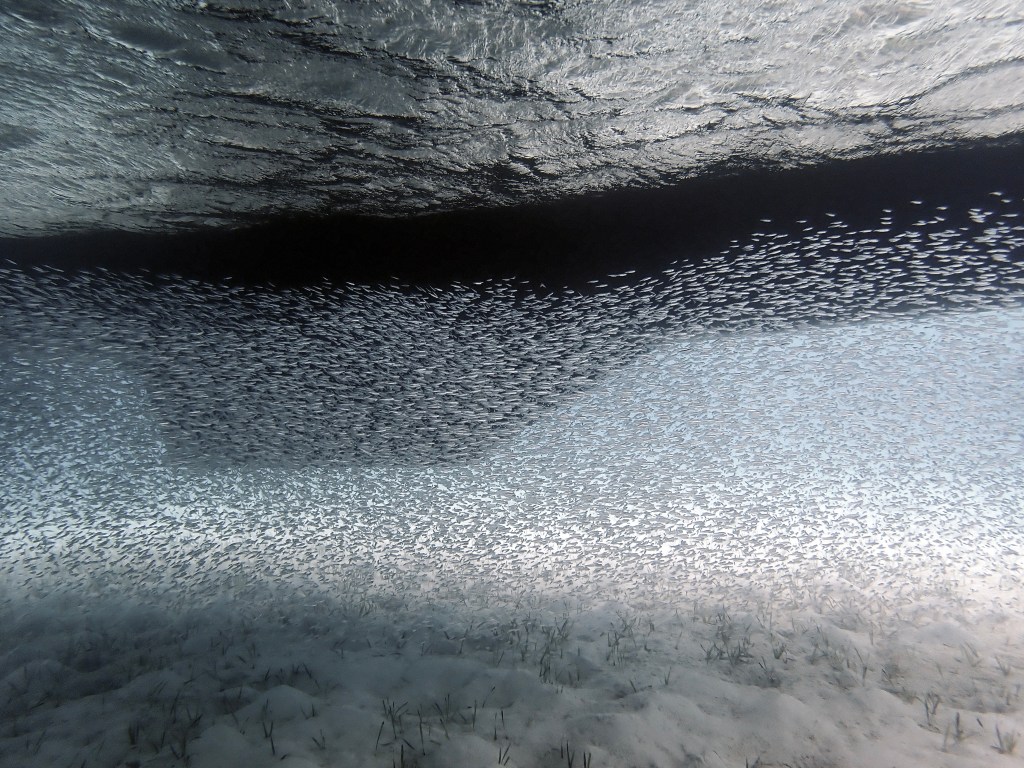
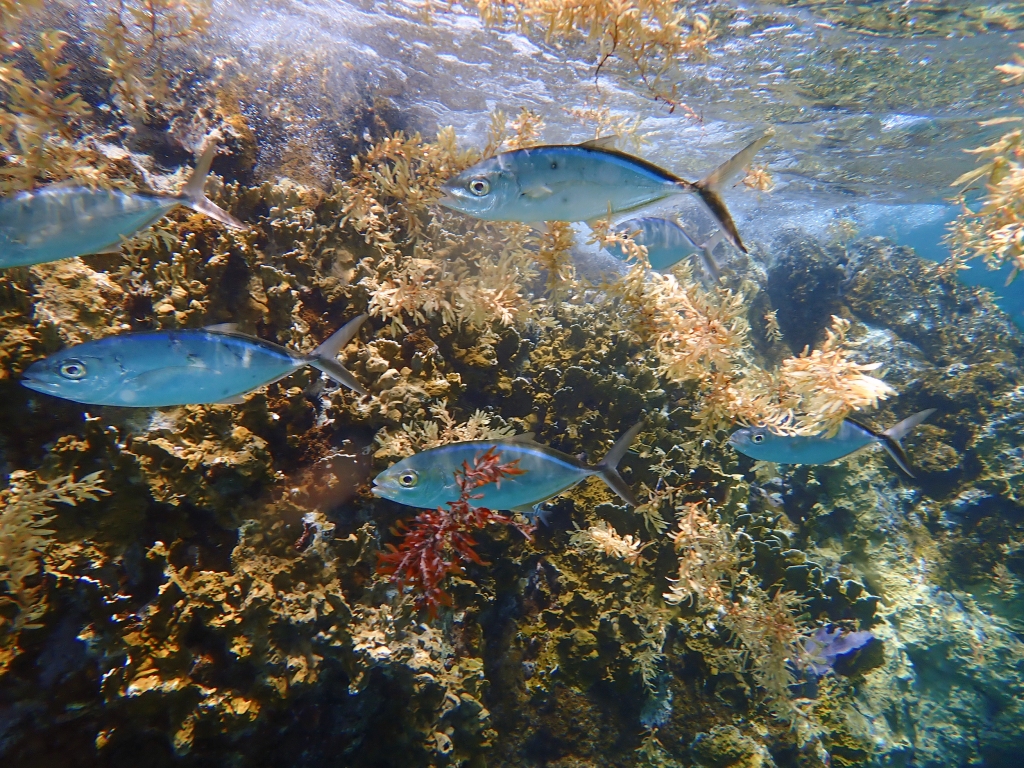
Glass minnows are shape shifters. It is possible to see through their translucent bodies.
Shroud Cay, Exuma—I expected that scraping barnacles and grass from the underside of my sailboat would involve hours of necessary but nasty work. Once, after a particularly messy hull cleaning, I came to the surface covered in algae, and my scalp was crawling with biting sea lice.
Today, however, my sealife encounter was ethereal.
As I worked underwater, a sphere of translucent glass minnows surrounded me in a sanctuary they found under the boat. Glass minnows are shape shifters. En masse, they form a defensive cocoon; a cloud of life that changes its appearance like smoke. It’s a fish version of starlings moving together in an underwater murmuration.
I posed no threat, they showed no fear.
It reminded me of the writings of naturalist John Burroughs: The best place to observe nature, he said, is where you are.
As always, sailing is not just about the wind and the sea; the places, the flora, fauna, and people encountered along the way are equally important.
Please click “Follow” so you don’t miss a new update, and please consider sharing this post with others who might enjoy connecting here. I welcome your commentsandwill always respond when I have an Internet connection. I will never share your personal information.
An additional website, www.JeffreyCardenas.com, features hundreds of fine art images—underwater, maritime landscapes, boats, and mid-ocean sailing photography–from exotic locations worldwide.
When we dive underwater, we observe a world inhabited by some of the most fascinating creatures on the planet. Imagine what these creatures experience when a terrestrial biped (us) suddenly appears in their environment. Then, it becomes the observer who is being observed. We are, after all, guests in their house.
There is much science regarding what fish and other sea life see underwater. Fish have spherical lenses in their eyes, which provide clarity, whereas human lenses are relatively flat. Our vision is blurred underwater (unless we wear a dive mask), but fish see everything. Fish also see a visible spectrum that is different from humans. Simply put, fish can see things underwater that humans cannot, even when we wear a mask. Marine reptiles are no exception; a sea turtle’s eye allows them to detect the glow of bioluminescent prey. Some fish, like bonefish, have a membrane over their eyes—like a diver’s mask—that allows them to forage in sand and silt to find food. Sharks may rely on scent and sensory input, but their eyesight is also remarkable. Marine biologists suggest that a shark’s vision may be 10 times better than that of humans in clear water.
That’s all fascinating stuff, but I don’t think about science when I put on a mask and snorkel to free dive on a coral reef. Instead, I am grateful for the privilege of sharing this undersea world, so I tread softly. I enter the water quietly, with minimal gear, and move slowly. I know that everything with eyes underwater watches me to perceive what threat I might pose. I de-escalate. When I minimize my presence, fish become as interested in me as I am with them.
The more opportunities I have to interact with the marine environment, the greater my respect is for a world I once took for granted. All it took was a little bit of eye contact.
As always, sailing is not just about the wind and the sea; the places, the flora, fauna, and people encountered along the way are equally important.
Please click “Follow” so you don’t miss a new update, and please consider sharing this post with others who might enjoy connecting with the voyage. I welcome your commentsandwill always respond when I have an Internet connection. I will never share your personal information.
An additional website, www.JeffreyCardenas.com, features hundreds of fine art images—underwater, maritime landscapes, boats, and mid-ocean sailing photography–from exotic locations worldwide.
Upcoming Exhibition: “On the Reef” will exhibit in The Studios of Key West’s Zabar Project Gallery, on view from January 2–30, 2025.
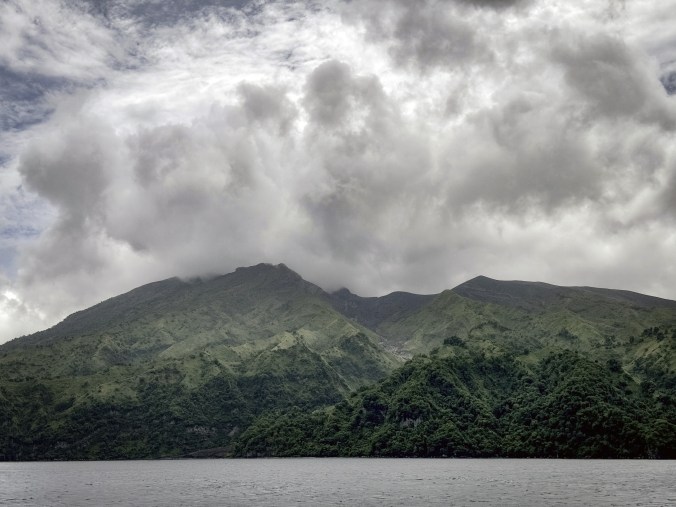
The crater of St. Vincent’s La Soufrière, which erupted in 2021
This lovely coastline of Wallibou, in northwest St. Vincent, has suffered greatly in recent years from both man and nature.
Three years ago, the still-active volcano La Soufrière erupted with a devastating blast that displaced 16,000 residents. Smoke and ash covered the island and closed airspace as far away as Barbados.
Then, only several months ago, the sailing catamaran Simplicity was discovered abandoned here with “copious amounts of blood” covering the interior. Police said the American-owned sailboat was hijacked in nearby Grenada by three West Indian assailants and brought to Wallibou. The bodies of Kathy Brandel, 71, and Ralph Hendry, 66, were never found.
Life continues despite the tragedies here. When I arrived in the Chateaubeliar village yesterday, a fisherman in a rowboat dropped off three avocados as a welcoming gift. Ashore, boys fished with handlines for jack mackerel from the rebuilt village pier. And at midnight, I was awakened by the local church’s gospel singing.
I could have avoided this small fishing village along Wallibou’s coastline. Guidebooks recommend caution, and not many sailboats anchor here anymore. Instead, my visit to Chateaubeliar gave me a lesson in the power of perseverance and hope.
As always, sailing is not just about the wind and the sea; the places, the flora, fauna, and people encountered along the way are equally important.
Please click “Follow” so you don’t miss a new update, and please consider sharing this post with others who might enjoy connecting with the voyage. I welcome your commentsandwill always respond when I have an Internet connection. I will never share your personal information.
An additional website, www.JeffreyCardenas.com, features hundreds of fine art images—underwater, maritime landscapes, boats, and mid-ocean sailing photography–from exotic locations worldwide.
“Fire coral will be the last remaining living coral on earth.”
I remember writing those words once, in a bluster of prophetic arrogance. That’s not exactly the most positive Earth Day message to consider as I dive this week on a shallow reef in the French West Indies at Île Fourchue, Saint Barthélemy.
First of all, fire coral is not even a true coral. Instead, it is more closely related to hydra, a very small predatory animal similar to jellyfish and other stinging anemones. But, for the sake of consistency, I will still refer to it as fire coral.
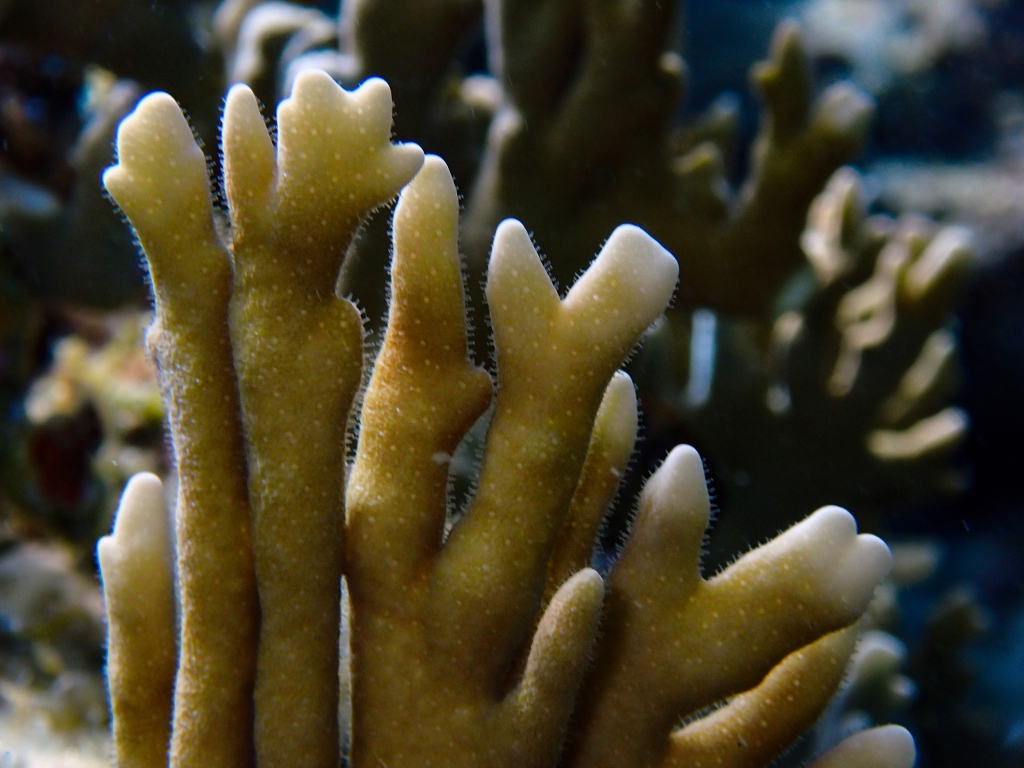
Fire coral can be either blade-like or encrusting. It is colored a mustard-yellow to dark orange, often with white edges. It has strong stinging cells that on contact cause intense pain lasting from two days to two weeks. Relapses of inflammation, itching, and welts are common. Fire coral releases venom through tiny hairs called cilia. It is their only defense mechanism against predators, including thoughtless human beings. Do not touch it, or any coral.
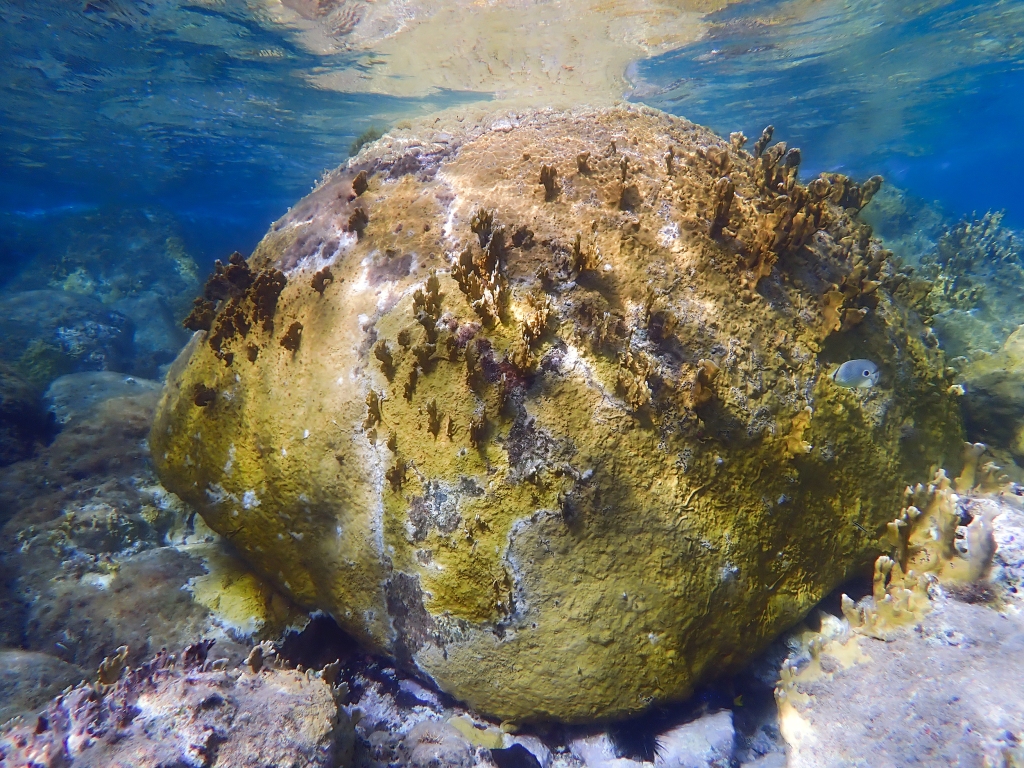
Because fire coral has the unusual ability to grow in two different forms, some marine biologists believe it has a survival edge over other Caribbean corals. It can grow like a bush with a stem and branches sprouting upward, or in sheets that appear as a flat coating across rocks and other surfaces.
“Fire corals have been around for millions of years and what they are doing is pretty darn successful,” says California State University marine biologist Peter Edmunds. For the past 30 years, he has been traveling to the Caribbean to document the life history of fire coral on inshore reefs.
“They are now poised to be… the inheritors of the reef, while other corals, particularly stony corals, die back,” he said. ”When it’s not stormy, they can produce branches and exploit the light and plankton in the water. When it’s storming and everybody gets beaten up, it loses its branches but it still has its sheets, which it can use to spread out and claim more territory.”
Researchers believe this adaptation may help save Caribbean reefs, which have been plagued by hurricanes, global warming, disease, and an overabundance of algae. Because fire corals are thriving as other corals die off, they are creating structures for fish and other organisms. Fire corals “are going to be very important habitat providers because they are able to survive under these stresses,” says Colleen Bove, a marine ecologist at Boston University.
But fire coral is not bulletproof. Some species have brittle skeletons that can easily be broken during storms, by anchors, or by careless divers and collectors who are taking fish for the aquarium trade. I watched blueheaded wrasse spawn over fire coral. Rock beauties, butterfly fish, yellow tangs, and the aggressive beau gregory retreat into branches of fire coral when threatened. In Brazil, fire coral colonies are extensively damaged by divers harvesting yellowtail damselfish. The fire coral is deliberately smashed and the fish hiding among the branches are captured in plastic bags.
Reproduction in fire corals is more complex than in other reef-building corals. The polyps reproduce asexually, producing the jellyfish-like medusae. These contain the reproductive organs that release eggs and sperm into the water. Fertilized eggs develop into free-swimming larvae that will eventually settle on the substrate and form new colonies.
Most divers wouldn’t mind seeing less fire coral on the reef, but I like to think of fire coral as a tactile warning to tread more carefully underwater. When the alternative may be a reef of dead rock, the sting of fire coral is a potent reminder that there is still life on that reef. And, it is one of the few ways the habitat has of fighting back.
As always, sailing is not just about the wind and the sea; the places, the flora, fauna, and people encountered along the way are equally important.
Please click “Follow” so that you don’t miss a new update,- and please consider sharing this post with others who might enjoy following the voyage. I welcome your commentsandwill always respond when I have an Internet connection. I will never share your personal information.






 Stella Maris Sail