“Fire coral will be the last remaining living coral on earth.”
I remember writing those words once, in a bluster of prophetic arrogance. That’s not exactly the most positive Earth Day message to consider as I dive this week on a shallow reef in the French West Indies at Île Fourchue, Saint Barthélemy.
First of all, fire coral is not even a true coral. Instead, it is more closely related to hydra, a very small predatory animal similar to jellyfish and other stinging anemones. But, for the sake of consistency, I will still refer to it as fire coral.
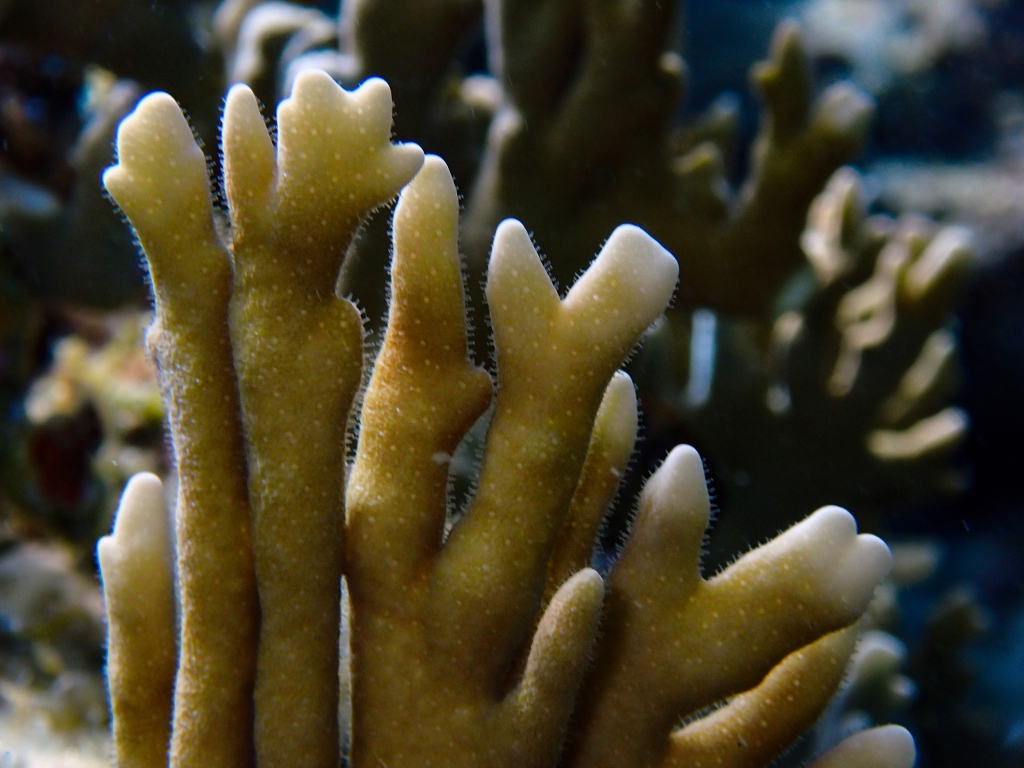
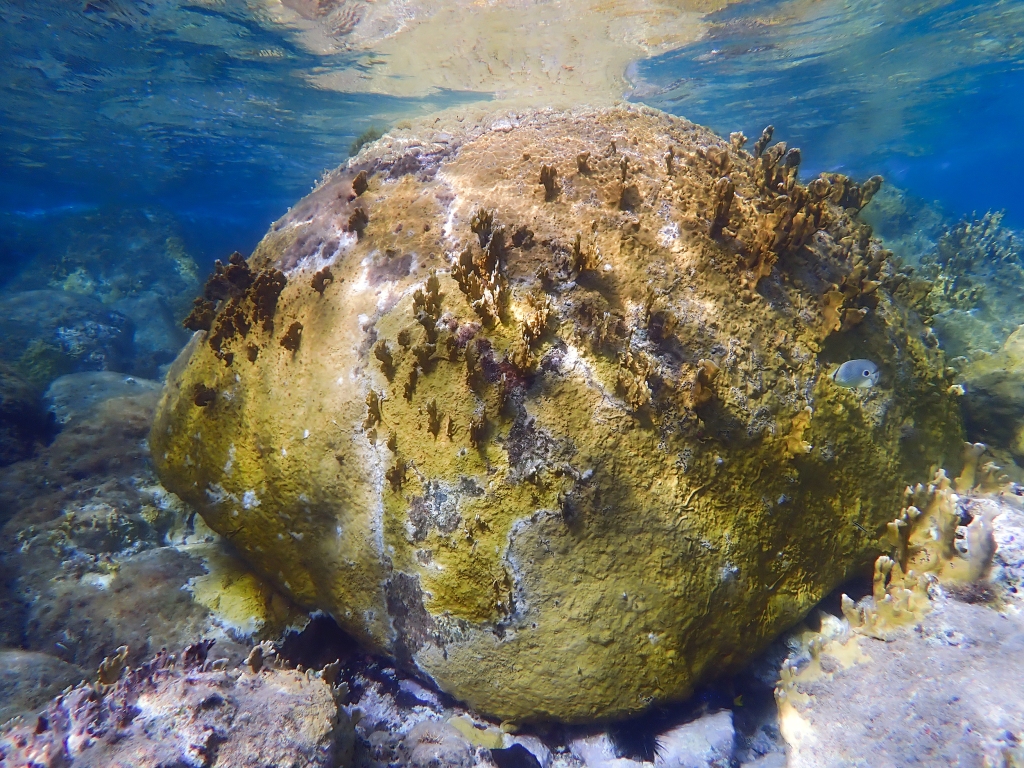
Fire coral can be either blade-like or encrusting. It is colored a mustard-yellow to dark orange, often with white edges. It has strong stinging cells that on contact cause intense pain lasting from two days to two weeks. Relapses of inflammation, itching, and welts are common. Fire coral releases venom through tiny hairs called cilia. It is their only defense mechanism against predators, including thoughtless human beings. Do not touch it, or any coral.
Because fire coral has the unusual ability to grow in two different forms, some marine biologists believe it has a survival edge over other Caribbean corals. It can grow like a bush with a stem and branches sprouting upward, or in sheets that appear as a flat coating across rocks and other surfaces.
“Fire corals have been around for millions of years and what they are doing is pretty darn successful,” says California State University marine biologist Peter Edmunds. For the past 30 years, he has been traveling to the Caribbean to document the life history of fire coral on inshore reefs.
“They are now poised to be… the inheritors of the reef, while other corals, particularly stony corals, die back,” he said. ”When it’s not stormy, they can produce branches and exploit the light and plankton in the water. When it’s storming and everybody gets beaten up, it loses its branches but it still has its sheets, which it can use to spread out and claim more territory.”
Researchers believe this adaptation may help save Caribbean reefs, which have been plagued by hurricanes, global warming, disease, and an overabundance of algae. Because fire corals are thriving as other corals die off, they are creating structures for fish and other organisms. Fire corals “are going to be very important habitat providers because they are able to survive under these stresses,” says Colleen Bove, a marine ecologist at Boston University.
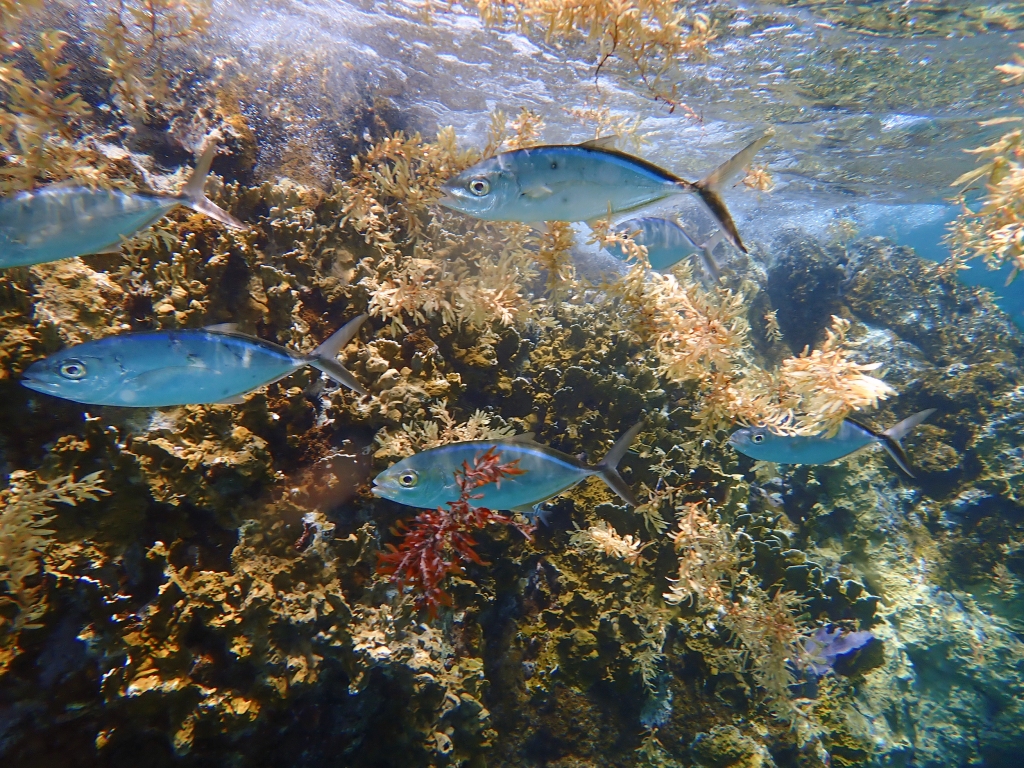
But fire coral is not bulletproof. Some species have brittle skeletons that can easily be broken during storms, by anchors, or by careless divers and collectors who are taking fish for the aquarium trade. I watched blueheaded wrasse spawn over fire coral. Rock beauties, butterfly fish, yellow tangs, and the aggressive beau gregory retreat into branches of fire coral when threatened. In Brazil, fire coral colonies are extensively damaged by divers harvesting yellowtail damselfish. The fire coral is deliberately smashed and the fish hiding among the branches are captured in plastic bags.
Reproduction in fire corals is more complex than in other reef-building corals. The polyps reproduce asexually, producing the jellyfish-like medusae. These contain the reproductive organs that release eggs and sperm into the water. Fertilized eggs develop into free-swimming larvae that will eventually settle on the substrate and form new colonies.
Most divers wouldn’t mind seeing less fire coral on the reef, but I like to think of fire coral as a tactile warning to tread more carefully underwater. When the alternative may be a reef of dead rock, the sting of fire coral is a potent reminder that there is still life on that reef. And, it is one of the few ways the habitat has of fighting back.
As always, sailing is not just about the wind and the sea; the places, the flora, fauna, and people encountered along the way are equally important.
Please click “Follow” so that you don’t miss a new update,- and please consider sharing this post with others who might enjoy following the voyage. I welcome your commentsandwill always respond when I have an Internet connection. I will never share your personal information.
It seems like another lifetime ago that I was obsessed with this fish.
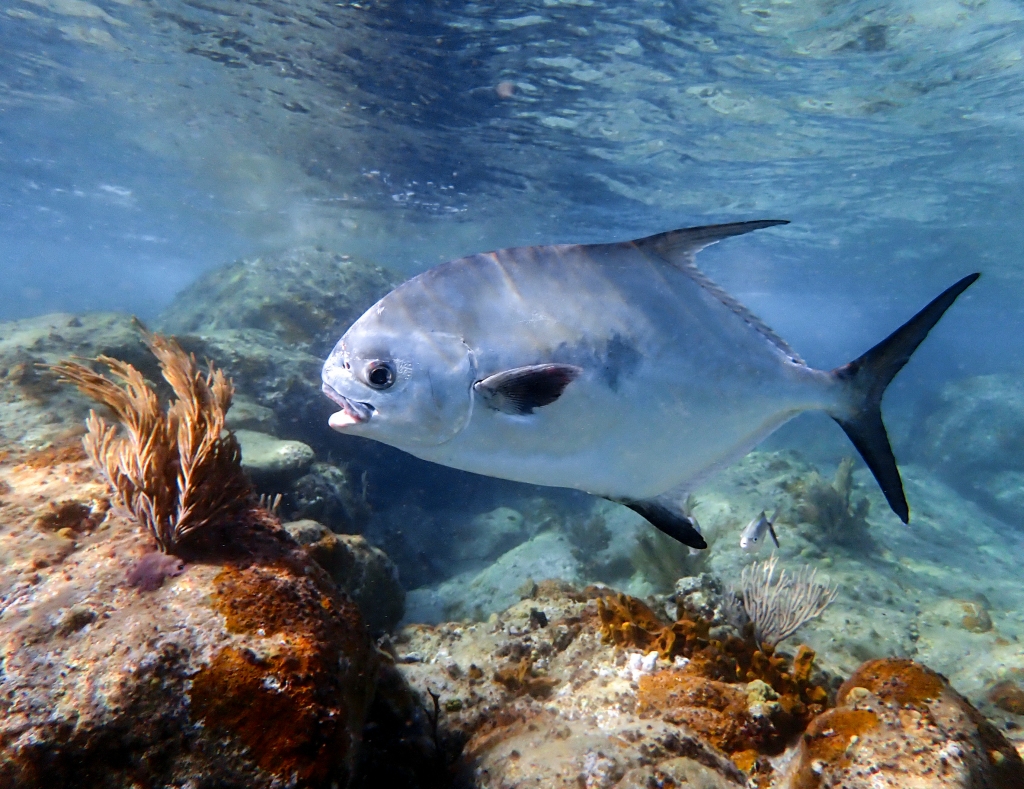
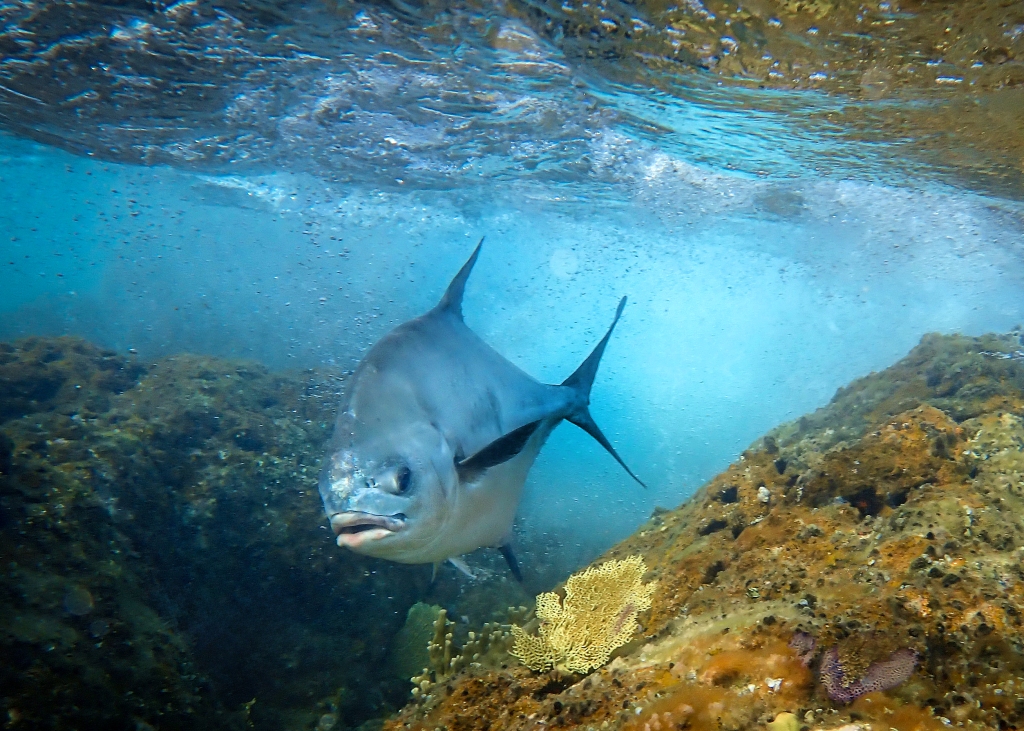
This fish is a permit, for those who may not know. For those of you who do know permit, you probably understand my obsession. It is regarded as the most challenging fish to catch on a fly rod. Some saltwater fly fishermen consider catching a permit in shallow water a lifetime achievement. Just look at that eye; it sees everything and quickly senses danger. It’s spooky; it perceives movement above and below the surface of the water. A permit often vanishes before an angler even sees it.
I was a fly fishing guide for several decades in my youth. Serious saltwater anglers made pilgrimages to my home waters of Key West each year for an opportunity to catch a permit. I hunted these fish all day, nearly every day, for years. Some days the results were heroic. Other days ended in humiliation. Many anglers fished for a week, never made contact, and went home in despair.
A few years ago, I traded my skiff for a sailboat, I migrated from shallow water to blue water, and I exchanged my fly boxes for a locker full of charts to navigate around the world. I don’t fish for permit anymore–it’s another story for another time–but I dearly miss my encounters with this great fish. I loved seeing them feed on the flats, their tails quivering with excitement as they discovered a crab, shrimp, or other crustacean on the ocean bottom. But, it has been years since I have even seen a permit.
These two worlds united serendipitously yesterday on a shallow reef off the Caribbean island of St. John. I was underwater photographing a living stand of elkhorn coral in the Virgin Islands National Park when I sensed movement behind me. I swirled around, saw the shadow of a fin, and found myself face-to-face with the lucid eye and the goofy rubber lips of a mature permit. My heart was apparently beating faster than this fish’s heart because while I hyperventilated, the permit merely looked on in curiosity. In all my years of fishing for permit, I have never seen one not flee from contact with a human being. This permit allowed me to photograph it for 30 minutes while it foraged and actively fed in front of me.
Sometimes wild fish, especially those in a protected environment, acclimate to human contact. They hang out with snorkelers in tourist locations because they are being fed junk food. The location of this reef, however, is not a marked dive spot where tourists swim and chum fish for photographs. I never saw another person in the water during the three days I swam on that reef. What is also unique is that this encounter was in national park waters where sport fishing and the taking of fish is allowed. This permit should have been wary of being caught, like every other permit I have seen.
Instead, this was truly a rare moment of coexistence with a wild creature. I’ll mark this day in the logbook of Stella Maris as a reunion with an old friend.
As always, sailing is not just about the wind and the sea; the places, the flora, fauna, and people encountered along the way are equally important.
Please click “Follow” so that you don’t miss a new update,- and please consider sharing this post with others who might enjoy following the voyage. I welcome your commentsandwill always respond when I have an Internet connection. I will never share your personal information.
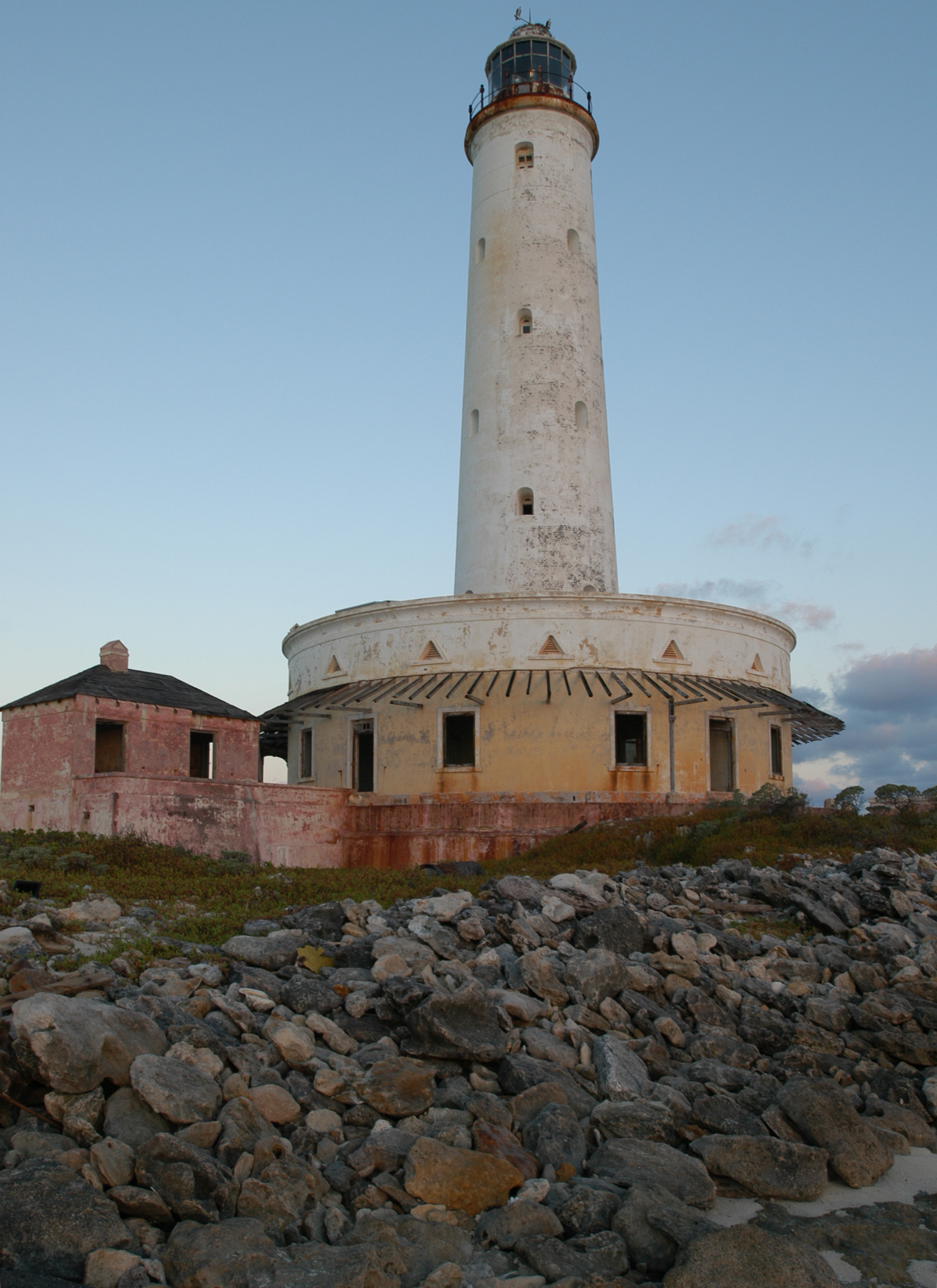
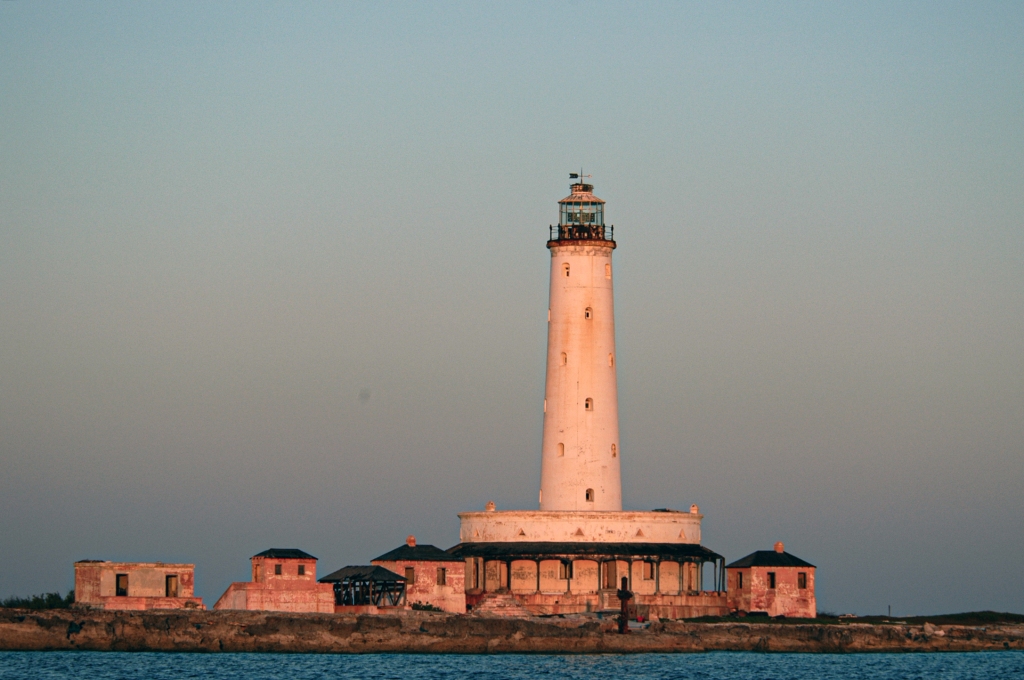
There are no lighthouse keepers today at Bird Rock in the southern Bahamas. However, a story still circulates of murder, mayhem, and madness at this isolated island outpost.
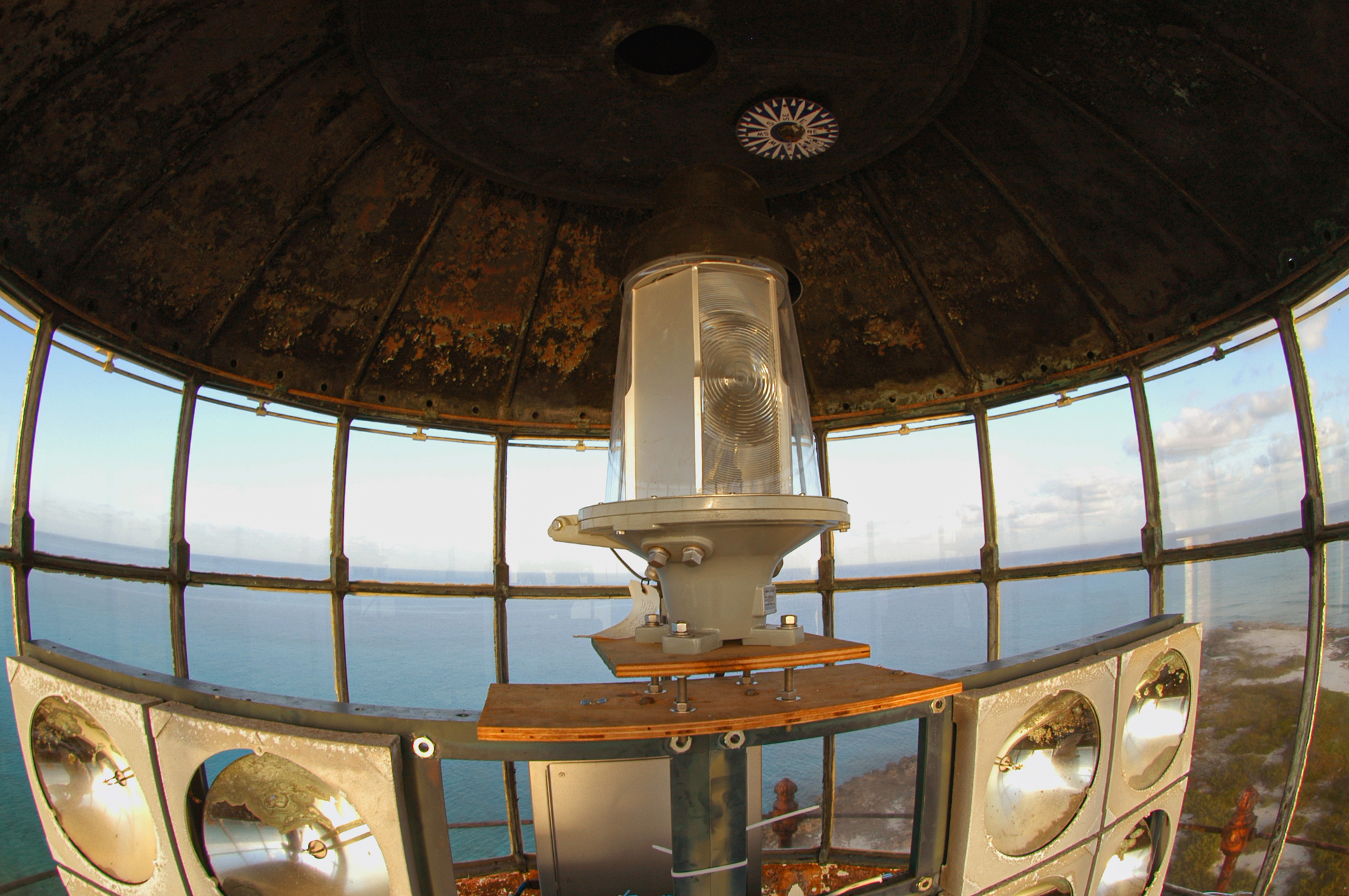
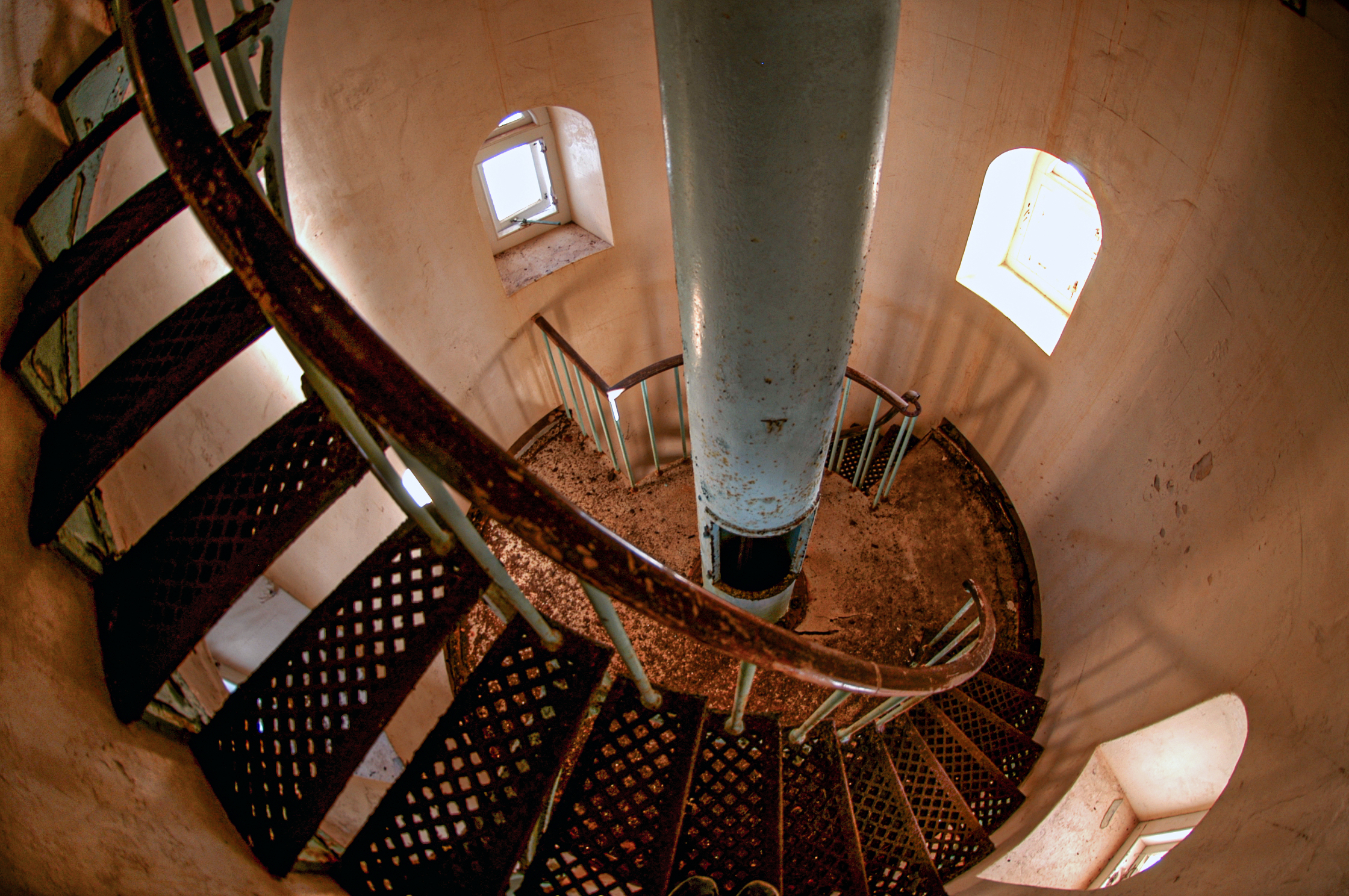
Constructed in 1876, the Bird Rock Lighthouse was an architectural marvel designed with a wide veranda supported by columns around the entire base of the structure. The lighthouse rises from a mass of rock offshore of Crooked and Acklins islands. In its heyday, the light and its keepers guided ships from the Americas to the Caribbean Sea and beyond.
Still photography images by Jeffrey Cardenas photographed in 2006, video images above in 2024
According to Timothy Harrison, author and publisher of Lighthouse Digest Magazine, two British couples sailed to Bird Rock in the late 1800s to become custodians of the lighthouse. They were unprepared for the hardship and isolation of living on a rock the size of a football field. Supply vessels called on Bird Rock only twice a year.
One of the wives, Mabel Brock, soon became ill on the island and died. No grave could be dug for Mabel because the rock was impenetrable. Her body was lowered into the sea next to the lighthouse.
Mabel’s husband, Stephen, was said to have gone crazy with grief. He accused the other couple–his cousin John and Mabel’s childhood friend Annie–of conspiring in Mabel’s death. The two men could no longer live peacefully together in the tight quarters of the lighthouse. One cousin had a machete, the other had a gun, and during a physical fight, according to this grisly yarn, the two lighthouse keepers went over the railing at the top of the lighthouse and fell 115 feet to their deaths.
Annie Bock, pregnant at the time, was the only remaining lighthouse keeper of Bird Rock. A relief ship eventually took her off the island and returned her to her home in England.
As sea stories go, this is a pretty tall tale. Author Tim Harrison writes that the initial account was based on an interview with Anna Randall Diehl, a late 1800s writer, who met Annie Bock and recorded the events. According to Harrison, the story appeared in the March 1898 edition of The Half Hour magazine published by George Munro’s Sons.
Unfortunately (but unsurprisingly), no additional accounts of the murder, mayhem, and madness of the lighthouse keepers of Bird Rock can be found.
I want to marry a lighthouse keeper And keep him company. I want to marry a lighthouse keeper And live by the side of the sea. I’ll polish his lamp by the light of day, So ships at night can find their way. I want to marry a lighthouse keeper, Won’t that be okay?
We’ll take walks along the moonlit bay, Maybe find a treasure, too. I’d love living in a lighthouse: How about you?
I dream of living in a lighthouse, baby, Every single day. I dream of living in a lighthouse, A white one by the bay. So if you want to make my dreams come true, Go be a lighthouse keeper, do! We could live in a lighthouse, A white one by the bay-ay-hay.
Won’t that be okay? Ya-da ta-da-da.
“I Want to Marry a Lighthouse Keeper”–ERIKA EIGEN
As always, sailing is not just about the wind and the sea; the places, the flora, fauna, and people encountered along the way are equally important.
Please click “Follow” so that you don’t miss a new update,- and please consider sharing this post with others who might enjoy following the voyage. I welcome your commentsandwill always respond when I have an Internet connection. I will never share your personal information.
Is this thing–this UFO–really even a sailboat? Tonight she is.
All weather forecasting models show that by morning we will have a strong northerly blast of 30-knot winds and 12-foot seas funneling into wedding-cake seas against a 2.5-knot current. They will be hellish conditions in which to cross the Gulfstream.
The good news is that morning is 12 hours away and we are on a fast broad reach. If Stella Maris continues to move like the scalded cat that she is, we will be in the safe harbor of Bimini for the duration of this blow.
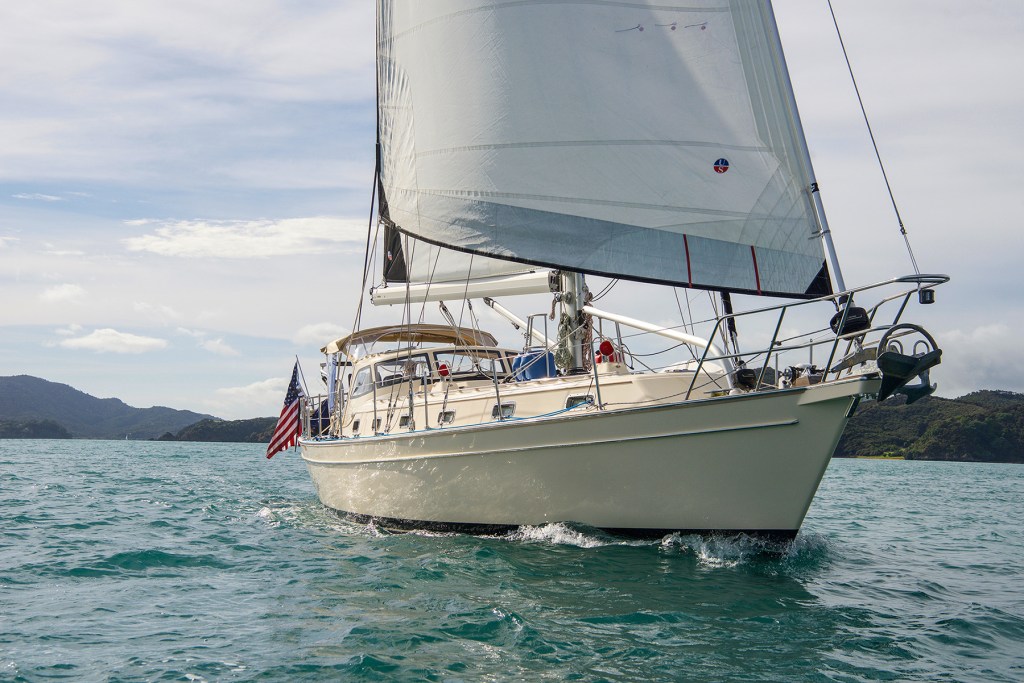
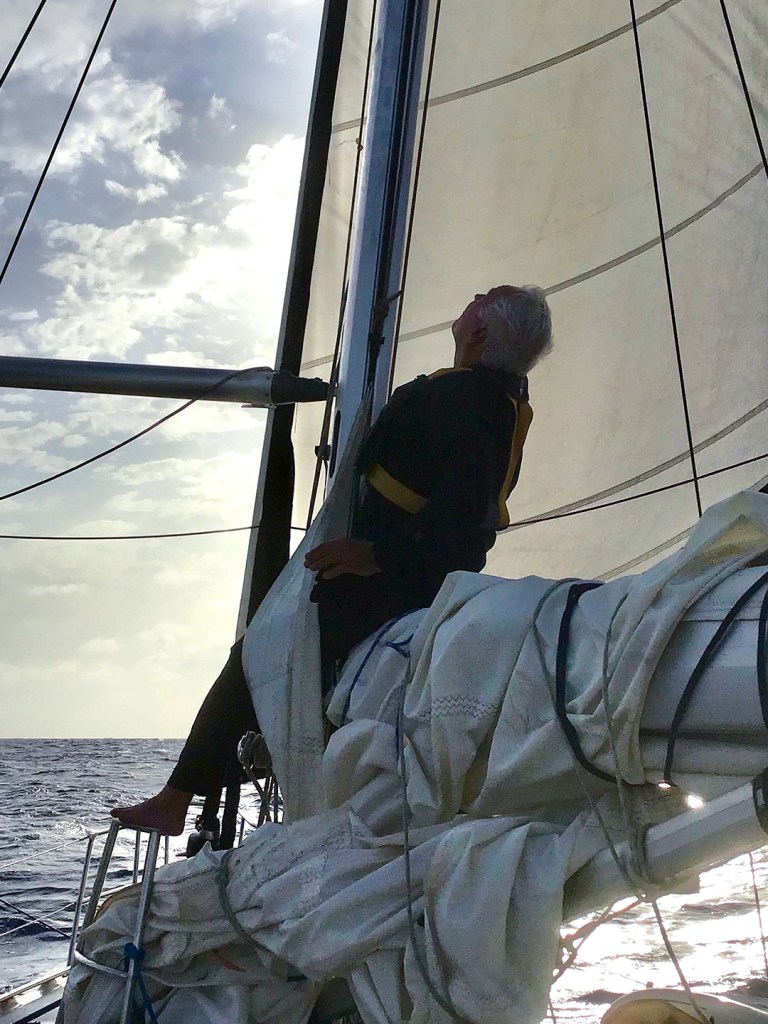
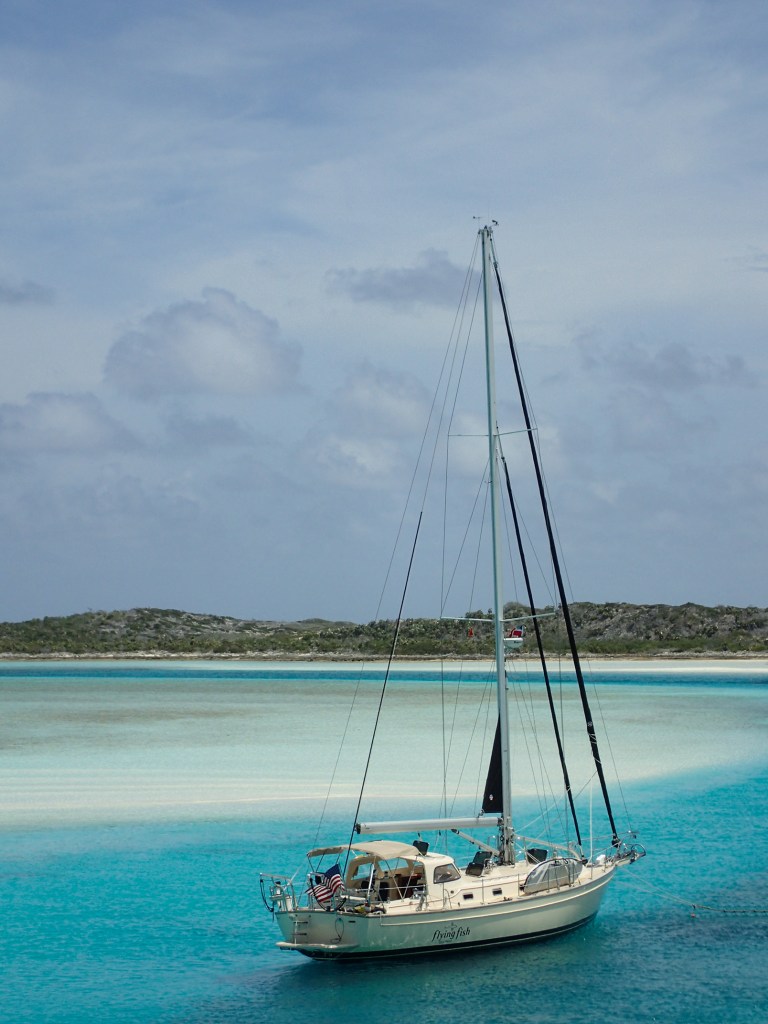
Stella Maris, a Lagoon 42 catamaran, is a different animal compared to Flying Fish, the Island Packet 46 monohull that I sailed around the world. If the Island Packet is a boat that can sail through any weather anywhere in the world, the Lagoon is more akin to a beach cabin with a stick and a sail. I sold the Island Packet because my world voyage had come to an end, and I bought the Lagoon because it is a far more family-friendly sailboat. Tonight I have family aboard; my brother Bob is sailing with me.
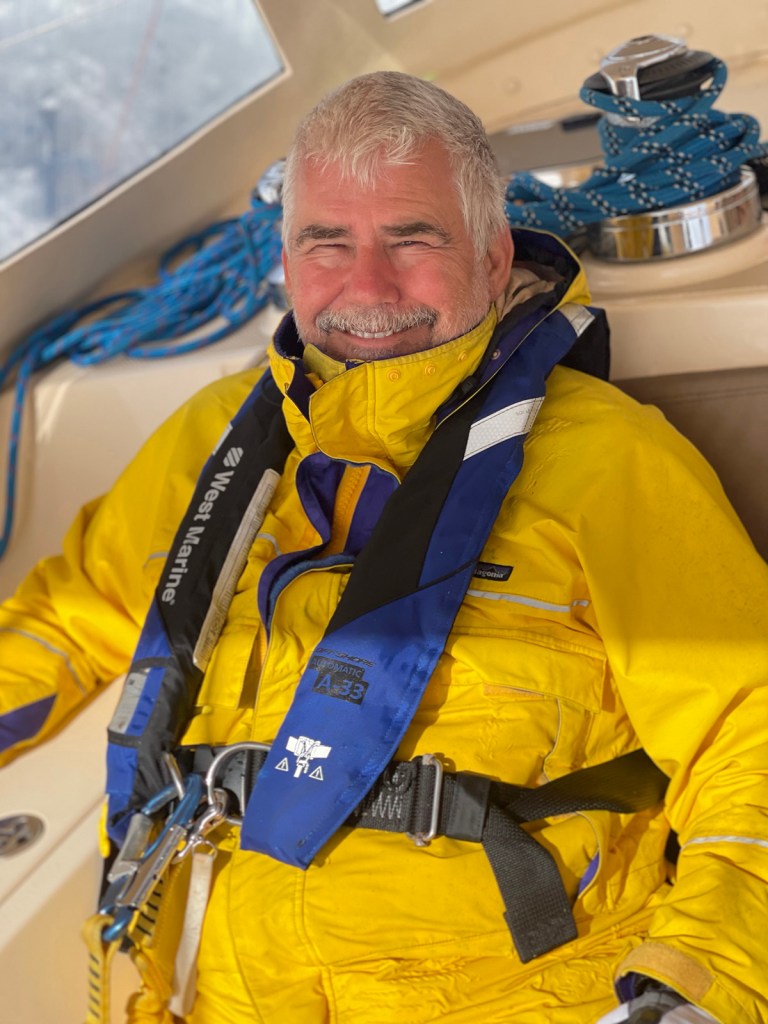
This is a sea change in my sailing life. I am learning that extreme adventure is not necessarily a requirement for a fulfilled life. Now at age 67, I don’t feel the need to cheat death to feel alive. The catamaran is perfect for that. It can take me to foreign places comfortably and still pump just the right amount of adrenaline into my bloodstream.
On the forecasting map tonight the heavy weather continues to rumble southward as we sail north and east toward the Bahama Bank. Sailing at eight knots, we reef the mainsail as the wind increases and Stella Maris skims across the building seas.
“It’s a good boat,” Bob says. I am also warming up to her. A full moon lights our passage. We will beat the weather into Bimini. I am grateful to be underway again, and who knows where this new boat will take me.
Night watch aboard Stella Maris as she crosses the Gulfsteam. Video credit: Bob Cardenas
Thanks for sailing along with Stella Maris.
As always, sailing is not just about the wind and the sea; equally important are the places, the flora, fauna, and people encountered along the way.
Please click “Follow” at the bottom of this page so that you don’t miss a new update,- and please consider sharing this post with others who might enjoy following the voyage. I welcome your comments, andI will always respond when I have an Internet connection. I will never share your personal information.
The good ship Flying Fish will now fuel the dreams of another sailor. This fine sailing vessel that carried me to some of the most remote and beautiful places around the world, has sold. The new owner is a trauma surgeon from New Orleans, an experienced sailor, and a saltwater fly fisherman. He pledges to continue the legacy of adventure that Flying Fish shared with me.
It may seem nonsensical to place so much emotional currency on an inanimate object like a boat. Some might say, “Don’t be ridiculous; a boat is just a ‘thing’. It doesn’t live and breathe.”
For me, Flying Fishdid live and breathe. On dark nights, I felt the movement of the hull through the water and listened to the song of the wind in the rigging. Flying Fish sheltered me when I needed safety. When I sailed alone, it challenged me intellectually. Flying Fish was my spirit guide to a world of places, people, and situations I would have otherwise never known.
Maybe it is just a boat, but this boat carried me on the most remarkable journey of my life.
TheBirth of a Boat2015
Flying Fish was born with the labor of dedicated and traditional boat builders. Each layer of fiberglass was carefully laid up by hand. I had confidence in this boat as I watched these men and women at work. I kept a fiberglass plug the size of a silver dollar that had been cut from the hull. It became a talisman reminding me of the strength and craftsmanship that went into building Flying Fish.
And then one day, mid-way through the construction of Flying Fish, all work on the boat inexplicably stopped. There was a padlock on the factory door, and Flying Fish was inside. No one answered the telephone at the boat company. Hundreds of thousands of dollars of my retirement savings–and my dream–were suddenly at risk as the boat company sank into fiscal disarray.
After months of bitter recriminations, legal action, and much sleeplessness, the boat company changed ownership (twice), remade itself, and the new owners delivered a magnificent sailboat capable of taking me around the world.
This is the day I delivered Flying Fish to her homeport in Key West.
Western Caribbean2017
Following an extended sea trial, my father and brother joined me for the first leg of the journey around the world–a 1,000-mile passage from Key West to Panama. Along the way, my brother tried to convince Dad that the dried flying fish he found on the deck each morning would make a delicious breakfast. Dad was skeptical.
Our passage south between Cuba and Mexico, and then through the Caribbean Sea offshore of Central America, was marked by intense tropical rain, and a suspicious boat that shadowed us along the Mosquito Coast. We made a midnight landfall in zero visibility at Panama’s Bocas del Toro.
The journey became real to me when Flying Fish transited the Panama Canal and entered the Pacific Ocean.
Pacific Crossing2018
My daughter Lilly joined Flying Fish in Panama for the Pacific crossing to Tahiti. As a USCG Master Captain, she provided youth, vitality, and expertise for the long passage to Polynesia.
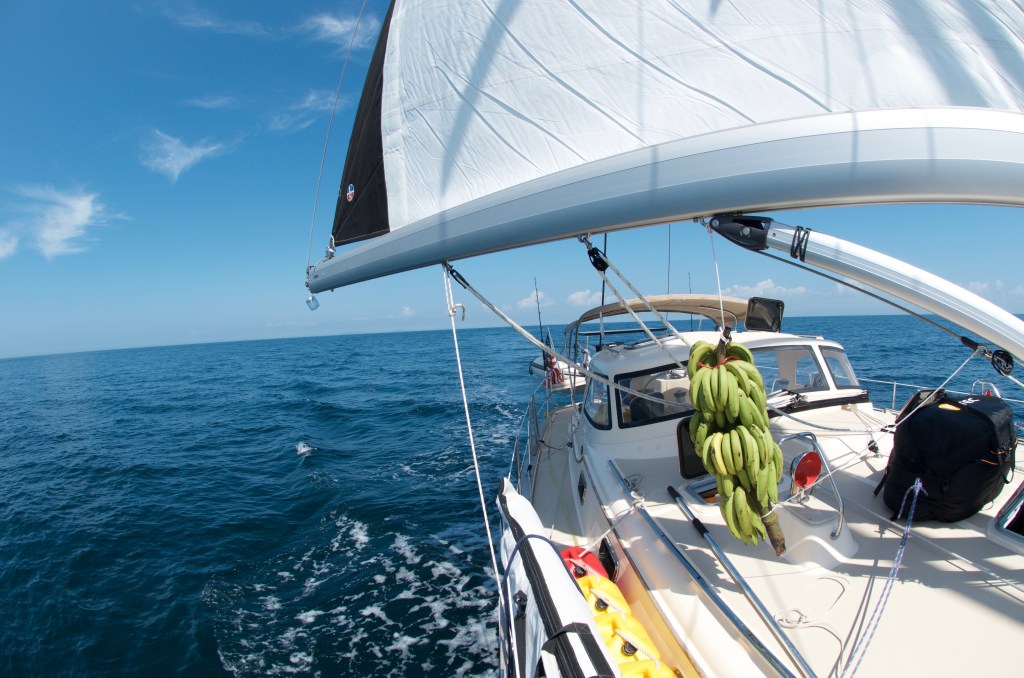
We provisioned fresh produce in Panama. When all the bananas became ripe at once, Lilly made enough loaves of banana bread to “feed the multitudes.”
I was content to ride the bow wave of Flying Fish for hours at a time as we crossed the Pacific. We didn’t see land for nearly a month, but the horizon changed by the hour. My mantra was words by Isak Dinesen: “The cure for anything is saltwater…”
On a calm morning, as Flying Fish crossed the Equator, Lilly jumped overboard to swim into the Southern Hemisphere.
Polynesia2018
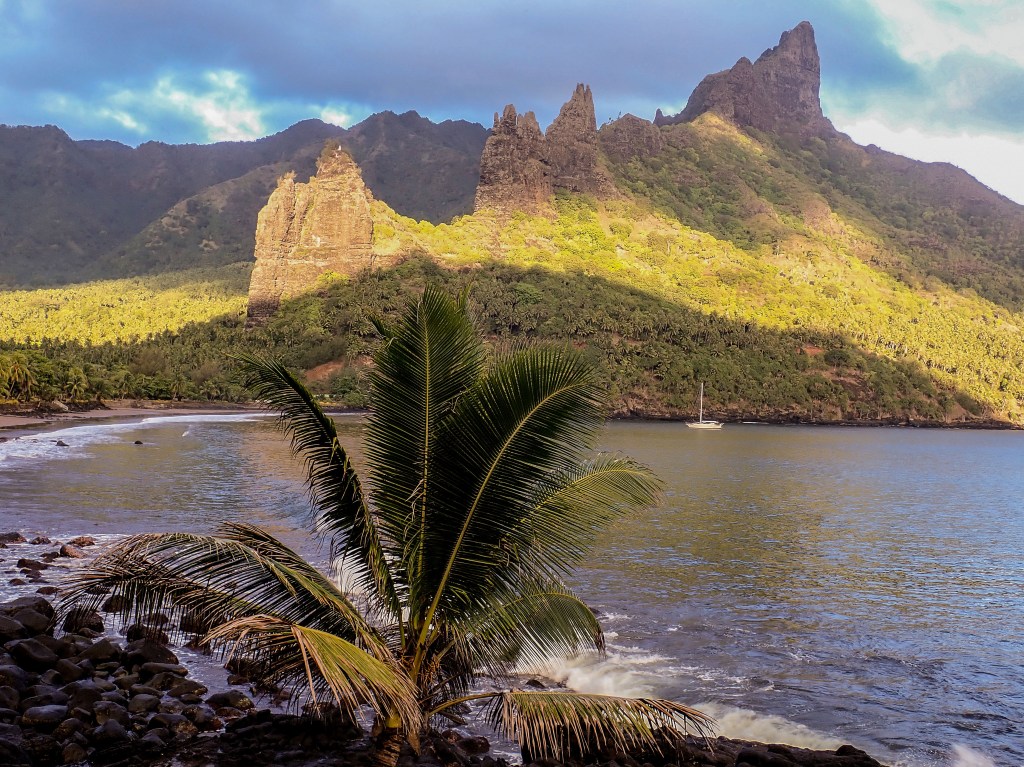
Our landfall in Polynesia was at Fatu Hiva in the Marquesas Islands. Flying Fish is anchored (above) in the Bay of Virgins. The beauty of the landscape–and the people–took our breath away. I remembered reading Thor Heyerdahl’s account of landing here in 1937. He and his newlywed wife, Liv Coucheron Torp, intended to “run away to the South Seas” and never return home. It was here that Heyerdahl first developed his theories regarding the possibility of trans-oceanic contact between the pre-European Polynesians and the people and cultures of South America.
Lilly and I were enchanted by the Polynesians who welcomed us with fresh fruit, flowers, and fish.
With bushels of fresh citrus, we enjoyed quenching our thirst in the equatorial sun and filling the icebox with freshly squeezed juice.
Flying Fish rests peacefully at anchor in Haapiti, Moorea. At the edge of the pass, there is a pristine surf break. The reef was healthy with live coral and tropical fish.
Flying Fish is anchored in the breathtaking Baie d’ Anaho in Nuka Hiva, one of the most secluded places on earth.
Oceania2018
With the cyclone season bearing down on the South Pacific, I sailed Flying Fish alone from Tahiti to Bora Bora, Niue, the Cook Islands, and Tonga en route to New Zealand. Sailing before the tradewinds was hypnotic. The jib and staysail set wing and wing pushed me thousands of miles across the Pacific Ocean.
I waited for a favorable weather window at the remote sunken atoll of Minerva Reef between Tonga and New Zealand. This reef rises thousands of feet from the ocean floor to barely break the surface of the water at Minerva. The rocks here are littered with shipwrecks, but the reef provided a sanctuary for Flying Fish.
Experienced sailors know they will encounter at least one severe weather system during the 1,350-mile route from Tonga to New Zealand. Several days out from Minerva the sea became glassy. It was the calm before the storm.
After months of sailing in the idyllic tradewinds of Polynesia, a full gale roared out of the deep southern latitudes to test Flying Fish and her captain. There is a mindset that is necessary when sailing alone in heavy weather. All actions and decisions must be made deliberately. A serious injury–or falling overboard–would likely be fatal.
New Zealand2019
The New Zealand landfall in Flying Fish was one of the highest moments of my life. The weather en route had been severe, but the boat was rock solid. Now, I knew for certain that Flying Fish could safely take me anywhere I wanted to go.
As cyclone season raged closer to the equator, I knew that here in the subtropics there would be months of rest and relaxation. New Zealand is known by the Māori as the “Land of the Long White Cloud.”
All of New Zealand is a sailor’s paradise, but the Bay of Islands north of Auckland provided consistent wind and spectacular calm water sailing.
For a boy born and raised at sea level, the landscape of New Zealand was otherworldly. This is Motukokako Island, and its companion rock known simply as “The Dog.”
Most anchorages in the Bay of Islands were undeveloped pastoral places with hiking paths and long sandy beaches. Flying Fish rests in solitude at a bay on Urupukapuka Island.
Coral Sea 2019
Flying Fish was refitted in New Zealand with re-cut sails, a watermaker, a new cockpit enclosure, and a fresh coat of bottom paint. I was healthy and well-rested. The boat and I were both prepared for the long solo passage that would take us thousands of miles through the Coral Sea toward Northern Australia.
These were the weather conditions Flying Fish was built to sail in–20 knots of wind off the stern quarter and a manageable following sea. After several days, I felt the rhythm of a long passage and the sea miles passed quickly under the hull.
Everything was under control… until it wasn’t.
At mid-day with good weather and no shipping traffic, I went below to rest. Minutes later, I awoke nearly upside-down to the crash of a breaking wave, a shower of cutlery and broken glass, and seawater pouring in through the companionway. Flying Fish had been knocked down, mast to the surface of the water, by a rogue wave.
It was the most serious situation I had encountered in thousands of miles at sea. Everything loose in my cockpit had been swept in the Coral Sea by the huge breaking wave. If I had been on deck without a safety harness, I would have also been swept into the sea. Flying Fish righted, as it was designed to do. The mast was still intact. And I was able to pump the water out of the cabin. This was not an emergency, but I was shaken. I kept looking over my shoulder for another breaking wave, but the seas were normal again. It was a wake-up call. I diverted my course from Fiji to New Caledonia to effect repairs. A full account in, “And Then This Happened,” is posted here.
Australia2019
It was Easter morning when Flying Fish sailed up to the dock in Noumea, New Caledonia. Church bells were ringing from all parts of the city. Selective memory can be a godsend. It was so easy to forget about the near-disaster with the seas calm and the sun shining. It would take several months to put the boat in order for the passage to Australia.
The sailing through the Iles Loyaute and Vanuatu was spectacular, but my senses were now continually on high alert, especially at night. This area of the Coral Sea was a hazard of submerged reefs. Radar, course deviation, and AIS alarms were set, but sleeping with the autopilot on was still only possible for a few minutes at a time.
In the middle of the night, a wave dislodged a hatch board and it flew with high velocity onto my foot, nearly severing a toe. I had a surgical staple gun in my med kit but the pain was so intense that I could not bear the thought of sending steel staples into my toe. I applied SuperGlue instead and wrapped it with gauze and duct tape. When I reached the closest doctor in Australia five days later, my foot was swollen with infection.
Weeks of recovery in Cairns, Australia passed before I was able to sail Flying Fish north to the Great Barrier Reef.
Indonesia2019
Flying Fish arrived in Tual, Indonesia, the first Port of Entry in the Arafura Sea. Waiting on the dock for me was Indonesian Coast Guard Capt. Lahan Bacho. With a no-nonsense demeanor, he indicated that he preferred sitting at the helm. Flying Fish was the only visiting yacht in port. Despite our cultural differences, Capt. Bacho and his family welcomed me into their lives. His daughter Sandrilla Oceani, in her hijab, turned heads as she toured me around the island on the back of her scooter. When I asked Capt. Bacho where I could find a Catholic church, he instead invited me to his mosque during the Call to Prayer. I gratefully accepted his invitation.
A fisherman returning from the sea in Indonesian jukung outrigger sails alongside Flying Fish. We greeted each other, sailed at the same speed for an hour or more, and smiled at each other in equal fascination.
An iridescent Indonesian kingfisher, perches and poops on the solar panel of Flying Fish. Photo courtesy: Lilly Cardenas
Lilly joined Flying Fish again for a journey deep up a jungle river in Borneo. We visited Camp Leakey where researchers were studying some of the last remaining wild orangutans. On shore, Lilly hung out with the reptilian locals at the settlement of Kumai. Flying Fish is anchored in the background, in the dark current of Borneo’s Sekoyer River.
As Flying Fish once again crossed the equator, this time going from south to north in the South China Sea, Lilly continued the tradition of swimming from one hemisphere to the next.
Malaysia 2020
In Singapore, Lilly left Flying Fish to rejoin the real world. As I sailed solo aboard Flying Fish, my world suddenly became very real, too. The Strait of Malacca is one of the busiest shipping passages in the world. Tons of oil from the Middle East en route to China pass through this narrow bottleneck each day. Piracy has been a problem in the strait. The passage is about 600 miles long but only a mile wide at its closest point. Navigation is challenging because, in addition to the supertanker traffic, hundreds of small unlighted fishing boats also use the strait.
Chinese New Year, January 25, 2020. The Year of the Rat–I am in Langkawi, Malaysia provisioning Flying Fish for a long passage across the Indian Ocean. The open vegetable market is packed nose-to-nose with Chinese tourists on holiday. The revelers are shouting, haggling–and sneezing–in the tightly packed crowd. A few days later en route to the Maldives, I become very sick with fever and respiratory problems. The symptoms exacerbate by the hour. In the middle of the night, off the coast of Sumatra, I am nearly delirious. I find shallow water next to an island, drop an anchor, and collapse onto the cabin sole of Flying Fish. I awake to the sound of Malaysian port police pounding on the hull yelling in English–“Quarantine! Quarantine! Quarantine!”
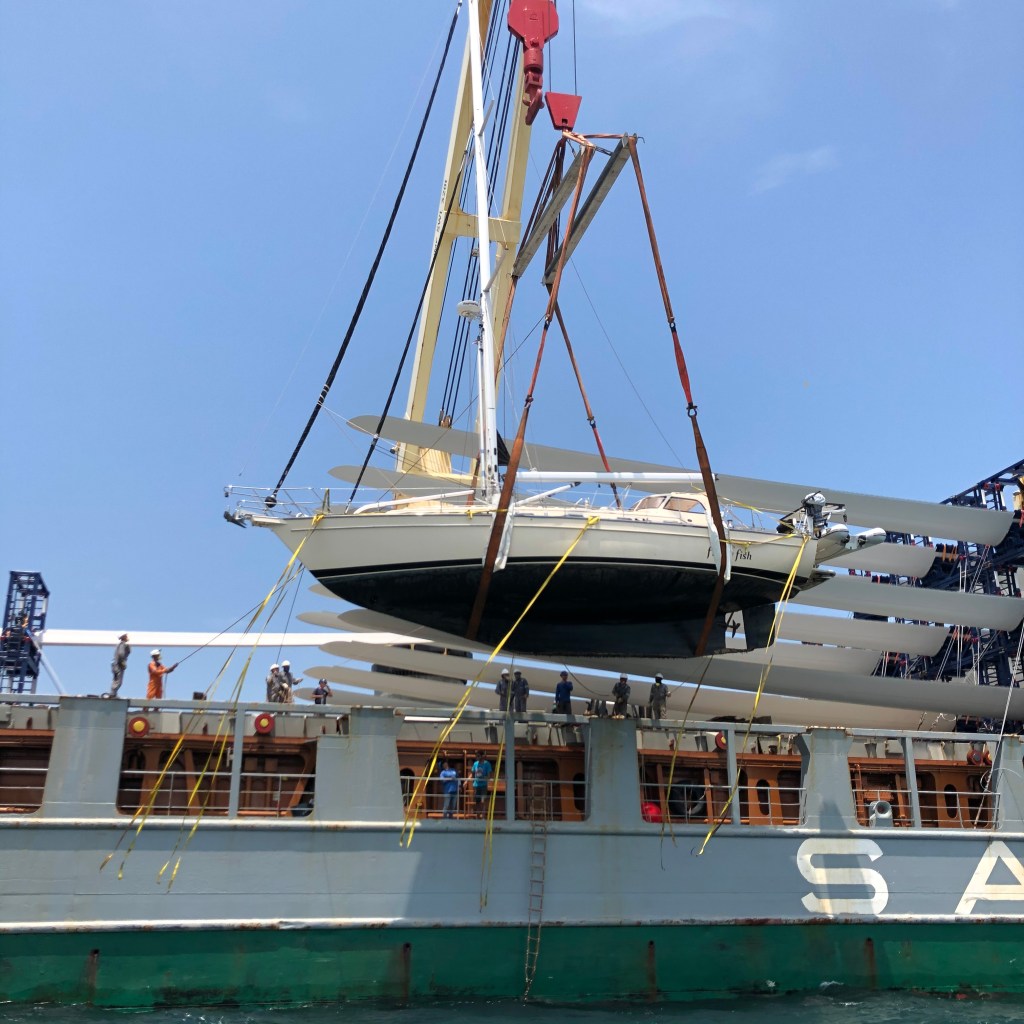
I had just been introduced to Sailing in the Time of COVID. The Sumatran Port Authorities were not happy to see me. They told me that a “rapidly spreading disease” is closing ports throughout the Indian Ocean, including my next destination in the Maldives. There were no tests available. They strongly encouraged me to sail in the opposite direction back to Phuket, which was still open to sailboats. But, Thailand would also be inundated soon with COVID. No one could guess how long this pandemic would last. A freighter carrying windmill blades to Turkey offered, for a fee, to carry Flying Fish and several other sailboats to the Mediterranean. There is no disease there, the shipping agent said. Turkey is open to visitors.
Turkey 2020
Flying Fish continued the next leg of her circumnavigation on the back of a freighter. Shipping regulations would not allow me to accompany the boat so I flew to Turkey to meet Flying Fish. On my arrival in Istanbul, there was news that the very next day Turkish borders would close indefinitely due to the pandemic. I scrambled to get one of the last flights back to the United States. Life had seemed so much simpler in mid-ocean aboard Flying Fish.
The freighter transited the Suez Canal with Flying Fish and deposited her with a shipping agent in Fethiye, Turkey. Meanwhile, friends on other sailboats who were in various places around the globe found themselves stranded. A few sailors were at sea when they were told they could not make entry anywhere because of COVID. For many, it was like an apocalyptic nightmare.
After several months, Turkey cautiously opened their border to some visitors. I caught the next flight back.
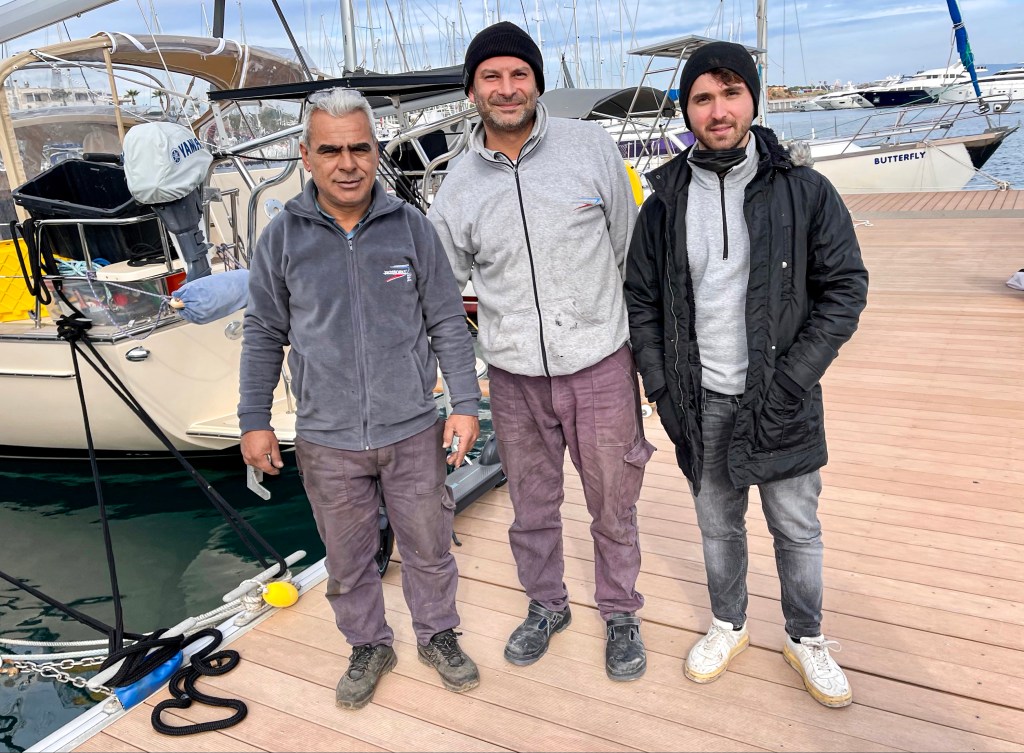
My reunion with Flying Fish was nerve-racking. I had never been away from the boat for so long; I hadn’t been aboard since Phuket. Flying Fish needed TLC, and thanks in part to the technical services of Three Mehmets (above) in Didim, Turkey, I was soon sailing again.
Turkey is one of the most beautiful places on earth to explore in a sailboat. There are 1,000 miles of pristine Mediterranean coastline bordering Syria to the south and Greece to the north.
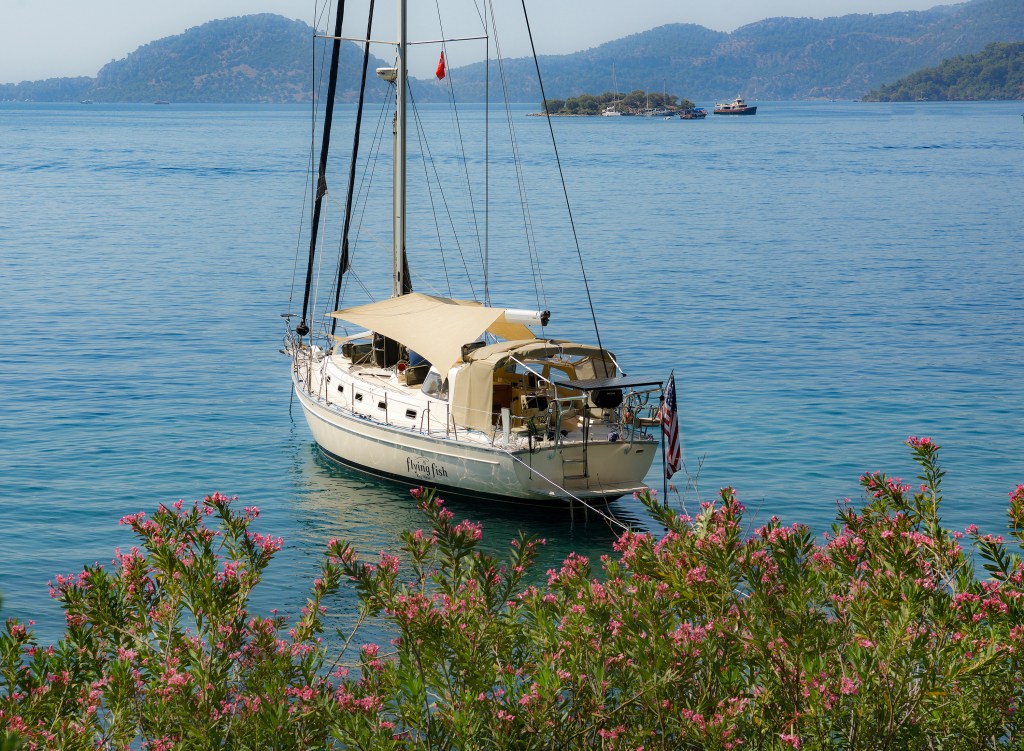
At Tomb Bay, ancient catacombs are carved into the rocky hillsides. Flying Fish is Mediterranean-moored here with an anchor forward and a stern line to a shoreline of oleander.
Malta2021
COVID concerns continued to affect travel in the winter and early spring of 2021. Greece and most other European Union countries still refused to accept arrivals from foreign sailboats. One EU exception was the island of Malta, located about 200 miles north of Libya and 200 miles east of Tunisia. It is in the direct center of the Mediterranean Sea. There is a unique natural history in Malta. Pleistocene fossil deposits reveal the existence and extinction of dwarf hippos, giant swans, and pygmy elephants. Malta sounded enchanting.
Flying Fish departed Turkey on the 680-mile run for the “Middle Sea.” A ferocious Meltemi wind developed, unforcasted, and rain turned into sleet, forcing me to take illegal sanctuary in the lee of an uninhabited Greek island. Despite the severity of the weather, the Greek military continued a non-stop VHF radio broadcast, warning all vessels from Turkey not to “violate sovereign waters.” I wondered: Were they talking to me?
Malta exceeded my expectations. It is a seafaring island with a maritime history that goes back to the Phoenicians. Not since Australia had Flying Fish arrived in a country where English was the common language. I loved the spontaneity and the eccentricity of the Maltese. One day I met up with a local man with his two young daughters and their friend. We enjoyed a picnic together aboard Flying Fish and a brisk sail offshore. Another day I watched horse trainers swim their thoroughbreds through the anchorage.
Sardinia2021
The shipping agent told me, somewhat apologetically, that as part of the entry protocol I had to be COVID tested aboard Flying Fish on arrival in Sardinia. Ughh, I thought, another swab in the nose. I had forgotten, however, that I was arriving in Italy where there are quite possibly the most beautiful nose-swabbers in the world. –Photo courtesy of Gioia Serra, Nautica Assistance
Summer in the Mediterranean was approaching and the quality of the light made Flying Fish shine like a gem in the Tyrrhenian Sea.
Ginny flew into Cagliari and joined Flying Fish for a couple of weeks. We had a blissful cruise along Sardinia’s Orosei Coastline, sampling rich local cannonau wines and afterward working off the calories by climbing the hills above our anchorages.
The rugged eastern shoreline of Sardinia created its own weather. We enjoyed retreating to the snug cabin of Flying Fish at the end of the day. It was always a room with a view.
The Costa Verde on the west shoreline of Sardinia doesn’t attract the rich and famous like other ritzy parts of the island. That was fine with me. Flying Fish is anchored just inside an enormous white rock known as the Pan di Zucchero.
Balearic Islands 2021
Lovely young Charlie de la Pampa Vialle greeted Flying Fish with a pleasant bonjour as I lowered the anchor at Menorca in the Balearic Islands. She had sailed with her parents Lou Lou and Antoine from Île-d’Aix, France aboard their catamaran Bamboche.
Flying Fish reaches past the Far de Formentor, along the rugged Mallorcan coast.
In many Mediterranean anchorages like this one in front of Illa Llatzeret in Menorca, history blends seamlessly into a modern community. The unusual historic complex of Illa Llatzeret was originally a sanatorium where patients were quarantined during the constant outbreaks of Bubonic plague in the late 1700s. It is now a national park and the island exudes tranquility rather than terror.
The monolith of Isla de es Vedrà created a stunning backdrop for this anchorage of Flying Fish in Ibiza.
Canary Islands & Cape Verde2021
Ginny Stones is a seasoned offshore sailor having earned hundreds of deep water miles in decades of sailing. We looked forward to sharing the Christmas time “Milk Run” passage aboard Flying Fish from the Canary Islands to Antigua. The passage began from Gran Canaria with a positive weather window and idyllic conditions.
A weather system south of the Canary Islands stalled and we were soon reefed down as winds and seas increased.
Then, an odd series of equipment failures occurred. A halyard parted at the masthead making our mainsail unusable. We debated (briefly) about going aloft to run a new halyard. We decided instead to jury rig the boom topping lift to re-raise and trim the mainsail. Within hours, a more serious situation developed. Suddenly, Flying Fish had no 12-volt DC power. This meant that until we could troubleshoot and solve the problem we had no lights, no electric pumps (including freshwater), no toilets, no cooking ability (the propane solenoid was electric) no navigational equipment, no autopilot, and no ability to start the engine. We knew that if our problem could not be resolved, the 2,600-mile crossing to the Caribbean was untenable. We immediately diverted southeast toward Africa and the Cape Verde Islands 480 miles away. Turning toward Cape Verde, however, brought us closer to the wind which was now peaking at gale force. We would ultimately spend four days hand-steering in deteriorating conditions, high seas, heavy rain, and zero visibility, with not even a compass light to guide our way. A full account of the situation, “One Hour at a Time,” is linked here.
Atlantic Crossing Redux2022
Flying Fish rocks and rolls across the Atlantic Ocean. (The video may take a few minutes to load.)
A team of angels helped Ginny and me resolve our problems at Cape Verde. Dear friends Hayden and Radeen Cochran, our daughter Lilly, and my brother Bob all offered suggestions by satellite phone. Ginny needed to return home to work (where 10-foot seas were not crashing over the boat). My brother Bob flew to Mindelo, Cape Verde to complete the sail with me to Antigua. There was no drama. We enjoyed each other’s company immensely, and sailed fast and hard before brisk winds and a following sea.
Bob and I had previously made two Atlantic crossings together: Florida to Portugal in 1976 with our entire family, and Gibraltar to Tobago a couple of years later. As brothers (Bob is three years older) we are like salt and pepper, but we had grown to understand and respect our differences and capabilities.
One of Bob’s many capabilities is that he is an extraordinarily skilled and motivated fisherman. There is not much he likes more than fresh fish and grits for breakfast.
His culinary skills were creative. Here, Bob digs into a bowl of sargassum weed that he sautéed in butter. His seaweed dish will not earn him a James Beard Award.
As the Caribbean hove into view, I raised the quarantine flag and the Antigua / Barbuda courtesy flag. We made the 2,565-mile crossing from Mindelo, Cape Verde to Jolly Harbour, Antigua in 15.5 days. For a bulletproof traditional cruising cutter with a full keel, Flying Fish covered the distance like it wanted to get there.
West Indies & Bahamas2022
Arrival in the West Indies aboard Flying Fish immediately felt like returning to home waters. The air was warm, the water clear, the coral alive–and the rum was pretty tasty, too. There were still nearly 1,500 miles to sail before Flying Fish closed the loop in Florida, but it seemed like home was just around the next island. The first thing I noticed was that I was beginning to drag my feet. I didn’t want this to end.
It always pays to check the anchor. I found a conch dinner right under the boat. Ginny arrived in St. Croix shortly thereafter and shucked off her traveling clothes, put on a bathing suit, a mask and snorkel, and immediately made friends with a red cushion sea star.
I sailed solo through the Turks & Caicos and into the Bahamas. Flying Fish picked up a mooring at Warderick Wells in the remarkable Exuma Cays Land and Sea Park.
On the home stretch, it was all about family. Ginny met Flying Fish again in Marsh Harbour, and then we rendezvoused with Lilly where she was working aboard a yacht in the Abacos. A new person in Lilly’s life joined us aboard Flying Fish.
“This guy is important to me,” Lilly said as she introduced Chris Wall. He is a seaplane pilot and an adventurer who once teamed up with a friend and flew around the world in a small airplane. Chris is learning quickly to love the ocean (“He’s my wingman when I am spearing fish in sharky water,” Lilly said.)
I was doing more hand steering of Flying Fish. Not because there was any problem with the autopilot; the original autopilot had worked great for more than 20,000 miles. I was hand steering because when it was over, I wanted to remember what it felt like to steer this boat. I knew our time together would be ending soon.
At Great Sale Cay in the Northern Abacos, Ginny and I celebrated our last sunset with Flying Fish. Photo courtesy: Chris Wall
Florida2022
Landfall in Florida for Flying Fish was at Ft. Pierce, where my mother and father live. Dad, now 96, came down to the dock with my sister Suz to share a champagne toast and remember that day in December 2017 when he joined Flying Fish for the first leg of the voyage to Panama. The celebration was short-lived. Mom, 93, had recently been admitted to the hospital with respiratory issues. She would recover, but it was clearly time for this journey to end and let someone else take the helm of this fine sailboat.
It is tough to say farewell to Flying Fish, but, oh, the places we have been together…
Thanks for sailing along with Flying Fish.
Please consider sharing this post with others who might enjoy following the voyage of Flying Fish. I welcome your comments, andI will always respond.
This new site, Jeffrey Cardenas Photography, will feature hundreds of fine art images — Underwater, Maritime Landscapes, Boats and Mid-Ocean Sailing photography from exotic locations worldwide.
Framed museum-quality images and first edition fine art books will be available, as well as a weekly photographic blog featuring new details of specific images.









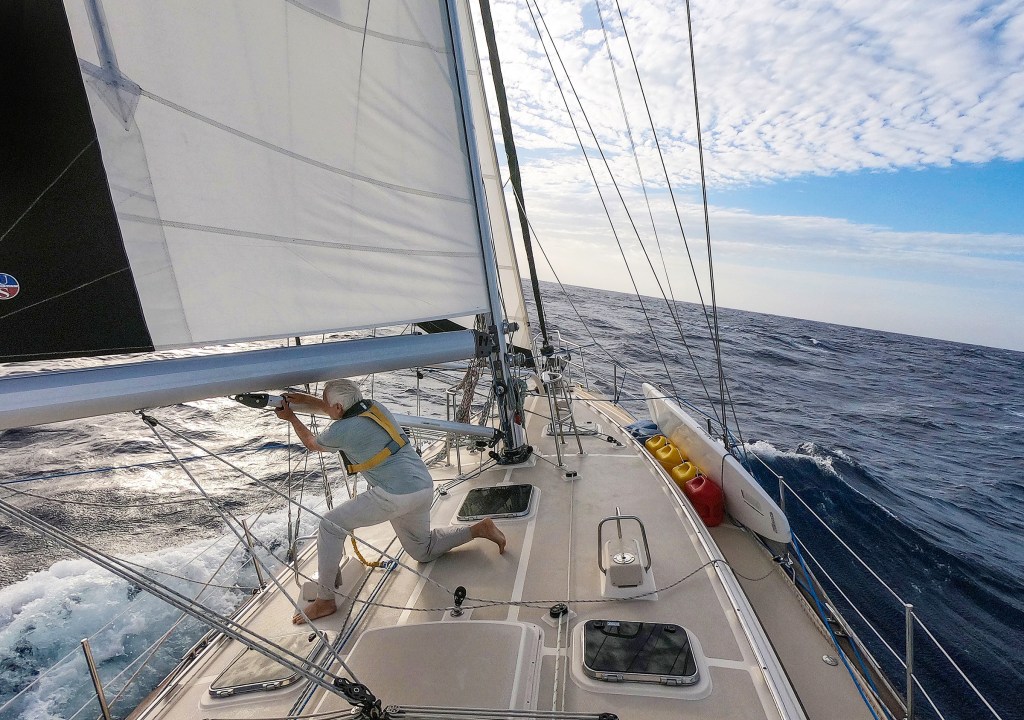


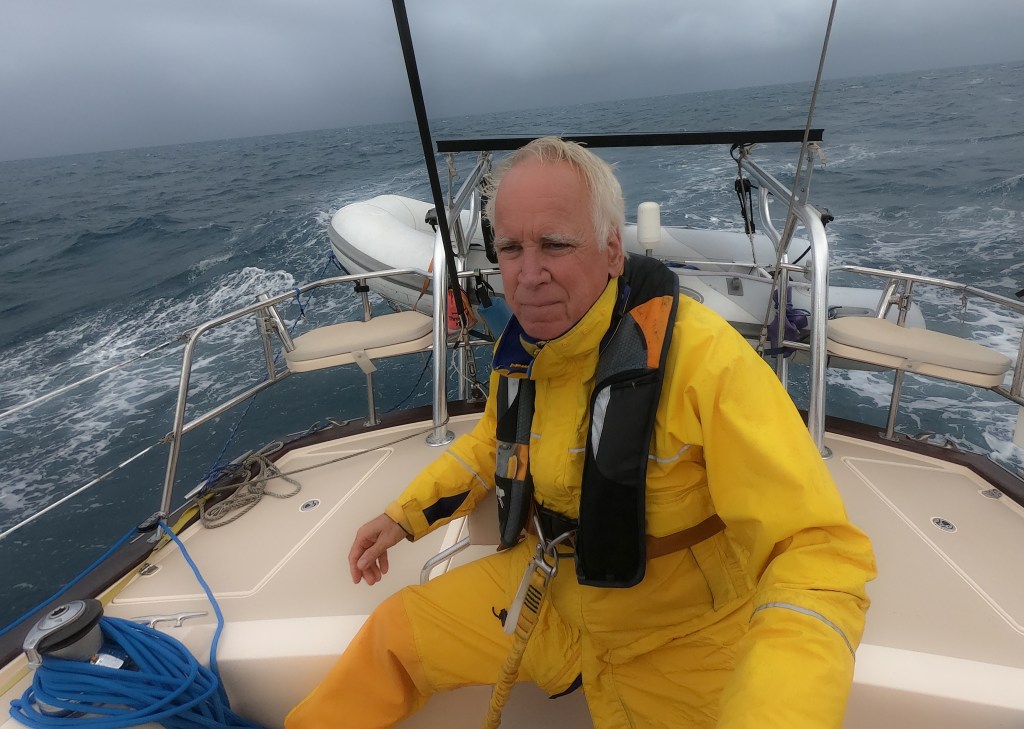
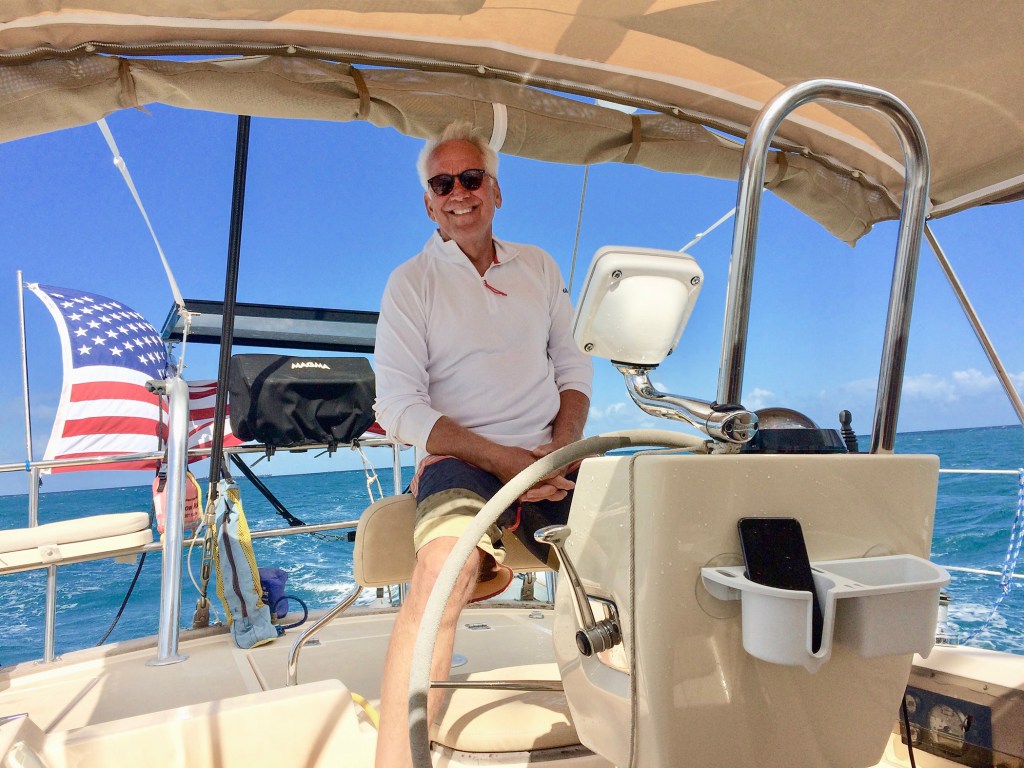













 Stella Maris Sail