Passage to the Middle Sea

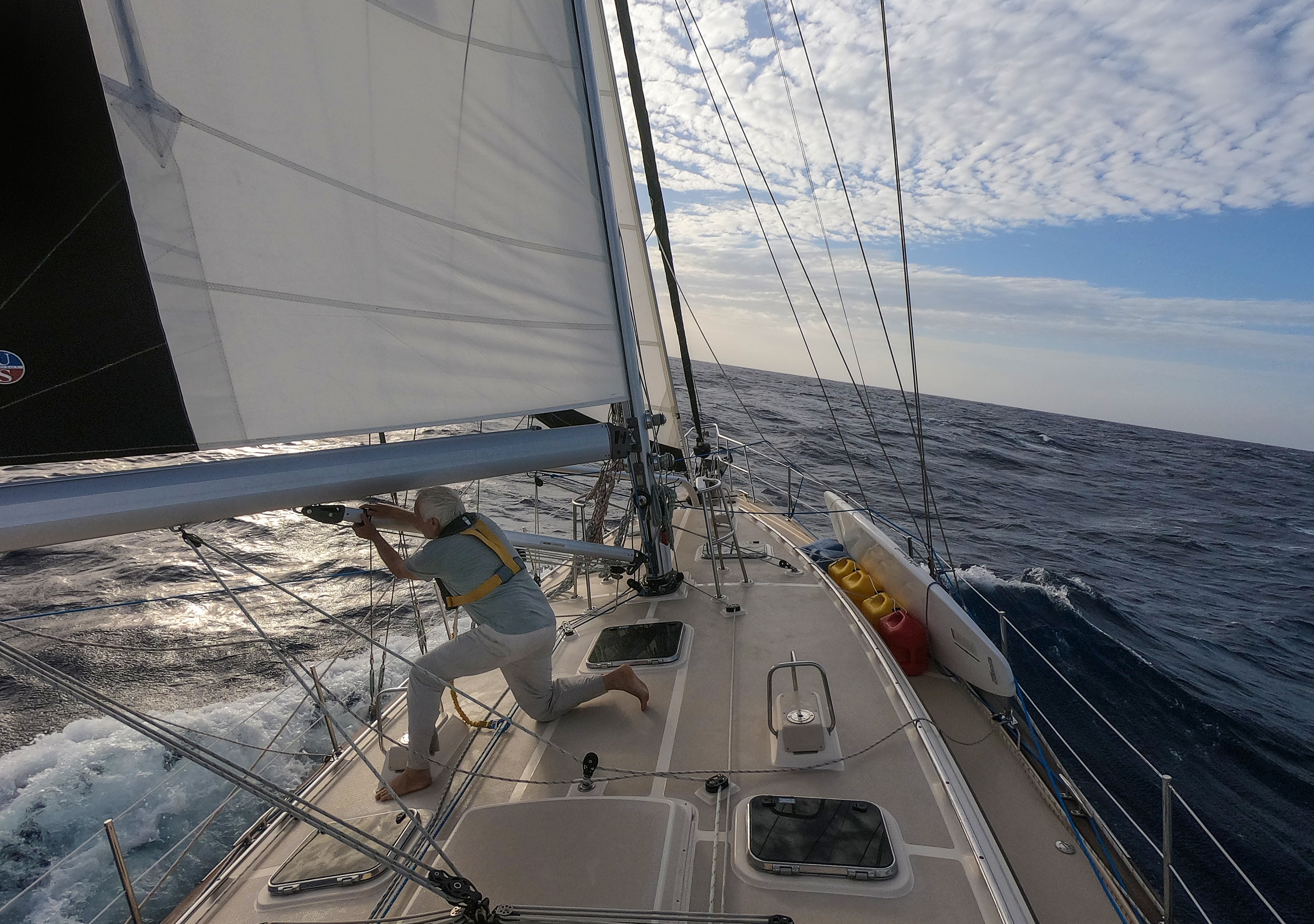
The rigging and foredeck of Flying Fish on passage in light air from Turkey to Malta. © Jeffrey Cardenas

A passage has a life of its own. Like a good book, there is a beginning, various plotlines, drama, and then it ends. The 680-mile passage of Flying Fish last week across the eastern Mediterranean from Turkey to Malta was no exception.

  • I felt some anxiety about my routing to Malta through Greek territorial waters. Greece and Turkey prohibit transit between their countries, and their war of words has recently escalated to saber-rattling.
  • Weather became an issue. A ferocious meltemi wind developed, unforcasted, soon after I departed from Turkey.
  • I experienced a startling “bump in the night” as Flying Fish’s keel met unseen rocks in a dark anchorage.
  • The meltemi turned into winter with freezing rain coating the deck.
  • As I continued into the Mediterranean, hundreds of merchant ships were stalled en route to Suez because a massive container ship had gone aground, closing the entire canal.
  • And in the middle of it all, I once again lost critical onboard electronics. Both the AIS and the autopilot became inoperative. I was electronically invisible to shipping traffic and, with my autopilot gone, I couldn’t even take my hands off the wheel to pee overboard.

Nobody said this was going to be easy.

The route from Turkey to Malta was an initial point of concern. Travel between ports in Turkey and Greece–COVID notwithstanding–has been shut down for months because of territorial sea disputes. Tensions are inflamed over an area of the continental shelf in the Aegean Sea believed to hold rich oil reserves. Territorial waters give the respective state(s) control over shipping. However, foreign ships usually are guaranteed “innocent passage” through those waters. Nevertheless, the Greek military continued a non-stop VHF radio broadcast, warning all vessels from Turkey not to “violate sovereign waters.” Short of heading several hundred miles south toward Egypt, transit through Greek territorial waters would be the only routing option for Flying Fish to sail west.

The passage began with a raging meltemi wind out of the Aegean. Meltemi winds form when a high-pressure system over Greece meets a low-pressure system over Turkey. North winds near gale force are often created in the chute between the two counter-rotating systems. Flying Fish struggled to make forward progress in steep, short-period seas between the islands. Temperatures plummeted as the northerly wind increased. Fortunately, there are abundant sanctuaries for protection from the meltemi among the Greek Islands. I dropped anchor to get some rest in a protected bay at sparsely inhabited Levitha Island, despite the questionable legality of doing so.

At 3 AM, I awoke to the sound of rock meeting fiberglass–never a good sound–and I realized that Flying Fish was not where I had dropped the anchor. In nearly 12,000 miles of sailing since leaving Key West, I had never, until this night, grounded the keel of Flying Fish. As the meltemi roared in the tight anchorage of Levitha, it created a vortex of wind spinning the boat around the anchor and into a rock below the surface. In my state of exhaustion hours earlier, I had made the cardinal error of situational awareness: I did not thoroughly examine my anchorage and allow adequate swing room. Awakened by this startling bump in the night, I sprung out of my berth, started the engine, winched up the anchor, and checked the bilge. There was no water ingress (external inspection would have to wait.) Flying Fish was floating. In pitch-black darkness and violent wind, I reversed my inward GPS track and motored out of the bay to deeper water. Only then I realized that I was half-naked and very, very cold.

“Being from the tropics, I like ice. I’m just not too fond of it when it comes out of the sky.”

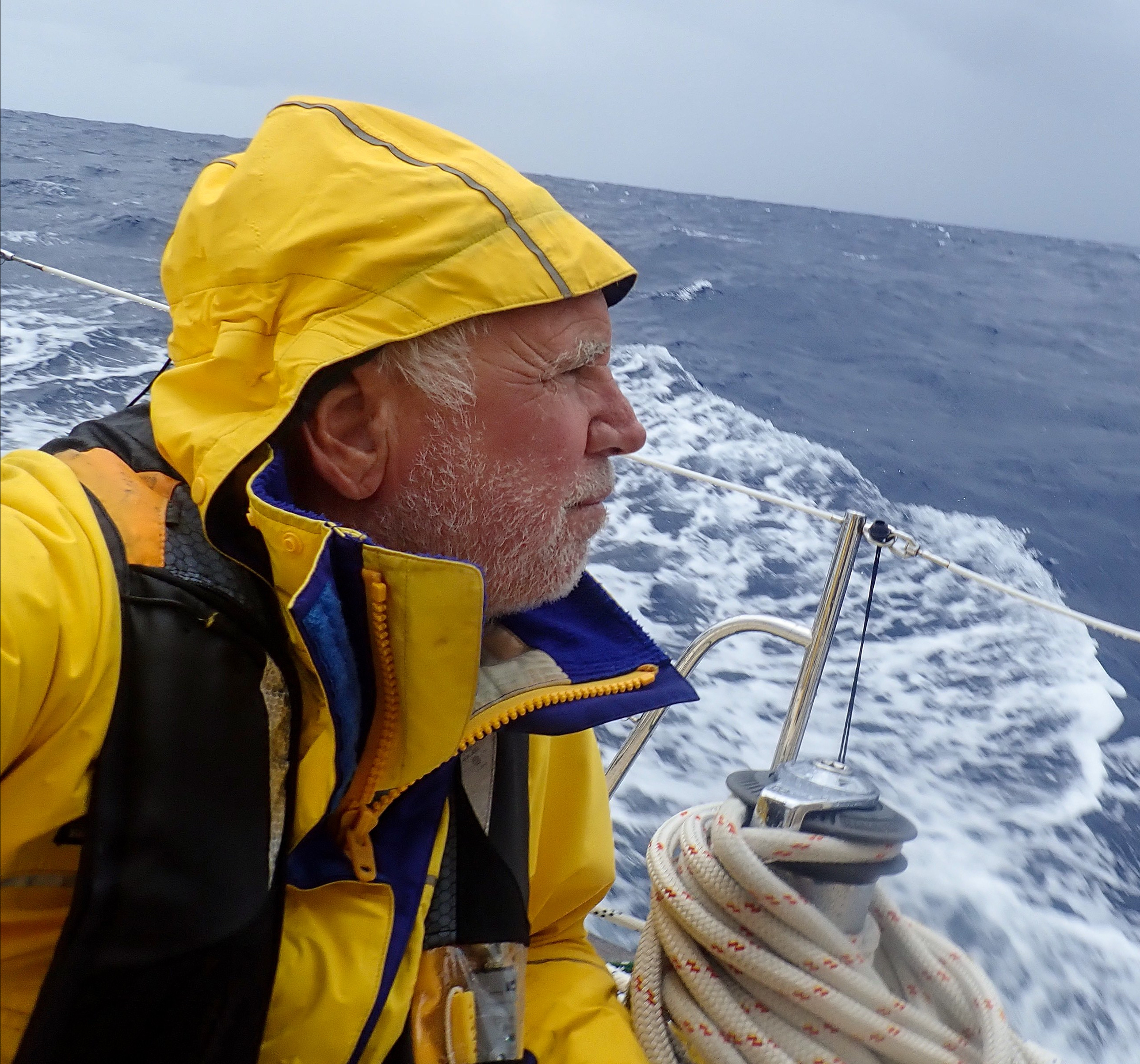
By morning there was sleet on the deck of Flying Fish. Temperatures were above 0°C on deck, but freezing rain was falling from the sky. I was still wet from the night’s activity. Being from the tropics, I like ice. I’m just not too fond of it when it comes out of the sky. I needed to find shelter and regroup. The Greek Waters Pilot guide recommends a secure anchorage at Nísos Íos. The book says of the Manganari Bay anchorage: “The island is extremely popular with young sun-lovers. Nude bathing is tolerated here.” A caïque brings beachgoers “topless and bottomless” daily from Íos. But that wasn’t happening today.

News about the blockage of the Suez Canal was scarce over my satellite reports, but I began to see an unending line of merchant ships jamming the shipping lanes toward Port Said. Deciphering lights, radio calls, radar blips, and other electronic information can be like reading code. Why is one ship moving one way while all the others are doing something different? Much of that information transmits by AIS (Automatic Identification System) to my mapping electronics. The AIS tells me who is navigating the same water as Flying Fish, essential information for collision avoidance. Most of the ships noted on AIS were tankers (empty tankers, it turned out, heading to the Middle East for more oil). One vessel was moving much faster than the others. It was listed on AIS as a “Dredging Operator,” expertise much needed considering the current circumstances. The Suez Canal blockage was now a critical event with global economic implications.

And then–poof!–all of the AIS targets vanished from my navigation screens. Simultaneously, Flying Fish turned abruptly to windward as the autopilot disengaged. Not again! A year earlier, as I began a 3,000-mile passage across the Indian Ocean, Flying Fish experienced an identical system failure. Unable to resolve the problem, I diverted first to Sumatra and afterward to Phuket for repairs (and then came COVID and a circumnavigation interrupted… but that is a different chapter for another day.) Now, 150 miles out of Malta, the situation (it always happens at night) was frustrating but manageable. I would sail the final stretch into the historic Valletta harbor the way my forebears did, using my eyes for navigation and my hands to steer. Even at night, every cloud has a silver lining.

The historic walled city of Valletta, Malta glows in the evening light. Photograph © Jeffrey Cardenas

Please click Follow at the bottom of this page so that you don’t miss a new update, and please consider sharing this post with others who might enjoy following the voyage of Flying Fish. I welcome your comments. I will always respond to your comment when I have an Internet connection. And I will never share your personal information.

You can follow the daily progress of Flying Fish, boat speed (or lack thereof), and current weather as I sail into the Mediterranean by clicking this satellite uplink: https://forecast.predictwind.com/tracking/display/FlyingfishClick the “Legends and Blogs” box on the right side of the tracking page for en route Passage Notes. 

To see where Flying Fish has sailed since leaving Key West in 2017, click here: https://cruisersat.net/track/Flying%20Fish

Instagram: FlyingFishSail
Facebook: Jeffrey Cardenas

Text and Photography © Jeffrey Cardenas 2021

Let this be a time of grace and peace in our lives   –Fr. John Baker
Three Years Before the Mast

Thoughts, Lessons, and Observations

A thousand miles from land… what happens out here can only be resolved out here. © Photograph: Jeffrey Cardenas / image by remote

“There is a witchery in the sea –Richard Henry Dana, Two Years Before the Mast, published 1840.

On this day three years ago, Flying Fish slipped the lines from her berth at Safe Harbor in Key West and was underway on a passage that has carried her nearly 22,000 miles and two-thirds of the way around the globe. Along the route there have been wonders and joy, injuries and illness, moments of fear, revelation, and accomplishment. There has also been disappointment. This year, as the COVID-19 virus infected the world, Flying Fish traveled 5,000 of those miles alone–from Thailand to Turkey–on the deck of a freighter as I waited impatiently in quarantine on the other side of the world. I certainly do not seek sympathy for being separated from a boat when millions of other people are separated from their families, some permanently. These are days in which we all live in some form of isolation–physically and emotionally–as a result of health issues, personal decisions, or just simple fate. My isolation was self-imposed when I set off from Safe Harbor. It has been a journey both inward and outward, and one with eyes wide open. Here are some of the thoughts and lessons learned from these three years aboard Flying Fish.


Patience

When things become complicated I have learned that I have two simple choices: I can either let impatience darken my horizon, or I can seek strength in what I cannot control. When I sail alone, I navigate a fine path between what is manageable and what is not. It is essential at sea to know the difference. On a 1,300-mile passage between Tonga and New Zealand in October 2018, I knew that even the best weather window at this time of year would include at least one full gale raging eastward from the Tasman Sea. We can understand the weather but we cannot control it. On this passage I watched satellite weather maps, and, later, the darkening clouds themselves. As the gale approached I braced for impact. Howling wind and massive breaking seas made it seem as if the world was ending. It wasn’t. It was just a gale. I knew that this would pass. And it did.

A face reflecting the wear-and-tear of sailing through consecutive gales en route to New Zealand. Photograph: © Jeffrey Cardenas / image by remote

Sanctity of Life

Who doesn’t believe in the sanctity of life? But the complex decision of what lives and dies at our hands is a gray area that can only be defined individually. These three years before the mast have given me a different perspective regarding co-existence on this planet. Aboard Flying Fish some days pass with no sign of life, nothing beyond my own beating heart–not birds or porpoise, not even any fish. Fish have been an important part of my life. I earned much of my livelihood as a fisherman. For decades, my job was to catch fish every day and catch as many of them as I could. In this pursuit the fish themselves became something less sentient. Sportfishing was entertainment and fish were a commodity. Catching or not catching represented profit or loss. But aboard Flying Fish, when sea life finally did appear, the creatures around me became companions during my long solitary journey. I loved watching shoals of tuna feed on the surface. My eyes followed the flight of every airborne flying fish. I was fascinated by the predatory saga when flying fish soaring above the wave tops were pursued by dorado from below and frigate birds from above. When I was hungry, I would catch one of the dorado. As one fish came to the boat it was often accompanied by dozens of its brothers. Initially, there was an overwhelming impulse to drop a line back for “just one more.” As the days and weeks at sea passed I wondered why I felt I needed more. I was just one person aboard Flying Fish. Why catch two fish when I could only eat one? I began having difficulty justifying why I wanted to feel the life struggle of another living creature? Two thoughts evolved as I gradually transitioned from anthropocentrism to a modified and more Eastern philosophy that holds all life as sacred: I learned that it is important for me to tread more softly. Equally important, I learned not to judge how others view the sanctity of life. I can live only within my own skin.

Co-existence. A Humpback whale breaches next to Flying Fish in Tonga’s Ha’apai Islands. © Jeffrey Cardenas

Changing Environment

I keep a worn copy of Rachel Carson’s The Sea Around Us aboard Flying Fish. Published in 1951, she wrote: “It is a curious situation that the sea, from which life first arose, should now be threatened by the activities of one form of that life.” I was horrified when I learned of Indonesian fishermen who poisoned and detonated homemade explosives on their pristine coral reefs. Granted, it is an effective method of fishing. The stunned reef fish float to the surface which makes gathering them more efficient. But how was it possible that those who were throwing explosives could not see that they were killing the reef for future generations? I considered this in the log of Flying Fish on August 25, 2019: “Many areas of Indonesia, including Flores Island, show evidence of reef bombing and cyanide fishing. I spent six hours on the not-yet-bombed shallow reefs of Sabibi Island yesterday. I was immersed in a dazzle and diversity of life that was simply difficult to comprehend. It was also beyond my comprehension that a person could drop explosives and poison a reef like this for the one-time opportunity to put some fish in a basket. That said, who am I to judge? My child has never been truly hungry. But would I blow up a coral reef to feed her?” How do we identify the line between immediate need and preservation for the future? And who gets to define that line?

Shallow water reefs still thrive in many parts of the tropical ocean where water quality is untainted by runoff, effluent, poison and explosive fishing devices. Photograph: © Jeffrey Cardenas

Orangutans Meet Global Economics

On the rugged island of Borneo in Southeast Asia’s Malay Archipelago there is a limestone cave believed to contain the oldest figurative art on earth, a depiction of a bull, carbon-dated to 52,000 years ago. Nearby is one of the largest coal mines in the world. Borneo is known for its ancient rainforest, home to wildlife including orangutans and clouded leopards. Soon, because of sea level rise and overpopulation, the Indonesian government will move its capital of Jakarta and 1.5 million new residents into what is left of the East Kalimantan rainforest. I have learned that even in the most remote areas of the world nothing is sacred when global economics are at stake. My daughter Lilly and I hoped to see the remaining wild orangutans so we sailed Flying Fish upriver from the south coast of Borneo. At the town of Kumai we anchored the sailboat and hired a riverboat guide to take us to the headwaters of Sekonyer River in Tanjung Puting National Park. Our destination was Camp Leakey, named after the legendary paleo-anthropologist Louis Leakey. We were amazed by the wildlife: Proboscis monkeys vaulted from the trees along the river. We heard the call of a rare rhinoceros hornbill. A False gharial crocodile warmed itself in the sun on the riverbank. And, finally, we saw wild orangutans. At the junction of two tributaries, the tannic but clear water flowing into the clear Sekonyer became jaundiced yellow in color. I asked what was causing it. Was this mud from a rainstorm upstream? “It’s always like this now,” our guide replied. “This tributary brings the runoff of mining and palm oil cultivation into the Sekonyer. Nothing lives here now.” Nothing lives here except more people with better jobs and higher incomes. But what is the cost to the natural habitat in one of the most remote places on earth?

From the security of her arboreal perch, a wild Kalimantan orangutan nurses her infant. © Jeffrey Cardenas

Vulnerability and Strength

I underestimated the level of mental and physical strength required to sail a boat around the world. It’s just sailing, right? It’s not that complicated. But when things go wrong at sea, they can go very wrong. Minor complications are exacerbated when sailing alone. Preparation is essential but even the most organized and experienced offshore sailors cannot completely prepare for the unexpected. In April 2019, I departed New Zealand for Fiji, a solo passage of 1,200 miles. Flying Fish was in better-than-new condition following a months-long refit in Opua. I was personally tuned up, too, eating “heaps” of healthy local produce and strength training daily in a nearby gym. My April departure date was based solely upon readiness and weather conditions. A dozen different weather routing sources finally established my best departure date as April 13. With a fresh Antipodean fall breeze aft of the beam I set sail from New Zealand to Polynesia. Fast forward three days to Latitude 29° 22′ 56” S and 174° 8′ 58” E, or about 700 miles SSW of Fiji. I am asleep in the cabin. Flying Fish is sailing a broad reach on autopilot in moderate but manageable conditions. All is well onboard, until it is not. I awaken suddenly to the roar of water. My world seems to turn upside down as an awful shower of glass, canned food, cookware, and a drawer full of cutlery rains down upon my head. I leap out of my berth onto shards of broken glass that tear into the soles of my feet. Water is pouring through an open hatch. In my semi-wakefulness I am convinced that Flying Fish is sinking in 13,000 feet of water. The boat has been knocked down–mast to the surface of the ocean–rolled broadside by a wave that must have exceeded by multiples any wave I had experienced since my departure from New Zealand. This rogue wave, perhaps caused by seismic activity near the Kermadec Islands, has flooded the cockpit of Flying Fish with nearly a ton of water. Gallons of seawater are inside the cabin and engine room. The boat is sitting heavy and deep. The breaking wave has stripped the deck of loose gear and canvas. A spare container of diesel on the deck has opened spreading a sheen of fuel oil and noxious fumes across the boat. I am disoriented, hyperventilating, and bleeding from the head and feet. I have never felt more vulnerable. Or alone. When my heart rate slows I realize this was a single, freak wave. The sea is once again normal. I pump water from the boat and assess damage. The hull is intact. The initial sense of vulnerability is replaced by an odd and unexpected feeling of inner strength. With the engine dead and the interior of the boat in shambles I deviate course to New Caledonia, the closest boatyard for repairs. I am still hundreds of miles and days from land but something within me has changed. I feel now as though I can face adversity at sea with a different level of confidence. I go below to make a pot of tea and attend to the debris aboard Flying Fish.

Prepping the foredeck of Flying Fish in anticipation of a gale in the Coral Sea near New Caledonia. Photograph: © Jeffrey Cardenas / image by remote

Gratitude

I returned briefly to Flying Fish in Turkey during the 2020 COVID season, but I sailed with a sense of survivor’s guilt. Was it right for me to be on a boat while others were quarantined in their homes? Now, in retrospect, I have replaced that guilt with gratitude. When we can choose the course of our lives we should consider it a privilege and act upon it. When fate chooses a different course for our lives we should seek positives along that route, even when none are immediately apparent. I recognize that this opportunity to navigate the globe is a privilege. I also know that at some point it will end. It may end sooner than I choose. Health, politics, and natural aging constraints are factors that will determine what remains possible for me aboard Flying Fish. It is essential that I live my best life, regardless of whether that life leads me to Borneo or to my backyard. During these three years before the mast I have learned that I cannot waste a single moment.

Turkey’s spiritual peak Babadağ, rising directly from sea level to a summit of 1,969 meters, watches over Flying Fish at anchor. © Photograph: Jeffrey Cardenas

Please subscribe at the bottom of this page so that you don’t miss a new update, and consider sharing this post with others who might enjoy following the voyage of Flying Fish. I welcome your comments.

I return to Flying Fish in January 2021. Once the voyage restarts you can follow the daily progress of Flying Fish into the Mediterranean, and onward, by clicking this link: https://forecast.predictwind.com/tracking/display/Flyingfish

To see where Flying Fish has sailed since leaving Key West in 2017, click here: https://cruisersat.net/track/Flying%20Fish

Instagram: FlyingFishSail
Facebook: Jeffrey Cardenas

Text and Photography © Jeffrey Cardenas 2020

Let this be a time of grace and peace in our lives   –Fr. John Baker
Wind in my Sails

DCIM100GOPROGOPR0432.JPG

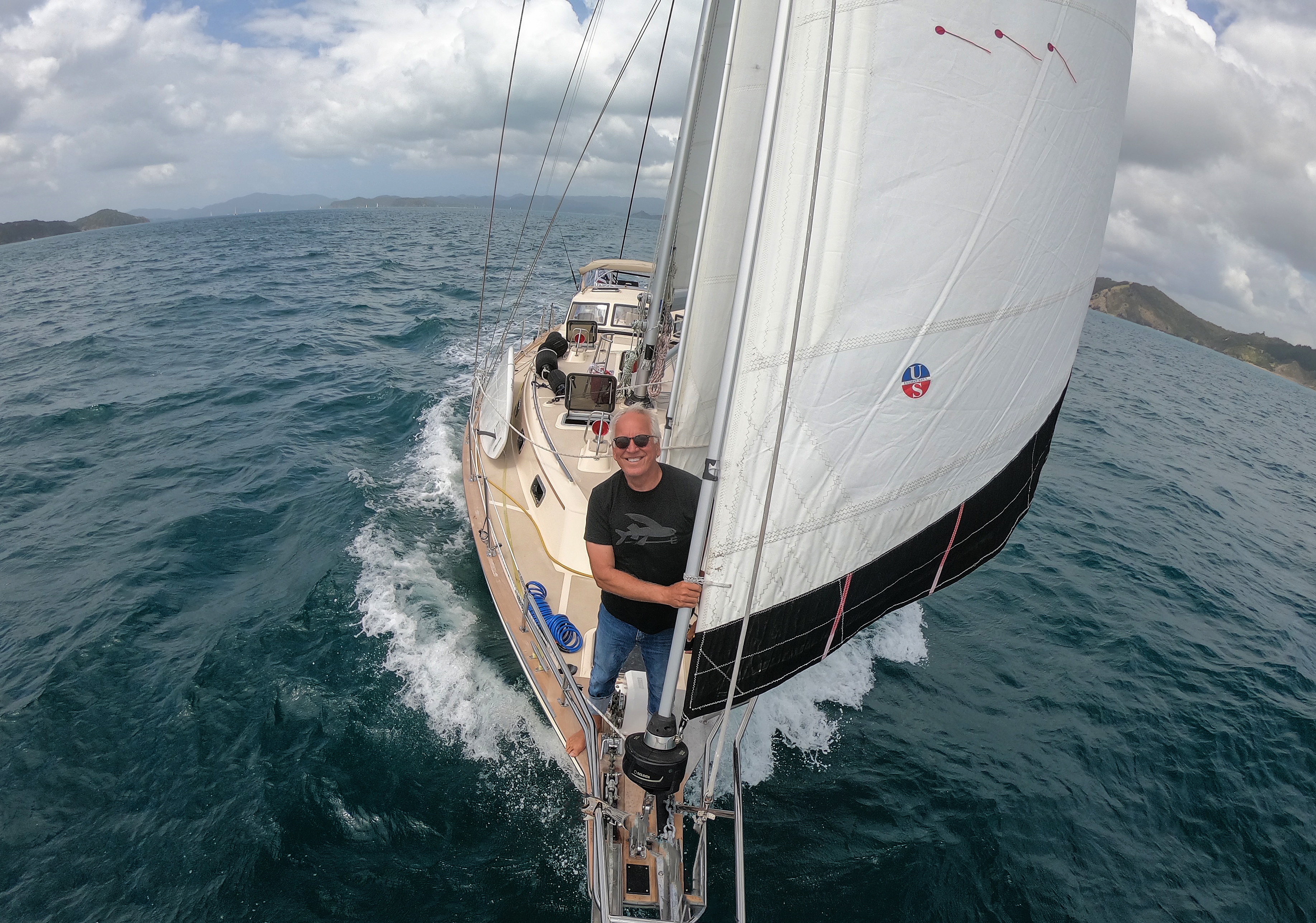
Flying Fish, just out of the boatyard and sailing again in New Zealand’s Bay of Islands. Photograph: © Jeffrey Cardenas

According to the ship’s log it is exactly 112 days and 10 hours since the sails of Flying Fish were last filled with wind.

Flying Fish has undergone a series of maintenance and repair projects that have kept her lashed to the dock and in the boatyard since her landfall in Opua, New Zealand last October. She needed a little lovin’ after the 10,000-mile passage from Key West. It has been too much time away from the water. Today Flying Fish once again spreads her wings.

The tropical cyclone season continues in the South Pacific so for another several months my passages will remain close to the safe harbor of Opua. This week I’ll sail among New Zealand’s Bay of Islands. In 100 square miles there are nearly 150 islands, some with fascinating historical antecedents.

Researchers believe large Māori migration canoes journeyed to the Bay of Islands a millennium ago from Hawaiki, the mythical home for the Polynesians dispersing across the Pacific. Captain James Cook landed here in 1769 and while he hunkered down waiting out a series of gales he charted and named the Bay of Islands. It was the first area in New Zealand to be settled by Europeans. The Māori provided the early settlers with and abundance of fresh produce and fish. The Europeans reciprocated with guns, alcohol, and venereal disease. Whalers arrived towards the end of the 18th century, and the first missionaries settled in 1814.

The missionaries and whalers did not cohabitate well. By the 1830s the settlement of Kororareka in the Bay of Islands was known as the “Hell Hole of the Pacific.” Dozens of whaleships anchored in the Bay of Islands, many of which had been at sea for over a year. Canoes filled with Māori women, “many naked and covered with fish oil” swarmed the boats to barter their favors for gunpowder and tobacco. Ashore, vagabonds, runaway sailors, and convicts bloodied each other in the crowded grog shops and brothels that lined the waterfront.

In 1835 Charles Darwin visited the Bay of Islands in HMS Beagle and left with the opinion that the European residents who had settled here were “the very refuse of society.” He described it as “the land of cannibalism, murder, and all atrocious crimes.” However, according to historian Richard Wolfe, before he departed the Bay of Islands Darwin donated £15 to fund the building of a new church. It was an ironic gesture coming from a man who would go on to publish The Origin of the Species, a treatise that would shake the foundations of Christianity.

Eventually, missionaries established a settlement a few kilometers across the bay in Paihia. Church hymns could be heard on the missionary side of the bay while gunshots echoed across the water from the Hell Hole of the Pacific.

I drop the anchor of Flying Fish in the lee of Urupukapuka Island. The water is turquoise and crystal clear. New Zealand’s Park Service maintains walking trails across the island that feature stunning panoramic views, beaches, and verdant forests abundant with native vegetation and rare birds. There are also archaeological ruins here, including the remains of author Zane Grey’s fishing camp in Otehei Bay. Grey arrived in 1926 and described the waters off the Bay of Islands as an “Angler’s Eldorado,” rich in billfish and tuna. His son Loren Grey once said that his father fished 300 days a year.

Born Pearl Gray (he later changed Pearl to Zane and Gray to Grey), Zane Grey published more than 90 books which sold in excess of 40 million copies. Over 100 films have been based upon his works. But on Urupukpuka Grey’s luxury lifestyle in the 1920s, as the worldwide economic depression loomed, chafed the local New Zealanders. He and his wealthy companions were considered the original glampers. It was said that when Grey caught a big fish he’d pull out a megaphone to announce his catch as he approached shore in his launch. Nonetheless, Grey is widely credited today with playing a major part in the foundation of New Zealand’s modern sport fishing industry. In Tales of the Angler’s Eldorado, Grey said, “The New Zealand coast is destined to become the most famous of all fishing waters. It will bring the best anglers from all over the world.”

I feel as if I am a time traveller as I sail among the the Bay of Islands. The Hell Hole of the Pacific, now named Russell, has been gentrified with chic shops, art galleries, and cafés. Offshore the New Zealand Millennium Cup is underway. Billed as the South Pacific’s premier superyacht regatta it features racing sailboats 160 feet long. The entry fee alone for this race is $5,400. On the ruins of Zane Grey’s fishing camp a group of Japanese tourists with mosquito net hats and bird binoculars chitter about while pop music plays and a server brings them burgers and beer.

It’s a little too much commotion for this solitary sailor. I tack offshore, trimming the sails to look for a quieter anchorage. I prefer to migrate toward a more simple existence where nature dictates the rules. Or as Zane Grey once said (presumably without a megaphone) “I need this wild life, this freedom.” 

OLYMPUS DIGITAL CAMERA

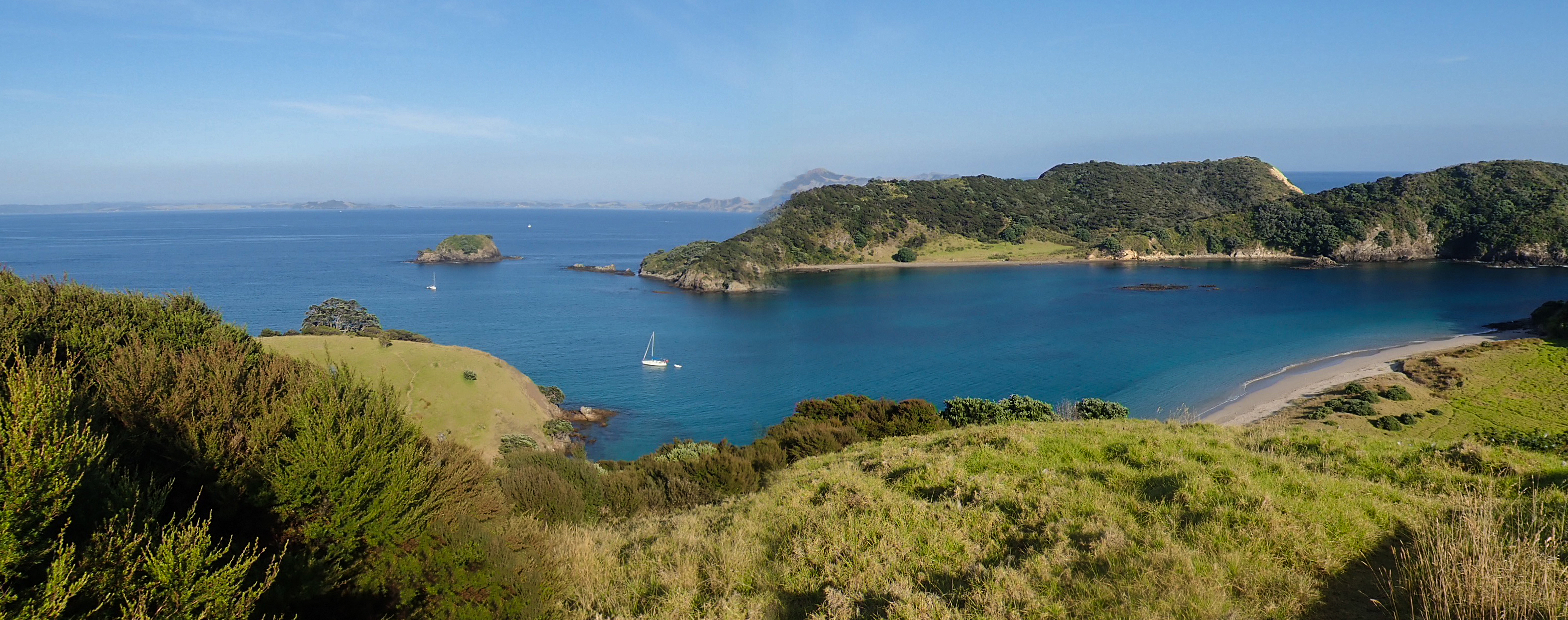
A panoramic view of Okahu Passage in New Zealand’s Bay of Islands. Photograph: © Jeffrey Cardenas

Please subscribe at the bottom of this page so that you don’t miss a new post, and please share this post with others who might enjoy following the voyage of Flying Fish

To see where Flying Fish has sailed in the past year click here: https://forecast.predictwind.com/tracking/display/Flyingfish

Text and Photography © Jeffrey Cardenas 2019

All rights reserved.

New Horizons

STELLA MARIS

&

FLYING FISH

Explore. Dream. Discover.

Twenty years from now you will be more disappointed by the things that you didn’t do than by the ones you did do. So throw off the bow lines. Sail away from the safe harbor. Catch the trade winds in your sails. Explore. Dream. Discover.” –Mark Twain

Welcome aboard! These are postings about a youthful spirit cocooned in an aging body sailing around the world trying to make sense of a changing planet. Enjoy the ride!


There is saltwater coursing through my veins—literally.

There is saltwater in all of us. The salinity of our blood is nearly identical to the salinity of the ocean. That may be a biological explanation for why I feel compelled to set sail across miles of open ocean. Other reasons are still not so clear.

When I was 25 years old, I left Florida for Europe alone in a 23-foot sloop named Betelgeuse–eight days after I was married. It was a voyage of high risk and adventure; remarkably, 45 years later, Ginny and I are still married. My life has been a blessing. I sailed in my youth. Then, I worked hard. Now, I am sailing again. After a five-year circumnavigation aboard Flying Fish, a 46-foot cutter, much of it solo, I now sail a more friends-and-family friendly catamaran–Stella Maris–designed for extended passages.

Join me as I raise the halyards once again and embark on new journeys across miles of open ocean. Sailing is not just about the wind and the sea; equally important are the places where boats carry me. Many of the passages will again be sailed single-handed. There will be challenges and personal discoveries. (At age 68, I am no longer bulletproof.) It will be the continuation of a voyage of memoir, and a reaffirmation of life on this planet.

Now, onward! Capt. Jack Sparrow said it best: “Bring me that horizon.”


Please click “Follow” at the bottom of this page so that you don’t miss a new update, and please consider sharing this post with others who might enjoy following these sailing voyages.

The most current posts always follow this welcome message. There is an post index menu on the right side of the page. I welcome your comments, and I will always respond when I have an Internet connection. I will never share your personal information.

To see where Flying Fish sailed after leaving Key West in 2017, click here.

To see the passages of Stella Maris in 2023, click here.

Instagram: FlyingFishSail and StellaMarisSailing
Facebook: Jeffrey Cardenas

Text and Photography © Jeffrey Cardenas 2024

Let this be a time of grace and peace in our lives – Rev. John C. Baker