Octopus’s Garden

An octopus has the highest brain-to-body mass ratio of all invertebrates and a camera-like eye that can distinguish the color and polarization of light. The eye follows me as I swim past. Photograph: © Jeffrey Cardenas

I’d like to be 
Under the sea 
In an octopus’ garden 
In the shade
…”

It seems you can’t swing a cat in the Mediterranean this summer without hitting a movie star. Meet my new neighbor, the Oscar-winning Octopus Teacher. Actually, I’m the new neighbor; the octopus lives here. And this isn’t really the Octopus Teacher (that famous cephalopod lived in South Africa). But here in the Mediterranean, during the summer, everybody is whoever they want to be. No questions asked.

I am who I want to be, and in the summer where I want to be is under the sea. My tropical island blood has finally acclimated to the ambient water temperature at latitude 40° north. In about six weeks, the Mediterranean Sea begins getting cold again. Today is my first dive of the year. “Dive” is an exaggeration. I float in the shallows with a mask and snorkel, and camera. It is otherworldly. There are shrimp and crabs and anemones. The variety of life that lives among the rocks and Poseidon grass in the Mediterranean is astounding. To see these shallows come to life it is only necessary to move slowly and pass over the sea bottom like the shadow of a cloud.

Life underwater is always a surprise. Today I am swimming along part of the Menorca shoreline supported by an antique seawall. Giant blocks were laid here in 1793 to build the Llatzeret, a sanatorium to quarantine patients during the Bubonic Plague. It seems ironic with a history of so much death above at Llatzeret that these rocks in the water below the fortress would support such a thriving community of sea life. It is here I meet my octopus friend.

I am enchanted. From the depth of her cave, she holds her ground by siphoning bursts of water at me and never breaking eye contact. (A note on gender reference: It takes more skill than I have to determine the sex of an octopus but, for personal reasons, I’ll reference this amazing creature as female.) She is confident and beautiful. Her body pulsates and changes color with emotion as we meet eye-to-eye. Nonetheless, it is clear that this is a creature that will not suffer fools gladly. In a Live Science article titled, “Animal Sex: How Octopuses Do It,” writer Joseph Castro says females are the dominant gender. If a male displeases her, she may show her disappointment by eating him alive. He writes, “Mating for males is a dangerous game due to the female’s penchant for cannibalism.”

I’m not here to mate. I’m just as curious as she is.

Friend or foe? With eyes blazing, the octopus leaves her lair to investigate a curious intruder in her territory. Photo: © Jeffrey Cardenas

Much of the circumnavigation of Flying Fish has been along the equator in warm water rich in sea life. The Mediterranean Sea has been less inviting. There were freezing temperatures (literally) in Turkey this past winter. In my boat cabin without heat, I would sleep under quilts and blankets, and a zipped-up down jacket to stay warm. For much of the year, swimming was out of the question. I remember dropping an essential ratchet wrench overboard at a mooring one February morning. The water was only three meters deep. I looked at that wrench under the boat every day for a month, but I could not bear the thought of diving into 57-degree water to retrieve it.

Now it is mid-July. I can swim again. The pleasure of the summer sun warms my skin. The water caresses me as I float with the tide. Below the surface of the water, a new world awaits.

“We would be so happy, you and me
No one there to tell us what to do
I’d like to be under the sea
In an octopus’s garden with you…”

–Octopus’s Garden / The Beatles 1969


Sailing is not just about the wind and the sea; equally important are the places to which this boat takes me.

Please click Follow at the bottom of this page so that you don’t miss a new update, and please consider sharing this post with others who might enjoy following the voyage of Flying Fish. I welcome your comments. I will always respond to your comment when I have an Internet connection. And I will never share your personal information.

You can follow the daily progress of Flying Fish, boat speed (or lack thereof), and current weather as I sail into the Mediterranean by clicking this satellite uplink: https://forecast.predictwind.com/tracking/display/FlyingfishClick the “Legends and Blogs” box on the right side of the tracking page for en route Passage Notes. 

To see where Flying Fish has sailed since leaving Key West in 2017, click here: https://cruisersat.net/track/Flying%20Fish.

Instagram: FlyingFishSail
Facebook: Jeffrey Cardenas

Text and Photography © Jeffrey Cardenas 2021

Let this be a time of grace and peace in our lives   –Fr. John Baker

Casu Marzu

Eating the Rare Sardinian Delicacy of Maggot-Infested Cheese

Cheese aficionados pair maggot-infested casu marzu with traditional carasau bread and a good local red wine such as Cannonau. Lots of Cannonau. Photograph: © Jeffrey Cardenas

In the spirit of, “I may never pass this way again,” I could not leave Sardinia without first having eaten casu marzu–the rare and illegal delicacy of maggot-infested cheese. What could go wrong?

Translation first: Casu marzu in Italian literally means, “putrid, rotten cheese.” The beauty of the Italian language is that it is direct; Italians say exactly what they mean. Casu marzu is not a “fragrant” cheese or a “bold” cheese. Casu marzu is a decomposing cheese. It is crawling with worms. And Italians will risk breaking the law just to get a taste of it.

The creation of a fine casu marzu begins normally enough as a classic sheep’s milk pecorino. Then the process gets a little weird. The cheese is left outside in the heat of summer with part of the rind removed. This attracts the cheese fly, Piophilidae, which can lay more than 500 eggs at one time. The larvae hatch and emerge as translucent white worms eating through the cheese. The process then goes from fermentation to a stage of decomposition, brought about by the acid from the maggots’ digestive system breaking down the cheese fats. The cheese texture becomes soft and creates a weeping liquid called làgrimas–teardrops. By the time it is ready for consumption, a typical casu marzu will contain thousands of maggots.

When I first asked about casu marzu, the local formaggiaio in Carloforte wagged his finger at me and then turned away. A street vendor was more forthcoming. “There is an open market on Wednesday,” he said. “Follow your nose.” At the open market, there were several cheese vendors. One said, in English, “Casu marzu? Of course. We have.” When he showed me the cheese, I asked where the worms were. “Ah,” he said, “the worms were here, but now they have gone away.” Casu marzu is considered by many Sardinians to be unsafe to eat when the maggots in the cheese have died.

Another cheese vendor, working out of the back of a truck, was cautiously watching our exchange. That’s the guy, I thought.

When I asked him for casu marzu he looked to his right, then looked to his left, and said, “Sei la polizia?” I laughed, “Do I look like the police?” He laughed and pulled out a white plastic construction bucket he had hidden under a table near his truck. When he took the towel off the top of the bucket it was filled with wheels of foul-smelling cheese crawling with worms. “I’ll buy a half-kilo,” I said, “but please hold the cheese in your hands so that I can make a photograph.” His face went serious. He shook his head no and then held out his arms with his wrists crossed like he was in handcuffs. “No photo,” he said. “Formaggio, si. Io, no.”

Casu marzu presents an interesting paradox for Italian cheese aficionados. It has been considered illegal by the Italian government since 1962, due to laws that prohibit the consumption of food infected by parasites. Those who sell casu marzu can face fines up to €50,000. European regulators in 2002 reinforced the law making the cheese illegal not only in Italy but also in all the common EU markets. Casu marzu is also illegal in the United States.

The cheese remains a revered delicacy. Despite official health concerns, Sardinians consider casu marzu safe. (Sardinia has the highest percentage of people living to 100 years or beyond. The proportion of centenarians in the population is twice the rate considered normal for the rest of the world.) Also, as a traditional product of Sardinia, it is locally protected, although it still remains available only on the black market. There is, however, a formal proposal pending before the EU to give casu marzu DOP (Protected Designation of Origin) status like other cheeses and fine wines.

So what is it like to eat cheese infested with worms? You had better enjoy eating strong cheese, and cover your eyes. Casu marzu has the taste and texture of aged gorgonzola, but it moves. Writer Kara Goldfarb describes it best:

“When eating the cheese, one is meant to close their eyes. It’s not to avoid looking at the maggots as you eat them but to protect your eyes from them. When bothered, the maggots will jump up, sometimes going as high as six inches. Next tip, it is imperative for one to properly chew and kill the maggots before swallowing. Otherwise, they can live in the body and rip holes through the intestines… The next step is less of a safety precaution and more of a way to just enhance the culinary experience. It’s advised to enjoy the casu marzu with a moistened flatbread. It also pairs well with a glass of strong red wine. Potentially because the two go well together, possibly because of the added liquid courage.”

In the end, being able to taste casu marzu is a cultural experience that I consider a necessity of travel. I remember eating the fruit durian when I was sailing through Sumatra. It smelled like raw sewage but tasted like a rich custard. Years ago, in a no-name restaurant in the Chinese ghetto off Tiananmen Square, I asked for the house specialty and was served a bull’s penis. These are the things that make our journeys rewarding.

Yes, those are maggots crawling out of the cheese… Photograph: © Jeffrey Cardenas

Sources:

“Maggot Cheese,” Gordon Ramsey, https://youtu.be/vZ_-JzM-YQg

Casu Marzu Cheese Is Dangerous, Illegal, And Filled With Maggots,” ATI, Kara Goldfarb

“Cazu Martzu,” Wikipedia

Most Rotten Cheese,” The World’s Worst: A Guide to the Most Disgusting, Hideous, Inept, and Dangerous People, Places, and Things on Earth, Mark Frauenfelder


Sailing is not just about the wind and the sea; equally important are the places to which this boat takes me.

Please click Follow at the bottom of this page so that you don’t miss a new update, and please consider sharing this post with others who might enjoy following the voyage of Flying Fish. I welcome your comments. I will always respond to your comment when I have an Internet connection. And I will never share your personal information.

You can follow the daily progress of Flying Fish, boat speed (or lack thereof), and current weather as I sail into the Mediterranean by clicking this satellite uplink: https://forecast.predictwind.com/tracking/display/FlyingfishClick the “Legends and Blogs” box on the right side of the tracking page for en route Passage Notes. 

To see where Flying Fish has sailed since leaving Key West in 2017, click here: https://cruisersat.net/track/Flying%20Fish.

Instagram: FlyingFishSail
Facebook: Jeffrey Cardenas

Text and Photography © Jeffrey Cardenas 2021

Let this be a time of grace and peace in our lives   –Fr. John Baker

Kidney Stones at Sea

Okay, I’m in Italy; a little drama is permitted… But, trying to pass kidney stones while sailing alone is no laughing matter. This fashionable model for the anti-spasmodic tonic Schoum Forte clearly shares my pain. Illustration credit: Soluzion Schoum Forte

There was that full horizontal knockdown from a rogue wave roaring out of the Southern Ocean. Also during these travels around the globe aboard Flying Fish: I cleaved open my scalp on a sharp edge of fiberglass, I broke a tooth, I nearly severed a toe. And, by the grace of God, I somehow avoided COVID-19 despite being in a crowded market in Langkawi during Chinese New Year in February 2020. Yet, no drama I have experienced compares with trying to pass a kidney stone alone on this boat.

I am on the island of San Pietro in Sardinia today. Carloforte is a lovely town, even through this lens of pulsating pain emanating from the area of my kidneys. There are no internists or urologists here, so I am self-diagnosing. I sought confirmation from a local pharmacist who winced at my Italian and then recommended an anti-spasmodic kidney detox tonic called Soluzione Schoum Forte. The tonic looks like a local Vermentino, but unfortunately, it doesn’t taste like one. First failed lesson: Understand the dosage: I thought, “due cucchiai da tavola, quattro-sei volte al giorno” meant, “take four to six spoonfuls twice a day.” Wrong. I got it backward. In the aftermath of that first triple dosage, I thought I would see that little girl with the spinning head from the Exorcist

It is estimated by the National Kidney Foundation that one in ten people will have a kidney stone at some time in their lives. Hopefully it won’t happen on a boat in a distant port-of-call. Kidney stones form when certain chemicals become concentrated enough in the urine to form crystals. These crystals grow, and as they make their way through the urinary tract, it hurts.

“Is this what killed Popeye?”

Peta Owens-Liston, ARUP Laboratories Science Writer

There are a lot of myths about what causes and prevents kidney stones. They can be caused by various conditions, including diet, dehydration, medications, infections, and genetics. Foods rich in oxalate, such as spinach, can contribute to stone formation. One thing is sure, passing a kidney stone is memorable. “It woke me up in the middle of the night. It left me gasping and sobbing. Screaming. Someone was sticking a knife in me and slowly turning it,” medical correspondent Petra Owens-Liston writes.

Preventative measures include changes to your diet. I don’t drink enough water when I am on the boat, I use too much salt, I enjoy coffee and good wine. Those can all lead to dehydration and, ultimately, kidney stones. Remedies can include medically blasting the kidney with sonic waves to break up stones. As a last resort, kidney stones can be surgically removed. One friend suggested a more straightforward solution. Her brother had a kidney stone and he felt the pain move down his back as the stone proceeded through the urinary tract. “Jump up and down a lot,” she said. “Gravity is your friend.” My Plan B to help move things along is to try a massage therapist; my happy ending would be the exorcism of this demon that lives in my plumbing.

Those are not seashells. A collection of kidney stones from ARUP Laboratories

With all seriousness, I realize that passing a kidney stone is a “first world problem.” To those who are truly suffering from more severe events in their lives, I mean no affront. We tend to focus on our own little orbit, especially when we are alone. Still, it is helpful to remember that there are more serious issues outside of our personal bubble.


Sailing is not just about the wind and the sea; equally important are the places to which this boat takes me.

Please click Follow at the bottom of this page so that you don’t miss a new update, and please consider sharing this post with others who might enjoy following the voyage of Flying Fish. I welcome your comments. I will always respond to your comment when I have an Internet connection. And I will never share your personal information.

You can follow the daily progress of Flying Fish, boat speed (or lack thereof), and current weather as I sail into the Mediterranean by clicking this satellite uplink: https://forecast.predictwind.com/tracking/display/FlyingfishClick the “Legends and Blogs” box on the right side of the tracking page for en route Passage Notes. 

To see where Flying Fish has sailed since leaving Key West in 2017, click here: https://cruisersat.net/track/Flying%20Fish.

Instagram: FlyingFishSail
Facebook: Jeffrey Cardenas

Text and Photography © Jeffrey Cardenas 2021

Let this be a time of grace and peace in our lives   –Fr. John Baker

Passing in the Night

Early morning landfall in Italy after crossing the Stretto di Sicilia between Africa and Europe. © Jeffrey Cardenas

From the Log of Flying Fish: 10 May 2021

I am sailing tonight through a chokepoint of continents.

Sicily and Europe are to starboard; the bright illumination of Palermo is visible far out to sea. To port, in darkness, there is Africa and the Tunisian shoreline once known as the Barbary Coast.

At 04:00 on this moonless night, I see the jaw-dropping silhouette of a mega yacht pushing fast to the east. My AIS shows the vessel as the 532-foot pleasure craft Eclipse, bound for Dubrovnik. Owned by Russian oligarch Roman Abramovich, Eclipse is said to be valued at nearly $1 billion. As it roars past, purple vanity lights under its hull shine deeply into the Mediterranean Sea.

This chokepoint is also one of the primary transit routes for migrants fleeing poverty and politics in Africa. Over 700,000 Africans crossed the Stretto di Sicilia to Italy in the past decade with the hope of opportunity and a new life in Europe. Most migrants leave the African shoreline entrusting their fate to human traffickers who grossly overload small boats of questionable seaworthiness with men, women, and children who can pay the price. Many pay the ultimate price; thousands have drowned making this passage. Human cargo passing through these waters continues to be a frequent, sometimes nightly, occurrence.

I have been thinking about this narrow passage in the Stretto di Sicilia for some time, wondering how I would respond if the shadow of a struggling migrant boat appeared to port, just as the silhouette of Eclipse had appeared to starboard.

If a private vessel, like Flying Fish, makes contact with migrants in the Mediterranean–even to lend assistance–it is an offense punishable by imprisonment from European Union authorities. Captains have been convicted of “human trafficking” for aiding migrants they felt were in distress. The irony is that international maritime law requires a captain to lend assistance to anyone in distress at sea. This legal contradiction would be fascinating to hear debated in a courtroom, but preferably not as a defendant.

Radio traffic is silent from the surveillance aircraft and patrol vessels in the straits tonight. I encounter no migrants on this dark expanse of water.

Larger questions loom: As I sail onward aboard Flying Fish, I wonder what am I doing for the greater global good? How do I reconcile my privilege and opportunity while others flee their homes with only the clothing on their backs? What is the solution? And if I am not a part of the solution, am I a part of the problem?

Along the Barbary Coast, some might argue that what is truly barbaric is the vast economic disparity of those of us aboard ships who are simply passing each other in the night.

###


Sailing is not just about the wind and the sea; equally important are the places to which this boat takes me.

Please click Follow at the bottom of this page so that you don’t miss a new update, and please consider sharing this post with others who might enjoy following the voyage of Flying Fish. I welcome your comments. I will always respond to your comment when I have an Internet connection. And I will never share your personal information.

You can follow the daily progress of Flying Fish, boat speed (or lack thereof), and current weather as I sail into the Mediterranean by clicking this satellite uplink: https://forecast.predictwind.com/tracking/display/FlyingfishClick the “Legends and Blogs” box on the right side of the tracking page for en route Passage Notes. 

To see where Flying Fish has sailed since leaving Key West in 2017, click here: https://cruisersat.net/track/Flying%20Fish.

Instagram: FlyingFishSail
Facebook: Jeffrey Cardenas

Text and Photography © Jeffrey Cardenas 2021

Let this be a time of grace and peace in our lives   –Fr. John Baker

Traditional Maltese Boats (and Kannoli)

A boat owner paints his luzzu with pride (and a little music from the earbuds) at the traditional fishing harbor of Marsaxlokk in Malta. © Jeffrey Cardenas

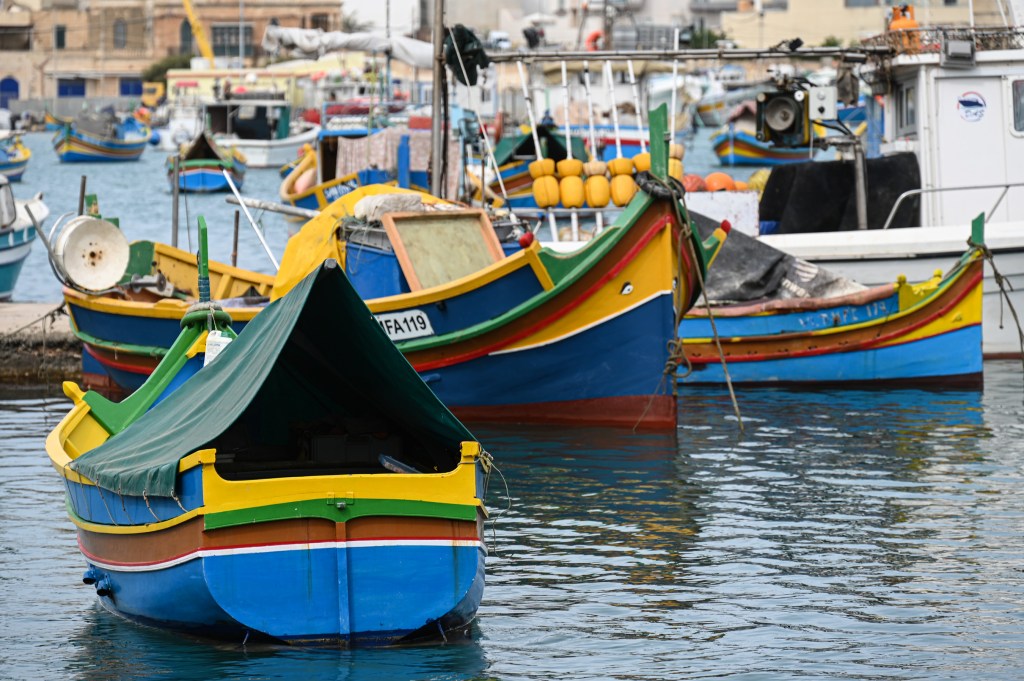
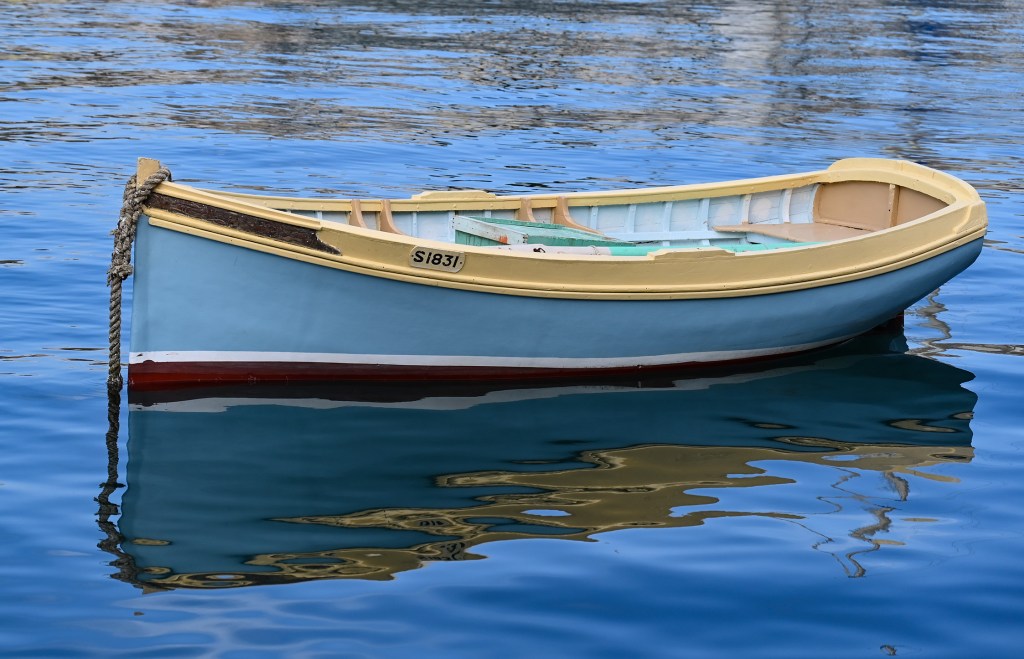
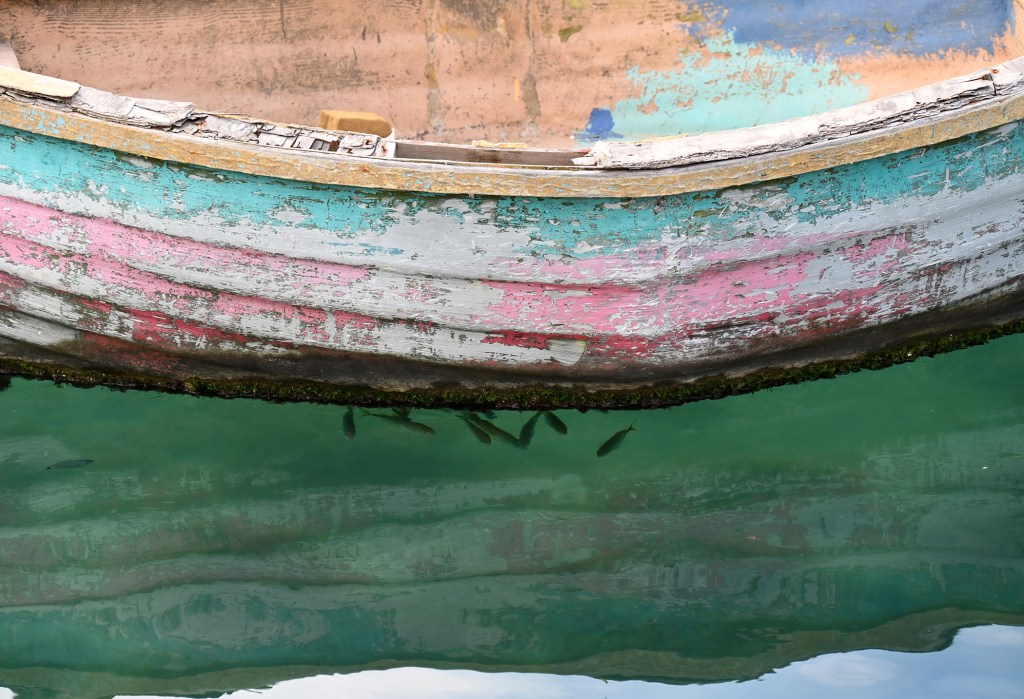
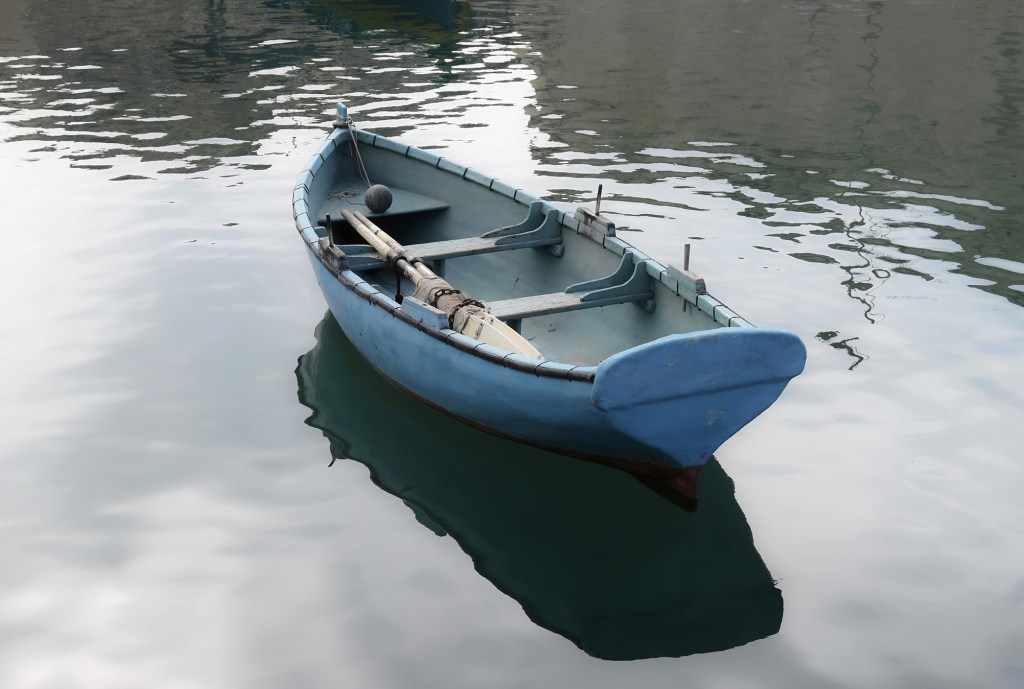
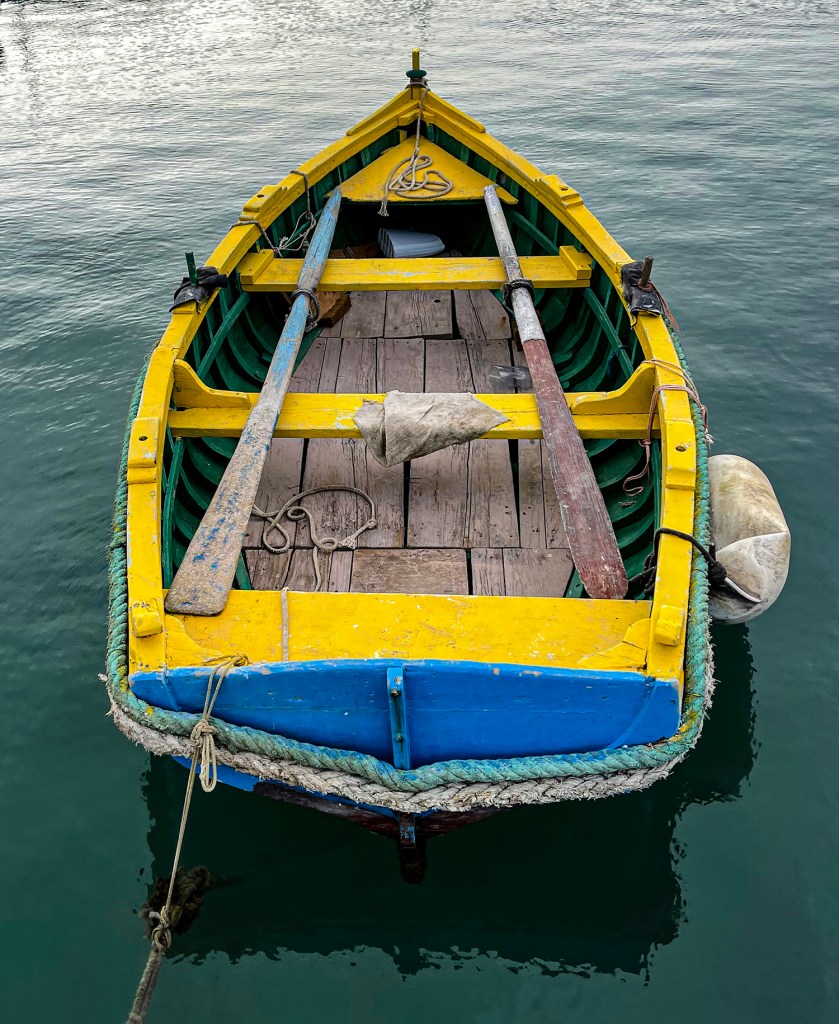
Maltese fishermen come from a long line of seafarers. I watch them moving about in the early morning of Msida Harbour, readying their traditional boats for another day on the water. Brightly painted luzzus and handcrafted rowing dories are loaded with nets and provisions. I am preparing for another day on the water, too. I will leave in a few hours on a 320-mile passage from Malta to Sardinia. I have a long to-do list this morning in Msida, but my attention is diverted by the scent of fresh-from-the-oven Maltese kannoli coming from the Busy Bee Bakery. Hmmm, I think as I turn toward the bakery. A sailor can’t go to sea without proper provisions…

The images of Malta’s traditional boats (not to mention the island’s kannoli) created memories I will carry on departure from this unique island. I arrived in Malta at a difficult time. The island was still in pandemic lockdown. Bars, restaurants, churches (even bakeries!) were closed indefinitely. Life was at a standstill, except at the waterfront. Each day, the sea came alive with fishermen in their traditional multicolored boats. Not even the worst virus in a century could stop the Maltese from going to sea.

It is interesting which images of a place etch into the grey matter and which fade away. I will sail from Malta with a little bit melancholy–there is never enough time–but also with a debt of gratitude. And, if things get rough, I have a sack of fresh-from-the-oven Maltese kannoli to help me along my way.


Malta’s Busy Bee kannoli. Passage provisions.

Sailing is not just about the wind and the sea; equally important are the places to which this boat takes me.

Please click Follow at the bottom of this page so that you don’t miss a new update, and please consider sharing this post with others who might enjoy following the voyage of Flying Fish. I welcome your comments. I will always respond to your comment when I have an Internet connection. And I will never share your personal information.

You can follow the daily progress of Flying Fish, boat speed (or lack thereof), and current weather as I sail into the Mediterranean by clicking this satellite uplink: https://forecast.predictwind.com/tracking/display/FlyingfishClick the “Legends and Blogs” box on the right side of the tracking page for en route Passage Notes. 

To see where Flying Fish has sailed since leaving Key West in 2017, click here: https://cruisersat.net/track/Flying%20Fish.

Instagram: FlyingFishSail
Facebook: Jeffrey Cardenas

Text and Photography © Jeffrey Cardenas 2021

Let this be a time of grace and peace in our lives   –Fr. John Baker