Pink Iguanas and Other Wildlife Humiliations

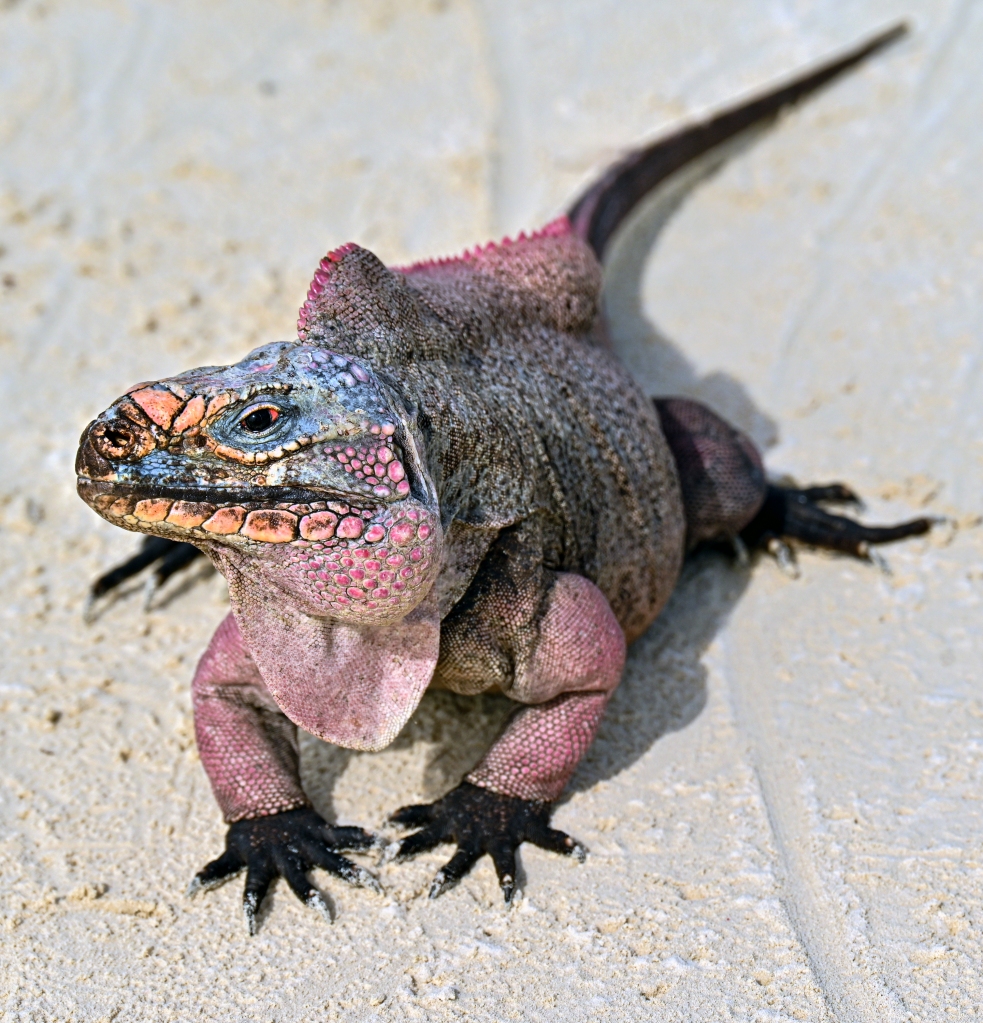
A pink rock iguana strikes a pose on an Exuma beach and begs for people food. Photograph: © Jeffrey Cardenas

I confess I was entertained the first time I saw a pink iguana trundling out of the scrub to greet me. A pink iguana? It was like a Bahamas Barbie with black shoes and a lizard’s face.

On other beaches in the Exumas, there are swimming pigs, stingrays that nuzzle your toes, sea turtles that want grocery-store lettuce, and nurse sharks the size of linebackers that photobomb your snorkeling adventures. 

These wild creatures have become a significant revenue center for Bahamian tourism, and for other destinations worldwide. In Exuma, charter boats carry hundreds of visitors to islands daily for the “wilderness adventure” of getting close–sometimes too close–to wildlife scavenging for human food scraps. 

Swimming with the pigs has become one of the “must-do excursions in the Bahamas,” according to one tour operator’s sales pitch. “They (the islands) are visited annually over 6.6 million times. Swimming with the pigs has become internationally famous.”

Whose idea was this, and where did the pigs come from? According to the company Swimming with Pigs, the swine were brought to an uninhabited island in the Exumas “by farmers decades ago to rid Staniel Cay Village of the stench.” Now, tourists pay big money to experience it for themselves. A private eight-hour tour costs $3,900, “excluding snacks, towels, gratuity, and a 5% credit card processing fee.”

There is etiquette for swimming with pigs. Posted rules include:

  1. Feed the pigs only approved foods, which are mostly bread, fruit, and vegetables. Your tour guide will provide you with information about other foods acceptable for feeding.
  2. Don’t feed the pigs on the beach. Keep their survival instincts in-tact [sic] by feeding them in the water.
  3. Be cautious. Don’t feed directly from your hand. Gently toss the food in the water beside the pig. Pigs are not very coordinated creatures.
  4. Do not alarm the pigs. Don’t take advantage of them. Do not harm them. These Exuma pigs are still wild animals and can be dangerous if threatened. (The italics, for emphasis, are mine.)

To corroborate the importance of Etiquette Rule Number 4, Google the phrase, “Venezuelan Instagram model Michelle Lewin Bitten by Wild Pigs.” Ms. Lewin found out the hard way that pigs crave people food when she was chased by wild swine on Big Major Cay. Apparently, it wasn’t too traumatic for her because she laughed and posted a close-up image of the raw-looking pig bite on one globe of her buttocks. She now has 16 million followers on Instagram.

And then there was this pandemonium when the television show The Batchelor filmed an episode on Pig Beach:

For those who don’t know, the premise of The Batchelor is a single, handsome guy who entertains a bevy of attractive young ladies from whom he is expected to select a fiancée. This guy in this episode entertained the girls on Pig Beach. I wonder how that worked out for him.

But it’s not just pig swimming that you get for $3,900 a day. The tour also includes visits to harbors where you can (for an extra fee) swim with nurse sharks. These are large, docile creatures that usually eat crustaceans, but they have become accustomed to being fed fish parts when humans are present. Some tourists forget that these sharks are also wild animals.

Katarina Zarutski, a 19-year-old nursing student at the University of Miami, was bitten by a nurse shark while vacationing in Exuma. According to an account in Business Insider, she posed for a photo in the water, and one of the sharks bit her arm and dragged her underwater for nearly eight seconds. She healed from the shark bite after undergoing multiple rounds of antibiotics to prevent infection, and surgery to remove pieces of nurse shark tooth embedded in her arm.  

“I respect wildlife tremendously,” she told Business Insider. “They’re wild animals, and it’s an uncontrollable situation. It’s important to remember to be careful.” The magazine reported that after the story of her shark bite went viral, Zarutskie’s Instagram went from having around 13,000 followers to 46,000 followers.

Another Exuma charter company promotes their tours this way: “After experiencing eye-catching scenic views, you meet with friendly sharks and iguanas trained by professional instructors to create your custom experience by touching, feeding, and interacting with our pleasant marine mammals. During the tour, our captivating team not only creates an ambiance with relaxation for body, mind, and soul but prepares a special blend of our secret ingredient, Bahamas Experience, while sipping aromatic cocktails and beers with notes of mango on the open waters, admiring a panoramic view of the picturesque waters, sandbank, and cays. Can your vacation taste any better? Like Dunkin Donuts… ‘It’s worth the trip.'”

I also wanted to “taste the experience,” but I don’t like crowds, so I pulled my dinghy ashore on Leaf Cay late in the day after the tours had ended. I had watched a dozen boats, commercial and private, land on the beach of this gorgeous 30-acre undeveloped island. Leaf Cay may be undeveloped, but it is inhabited–by hundreds of Bahamian northern rock iguanas.

As I stepped onto the island, the underbrush rustled, and dozens of fat pink iguanas suddenly surrounded me. They looked at me with shifty red eyes, and when they saw that I didn’t have food in my hands, one by one, they turned away to find a warm stone and wait for a more generous visitor. 

The Bahamian northern rock iguana is a colorful species of lizard that has seen its numbers decline in recent years. Less than 5,000 animals still linger in the wild, and Leaf Cay remains one of the best places in the Bahamas to see them. On its website, a yacht management company writes: “Say hello to the rock iguanas, a local and endangered species. They are friendly and welcoming to visitors – especially if you come with grapes! Once your yacht tender touches the shore, you’ll be greeted with masses of grey and pink iguanas waiting for their fruity snack.”

The problem is biologists have found iguanas fed by tourists on remote islands in the Bahamas have developed a sweet tooth and high blood sugar because tourists feed them grapes. A National Geographic article on Bahamian wildlife tourism notes that iguanas might be losing their normal appetite for grazing on local plants (wild dilly, black torch, darling plum, and blolly) as they flock to the places where they’re more likely to get high-calorie treats. Chuck Knapp, a scientist from the Shedd Aquarium in Chicago who has made a career studying Bahamian iguanas, told National Geographic that he worries some rock iguanas may be showing signs of diabetes. He has noticed iguanas have begun to poop sand. He thinks this might be from eating food like grapes left on the beaches. 

It is not just in the Bahamas where tourism is affecting marine wildlife. In the Florida Keys, dockside tarpon feeding has become a carnival sideshow, turning one of the world’s most magnificent gamefish into bait-eating beggars by tourists who hand-feed them fish pellets and rancid sardines. In Boca Raton, a woman was bitten on the forearm by a small nurse shark, and it refused to let go even after it was killed. Witnesses told the Sun Sentinal newspaper that a group of people had been harassing the shark and pulling its tail when it turned on the woman and bit her. She was admitted to the hospital with the shark still attached to her arm.

Astonishingly, we have not evolved to the point where humans no longer need to dominate other living things for pleasure and entertainment, even if they are pink iguanas. Learning how to tread more respectfully in nature has taken me decades. I understand that we all must earn our daily bread, but if there is an option to earn that dollar through observation and appreciation instead of manipulation, why not follow a more ethical path?


A swimming pig in Exuma with a mouthful of romaine lettuce. Photograph: © Jeffrey Cardenas

References:

  • Bahamas National Trust, (2008), Endangered Species of the Bahamas: Bahamian Rock Iguana
  • National Geographic, (6 Aug 2018), Can the Bahamas Keep Wildlife Tourism in Check? Sarah Gibbens
  • Phys.org, (22 April 2022), Ecotourism giving rare iguanas a sweet tooth, Kelly MacNamara
  • Iguana Specialist Group, Iguanas are among the world’s most endangered animals
  • Yacht Management, (28 Sep 2018), Things to Do: Visiting the Animals of the Exuma Cays
  • YouTube, (8 Feb 2016) Swimming with Pigs! – The Bachelor
  • Washington Post, (16 May 2016), ‘It wasn’t letting go’: Woman rushed to hospital with a shark attached to her arm, Lindsey Bever
  • Business Insider, (12 July 2018), A 19-year-old model was bitten by a shark while she was on vacation in the Bahamas, Nian Hu 

As always, sailing is not just about the wind and the sea; the places, the flora, fauna, and people encountered along the way are equally important.

Please click “Follow” so that you don’t miss a new update,- and please consider sharing this post with others who might enjoy following the voyage. I welcome your comments and will always respond when I have an Internet connection. I will never share your personal information.

Instagram: StellaMarisSailing

Facebook: Jeffrey Cardenas

Text, Photography, and Videos © Jeffrey Cardenas 2023

Let this be a time of grace and peace in our lives – Rev. John C. Baker
Flamingo Tongue Snail

Don’t kill me because I’m beautiful

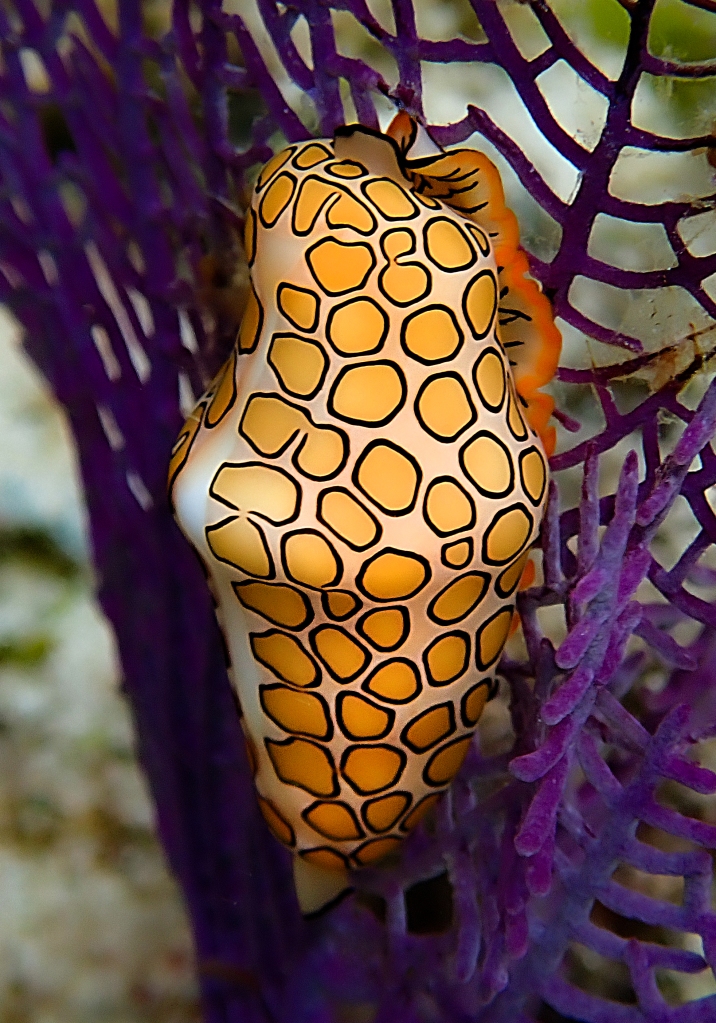
The spotted mantle of the flamingo tongue snail warns predators that, despite being pretty, it is also poisonous. Photograph: © Jeffrey Cardenas 2023

The bare shell of the flamingo tongue snail looks like a characterless white rock. It is the living part of this animal–the mantle–that dresses up the shell with its outrageous leopard-print cloak. It does this to impress its underwater neighbors. The flamingo tongue is not looking for a date. It simply wants to avoid being eaten. The colorful spots tell predators, like lobsters and pufferfish, that, however beautiful it might be, the flamingo tongue is also toxic.

I am weathered-in aboard Stella Maris for several days with 30-knot winds and driving rain. There is no better cure for cabin fever than time spent underwater. I particularly enjoy freediving in shallow water, where I can get up close and personal with the minutiae of the underwater world. The flamingo tongue snail is a part of this world today. At less than an inch long, it might be easily overlooked were it not for its flashy costume.

The snails are most frequently found grazing on toxic soft corals like sea fans and other gorgonians. The flamingo tongue uses its foot, which resembles a long ribbon with teeth, to secrete chemicals that dissolve coral into digestible food. The snail is not concerned by the coral’s toxicity—it repurposes the chemicals by storing those toxins in its own tissues to use as a defense mechanism against predation. 

Not every diver is happy to see flamingo tongues because as they graze, they leave a thin trail of dead coral polyps in their wake. But the snail will rarely kill its host coral. Most damaged gorgonians can regenerate their lost tissues. Marine biologists who have specifically studied snails and their effect on coral say that because the polyps regrow, this predation is part of a well-balanced reef.

Female and male flamingo tongue snails leave behind mucus trails that release pheromones on the soft coral when it is time to breed. Flamingo tongue snails are hermaphroditic, having both male and female reproductive organs. However, they cannot fertilize themselves and require a mate to reproduce. Mating can last up to four hours (snails move slowly). Four days after mating, the female lays her sticky white egg clusters onto part of an exposed gorgonian skeleton. Each egg can contain up to 300 embryos! After ten days, the egg capsules hatch to release free-swimming larvae.

The flamingo tongue snail is not currently considered endangered, but like many marine organisms, it is threatened by human activities. It is listed in Appendix II of the Convention on International Trade in Endangered Species of Wild Fauna and Flora (CITES), meaning that international trade in this species is regulated to ensure that it does not become threatened with extinction.

Conservation efforts for the flamingo tongue snail include protecting its coral reef habitat through marine protected areas. Some countries, such as Jamaica, have implemented regulations to limit the collection of flamingo tongue snails, and the United States has banned the import of these snails for the souvenir trade. Flamingo tongues are often collected by people who mistakenly think that the shells themselves are colorful when they see the leopard spots on the mantle. Once a flamingo tongue snail dies, the mantle is gone and the surface of its shell becomes a bleached bone-white piece of calcium. 

Flamingo tongue snails may not yet be endangered. Still, as I swim in this gorgonian garden and see so much beauty on a windy and rainy day, it makes me wonder: what is so toxic about human nature that makes some people, when they see something beautiful, want to kill it for a collection? Life on coral reefs is already seriously threatened by climate change, ocean acidification, and mass tourism. The one thing we can do right now is minimize our impact by moving more slowly–and less possessively–in this fragile underwater world.


Beautiful in life, a souvenir trinket in death.
Photograph: © Jeffrey Cardenas

REFERENCES:

  • National Marine Sanctuary Foundation (21 Feb, 2020) Sea Wonder: Flamingo Tongue Snail
  • Oceanus (26 Aug, 2008) Biochemical Warfare on the Reef, Kristen Whalen–Woods Hole Oceanographic Institution
  • One Earth (8 Aug 2023) Flamingo tongue snail: the beautiful tropical creature of the Caribbean, Lindsey Jean Schueman
  • Ocean Conservancy (10 Sep 2021) What is the Flamingo Tongue Snail?, Eric Spencer

Thanks for sailing along with Stella Maris on this Bahamas leg of our journey.

As always, sailing is not just about the wind and the sea; equally important are the places, the flora, fauna, and people encountered along the way.

Please click “Follow” so that you don’t miss a new update,- and please consider sharing this post with others who might enjoy following the voyage. I welcome your commentsand I will always respond when I have an Internet connection. I will never share your personal information.

Instagram: StellaMarisSailing
Facebook: Jeffrey Cardenas

Text, Photography, and Videos © Jeffrey Cardenas 2023

Let this be a time of grace and peace in our lives – Fr. John Baker

Breathe In, Breathe Out…

I am anchored tonight next to an island blowhole.

As ocean swells from a distant storm meet the iron rock shoreline, water travels under great force through a labyrinth of ancient passages in the limestone until it emerges as a fountainhead roaring with a blast of sea air.

Breathe in, breathe out… I will sleep in peace listening to this tonight.


A secluded anchorage with a hydrodynamic soundtrack. Turn up the volume…

Thanks for sailing along with Stella Maris.

As always, sailing is not just about the wind and the sea; equally important are the places, the flora, fauna, and people encountered along the way.

Please click “Follow” so that you don’t miss a new update,- and please consider sharing this post with others who might enjoy following the voyage. I welcome your commentsand I will always respond when I have an Internet connection. I will never share your personal information.

Instagram: StellaMarisSailing
Facebook: Jeffrey Cardenas

Text, Photography and Videos © Jeffrey Cardenas 2023

Let this be a time of grace and peace in our lives”   – Fr. John Baker

Dry Land Feels Weird

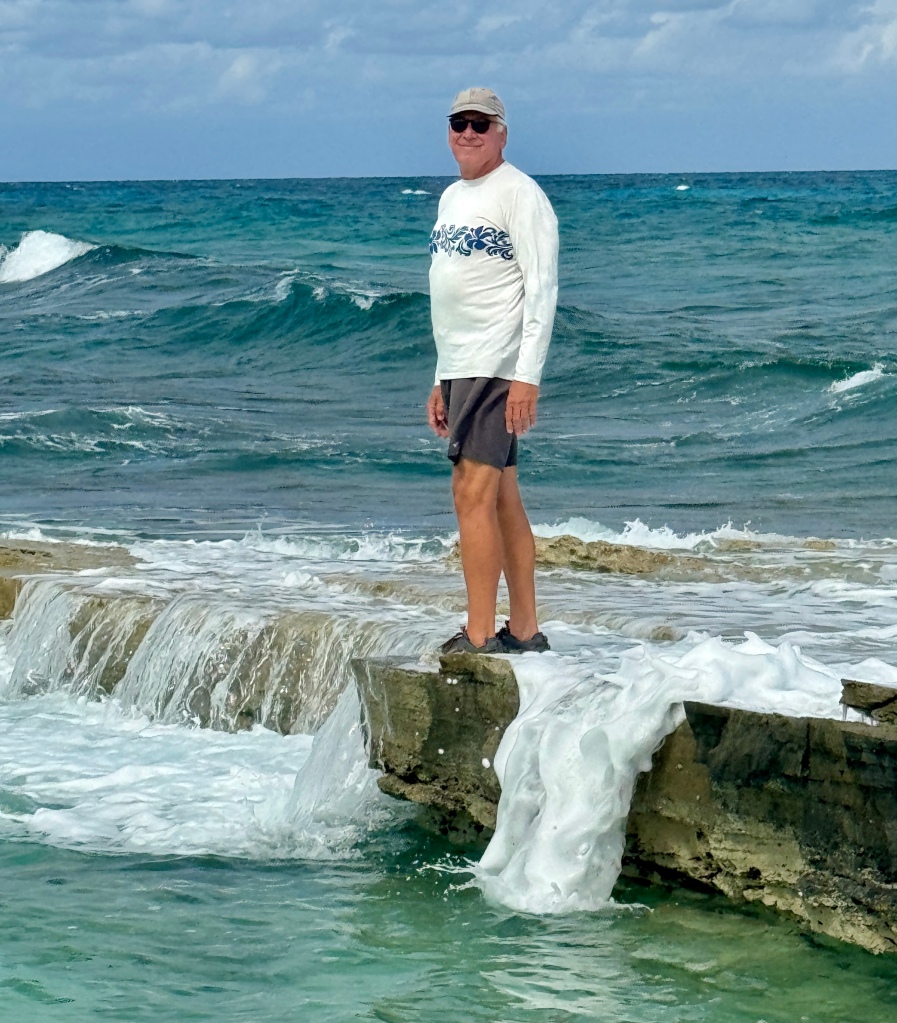
I am most comfortable on the water and underwater. Things get weird when I reach dry land.
Photograph: © Jeffrey Cardenas

At the Moriah Harbour Cays National Park in the southern Exuma Cays, conservationists understand that not everyone wants to get wet. What is dry on these islands is as spectacular as the underwater world that surrounds them. The addition of a little human waggishness adds to the experience. On the southern tip of Stocking Island an “Art Trail” has been cut through the coppice allowing restless sailors to stretch their legs and express personal wit.

Wilson was here…

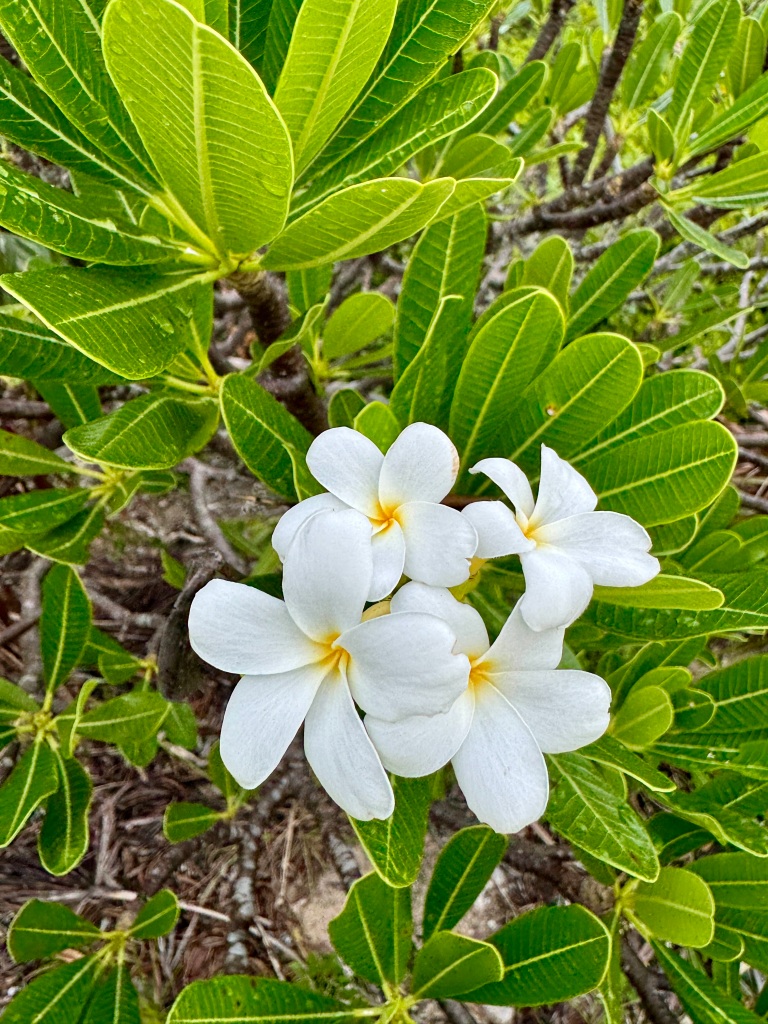
Of course, nature always has the last laugh. The natural beauty of the coppice (a Bahamian hardwood forest) is breathtaking. In the 22,833 acres of Moriah Harbour Cays National Park, trails pass through exotic palm groves. Caves are cut into calcium carbonate limestone. Lowlands are alive with American Oystercatchers and Giant White Landcrabs. An upland hiker might be startled by a Bahamian Blind Snake or an Antillean Nighthawk. And, growing so thick that it nearly shuts off sunlight, is flora that includes Drawf Frangipani, dominant stands of Bahamian Poisonwood, and wild Oncidium Orchids.

Dry land, I learned, can be a wonderland. All I need to do to experience it is step ashore once in a while.


And, at the end of the trail, there is always the sea.

Thanks for sailing along with Stella Maris.

As always, sailing is not just about the wind and the sea; equally important are the places, the flora, fauna, and people encountered along the way.

Please click “Follow” so that you don’t miss a new update,- and please consider sharing this post with others who might enjoy following the voyage. I welcome your commentsand I will always respond when I have an Internet connection. I will never share your personal information.

Instagram: StellaMarisSailing
Facebook: Jeffrey Cardenas

Text and Photography © Jeffrey Cardenas 2023

Let this be a time of grace and peace in our lives”   – Fr. John Baker

A Hidden World Protected

Eleuthera’s New Seahorse National Park

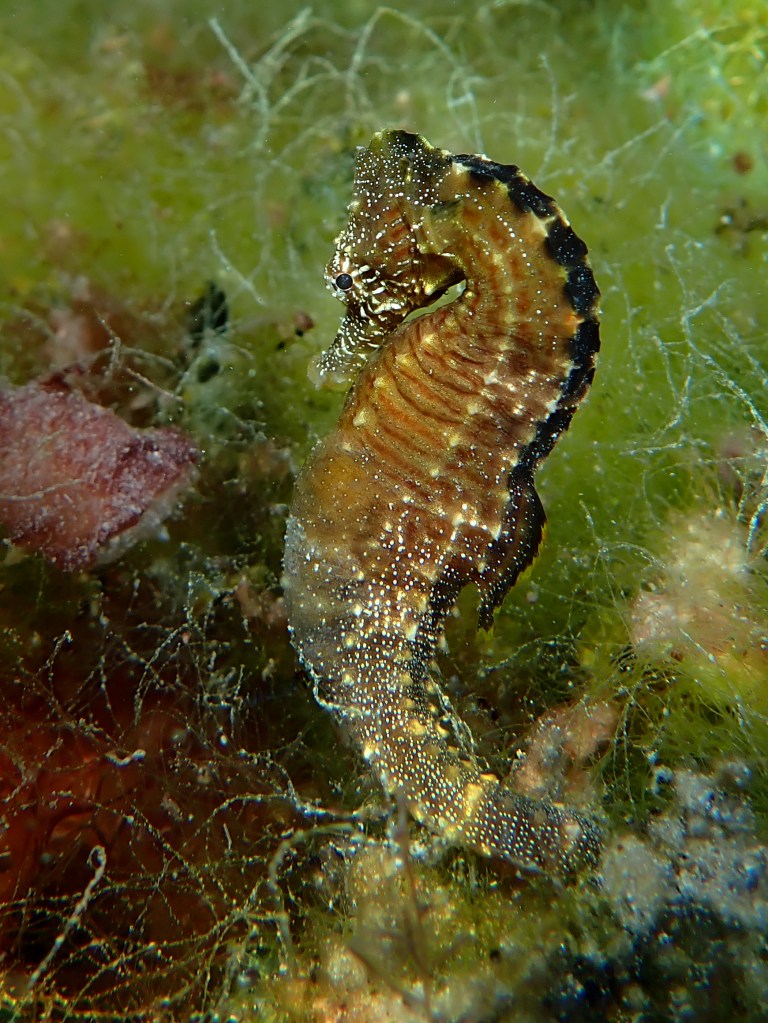
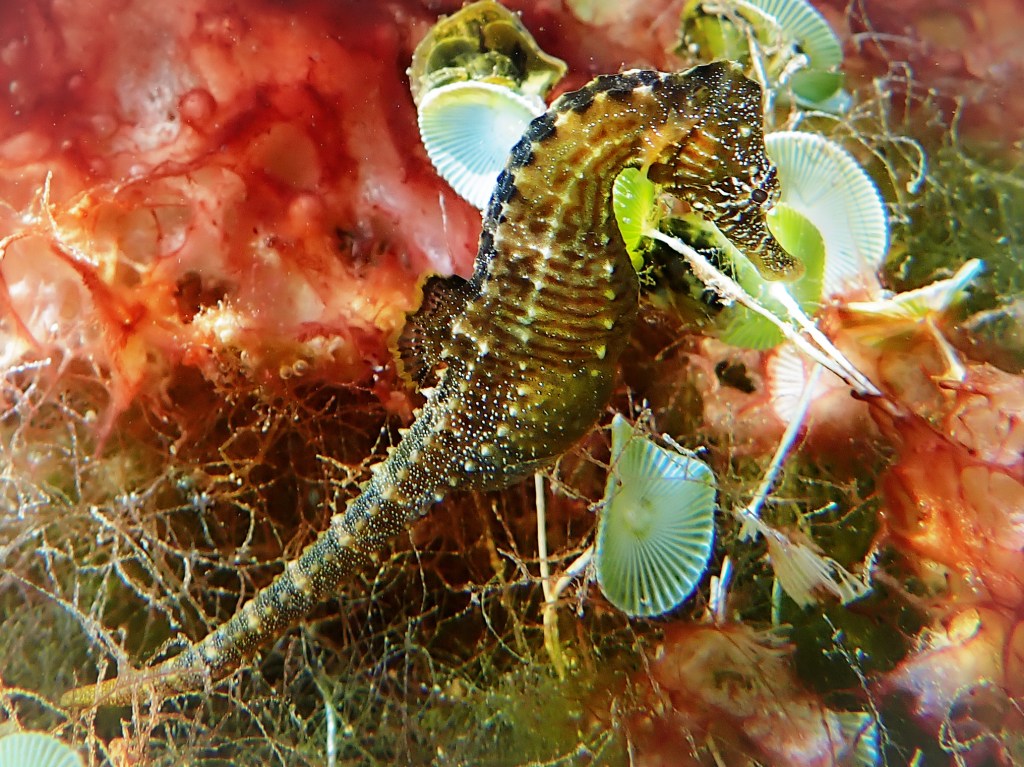
This proud papa, a lined seahorse, flaunts his pregnancy with a swollen brood pouch and will soon give live birth to hundreds of baby seahorses. Photograph: © Jeffrey Cardenas

I am channeling Charles Darwin today as I step out of the thick Bahamian scrub and into a landlocked pool of anchialine water in Central Eleuthera known as Sweetings Pond.

This body of water, fed from a maze of subterranean connections to the ocean, is teeming with bizarre life forms. They include the red flame scallop (which is actually a clam) that can dislodge itself from the seabed and “walk” away from predators by clapping its valves together. And then there is a gelatinous sea slug called a fringeback nudibranch with sharply serrated gill fingers and long tendrils that pulsate in shades of aquamarine. But the show-stopper is a mutated miniature lined seahorse with enough characteristics from two distinctly different types of seahorses that some marine biologists think we could be witnessing the evolution of an entirely new species.

Protecting the 500-acre Sweetings Pond with its unique biodiversity has been a quiet mission for conservationists. Until recently, researchers and locals managed to keep its location a secret. In its anonymity, the pond faced no immediate danger. However, the rampant development of resorts and marinas in the Bahamas, as well as other threats including agricultural runoff and poaching has encouraged marine researchers and governmental organizations like the Bahamas National Trust to push for the preservation of this rare habitat.

One of those researchers, Dr. Heather Masonjones from the University of Tampa, has been studying the seahorse population in Sweetings Pond for over five years. In an interview with BBC Wildlife magazine, she said that the pond may have one of the most densely populated seahorse communities anywhere on Earth. She hopes the protection of the pond brings sustainable tourism that will educate people about seahorses and contribute to improving their conservation worldwide. “If we don’t take action it could be lost forever.”

Several weeks ago, the Bahamian government formally designated Sweetings Pond as its newest National Park. “The declaration of Seahorse National Park is more than just a designation,” said Lakeshia Anderson-Rolle, Executive Director of Bahamas National Trust. “It is our shared promise to our community, to future generations, and to the world that we are committed to conserving our unique and diverse ecosystems.”

Click on a photograph above for a larger, full-resolution image. All photographs © Jeffrey Cardenas


Thanks for sailing along with Stella Maris.

As always, sailing is not just about the wind and the sea; equally important are the places, the flora, fauna, and people encountered along the way.

Please click “Follow” so that you don’t miss a new update,- and please consider sharing this post with others who might enjoy following the voyage. I welcome your commentsand I will always respond when I have an Internet connection. I will never share your personal information.

Instagram: StellaMarisSailing
Facebook: Jeffrey Cardenas

Text and Photography © Jeffrey Cardenas 2023

Let this be a time of grace and peace in our lives”   – Fr. John Baker