“Do not cry because it’s over, smile because it happened.” – Unattributed
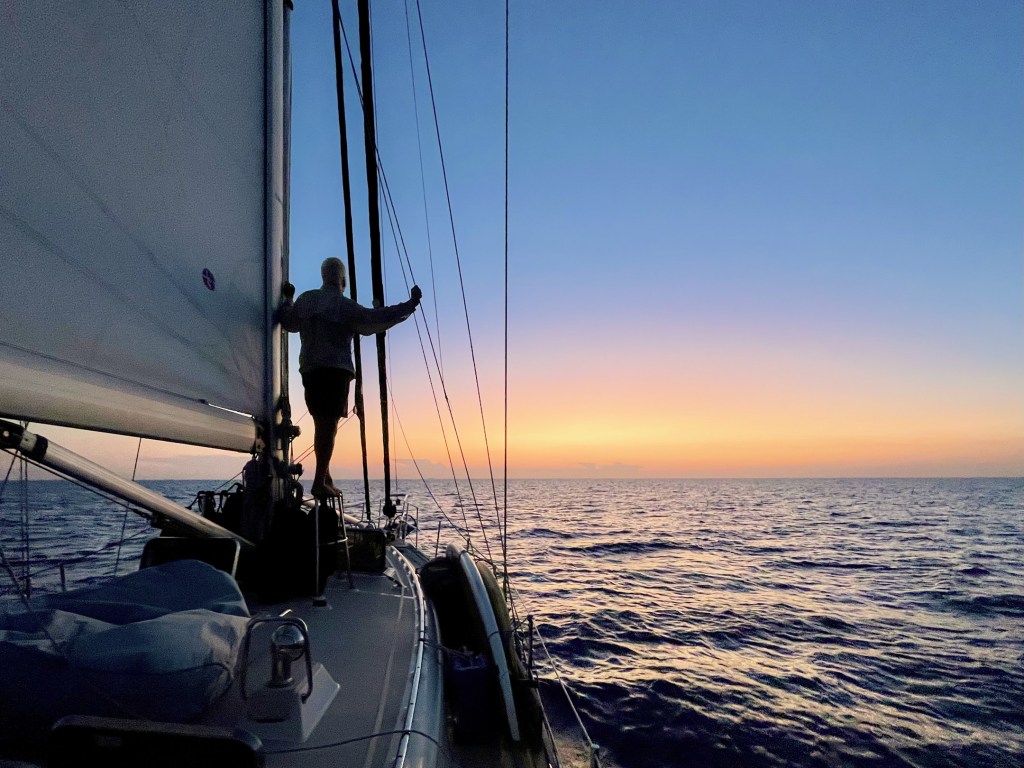
It is a feeling similar to running aground. One moment I am sailing full and by, ebullient, eyes set on a new horizon. In the next moment, life aboard Flying Fish comes to a grinding halt. I am speaking metaphorically, of course. The boat has never been in better condition. Flying Fish is ready to go around the world again, but my voyage aboard her has come to an end.
One might think that going around the world at seven miles an hour would provide ample time for a person to prepare for the end of a voyage. I can read a map, and I saw that the loop was closing, but after nearly five years at sea, I had apparently conditioned myself into believing that I was living an endless summer.
There is a pull, however, that is greater than the tides that carried Flying Fish around the world. It is family. My wife Ginny and I have been married for 41 years, and she has been patient with my restlessness. My mother and father are in their mid-90s and challenged by health issues. My brother and sister are in Key West, where I have lived for more than four decades. Family is the beacon that guided me home.
My family also brought me home in a literal sense. I sailed Flying Fish into the Abaco Islands to join my wife Ginny and our daughter Lilly. And there was a surprise. Last year, Lilly had met an amazing man named Chris Wall, an aviator who had once circumnavigated the globe in a small airplane. Chris was welcomed on board Flying Fish and the four of us gunkholed through the northern Bahamas before turning the boat west toward Florida. “Be careful,” Chris said, drawing on the experience of his global adventure. “The most difficult time of your entire journey will come when the adventure ends.” His words were prophetic.
Chris was a newcomer aboard Flying Fish, but Ginny and Lilly were more personally and emotionally invested in the passage around the world. Lilly had crossed the equator twice aboard Flying Fish, once south of the Galapagos, and a second time in the South China Sea. Both times she celebrated the transit of 0° degrees latitude by swimming under the hull of Flying Fish, as we crossed into a different hemisphere. Ginny had her own adventures. Last year, she endured a potentially catastrophic passage with me aboard Flying Fish, 1,000 miles west of Africa. Without her help, I might still be floating aimlessly in the South Atlantic Ocean.
My 95-year-old father Robert joined me for the last leg aboard Flying Fish. It was a short but poignant 15-mile passage from Ft. Pierce, Florida north to Vero Beach. Dad will be 96 in a couple of weeks. Everything that has to do with my lifetime aboard sailboats began with him, including this voyage. Dad, and my brother Bob, were aboard on December 1, 2017, when Flying Fish departed from Key West for the Panama Canal.
Dad was quiet during that last leg to Vero Beach. We were both lost in thought. Finally, he said, “Where has all the time gone?”
Time passes so quickly as we age, but Dad’s time on the sea has been well-spent. He sailed across both the Atlantic and the Pacific leaving a wake for me to follow. Mom and Dad, who will celebrate their 71st wedding anniversary this year, raised four kids to love and respect the ocean. On the last leg of this journey, Dad helped me pilot the boat into a safe harbor where Flying Fish was transferred into the hands of a broker and listed for sale.
“Where has all the time gone,” I repeated, “and what comes next?”
In this context, I often think of the French sailor Bernard Moitessier who, in 1968, participated in (and was winning) the Golden Globe Race, the first non-stop, singlehanded, round-the-world sailboat race. On the home stretch of his circumnavigation, Moitessier could not face the idea of his voyage coming to an end. Instead of returning to the starting line in England, and to the accolades awaiting him there, he continued sailing an additional 15,000 miles east until he found seclusion in French Polynesia. Moitessier notified race officials (and his family) that he was dropping out of the race and continuing around the world a second time by firing a note using a slingshot onto the deck of a passing ship. In the note, he wrote an explanation for dropping out of society: “Parce que je suis heureux en mer et peut-être pour sau her mon âme” (“Because I am happy at sea and perhaps to save my soul.”)
It has been six weeks since I returned to land. I have not, until now, been able to write a single word reflecting upon this marvelous journey. I can barely speak a coherent sentence. I have re-entered a bewildering tornado of noise and commotion, violence and anger. What’s going on? Is the world different now, or has it always been like this and I have just become accustomed to the solitude and tranquility of life at sea?
My immediate challenge is to tune out the static and regain focus. As to the question of what comes next, I have no answer. What I do know is that it has been a privilege and a blessing to see the world from the deck of Flying Fish.

Thanks for sailing along with Flying Fish.
Sailing is not just about the wind and the sea; equally important are the places, the flora, fauna, and people encountered along the way.
Please consider sharing this post with others who might enjoy following the voyage of Flying Fish. I welcome your comments, and I will always respond.
You can read additional Passage Notes from the daily progress around the world aboard Flying Fish by clicking this satellite uplink: https://forecast.predictwind.com/tracking/display/Flyingfish.
To see where Flying Fish has sailed since leaving Key West in 2017, click here: https://cruisersat.net/track/Flying%20Fish.
Instagram: FlyingFishSail
Facebook: Jeffrey Cardenas
Text and Photography © Jeffrey Cardenas 2022
Let this be a time of grace and peace in our lives – Fr. John Baker
 Stella Maris Sail